
Starter cultures
The jar that borrows from the last batch: inside Sichuan's paocai brine
Sichuan cooks ferment vegetables in a water-sealed jar and keep the brine for the next batch. Studies show what lives in it and what salt, acid and air do, but no one has published a safe home method.
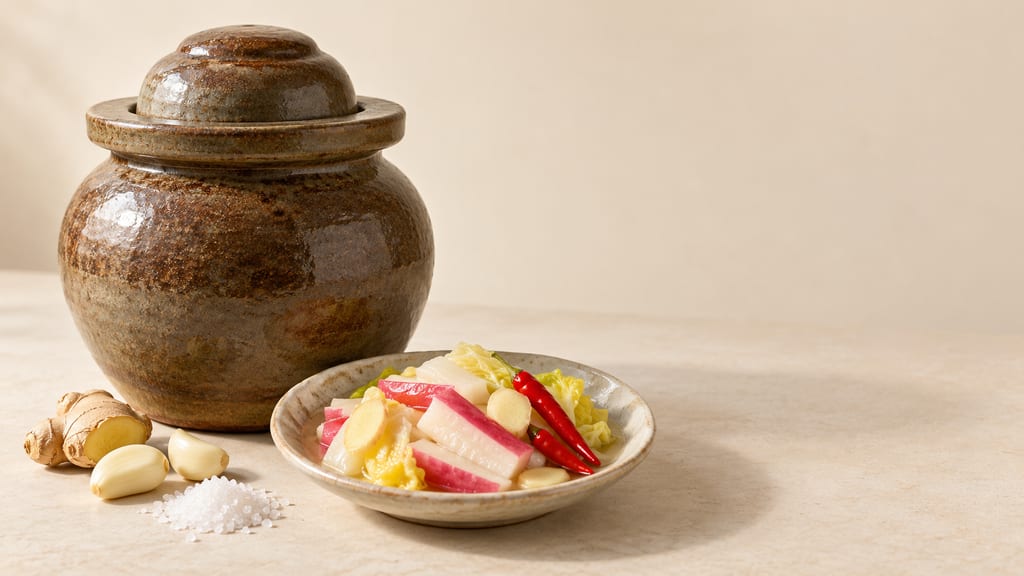
A glazed Sichuan-style pottery jar with a domed lid beside a dish of pickled radish and cabbage; an illustration of the vessel and the food, not a real batch.
Two kilograms of vegetables and a fifth of an old brine
A research batch of Sichuan-style paocai starts in a pottery jar that holds 4 L. Into it go 1 kg of red radish and 1 kg of cabbage, bought at a market in Ya'an and cut into pieces 2–3 cm across. Garlic, hot red pepper, ginger and Chinese prickly ash go in with them. The brine is 2 L of water with 8% salt and 1% baijiu, the Chinese grain spirit. One more ingredient is a fifth of the liquid, taken from a local family's paocai brine that had been in use for more than five years. Then water is added to the jar's edge to seal it, and the jar stands at 24 ± 2 °C.
That borrowed fifth is the subject of this story. Paocai means brined vegetables, and in Sichuan it is typically served as a side dish or an appetiser. Homemade paocai usually uses aged brine as its starter, a brine that has been fermented for many years and even decades. The vegetables come out of the jar and are eaten. The liquid stays, and some of it goes into the next jar. The practice is a form of back-slopping, which means seeding a new batch with a little of the last.
Why the jar needs water
In most cases, Sichuan pickle containers are sealed with water or plastic film, and a few pickle enterprises ferment without any seal at all. A jar sealed with water has a trough around the neck. Water in the trough lets gas from the ferment escape through the liquid while cutting down direct air exchange. It is not a hermetically clamped pressure vessel.
Why that matters was tested at Xihua University in Chengdu, in a laboratory and not a kitchen. Radish went into nine 5 L glass jars with a 6% salt brine, and each jar was inoculated with 10^6 CFU/mL of Lactobacillus plantarum E11, a lactic acid bacterium. Some jars were covered only with gauze. Some had their lids taken off for an hour every day. Some stayed closed. They stood at room temperature for 64 days.
By day 32 the open jars were dominated by Lactobacillus (90 ± 2% of the bacteria), with Pediococcus at 4.7 ± 0.3% and Lactococcus at 1.2 ± 0.8%. The closed jars held a different community, in which anaerobic genera made up 50 ± 9% of the bacteria. Oxygen exposure brought a surface film called a pellicle and what the team called aerobic deterioration, while the closed jars kept a pleasant aroma and texture. That aroma was a quality judgement made in a research jar. It does not tell a cook that a brine is safe.
Who lives in a brine that old
One survey took 100 paocai samples and found that age was not a small variable: the samples ranged from 5 days to 15 years old. Across them the pH ran from 2.95 to 5.23, salt from 0.13% to 15.41% and total acid from 6.61 to 18.33 mg/mL. The living count was between 3.55 and 8.99 LogCFU/mL, a spread of more than five orders of magnitude. Five groups of bacteria dominated: Lactobacillus, Pediococcus, Leuconostoc, Lactococcus and a set of unclassified genera.
Another team sequenced 38 aged, home-made Sichuan brines of differing titratable acidity, a measure of how much acid a brine holds. Lactobacillus acetotolerans was the most dominant species and rose with acidity, while Lactobacillus brevis rose with acetic acid. In the Ya'an batch, Lactobacillus made up 92.35% of the starting brine on average, and the two leading species were Lentilactobacillus buchneri (9.9%) and L. acetotolerans (12.5%). In red radish paocai Lactobacillus made up 85.10% and in cabbage paocai 81.84%.
These lists differ, and the differences come from different sampling, methods and naming. They cannot be added together into a recipe for a starter. It also helps to keep three things apart: the brine, the vegetables fermented in it, and any one organism isolated from it. A finding about one is not a finding about the others.
Salt chooses first, acid chooses later
In the 100-sample survey, salt acted as the first filter, mainly by favouring Lactococcus and Leuconostoc. As total acid climbed, acid took over as the main force, and Lactobacillus and Pediococcus increased. A brine's community is therefore not fixed. It moves as the jar sours.
Salt does not act alone or simply. In a separate experiment, salt had no significant effect on the bacterial community at phylum level, the broadest taxonomic ranks, and Lactobacillus and Lactococcus became dominant anyway. Higher salt did raise the volatile compounds in the paocai, mainly aldehydes and alcohols, and the authors judged that it improved the flavour. A study of radish paocai found Weissella and Lactobacillus predominant, and most flavour-related pathways in its microbes were up-regulated as salt rose. The salt levels behind these two results were not retrieved, so they give no target.
Yeasts live in the liquid too. Researchers isolated 21 yeast strains from paocai juice made by farmers in western, eastern and southern Sichuan. One of them, Wickerhamomyces anomalus strain Y3, tolerated 14% salt and a pH of 3–4, and it produced 1.22 g/L of total ester, a group of aroma compounds. That was a culture-isolation study and not a home method.
When the jar turns
Not every jar succeeds. Researchers collected seven putrid paocai samples from seven families in seven Sichuan cities in July 2017. From them they grew 45 strains and identified 22. Sixteen were Bacillus species, three Candida species, and one each Staphylococcus saprophyticus, Kodamaea ohmeri and Geotrichum candidum. The signs of spoilage they listed were a biofilm or white stickiness on the surface, turbid brine, soft and rotten vegetables, and browning or fading.
That list describes samples that had already failed. It is not a test for a jar that looks fine, and it carries no safety rule. Smell, a surface film, cloudiness and taste cannot show that a brine is safe or unsafe.
What is still unwritten
No dated account of keeping paocai brine going has turned up. The age of Chinese pickling is often given as thousands of years, but that figure comes from secondary statements and not from a dated source for retained paocai brine, so this story does not repeat it.
The research also leaves out what a cook would need. None of it gives a validated endpoint, a salt floor, a pH target, a storage limit or a refresh interval for brine kept at home. The Ya'an batch is a research design with a stated family-brine source, not a recipe that was tested for safety. For now, the studies describe a living liquid that salt, acid and air shape, and they stop there.
Community
No community contributions have been published for this entry yet.
Share what you made
Sign in to contribute. Published comments and photos are free to read.
Sources
Food Research International 137:109559 (2020), PubMed
Divergent role of abiotic factors in shaping microbial community assembly of paocai brine during aging processCited in: Who lives in a brine that old; Salt chooses first, acid chooses later
Food Control 78:14–23 (2017), ScienceDirect
Assessment of bacterial profiles in aged, home-made Sichuan paocai brine with varying titratable acidity by PacBio SMRT sequencing technologyCited in: Who lives in a brine that old
Food Science & Nutrition 7(9):2939–2947 (2019), PubMed Central
Isolation and identification of the spoilage microorganisms in Sichuan homemade Paocai and their impact on quality and safetyCited in: When the jar turns
Foods 11(1):62 (2022), PubMed Central
Metagenomic Study on Chinese Homemade Paocai: The Effects of Raw Materials and Fermentation Periods on the Microbial Ecology and Volatile ComponentsCited in: Two kilograms of vegetables and a fifth of an old brine; Why the jar needs water; Who lives in a brine that old; What is still unwritten
RSC Advances 9(66):38520–38530 (2019), PubMed Central
Influence of oxygen exposure on fermentation process and sensory qualities of Sichuan pickle (paocai)Cited in: Why the jar needs water
Journal of the Science of Food and Agriculture 101(15):6202–6210 (2021), PubMed
Effects of salt concentration on the quality of paocai, a fermented vegetable product from ChinaCited in: Salt chooses first, acid chooses later
Foods 12(15):2934 (2023), PubMed Central
Isolation of Aroma-Producing Wickerhamomyces anomalus Yeast and Analysis of Its Typical Flavoring MetabolitesCited in: Salt chooses first, acid chooses later
Food Research International 160:111622 (2022), PubMed
Effects of salt concentration on the quality and microbial diversity of spontaneously fermented radish paocaiCited in: Salt chooses first, acid chooses later
Gaps
- The age of the practice of retaining paocai brine is not established.
- No validated home endpoint, salt level, pH target, storage limit or refresh interval is established.
Updated 2026-10-29