
Starter cultures
A tub of nukamiso: the rice-bran bed that Japanese cooks keep going for decades
In 1626 a retired lord wrote to his son that a tub of rice-bran paste had tasted good. Four centuries on, scientists are working out what lives in such a bed, where the microbes come from and why a new bed takes weeks to ripen.
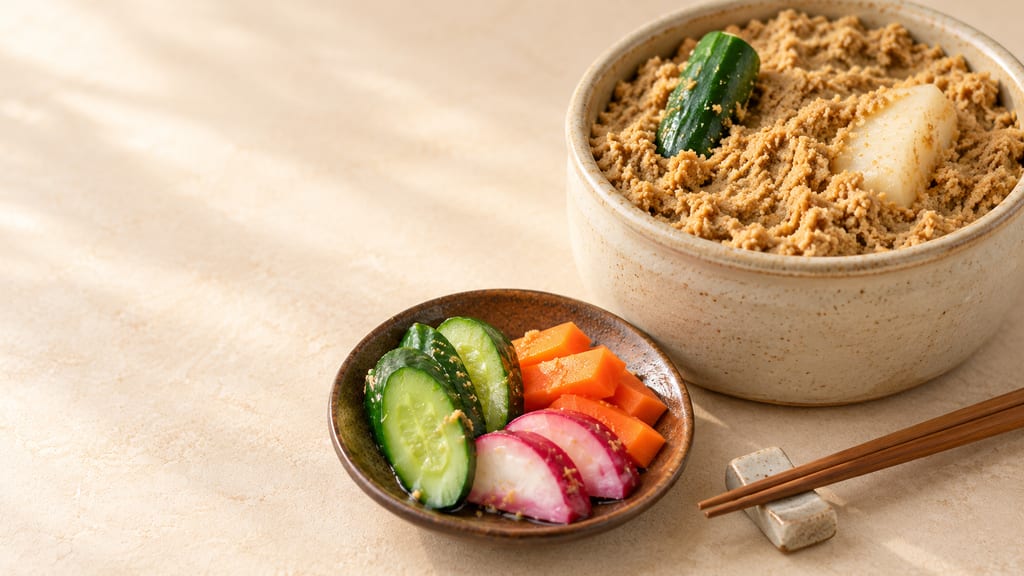
Cucumber, carrot and radish pickles beside a crock of rice-bran paste; a generated image of the food and the bed, not a photograph of a real batch.
A tub of nukamiso, 1626
In 1626 a retired lord wrote to his son. Hosokawa Tadaoki, living in retirement at Nakatsu, told Tadatoshi that he had received one tub of nukamiso, that it tasted good and that he was satisfied. Kokura, the castle town that is now part of the city of Kitakyushu, traces its documented nukamiso to the early Edo period, and this letter is the dated piece of evidence. What the tub held, and whether it matches the bed a cook keeps today, the letter does not say.
Four centuries later the tub has become a subject for laboratory work. Researchers in Japan have followed what lives in a rice-bran bed day by day, counted its bacteria and yeasts, and tried to start new beds from old ones. Their results show a culture that nobody adds from a packet and nobody fully controls, and that still turns vegetables into pickles.
Bran, salt, water and vegetables
Nukadoko is the bed itself: a paste of salted rice bran in which vegetables are buried until they turn into pickles. The pickles are nukazuke. The paste is also called nukamiso, bran miso, which is the word in the letter. Rice bran is the by-product of polishing brown rice, so the bed starts from what the mill takes off the grain.
Japan's agriculture ministry says salted vegetable pickles are believed to go back to the Jomon era, and that that commercial pickle makers appeared in the Edo period as Japanese-style restaurants multiplied. It names nukazuke as one of the typical pickles. Cucumber, carrot and radish are typical pieces to pickle.
What sets a bed apart from a one-off brine is that it is kept. The vegetables come out and the bed stays, to be fed and turned and used for the next batch. A good deal of the science below is an attempt to say what "kept" means for a living mixture of bran and microbes.
Old tubs of Kokura
Kokura has its own stories about the bed. One holds that Ogasawara Tadazane, the first lord of Kokura, liked nukazuke. Another says that the old name tokozuke, bed pickles, comes from the habit of keeping the barrel in the tokonoma, the alcove of a Japanese room. Both are local tradition, not documents.
A 1928 pickling cookbook from the publisher Shufunotomo lists Buzen sugar miso as a family heirloom, and a sugar-miso bed 40 to 50 years old was not unusual. Kokura households are said to keep beds 100 years old without much surprise, though no survey backs the figure. Sansho, the Japanese pepper, is described as a feature of Kokura-area beds, which matters for the experiments that follow.
Starting a bed from nothing
A new bed begins with no starter. A team from the pickle maker Tokai Pickling in Toyohashi, Aichi, and Kyushu University in Fukuoka made spontaneous beds from four brands of rice bran and followed them for two months. In the first week the early bacteria differed from bed to bed. Later Lactobacillus plantarum, a lactic acid bacterium that sours many vegetable ferments, dominated.
A follow-up experiment tested what chilli and Japanese pepper do. Their beds sat at 24 °C for 60 days, and a hand in a sterilised latex glove mixed each one every day. Salt was held at 4 to 5% by adding sodium chloride three times. In every bed the first colonist was Staphylococcus saprophyticus. Beds with Japanese pepper (Zanthoxylum piperitum) or red pepper (Capsicum annuum) shortened the lag before lactic acid fermentation took off, and in all three spiced beds Pediococcus pentosaceus dominated between days 5 and 10.
Yeasts came late and stayed. From day 8 to day 60 they were above 100,000 per gram. The authors suggest that they consume the lactate and acetate that the bacteria leave behind, but that is a hypothesis, not a measurement.
Where the microbes come from
One idea is that the vegetables seed the bed. A 2024 study put it to the test. It followed beds pickling different vegetables and compared the bacteria in the bed, in the pickles and on the raw vegetables and bran. Lactic acid bacteria dominated both bed and pickles, and Lactiplantibacillus plantarum was the dominant species in every vegetable pairing, appearing about 19 days in.
The raw materials did not match that story. Lactic acid bacteria were not detected in either the fresh vegetables or the rice bran. The vegetables carried Pantoea, Sphingomonas and Serratia, and none of them increased in the bed. No species could be traced from a raw vegetable into the bed. Staphylococcus xylosus lived in the beds but was absent from the pickles.
So the lactic acid bacteria that take over the bed were either too few to detect at the start or came from somewhere else. The experiment does not say which.
What daily care does
In Kokura the daily mixing has a name, sewa o suru, taking care of the bed. The belief is that handling the bed brings in the vegetables' own microbes, and that it brings in air. A well-kept bed is said to hold 100 million to a billion lactic acid bacteria and 1 to 10 million yeasts per gram. Given the vegetable study above, the first part of that belief is not supported by what that study measured. The care itself has a measured effect: an earlier Japanese study found that a bed left unstirred develops a bias between its upper and lower layers.
The experimental beds were kept up by adding salt and fresh bran. In the 2024 vegetable study salt went in at 11, 19, 23 and 31 days and fresh bran at 23 and 31 days, and the bed was mixed by hand at each sampling. Its salt content started near 6% and fell with use, and the pickles themselves held 1 to 3%. A commercial bed in a 2023 experiment ran at about 1.5% in all its batches. These are the design of each experiment, not a recommended salt level for a home bed.
A 150-year-old starter
If a mature bed carries a community that works, a new bed can borrow it. A 2024 team from BIOTA Inc. in Tokyo and several Japanese universities tested exactly that with a bed described as 150 years old. Its ingredients were rice bran, salt, water, kombu seaweed, dried young sardines, bird's eye chilli, Sichuan peppercorns and rice malt. They set it as a starter in two open environments and followed both for 29 days.
In one location, Loigolactobacillus rose from 69.6% of the bacterial community on day 0 to 99.0% on day 29. In the other it went from 69.5% to 99.4%. In the second location it had taken over by about day 6, while the first kept a more varied community until about day 14 or 15. The method could not name the species. Earlier work on a 150-year-old bed describes Lactobacillus namurensis appearing a few days after the bed is refreshed, and Lactobacillus acetotolerans growing very slowly and dominating after a few weeks of ripening.
An old bed can seed a new one, and the two settings end up with similar communities. None of that is a recipe for keeping a bed for 150 years.
What heat and cold do to a bed
A 2023 experiment on a commercial bed treated it more roughly. In an untreated bed the lactic acid bacteria rose from 380,000 per gram at the start to 12 billion per gram after the third round of pickling. A second bed held at 80 °C for 30 minutes had no lactic acid bacteria before or after the first round, and they first appeared after the second round, at 3.6 million per gram. Adding three starter species did not speed up the first round.
A third bed, unused and left unstirred in the refrigerator at 5 to 6 °C for three months, saw its lactic acid bacteria fall from 150,000 to 330 per gram, while its pH slid from 5.60 to 5.02. Eight strains isolated in the work were identified as Leuconostoc mesenteroides (two), Lactobacillus brevis (two), L. curvatus (two), L. fermentum (one) and L. delbrueckii (one). In these beds, heat and cold moved the community a long way from where it started.
From the tub to the table
Pickles are the main use, but Kokura also cooks with the bed. Nukadaki, the local dish, simmers mackerel in nukamiso. A recipe for it takes two mackerel cut into 8 pieces, 150 g of nukamiso, 900 ml of water, and 100 ml each of sugar, mirin, sake and soy sauce. The fish and liquids are simmered, the nukamiso goes in, and everything cooks for 10 to 15 minutes on low heat. About a week in the refrigerator is the figure given for keeping it, which is a quality estimate, not a safety limit.
The vegetables that have sat in the bed are also stir-fried with cabbage or meat, and nukadaki turns up in sandwiches. On nutrition, the bed adds vitamins B1 and B2, and nukazuke contains more vitamin B1 than the same vegetable fresh.
What is still unknown
A bed is not one starter in a jar. It is a community that forms in bran and salt, changes with the vegetables and the care it gets, and can be seeded from an older bed. The lactic acid bacteria that dominate it are in place within weeks, and where they first come from is unsettled.
Nobody has published safe limits for a home bed: not for salt, not for pH, not for temperature, and not for when to throw a bed out. The figures above come from particular experiments with particular beds. Smell, colour and taste are how cooks judge a bed, and none of them shows that a bed or a pickle is safe.
Community
No community contributions have been published for this entry yet.
Share what you made
Sign in to contribute. Published comments and photos are free to read.
Sources
Journal of Bioscience and Bioengineering 118: 520-525 (2014)
Monitoring of the microbiota profile in nukadoko, a naturally fermented rice bran bed for pickling vegetablesCited in: Starting a bed from nothing
City of Kitakyushu
Kitakyushu City leaflet on nukamiso, nukazuke and nukadakiCited in: A tub of nukamiso, 1626; Bran, salt, water and vegetables; Old tubs of Kokura; What daily care does; From the tub to the table
Bioscience of Microbiota, Food and Health 43(4) (2024)
Impact of vegetables on the microbiota of the rice bran pickling bed NukadokoCited in: Where the microbes come from; What daily care does; From the tub to the table; What is still unknown
Current Microbiology 81(8): 250 (2024)
The Similarities in Microbial and Chemical Patterns of Fermentation in Two Open Environments were Promoted by Using 150-Year-Old Nukadoko as StartersCited in: A 150-year-old starter; What is still unknown
Bioscience of Microbiota, Food and Health 34: 1-9 (2015)
Effects of Japanese pepper and red pepper on the microbial community during nukadoko fermentationCited in: Starting a bed from nothing; A 150-year-old starter; From the tub to the table
Japanese Journal of Food Microbiology 40(2): 57-62 (2023)
Effect of the Heat Treatment of Rice Bran Paste, Nukadoko, on Nukazuke FermentationCited in: What daily care does; What heat and cold do to a bed
Ministry of Agriculture, Forestry and Fisheries (Japan)
Pickled | Traditional Foods in JapanCited in: Bran, salt, water and vegetables
Gaps
- The 1626 letter is known from a quotation in a city leaflet; the archival edition has not been checked, and the leaflet is undated.
- The age of the 150-year-old bed is the figure given for it; the 2014 paper was read as an abstract only.
- No study here gives validated home limits for salt, pH, temperature or when to discard a bed.
Updated 2026-10-29