
Starter cultures
Seeding the olive vat: what starter bacteria and yeasts did to table olives
Researchers in Seville and Athens seeded olive brines with chosen bacteria and yeasts. Acid arrived faster, but the strains did not always stay in charge, and no source gives a kitchen method.
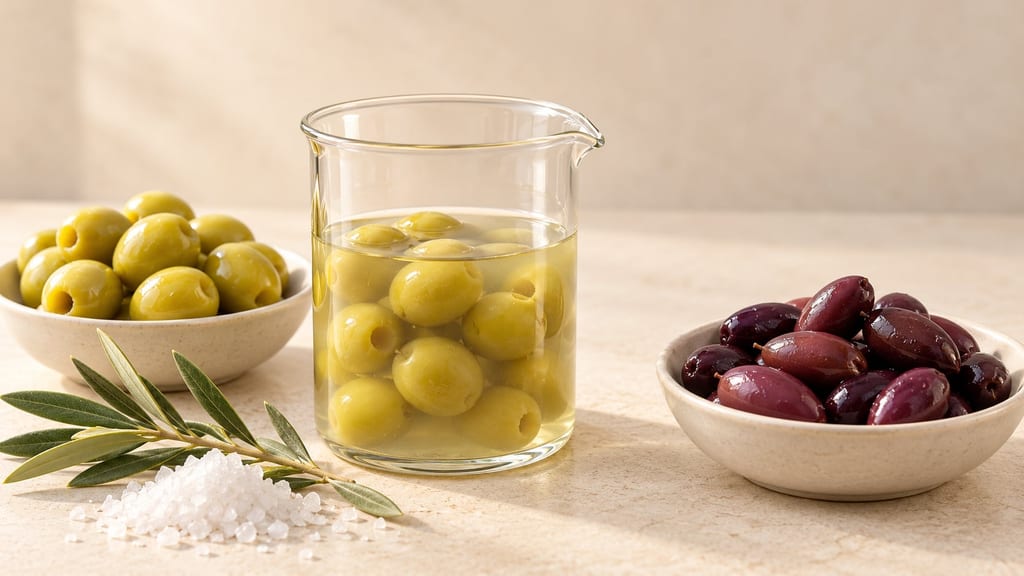
Green and black table olives, the fruit that lye, brine and starter cultures turn into a fermented food.
A hundred litres of bacteria in a 16,000-litre vessel
On 26 September 2011, 100 litres of bacterial culture went into each of four vessels of freshly brined green olives at JOLCA Aceitunas, a table-olive company in Seville. Every vessel held 16,000 litres: 9,856 kg of olives and 6,374 litres of brine. Two more vessels got no culture and served as controls. The bacteria were two lines of Lactiplantibacillus pentosus, TOMC LAB2 and LAB4, that researchers at the Instituto de la Grasa (CSIC), a research institute in the same city, had been testing.
The experiment asked whether a chosen strain could be made to run an olive fermentation. Left alone, a vat ferments from whatever microbes arrive on the fruit and in the plant. A starter is a bet that putting the right bacteria in on the first day gets acid into the brine sooner and leaves unwanted microbes less room. Over two seasons, 16 vessels and about 158 tonnes of olives, the Seville team found out how much of that bet pays off, and how much of it comes undone later.
Lye first, then the brine
The olives in those vessels were Spanish-style, also called Sevillian. They are picked green and treated with a dilute solution of sodium hydroxide, lye, which removes and transforms oleuropein, the bitter compound of the raw fruit. They are then covered with brine and left to ferment. The other main route for green olives, the Picholine or American style, skips the fermentation. The International Olive Council uses that split to sort green olives into fermented and unfermented styles. Natural black olives, which have no lye step, have their own article.
Published lye figures depend on who is describing what. The Seville plant used 2.6% sodium hydroxide for about 6 hours, washed the fruit for 8 hours, then held it in 11% (w/v) sodium chloride for about 10 hours. A 2023 review of what alkali does to green olives gives wider ranges: lye at 2–5% for 6–10 hours, then brine of 8–10% salt and fermentation at around 25 °C for up to four months. The review does not say whether its percentages are by weight or by volume. For Castelvetrano-style olives it gives 2–3% lye for a few hours. In the Seville vessels the salt fell to about 6% (w/v) once fruit and brine had settled.
Fermentation here means lactic acid bacteria turning the olives' sugars into acid. As the acid builds, the pH falls and the brine becomes a harder place for other bacteria to live. Enterobacteriaceae, a family of bacteria that begin at very high numbers in a fresh vat, are the ones a good fermentation leaves below detection. A fermentation that starts on its own can take 24 to 48 hours just to get going. The Seville team also acidified each vessel's brine with food-grade hydrochloric acid, 25 litres (35% w/w) per vessel in the first season. In the second season some vessels got 25 litres and some 10.
Two strains and a faster start
Before the factory trial came a test at a pilot plant. Brines inoculated with TOMC LAB2 and LAB4 acidified better and used up the olives' sugar faster than a spontaneous fermentation, and the lactic acid bacteria reached their peak sooner. At the end, a DNA fingerprinting method called RAPD-PCR recovered both strains from the olives at high frequencies, so the starters were still present and had not been displaced by native bacteria.
On the fruit surface, yeasts and lactic acid bacteria reached about 6 and 7 log10 CFU/cm². A log10 count runs in powers of ten, so 7 means roughly ten million colony-forming cells per square centimetre. Enterobacteriaceae began at about 9 log10 CFU/cm², a billion per square centimetre, and fell below the detection limit by the end.
The choice of species matters. A 2012 review by Botta and Cocolin at the University of Turin found that L. pentosus starters outperformed L. plantarum starters when each was added alone. When the two were combined in green olive brine, the L. plantarum cultures failed to take hold. Commercial starters of both species are on the market for vegetables in brine, and the review names no product.
The season the starter did not take over
The first factory season was built as a comparison: a control, LAB2 and LAB4, each in two vessels. The inoculum was grown in 200 litres of brine with 4% salt, 0.1% MRS medium and 2.5% glucose, held for a day at 20–30 °C until it reached about 8 log10 CFU/mL, and 100 litres of it went into each treated vessel.
By the numbers that usually count, it worked. Inoculated brine held about 6.0 log10 CFU/mL of lactic acid bacteria, against 2.0–3.2 in the controls. Enterobacteriaceae stayed below 3 log10 CFU/mL in the brine, but only for the first week. Brine pH started at 5.1 in September and 5.5 in October, and the brines took between about 18 and 50 days to settle.
The researchers judged the season a failure anyway. The brine looked like a success, but the starter had not become the dominant strain, and dominance was the point. A vat that acidifies well because wild bacteria did the work has not shown that the starter is any use.
The second season changed one thing. Ten vessels received LAB2 alone, inoculated on 27 September and 25 October 2012, when processing temperatures averaged 27 °C and 22 °C. Each vessel got a dose right after brining and a second dose 24 hours later. That re-inoculation was essential for the starter to dominate.
Survival through storage
Dominating a fermentation did not mean surviving the months after it. In the brine of the September 2012 lots, the lactic acid bacteria disappeared at about day 40. On the olives from the October lots they survived beyond 250 days. Complete inhibition of LAB2 during storage surprised the researchers, who described it as still under investigation. What in storage caused it is unresolved.
A separate jar experiment shows the strain can be added after fermentation too. Manzanilla olives were packed at 175 g per 314 mL jar with 145 mL of brine at 5.5% salt, and the finished pH sat near 3.8. In one lot the fruit had fermented spontaneously and was then heated in an 85 °C water bath for 5 minutes. After 200 days, unfortified jars of that lot held no lactic acid bacteria on the fruit. Jars with LAB2 added carried 6.77 log10 CFU/cm², and LAB2 accounted for all 20 of 20 isolates recovered. In the other two lots LAB2 made up 10 of 19 and 11 of 19 isolates. Storage ran from 18 °C in March to 31 °C in September.
Yeasts as starters on Kalamata olives
Not every starter is a bacterium. At the Agricultural University of Athens, Bonatsou and Panagou tested five yeasts on cv. Kalamata natural black olives: four Candida boidinii strains, Y27, Y28, Y30 and Y31, and one Saccharomyces cerevisiae strain, Y34. Each duplicate 8-litre vessel held about 5.0 kg of olives and 3.0 litres of 7.0% (w/v) brine acidified with 0.5% (v/v) vinegar. They sat at room temperature for 150 days after inoculation at 3 × 10⁶ CFU/mL.
At day 60, C. boidinii Y28 had made yeasts the dominant group, with lactic acid bacteria 1.0–1.5 log units lower. By day 150 it had nearly vanished: 25% survival in the brine and none on the olives. Y27 survived best, at 50% in the brine and 45% on the olives. Y30 held 25% and 10%, Y31 0% and 10%, and the S. cerevisiae Y34 5% and none.
Survival and acidity did not line up. Y27 and Y31 both ended at pH 3.77, though Y31 had barely survived. Y28 ended at 4.15, below the uninoculated control at 4.49. Y30, at 4.61, and Y34, at 5.03, finished less acidic than the control. Yeasts have been paired with bacteria before: a Candida diddensiae added alongside lactic acid bacteria clearly inhibited spoilage bacteria in earlier work reviewed in 2012.
A cultivar that resists
Some olives are harder to ferment than others. The Campiñesa cultivar resists lactic fermentation even with a commercial starter named OleicaStarter. A 2023 team including Rodríguez-Gómez worked with LP309, a new L. pentosus strain, which was added to help the lactic acid bacteria survive the early part of the fermentation.
They reported a final pH of 4.08, free acidity of 1.00 g per 100 mL of brine, 6.17 log CFU/mL of lactic acid bacteria and 11.85 g/L of lactic acid. They also reported that the product met Codex quality and safety standards. LP309 is a different strain from LAB2 and LAB4, so none of these figures describes the others.
What the trials add up to
A starter can speed the start of an olive fermentation, and in the Seville work it could be made to stay in charge, but only after a second dose and with a season that suited it. Strains do not transfer by name: LAB2, LAB4, the Kalamata yeasts and LP309 each behaved in the fruit, brine and season they were tried in. Whether a strain that works in one vat works in another cultivar is mostly untested.
Everything here comes from research or industrial settings. The numbers are pH readings and microbial counts from instruments, not something a kitchen can reproduce by smell, taste or bubbling, and none of those would show a batch is safe. The sources give no dose, no way to keep a culture alive and no home procedure for any of it. Olives bought finished benefit from this work. A home curer has to treat it as research.
Community
No community contributions have been published for this entry yet.
Share what you made
Sign in to contribute. Published comments and photos are free to read.
Sources
Food Microbiology
Production of potential probiotic Spanish-style green table olives at pilot plant scale using multifunctional startersCited in: A hundred litres of bacteria in a 16,000-litre vessel; Two strains and a faster start; What the trials add up to
Frontiers in Microbiology
Assessing the Challenges in the Application of Potential Probiotic Lactic Acid Bacteria in the Large-Scale Fermentation of Spanish-Style Table OlivesCited in: A hundred litres of bacteria in a 16,000-litre vessel; Lye first, then the brine; The season the starter did not take over; Survival through storage; What the trials add up to
Foods
Fermentation of cv. Kalamata Natural Black Olives with Potential Multifunctional Yeast StartersCited in: Yeasts as starters on Kalamata olives; What the trials add up to
Journal of Food Science
LP309 a new strain of Lactiplantibacillus pentosus that improves the lactic fermentation of Spanish-style table olivesCited in: A cultivar that resists; What the trials add up to
Growables
Table olives: International Olive Council processing styles (mirrored copy)Cited in: Lye first, then the brine
Frontiers in Microbiology
Microbial dynamics and biodiversity in table olive fermentation: culture-dependent and -independent approachesCited in: Lye first, then the brine; Two strains and a faster start; Yeasts as starters on Kalamata olives
Frontiers in Microbiology
Fortification of table olive packing with the potential probiotic bacteria Lactobacillus pentosus TOMC-LAB2Cited in: Survival through storage
Molecules
The Fate of Chlorophylls in Alkali-Treated Green Table Olives: A ReviewCited in: Lye first, then the brine
Gaps
- The pilot-plant study was read only as an abstract, so its temperatures, durations and sample sizes are unknown, and the LP309 figures also come from an abstract.
- The large-scale study gives no storage temperature, and its text and table disagree on October dominance, so season-by-season percentages are left out.
- The International Olive Council trade standard and the EU table-olive rules were not read, so what they say about starters is unknown.
Updated 2026-10-29