
Starter cultures
Three years in oak or fifteen days in a jar: what a fermented chilli sauce really is
Chilli mash ages for up to three years in Louisiana barrels, sours in two weeks in a Basque jar, and in one trial was not needed at all. What happens in the mash, and what the word fermented leaves out.
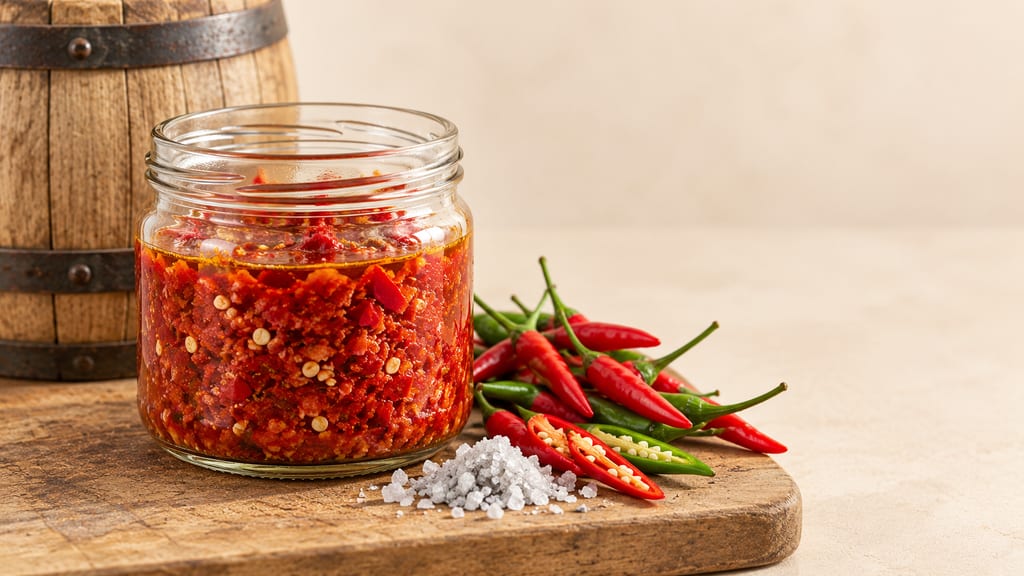
Pepper mash is a stage on the way to a sauce: salted, crushed chilli in a jar under a film of oil, beside the whole peppers it started as.
Six hundred and fifty-eight bottles
In 1868 the McIlhenny family grew its first commercial pepper crop on Avery Island, Louisiana. The next year it sent out 658 bottles of sauce, and in 1870 it secured a patent. That is most of what the company’s own history says about the beginning. It gives no recipe, no salt figure and no account of the mash that sits behind the bottle.
The mash turns up in the company’s description of its original red sauce: pepper mash aged for up to three years in white oak barrels, then finished with distilled vinegar. It is tempting to read three years as three years of fermentation. The wider literature on Louisiana-style mash warns against that. The mash is salted ripe pepper fermenting as a mash, and ageing for up to three years is not the same as uniformly active fermentation. How much of that time is fermenting and how much is waiting, no figure available settles it.
The range is wide across the whole family of sauces. Tabasco-type and sriracha-type sauces ferment mashed, salted peppers for anything from two weeks to three years. One word, fermented, covers both ends.
What happens in a mash
A mash is peppers crushed or chopped and left alone, usually with salt. Lactic acid bacteria and yeasts already on the fruit take over. The bacteria turn sugars into acid, and the pH, the scale on which lower means more acidic, falls.
One published study, by Watts and colleagues in 2018, followed a red hot chilli pepper mash for 18 months. They tracked microbial counts, pH, acid, colour and aroma through natural fermentation. The lactic acid bacteria and yeasts grew side by side, which the researchers call symbiotic. The pH fell significantly while acid rose. Colour changed little. Six aroma compounds rose early and then declined.
Smaller numbers come from shorter trials. A 2005 Louisiana State University thesis by Foong Ming Koh, as a later paper summarises it, ground Capsicum frutescens with 8% salt and let it ferment spontaneously for a month. The pH fell from 4.7 to 3.9 in plastic and to 3.7 in wood. A different experiment fermented habanero in a 5% salt brine and recorded a fall from pH 5.24 to 4.87 over 14 days. Pepper, salt level and container all differ, so the figures cannot be lined up. They show how far apart a mash can sit after a few weeks.
Fifteen days in a Basque jar
Late in November 2021, Gorria peppers from the Espelette region were harvested and frozen at −20 °C. A team at the Basque Culinary Center in Donostia-San Sebastián, with colleagues at Mondragon Unibertsitatea and BC3 in Leioa, wanted a green chilli hot sauce from raw material that would otherwise go unused, and they wanted to know what fermenting the mash contributed.
They filled 500 g jars and set up two treatments. One jar fermented spontaneously. The other received Lactiplantibacillus plantarum Harvest LB-1 from Chr Hansen at 0.08%, the producer’s suggested dose. Unfermented mash, sampled on day 0, served as the baseline. Each jar was covered with 20 mL of olive oil and held at 21–24 °C for 15 days.
The unfermented mash started at pH 5.2. After 15 days the spontaneous jar had reached pH 4.8, and the jar with the starter pH 3.7. The microbial count in the starter jar went from 4.6 to 8.8 log CFU/mL, a rise of 4.2 log units, roughly 16,000-fold. In the spontaneous jar the count rose only slightly. The starter did what a starter is for: it made the acid arrive sooner.
Then the mash was smoked at 72 °C for 150 minutes, strained and thickened with 0.2% xanthan gum. The finished sauce had a mean pH of 3.3, with a standard deviation of 0.17. Torán-Pereg and colleagues concluded that fermentation was unnecessary for this product, which they found had little effect on its sensory properties. That is a result for one prototype, made one way. It does not say that chilli sauces gain nothing from fermenting, and it shows how much of a sauce’s character, and its acidity, can come from steps after the mash.
Choosing the bacteria, and a number that will not agree
The Basque starter was bought. Di Cagno and colleagues took the other route in 2009 and looked for bacteria in the peppers themselves. They isolated Lactiplantibacillus plantarum PE21, Latilactobacillus curvatus PE4 and Weissella confusa PE36 from raw peppers and used them to ferment red and yellow Capsicum annuum.
The process had four steps. The peppers were blanched at 85 °C for 2 min, fermented at 35 °C in a 1% brine, heated at 85 °C for 15 min and then stored at room temperature for 30 days, with or without sunflower oil. Peppers made with the starters stayed below pH 3.7. Controls sat around pH 4.87. Enterobacteria and yeasts were held back, and after 30 days the started peppers were firmer and scored higher on colour.
One number in this account is unsettled. Accounts of the work disagree on its length. One gives the fermentation as 15 hours at 35 °C, and a later paper that cites it says 15 days. Fifteen hours and fifteen days differ by a factor of 24, and neither can be confirmed without the full text. Anyone reusing the method should not copy either figure.
Chilli with grain and soy, chilli with garlic
Chilli does not ferment alone in every tradition. Gochujang, the Korean paste, belongs to the jang-making tradition that UNESCO added to its Representative List of Intangible Cultural Heritage in 2024. It combines chilli with grain, soy-derived material and salt, and many traditional formulas add malt. Some of its sweetness can come from starch conversion rather than added sugar. It is not chilli powder stirred into miso. The saccharification of the grain and the fermentation after it shape its character, and an instant gochujang-style sauce made as a shortcut is a different process from matured gochujang. No verified salt level, pH or duration for gochujang is available, so none is given here.
In China, duojiao is chopped salted chilli, and it is a family of preparations rather than one formula. A 2013 study compared five added-salt treatments over four weeks of natural fermentation. A 2018 study in Food Science, on changes in microflora and organic acids during the fermentation of chopped pepper, started from a fresh chopped chilli base with 10% salt, 5% garlic, 3% ginger, 0.5% baijiu and 0.1% calcium chloride, held at 30 °C and sampled over 12 days. One batch was inoculated with a 5% addition of Lactiplantibacillus plantarum W-4 at 10⁷ CFU/mL. A group standard for Chen-tan duojiao, T/HNSZA 0008-2024, was issued on 16 December 2024 and took effect on 1 March 2025, but its text has not been recovered. No household storage period or safety endpoint is recorded.
Doubanjiang, the Sichuan chilli-bean paste, is a concentrated base used sparingly. A good fermentation of any of these pastes does not establish that a diluted, blended or bottled product built on it is shelf-stable.
Where the safety rules sit
The numbers that decide whether a chilli product can sit on a shelf come from rules written for processors, not from fermentation experiments. In the United States, 21 CFR 114.3 defines acidified foods as low-acid foods to which acid or acid foods are added, with a water activity above 0.85 and a finished equilibrium pH of 4.6 or below. A low-acid food has a finished pH above 4.6 and the same water activity.
Canadian guidance for commercial fermented vegetables, published by the BC Centre for Disease Control in 2024, sets out the reasoning. Processors are to reach a finished pH of 4.6 or lower and keep it there for the intended shelf life, to control Clostridium botulinum, whose spores may germinate when the pH rises above 4.6. They are to hold finished fermented vegetables for at least two weeks before distribution, particularly after ferments shorter than a week. For peppers, blanching at 85 °C for 2 min is required to inactivate enzymes. Staphylococcus aureus may grow at 7–10% salt down to pH 4.2. Adding acid directly to vegetables is a separate process with no fermentation component.
These are processor rules, and quoting them does not turn them into a home method. Against that line of pH 4.6, the experiments above look different. The spontaneous Basque jar was at pH 4.8 after 15 days and the starter-free controls in the 2009 trial near 4.87. The habanero brine was at 4.87 after 14 days. The jars with starters were at 3.7 or below. These are laboratory measurements of particular batches, and they do not establish safety for any other jar.
A long age is a quality choice, not a safety margin, so three years in oak proves nothing either way. Smell, taste and bubbling never settle it, and one measurement does not settle it either.
What the word leaves out
A bottle labelled fermented can mean a salted mash aged for years in oak, a mash soured for two weeks and then smoked, a mash vinegared and bottled, or a paste built on grain and soy. Each stage, the mash, the acidification, the heating and the bottling, needs its own evidence before it is added to another.
The reader’s best question about any fermented hot sauce is not whether it was fermented but what was done after the mash, and how the finished acidity was reached. The evidence gathered here holds no validated household method, endpoint or storage time for a bottled chilli sauce, and none is offered.
Community
No community contributions have been published for this entry yet.
Share what you made
Sign in to contribute. Published comments and photos are free to read.
Sources
International Journal of Food Science & Technology
Microbiological changes and their impact on quality characteristics of red hot chilli pepper mash during natural fermentationCited in: What happens in a mash
McIlhenny Company (TABASCO)
Our HistoryCited in: Six hundred and fifty-eight bottles; What the word leaves out
Foods
Physicochemical and Sensory Evaluation Data to Drive the Development of a Green Chili Pepper Hot Sauce from Unexploited Raw MaterialsCited in: Six hundred and fifty-eight bottles; What happens in a mash; Fifteen days in a Basque jar; Choosing the bacteria, and a number that will not agree; Where the safety rules sit; What the word leaves out
International Journal of Food Microbiology
Use of autochthonous starters to ferment red and yellow peppers (Capsicum annuum L.) to be stored at room temperatureCited in: Choosing the bacteria, and a number that will not agree; Where the safety rules sit
Code of Federal Regulations, Legal Information Institute
21 CFR 114.3 Definitions (acidified foods and low-acid foods)Cited in: Where the safety rules sit; What the word leaves out
BC Centre for Disease Control, via Manitoba Agriculture
Fermented Foods Guidance, Section 3.1 Vegetables (Hudson, Coopland, Dale, McIntyre, 2024)Cited in: Where the safety rules sit; What the word leaves out
Food Science (Shipin Kexue)
Changes in Microflora and Organic Acid Contents during the Fermentation of Chopped PepperCited in: Chilli with grain and soy, chilli with garlic
UNESCO Intangible Cultural Heritage
Knowledge, beliefs and practices related to jang making in the Republic of KoreaCited in: Chilli with grain and soy, chilli with garlic
Gaps
- The 2018 pepper-mash paper and the 2009 starter paper were available only as abstracts and summaries, so their methods, salt levels and the starter paper’s true fermentation time (15 hours or 15 days) are unconfirmed; no company salt level for Tabasco and no salt amount for the Basque mash is in hand.
- The content of the 1870 patent, and whether an early Tabasco process included a naturally fermenting stage, have not been established.
- No verified salt, pH or duration exists here for gochujang, the 2024 duojiao standard’s text was not recovered, and no household method, endpoint or storage time is established.
Updated 2026-10-29