
Starter cultures
Two jars of rejuvelac, two different sets of bacteria
Rejuvelac is sprouted-grain water that people drink and use to start cashew cheese. Two studies of the quinoa version found almost no bacteria in common, and neither shows that a home batch is safe.
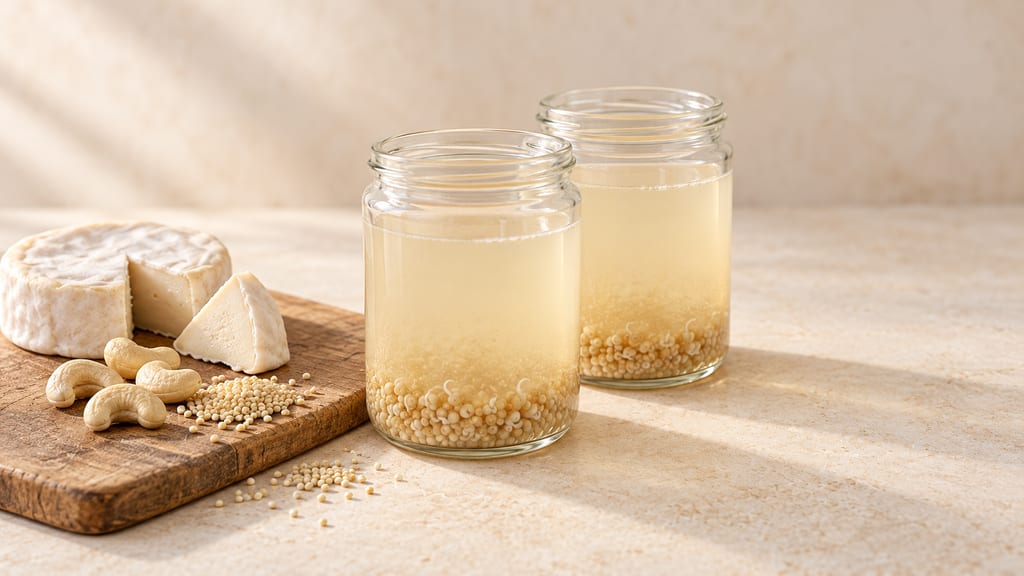
Quinoa soaked in water, the starting point of rejuvelac, beside the cashews and soft cheese it is used to ferment.
Same grain, two very different jars
Two research groups have looked at the microbes in quinoa rejuvelac, the sour grain water used to start plant-based cheese, and their results barely overlap. At a cashew-cheese producer in London, Ontario, the liquid was dominated by Pediococcus and Weissella, two genera of lactic acid bacteria, and it had reached a pH between 3.80 and 4.30 before anyone used it. In a laboratory in Rio de Janeiro, a batch of the same grain in water finished at pH 4.9, and between 97.59% and 98.97% of its bacteria belonged to Pseudomonadota, a large bacterial group that includes Pseudomonas, Enterobacter and Acinetobacter. Lactic acid bacteria were absent or barely detectable.
Both studies are small, and each has a limit that matters. Read together they show how much one word can cover. They also leave unanswered the question most readers will bring to a jar of sprouted grain on the counter: is it safe to drink?
What goes into the jar
Rejuvelac is made by soaking a grain or pseudocereal, usually sprouted, in water for about two days at room temperature. A pseudocereal such as quinoa is a seed eaten like a grain without coming from a grass. The grain can be soaked again for a second batch, which takes about a day. Where the microbes in the jar come from has not been established: the Brazilian group lists a microbiome analysis of the dry seeds before soaking as work still to do.
The liquid has two uses. People drink it, and cheesemakers add it to blended cashews as an inoculum, a small dose of microbes meant to start a fermentation. Three things should stay apart: the rejuvelac, the cashew base it is added to, and the cheese that results. The two studies sampled different ones of these, and neither describes a pure culture or a named commercial strain.
A name with a thin history
The invention of rejuvelac is commonly credited to Ann Wigmore, a holistic practitioner who was born in Lithuania in 1909, died in 1994 and promoted wheatgrass and living foods from the 1940s. No primary source for the credit has turned up. The reference behind it is a 1997 book review, and no year of invention is given.
The same encyclopedia entry links rejuvelac to a traditional Romanian drink called borș, but the pages it cites for that link do not concern Romania. The earliest record, the name's original meaning and any regional tradition therefore remain unknown. Everything solid about the drink's microbes is recent.
Sampling a cashew cheese in London, Ontario
The best-described rejuvelac comes from a 2020 study by Chen and colleagues at Western University, who sampled the plant-cheese producer Nuts for Cheese in London, Ontario. Two of the study's authors are affiliated with that company. The rejuvelac was the liquid kept from quinoa sprouted in water for about two days, taken after its pH had reached 3.80 to 4.30. That figure is a reading from before the liquid was used. It says where the liquid stood at that moment. It is not a safety endpoint, and nothing in the work shows that a pH in this range makes a batch safe.
The rest of the process is thinly described. Cashews were soaked and blended at room temperature with the rejuvelac and left to ferment for 2 to 4 days. Soak time, sprouting time, the ratio of liquid to nuts and the temperature are not recorded, so the work cannot be turned into a recipe. The team followed a brie-style and a blue-style cheese from two batches over 0 to 72 hours, taking three 1,000 g samples at each stage, all from one facility.
Viable counts reached about 100 million to 1 billion colony-forming units per gram (10⁸–10⁹ CFU/g). Plating picked out Weissella cibaria from the rejuvelac and the blue cheese, Leuconostoc citreum from the brie and Lactococcus lactis from the blue. Sequencing a section of the 16S ribosomal RNA gene, which counts bacteria by genus without growing them, gave a wider view. The rejuvelac was dominated by Pediococcus and Weissella. In the brie, Pediococcus, Weissella and Lactobacillus made up nearly 60% of the community, and in the blue, Weissella, Pediococcus and Lactococcus made up over 80%.
Enterobacteriaceae, a family that includes Salmonella and E. coli, were present at low levels in the rejuvelac and undetectable by the end of fermentation. The growth media did not target that family, which makes the result weaker than it sounds. The cheese itself was already very acidic. The brie measured pH 3.0 before fermentation, 2.9 after it and 2.8 in the final product, and the blue 3.0, 2.9 and 2.9, so the pH barely moved. No pathogen was tested for. The conclusion that fermentation further improves the cheese's food safety rests on pH alone.
Less cashew allergen, but not none
Cashew is a major food allergen, so the same team measured it. An ELISA, a test that detects a protein with antibodies, found less cashew allergen in all five products after 72 hours: 35% less in the brie, 54% less in the blue, 66% less in a cheddar-style cheese, 49% less in a herb cheese and 29% less in a red one. Starting levels ran from 159,850 to 266,800 ppm. The herb and red products are listed with the same starting value, 248,750 ppm, which may be a transcription error. Most of the fall came in the first 48 hours.
That is a measurement of protein, not a reduction in risk. No level fell below about 60 ppm per serving, the threshold for cashew allergy, and no clinical or IgE testing was done. IgE is the antibody involved in allergic reactions. Fermentation lowered the measured allergen in these batches. It did not remove it, and it should not be treated as a way of making nuts safe for someone who is allergic.
A spontaneous batch in Rio de Janeiro
A 2026 paper from Rio de Janeiro State University, with a co-author at Sacred Heart College in Tirupattur, India, carries 'homemade' in its title, but no household made the batch. The team adapted traditional artisanal protocols to laboratory conditions. About 40 g of white quinoa soaked for 24 hours in 500 mL of potable water, the soaking water was discarded, and 500 mL of sterilised water went in. The jars stood for 48 hours at 25 ± 2 °C in sterile glass. Three fermentations ran independently.
The pH fell only slightly, from 6.1 to 4.9, and there were no readings in between. Titratable acidity and alcohol were not measured. Sequencing of the 16S V3–V4 region and shotgun metagenomics showed Pseudomonadota at 97.59–98.97%, with Pseudomonas, Enterobacter and Acinetobacter the most abundant genera. Lactic acid bacteria were absent or detected at negligible levels.
The team concluded that spontaneous rejuvelac made this way presents substantial microbiological hazards. Two limits apply to that conclusion. The preparation was a laboratory adaptation with sterilised water and sterile jars, not a kitchen batch. And no one counted living organisms or tested for a pathogen. Hazard was inferred from genes for virulence and antibiotic resistance found in the DNA, and sequencing shows which DNA was present, not that anything was alive or could cause illness. The team itself calls a microbiome analysis of the seeds before soaking highly valuable.
Why the two results do not settle it
The 2020 rejuvelac reached pH 3.80 to 4.30 before use and was rich in Weissella and Pediococcus. The 2026 batch stood at pH 4.9 after 48 hours at 25 °C and held almost no lactic acid bacteria. Acidity looks like the variable that separates them, but the two preparations differ in many ways: seed, water, vessel, soaking and the producer's undisclosed details. A comparison cannot show which difference mattered, and the Brazilian work took no readings between the first and last day.
Neither study tested for pathogens, so neither can say whether a home batch is safe. No challenge study, one that adds a pathogen on purpose and follows what happens, has been found for rejuvelac or any cereal beverage. The nearest evidence comes from dairy drinks and from tests in laboratory dishes.
Sprouts carry their own record
Rejuvelac starts the way sprouts do, with seeds held wet and at room temperature, and sprouts have a documented history of outbreaks. Sprouting conditions suit foodborne pathogens. In most outbreaks the seed is where contamination began, and even a very low level on the seed can multiply to millions of cells per serving.
In the United States, 14 outbreaks linked to sprouts between 2006 and July 2019 caused 504 illnesses, 118 hospitalisations and two deaths, and 10 of the 14 were Salmonella. Groups at higher risk are advised to avoid raw sprouts. Those figures concern sprouts eaten as food. They do not measure the risk of rejuvelac, which has not been studied for it.
What acid does in other foods
Acidity can protect, but the evidence comes from other foods. Togwa is a Tanzanian lactic cereal gruel with a pH of 4 or below. Children who were given it for 13 days saw enteropathogen carriage drop from 27.6% to 7.8% by day 7, against 16.7% to 11.4% in a control group, and the researchers suggested that regular togwa may help control intestinal colonisation.
Acidity also has limits. Listeria monocytogenes added to ayran, a Turkish fermented dairy drink at about pH 3.90 or lower, showed no significant change over 21 days at 4 °C. At 20 °C it was eliminated by day 3 or 5. The researchers concluded that contaminated ayran could be a public health risk. A 2026 buttermilk study saw Listeria counts fall gradually, yet a predictive model, ComBase, forecast growth, a mismatch the researchers took as a limit of such models. None of these foods is rejuvelac.
What a reader can take from this
Rejuvelac is a practice rather than a species. In one commercial setting it was an acidic liquid rich in Weissella and Pediococcus that started cashew cheeses sitting near pH 3. In one laboratory it was a spontaneous batch at pH 4.9 dominated by bacteria far from the lactic acid group. The same word described both.
No validated household method, monitoring plan, endpoint or storage period exists for rejuvelac. Smell, taste, bubbles and a single pH reading do not show that a batch is safe, and a pH reached before use is a description, not a guarantee. Cashew cheese made with rejuvelac still contains cashew allergen. The open questions are concrete: where the microbes come from, how a home batch compares with a laboratory one, and whether any pathogen can survive or grow in the liquid.
Community
No community contributions have been published for this entry yet.
Share what you made
Sign in to contribute. Published comments and photos are free to read.
Sources
Nutrients 2020;12(3):648. Chen JM, Al KF, Craven LJ, Seney S, Coons M, McCormick H, Reid G, O'Connor C, Burton JP; Western University, Lawson Health Research Institute, Nuts for Cheese and Brescia University College, London, Ontario. Two of the authors (Coons, McCormick) are affiliated with Nuts for Cheese, the producer that was sampled; the paper declares no conflict of interest.
Nutritional, Microbial, and Allergenic Changes during the Fermentation of Cashew 'Cheese' Product Using a Quinoa-Based Rejuvelac Starter CultureCited in: Same grain, two very different jars; What goes into the jar; Sampling a cashew cheese in London, Ontario; Less cashew allergen, but not none; Why the two results do not settle it; What a reader can take from this
Life (Basel) 2026;16(4):556. Brasileiro CG, Moreno MTDC, Santos EO, Saranraj P, Cardoso AM, Vieira JMBD; Rio de Janeiro State University and Sacred Heart College (Autonomous), Tirupattur
Assessing Food Safety Risks in Homemade Fermented Beverages: A Case Study with Quinoa RejuvelacCited in: Same grain, two very different jars; What goes into the jar; A spontaneous batch in Rio de Janeiro; Why the two results do not settle it; What a reader can take from this
Virginia Tech extension (Setareh Shiroodi and Laura K. Strawn), first published August 2019, last reviewed August 2024
Sprout SafetyCited in: Sprouts carry their own record; What a reader can take from this
Epidemiology and Infection, DOI 10.1017/s0950268898001800 (abstract)
Kingamkono R, Sjögren E, Svanberg U. 1999. Togwa and enteropathogen carriage in Tanzanian childrenCited in: What acid does in other foods
Mljekarstvo 65(2):130–137, 2015. Akkaya L, Kara R, Muduroglu R, Sagdic O
Survival of Listeria monocytogenes in Ayran, a traditional Turkish fermented drinkCited in: What acid does in other foods
PMC13206578, PMID 42195947 (abstract)
Śmigiel P, Kowalik J, Bielecka M. 2026. Buttermilk with microfiltration retentate and Listeria monocytogenesCited in: What acid does in other foods
Gaps
- No primary source gives the origin of rejuvelac. The Wigmore credit and the link to a Romanian drink rest on secondary sources, and the 1997 book review cited for Wigmore has not been checked.
- No study has tested rejuvelac for pathogens. The 2020 process lacks soak time, sprouting time, water ratio and temperature, and no household, wheat or other-grain data were found.
Updated 2026-10-29