
Techniques
Sour without salt: gundruk, sinki and the Himalayan pit
Nepali households turn surplus greens and radish into dried, sour staples with no salt in the jar. The pot, pit and laboratory methods give different timings, and the sources disagree on temperature and moisture.
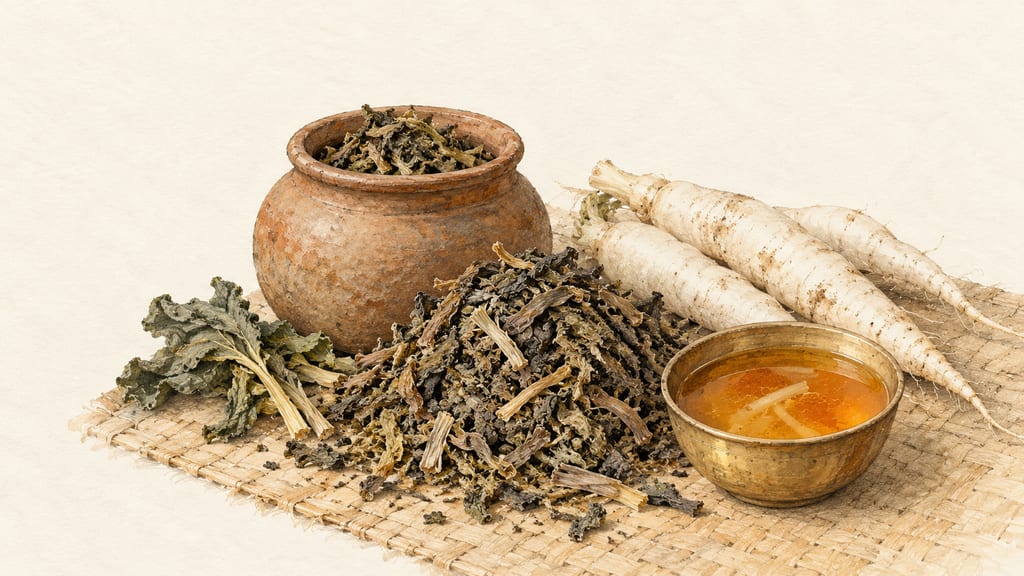
Dried gundruk, fresh mustard greens, white radish and a bowl of sinki soup: the raw materials and the finished foods of the two ferments (an illustration).
More greens than a household can eat
In Nepal the leaf harvest that becomes gundruk comes in October and November, and it is much more than a household can eat fresh. One household method runs like this. The leaves are wilted for a day or two, shredded with a knife or a sickle, and packed tightly into an earthenware pot. Warm water, at about 30 °C, goes in to cover them. The pot is kept warm, in the sun by day and near the fire at night. After five to seven days the leaves taste mildly sour, and they come out to dry on mats in the sun.
What is left is gundruk, a dry, dark, sour food. A 2008 monograph from the Nepal Academy of Science and Technology calls it the major source of minerals and vitamins in the off-season, when green vegetables are scarce. Fresh, it does not keep for more than three or four days at ambient temperature, so it is dried and packed.
Nothing in that sequence mentions salt. The radish version, sinki, is described outright as non-salted. So what keeps a pot of wilted leaves from rotting? The answer is in the chemistry of the jar, but first the two foods need separating.
Two foods that share a habit
Gundruk is made from leaves: mustard greens (Brassica juncea, called rayo), cauliflower leaves, cabbage and radish leaves. Sinki is made from the radish taproot, the white root itself. The FAO defines sinki as a sour pickle made from radish taproots, eaten in India, Nepal and parts of Bhutan, either as a pickle or as the base of a soup. A gundruk made from radish leaves is still gundruk. It is not sinki.
Neither name stands for one method. None of the methods described below puts salt in the jar or the pit, but they differ in vessel, in time and in temperature, and they should be read as separate workflows.
Where they began is not known. The Nepal Academy monograph says sinki’s exact origin is very difficult to trace because authoritative accounts are lacking, and it says the same of gundruk. Both foods belong to Nepal and its neighbouring Himalayan communities, and the best gundruk is reported to come from the hills. No source gives a birthplace or a date.
How a pot of greens turns itself sour
Start with what the jar does to its contents. In a 2020 study of gundruk made from mustard leaves, the raw leaves had a pH of 6.59, nearly neutral. Over 16 days at room temperature the pH fell to 3.71, reaching its lowest point on day 9. Acidity, measured as a percentage, rose from 0.095% to 1.200% by day 12, about 12.6 times higher. Sinki follows the same arc. In a 1993 study of radish roots fermented in glass jars, the pH went from 6.7 to 3.3 and the titratable acidity from 0.04% to 1.28% in 12 days at 30 °C. The pH scale is logarithmic, so these drops are large: about 750-fold more hydrogen ions in the gundruk jars, about 2,500-fold in the sinki jars.
The acid is lactic acid, and living bacteria make it. In the gundruk jars the count of lactic acid bacteria rose from about 60,000 colony-forming units (cfu) per gram on the raw leaves to about 955 million per gram on day 3, a rise of roughly 16,000 times in three days. It then settled near 63 million. Those jars are described with no starter and no salt, so the bacteria were presumably already on the leaves.
They do not work as one species. In the 1993 sinki work, Tamang and Sarkar isolated 453 lactic acid bacteria strains from 40 samples. Lactobacillus fermentum started the fermentation, Lactobacillus brevis followed, and Lactobacillus plantarum took over and dominated; L. brevis turned up in every sample. The Nepal Academy monograph gives a slightly different order for sinki: Leuconostoc mesenteroides and L. brevis lead early, and L. plantarum dominates once the pH is lower, before low pH eventually holds it back. For gundruk, work from the 1980s that the FAO cites has Lactobacillus cellobiosus and L. plantarum starting the fermentation and Pediococcus pentosaceus peaking on day 5. The accounts agree on the type of organism and disagree on the sequence.
Two physical conditions help the bacteria. The first is little air. Sinki makers press the radish in tightly so that most of the air is driven out, and the gundruk jars in the laboratory study were sealed and described as anaerobic. The second is juice. Wilting and crushing break the plant tissue, and the leaves release their own liquid, which is the medium the bacteria grow in. Warm water is added to cover the leaves, and in a pit the heavy stones on top keep pressing the contents down.
So the mechanism that replaces salt, as these sources describe it, is packing, juice, warmth and time, with falling pH as the measurable result. That is a description of what happened in particular jars and pits. It is not a set of conditions that a home cook can copy and trust, and a later section returns to that.
Gundruk in a pot, a pit and a laboratory jar
Gundruk is not one recipe. At least four documented workflows give four different durations, and the figures do not average into a single number.
The household pot described at the start takes five to seven days, at an ambient temperature of about 18 °C. The Nepal Academy monograph describes a container method that takes 10 to 15 days. Wilted leaves are crushed and shredded, tamped into an earthen pot, a bamboo barrel called a dhungro, or a glass or plastic container, and pressed lightly. The container sits in the sun by day and near the fireplace at night. The first sign is froth from the vessel, then a brown liquid, and makers judge that it is finished by smell and sour taste.
The pit method works at a larger scale. The pit is warmed by burning hay or straw, lined with rice straw and banana leaves, and filled with wilted, shredded leaves pressed down with clean feet. Warm water is sprinkled in, the top is covered with straw and soil, and heavy stones go on as a weight. Fermenting in bulk is said to produce better gundruk, at 15–20 °C, and a week in the pit at about 20 °C is said to be enough. Those temperatures come from a scanned page that is hard to read, so they need checking against the printed page.
The laboratory jars of the 2020 study give a fourth set of figures. The researchers bought mustard leaves at a market, sun-wilted them for a day, crushed them and soaked them for 15 minutes in lukewarm water. About 400 g of crushed leaves went into each of 16 jars of 500 ml, pressed down and sealed. The jars sat at room temperature, 20–25 °C, for 16 days, and the leaves themselves stayed around 20–22 °C. The authors call it a preliminary effort.
Five to seven days at about 18 °C, about a week at about 20 °C, 10 to 15 days beside a fire, 16 days at 20–25 °C: these are different vessels, volumes and ways of deciding that the batch is done. A household stops when the taste is right. The laboratory ran its jars for a fixed 16 days and measured them. The sources do not explain the gap, and nothing here supports picking one of the numbers as the correct time.
Sinki: the winter pit and the twelve-day jar
The traditional sinki method uses a pit in the ground, and only in winter. The monograph describes choosing succulent radish, preferably the white variety found in the hills. The leaves are removed, the roots are washed and wilted in sun or shade until tender, then crushed. The pit is 3 to 4 feet deep and 2 to 3 feet across (roughly 0.9–1.2 m by 0.6–0.9 m; the printed figures are hard to read in the scanned copy), plastered with mud, and warmed and disinfected by burning straw inside. It is lined with rice straw and then banana leaves. The crushed radish goes in layer by layer, pressed down by foot, and in cold weather warm water may be sprinkled over it. The top is covered with wilted radish leaves, straw and soil, and a heavy stone or a log is laid on it. Excess liquid drains into the soil.
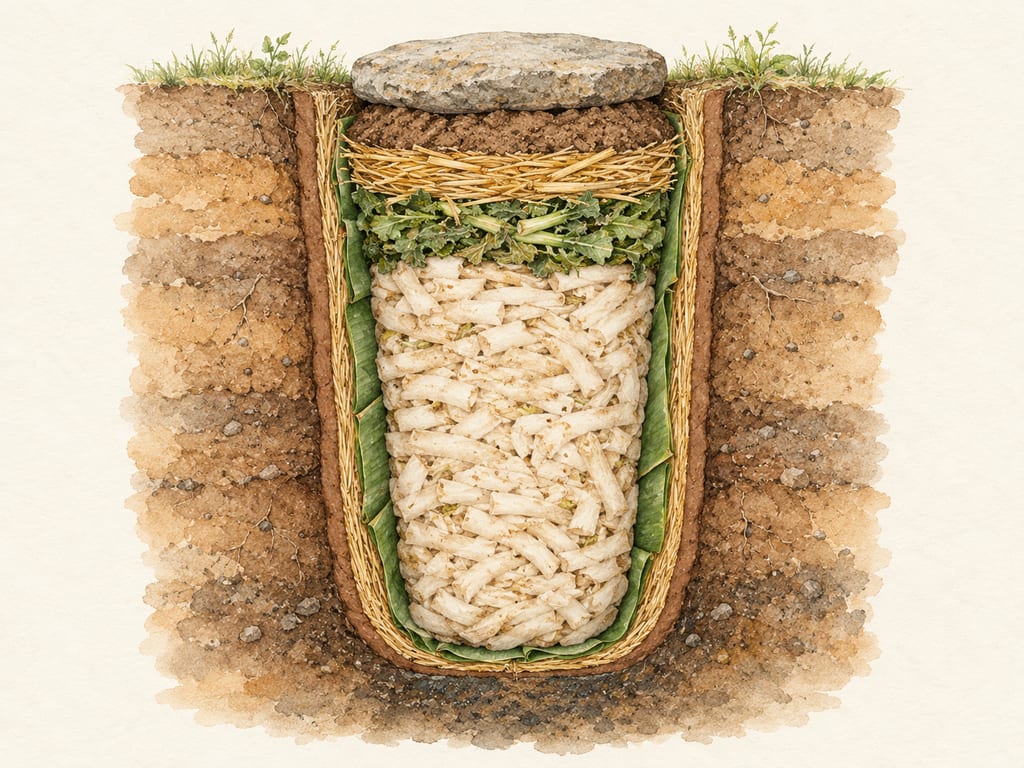
The pit takes 20 to 40 days, depending on temperature, and makers judge that it is ready by smell. Lower temperatures, 15–22 °C, are reported to give better sinki with a smoother flavour, though that figure is another one that is hard to read in the scan. The finished radish is cut and sun-dried until brittle. This pit method has been handed on from generation to generation.
A smaller container does the same job faster. Radish is packed into glass or earthenware with warm water and kept in the sun by day and near the fireplace at night. Sour flavour develops in 10 to 15 days, and the juice that the radish gives off is drawn off from the container.
The laboratory version is a glass jar. In the 1993 study the best result came after 12 days at 30 °C, and the FAO repeats that as the optimum for a jar process. The FAO also cites a clay-lined pit that runs for two to three months, a third pit figure that sits beside the monograph’s 20 to 40 days.
The temperatures disagree too. The jar study found 30 °C best. The monograph says 15–22 °C yields a better sinki. They come from different set-ups, a laboratory jar and a village pit, and the sources do not reconcile them. The jar figure is an optimum from laboratory conditions and the pit advice is about the quality of the finished sinki. The sources do not say whether the two figures truly conflict or measure different things.
Drying is a second process
Fermentation sours the vegetable. Drying keeps it. The two stages change different things, and a well-dried sinki does not prove that the fermentation before it was controlled.
Gundruk is sun-dried on mats and then packed. The monograph recommends high-density polyethylene for packing, and says solar drying improves hygienic conditions and reduces drying time, although that passage is another that reads poorly in the scan. The FAO account cites a loss of about 90% of the carotenoids, probably in sun-drying.
Dried sinki, stored in earthenware over a fireplace, is said to keep for more than a year in the traditional method. How dry it should be is an open conflict. The FAO, citing a 1996 work by Steinkraus, gives about 21% moisture for dried sinki. The monograph points to below 10%, along with a water activity below 0.6 and a pH below 4, as the principle behind its keeping; those figures also come from the hard-to-read scan. About 21% and below 10% are different targets, and they are not merged here.
Salt arrives at the table
Salt does enter the story, but later. Gundruk is served as a side dish or appetiser. The monograph describes it washed or soaked and eaten as a pickle with onion, oil and salt, or cooked into a soup with salt, oil and tomato and served with rice. Gundruk sadeko is a salad of the sour greens with onion, tomato and chilli.
Sinki goes into soup or into a pickle. The FAO’s serving method, taken from the same 1996 work, rinses the dried pieces for two minutes, squeezes them, fries them with salt, tomato, onion and green chilli, boils them in rice water and serves the soup hot. The Nepal Academy monograph also describes tasting fresh sinki with salt, onion and tomato, or making it into soup.
So the same radish that fermented without salt reaches the bowl with it. The salt is a seasoning for the plate, not a control on the jar.
What the numbers do not settle
What is written down describes how these foods have been made, not how to make them safely at home. Nobody has published a validated limit for salt, pH, time, temperature, moisture or storage. A pH of 3.3 in a laboratory jar says what that jar did, and a pit in a hillside is a record of a practice, not a building specification. Sour taste, a good smell and froth are how makers judge a batch is done. They are not tests of safety, and for that reason this article gives no recipe.
What the sources do show is a strategy households use: take what the harvest gives, wilt and crush it, pack it tight, keep it warm, and let the leaves’ own bacteria acidify it. The rest is open. The pit temperatures and the moisture targets need checking against the printed page, the sources do not compare the gundruk and sinki workflows side by side, and they do not say why the jar optimum is 30 °C when the pit advice is 15–22 °C.
Community
No community contributions have been published for this entry yet.
Share what you made
Sign in to contribute. Published comments and photos are free to read.
Sources
Food and Agriculture Organization of the United Nations
Fermented fruits and vegetables: A global perspective. Chapter 6. Typical products of bacterial fermentationsCited in: More greens than a household can eat; Two foods that share a habit; How a pot of greens turns itself sour; Gundruk in a pot, a pit and a laboratory jar; Sinki: the winter pit and the twelve-day jar; Drying is a second process; Salt arrives at the table; What the numbers do not settle
Nepal Academy of Science and Technology
Traditional Foods of NepalCited in: More greens than a household can eat; Two foods that share a habit; How a pot of greens turns itself sour; Gundruk in a pot, a pit and a laboratory jar; Sinki: the winter pit and the twelve-day jar; Drying is a second process; Salt arrives at the table; What the numbers do not settle
Journal of General and Applied Microbiology
Sinki: a traditional lactic acid fermented radish tap root productCited in: How a pot of greens turns itself sour; Sinki: the winter pit and the twelve-day jar; What the numbers do not settle
Food Science & Nutrition
Kinetics and modeling of growth and lactic acid production in Gundruk, a Himalayan fermented vegetable dishCited in: How a pot of greens turns itself sour; Gundruk in a pot, a pit and a laboratory jar; What the numbers do not settle
Gaps
- The Nepal Academy figures for pit depth and temperature, sinki moisture and water activity come from a scanned page and need checking against the printed page.
- No validated salt, pH, time, temperature, moisture or storage limit exists in these sources for making either food at home.
- No birthplace, date of origin or common calendar is established for either food.
Updated 2026-10-29