
Techniques
Taking the bite out of an olive: lye, brine, water and salt
A raw olive is too bitter to eat. Curers have fixed that with lye, brine, water and salt, and only some of those methods involve fermentation. Here is what each one does to the fruit.
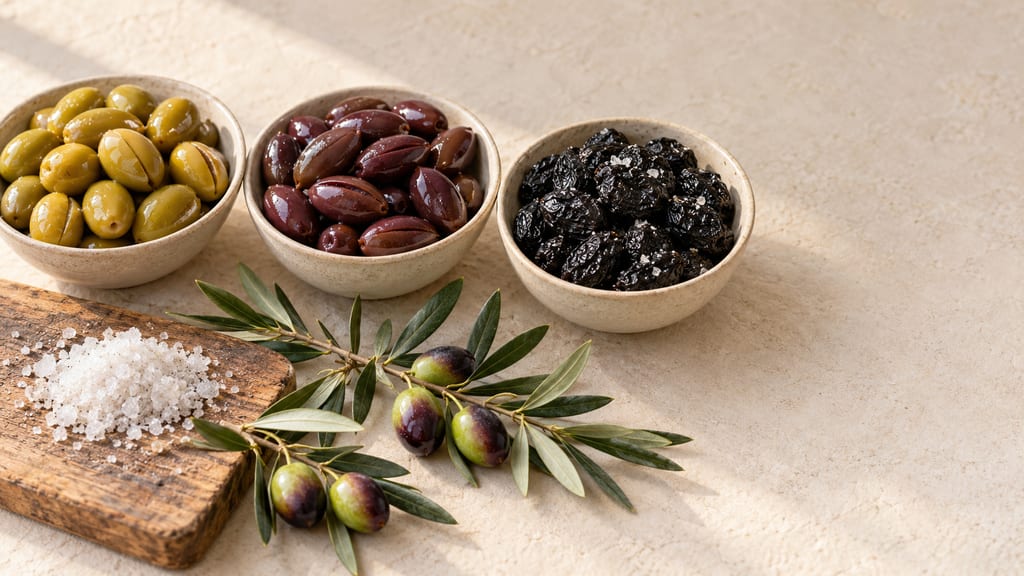
Cured olives of several kinds, from cracked green fruit to wrinkled dry-salted black ones, beside coarse salt.
Where the bitterness comes from
Bite a freshly picked olive and what you taste is mostly bitterness. The main cause is a compound called oleuropein, with a close relative, ligstroside, adding to it. In taste-dilution trials, oleuropein and its aglycone (the molecule left once a sugar has been cut off) both register as bitter at 50 micrograms on a one-square-centimetre square of paper.
Every way of curing an olive either removes oleuropein or breaks it into pieces that do not taste bitter. The fruit does some of this itself, slowly. An enzyme called β-glucosidase strips off the glucose and leaves oleuropein aglycone, and an esterase then splits the aglycone into hydroxytyrosol and elenolic acid, which UC Davis chemists describe as nonbitter. The ester bond can also break on its own. Strong base or acid cuts the same bond without any enzyme, giving hydroxytyrosol and a fragment called oleoside methyl ester, and that is the chemistry behind lye. Water and brine work differently: the bitter compounds drift out of the flesh into the liquid, where acid or microbial enzymes can break them down.
Debittering and fermentation are separate jobs, and the two are easy to confuse. Lye debitters. Fermentation, when it happens, is the work of lactic acid bacteria and yeasts in brine. It follows lye in some styles, replaces lye in others and does not happen at all in a third group. The sections below sort the methods by which of these they use.
Lye: hours instead of months
Lye is sodium hydroxide, and it does two things to an olive. It hydrolyses oleuropein, and it softens the cell walls, so the bitter and sugary compounds that remain move out into the rinse water and brine faster. A lye treatment is measured in hours. A brine cure with no lye is measured in months.
The treatment has to be washed out before a fermentation can start. Leftover oleuropein and related phenolics hold back lactic acid bacteria, so lye-treated olives that are meant to ferment go through a water rinse first, which also carries off the sodium hydroxide.
Lye is not the oldest tool. The International Olive Council says olive or oak ash, and sometimes lime, were used to take out the bitterness before modern sodium hydroxide. Its summary gives no date for the change, and none of the sources dates the first deliberate debittering. The University of California guide says lye is almost always used today.
Spanish style: lye, a rinse, then a lactic fermentation
In the Spanish, or Sevillian, style, green olives get lye first, a rinse second and a brine third, and only the third stage is a fermentation. The University of California home guide stops the lye when it has penetrated about three-quarters of the way into the flesh, which takes at least 5 hours. It then has the cook wash the fruit three or four times over 24–30 hours.
The washed olives go into brine: 10 ounces of salt per gallon for large fruit or 1 pound for small fruit, roughly 7.5% and 12%. The guide adds a starter of 6 fluid ounces of unheated dill-pickle or sauerkraut brine per gallon of olives plus brine, and keeps the jar at 21–32 °C. Fermentation takes 2 to 6 months in that account, and the olives can then stay in brine for up to a year. Commercial practice runs from 1 to 7 months, in brine of 9–10% sodium chloride that falls to 4–5% as water leaves the fruit. The finished olives are canned in 5–7% brine at a pH below 3.5.
The lye strength is where the sources disagree most. The University of California guide uses 2 ounces per gallon for Sevillano and 2.5 ounces for Manzanillo and Mission, which works out to about 1.5% and 1.9%. The International Olive Council summary gives 2–3.5%. The Corsetti review gives 2.5–3% weight per volume. Johnson and Mitchell give 2.0–5.0% sodium hydroxide for 18 to 22 hours, and say in the same paragraph that olives sit in lye for 8 to 10 hours. None of the sources reconciles these numbers, and the University of California guide ties its endpoint to how far the lye has travelled into the flesh, not to a clock.
Brine alone: waiting for the bitterness to leave
Without lye, debittering depends on diffusion, so the process is slow. The industrial Greek method puts black olives straight into 8–10% sodium chloride brine, weight per volume, for 6 to 12 months while yeasts and lactic acid bacteria ferment. The 2012 review led by Aldo Corsetti of the University of Teramo gives 6–10% and 8 to 12 months. The microbes do more than add flavour: the enzymes of yeasts and lactic acid bacteria can break down the oleuropein that has already diffused into the brine.
The University of California guide gives a home version of the Greek style. Black olives go into a medium brine of 8 ounces of salt per gallon for 7 days, then into a strong brine of 1 pound per gallon for at least 2 months. They are eaten after 2 months, still bitter, or after 3 months, less so, and the guide stores them for up to a year. The strong brine converts to about 12%, above the review figures. That gap is partly a matter of basis, since the guide does not say whether a gallon means water or finished brine, so the comparison is approximate. The guide also gives a Sicilian style for green Sevillano olives: brine of 10 ounces per gallon for large fruit or 1 pound for small, 2 cups of vinegar per gallon, about 21 °C for about 2 months, then 2 to 4 months more.
Water and salt, with no fermentation
Plain water can do the job if the fruit is cut open to let the bitterness out. The University of California guide gives two examples. For Kalamata-style olives, it takes naturally black ripe fruit, makes two lengthwise cuts in each olive and changes the water daily for 8 to 10 days, or up to 20 for a less bitter olive. The olives then sit in a finishing brine of 1 pound of salt and 1 quart of red wine vinegar per gallon for about a month at 16–27 °C, and keep refrigerated for up to a year. For Mediterranean-style olives, it uses green-ripe fruit, crushes it and changes the water daily for 6 to 7 days. The finishing brine is 1 pound of salt and 2 cups of white wine vinegar per gallon, the olives are ready after 4 days and they keep refrigerated for up to a year. Neither involves a fermentation.
Dry salting uses no water at all, and the salt draws moisture out of the flesh. Johnson and Mitchell call salt and oil curing an old practice, with olives packed in drums in layers of dry salt for weeks to months while yeasts, moulds and Enterobacteriaceae grow on the surface. The University of California guide takes fully ripe dark olives, mixes 1 pound of salt with every 2 pounds of fruit, which is 50% of the olive weight, re-mixes the batch weekly for a month and calls the olives ready in 5 to 6 weeks. The International Olive Council describes a Greek example with salt at about 15% of the olive weight. In an industrial trial in Greece, about 100 kg of olives and 40 kg of coarse salt sat in a 220 L PVC drum. After 80 days the olives had lost 21 g of weight per 100 g, their salt content had reached 7.4 g per 100 g and their water activity had fallen from 0.98 to 0.76. The product counted as unfermented, and yeasts were the only microbial group found. The sources give no tested salt ratio for a home batch.
Black ripe olives: all lye, no fermentation
California black ripe olives came out of the late 1800s, developed by a Northern California homemaker named Freda Ehmann. The industrial method gives the fruit three to five lye treatments of 0.5 M sodium hydroxide, about 2.0% weight per volume, of several hours each, with air bubbled through the rinse water between them. A fermentation is not needed, because the lye does the debittering. The finished olive has a final pH of 5.8–7.9, far above the pH below 3.5 of canned Spanish-style olives, and it is canned and heat sterilised.
The colouring step carries two doses in the Johnson and Mitchell review: 0.1% ferrous gluconate in the text and 5 g/L in the process diagram, which is five times as much. Their California section names ferric gluconate instead. The International Olive Council summary describes an initial 2% lye solution and 0.1% ferrous gluconate or lactate, with washing to near-neutral pH before canning.
The University of California home guide gives a version without the factory. Dark ripe olives get five lye treatments, four at 1.5 ounces per gallon and a last at 2 ounces, with a day in the air between them. They are then washed for 7 to 8 days and are ready in about 2 weeks.
What the University of California guide says about lye at home
The home-pickling publication from the University of California, ANR 8267, is dated June 2007, and it warns that research is ongoing and its recommendations may change. Its figures are what that guide states and are not current, validated guidance. For green olives with no fermentation, it uses 2 ounces of lye per gallon of cold water, about 1.5%, cooled to 18–21 °C before use. The fruit is stirred every 2 hours, and the first treatment runs 10 to 12 hours until the lye reaches the pit. A second treatment at 1 ounce per gallon runs for up to 30 hours, and a third at 1.5 ounces per gallon is added if needed. The olives are then washed for 7 to 8 days and are ready in about 2 weeks.
The safety instructions are specific. The lye must be 100% sodium hydroxide, and 2 ounces equal 4 level tablespoons of flake lye or 3 level tablespoons of granular. Add lye to cold water, never water to lye. Wear goggles, intact rubber gloves and long clothing. Never use aluminium, tin, lead or zinc-galvanised metal, which react with lye. Stainless steel, cast iron, enamelware, glass, stoneware, wooden barrels and food-grade plastic are listed as safe containers. Used lye and rinse water go down a household drain and are flushed well, never into a storm drain. For skin or eye contact, rinse for 15 minutes and call Poison Control.
The cost of speed
Lye is fast, and the speed has a price at the other end. UC Davis researchers cite an estimate that a three-step process produces 580–660 kg of wastewater for every 100 kg of olives, at a pH of 9.0–12.0, with a chemical oxygen demand of 1,500–3,800 mg O2/L and a biological oxygen demand of 390–1,150 mg O2/L. Per tonne of fruit, Johnson and Mitchell count 8.0 cubic metres of water for California black ripe olives, of which 2.0 is lye wastewater, 3.9–7.5 for the Spanish style and 0.9–1.9 for the Greek style. The slowest method uses the least water. That cost is the stated motive for a UC Davis study of β-glucosidase enzymes that could break down oleuropein in place of lye.
For a reader, the main lesson is that the method sets the calendar. Lye gives an edible olive in days or weeks, brine takes months, water and salt fall in between, and each style has its own stages, so no timing, strength or storage limit carries over from one to another. The storage times in these guides are the guides' own statements, and none of the sources provides a tested safety limit for a home batch.
Community
No community contributions have been published for this entry yet.
Share what you made
Sign in to contribute. Published comments and photos are free to read.
Sources
University of California Agriculture and Natural Resources
Olives: Safe Methods for Home Pickling, ANR Publication 8267Cited in: Lye: hours instead of months; Spanish style: lye, a rinse, then a lactic fermentation; Brine alone: waiting for the bitterness to leave; Water and salt, with no fermentation; Black ripe olives: all lye, no fermentation; What the University of California guide says about lye at home; The cost of speed
International Olive Council
Table olivesCited in: Lye: hours instead of months; Spanish style: lye, a rinse, then a lactic fermentation; Water and salt, with no fermentation; Black ripe olives: all lye, no fermentation
ACS Omega (Guggenheim et al., 2018, University of California, Davis)
β-Glucosidase Discovery and Design for the Degradation of OleuropeinCited in: Where the bitterness comes from; The cost of speed
Journal of Food Quality (Johnson and Mitchell, 2018, University of California, Davis)
Reducing Phenolics Related to Bitterness in Table OlivesCited in: Where the bitterness comes from; Lye: hours instead of months; Spanish style: lye, a rinse, then a lactic fermentation; Brine alone: waiting for the bitterness to leave; Water and salt, with no fermentation; Black ripe olives: all lye, no fermentation; The cost of speed
Frontiers in Microbiology (Corsetti, Perpetuini, Schirone, Tofalo and Suzzi, 2012, University of Teramo)
Application of starter cultures to table olive fermentation: an overview on the experimental studiesCited in: Where the bitterness comes from; Lye: hours instead of months; Spanish style: lye, a rinse, then a lactic fermentation; Brine alone: waiting for the bitterness to leave
LWT - Food Science and Technology (Panagou, 2006)
Greek dry-salted olives: Monitoring the dry-salting process and subsequent physico-chemical and microbiological profile during storage under different packing conditions at 4 and 20 °CCited in: Water and salt, with no fermentation
Gaps
- No source gives a tested way for a home curer to confirm that lye has been rinsed out, a validated salt ratio for dry curing or a current storage limit for any home style.
- The lye strengths for Spanish-style olives, the ferrous gluconate dose and the heat-sterilisation figures for California olives differ between sources, and sometimes within one review, and they are left unreconciled here.
- The International Olive Council summary does not say whether Picholine-style olives ferment, and the earliest use of ash or lye on olives has no date.
Updated 2026-10-29