
Techniques
A pit full of breadfruit, and no one agrees how long it keeps
From Samoa to the Marshall Islands, people buried peeled breadfruit and dug up a sour paste. Leaves, timing and keeping times differ by island, and nobody has measured what lives in the pit.
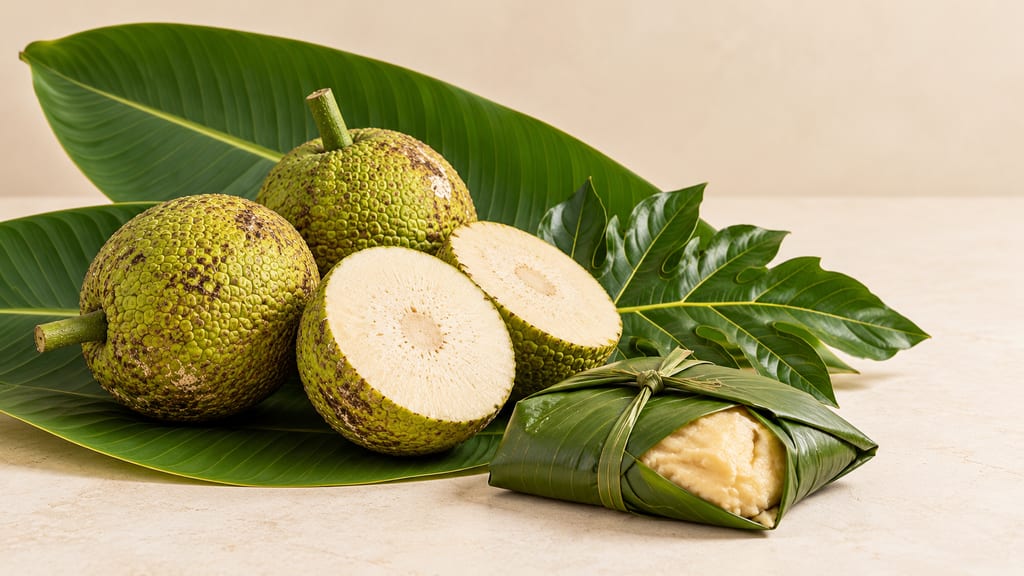
A still life of the materials: fresh breadfruit, broad leaves and a leaf-wrapped parcel of fermented paste, not a photograph of a pit.
A pit a metre across, ten breadfruit, 34 days
Under the guidance of Chief Ofala Va’alaufuti, the researcher Paul Alan Cox dug a pit in Samoa about a metre across and a metre deep. Into it went ten mature breadfruit, peeled, washed and quartered. Banana leaves and overlapping Heliconia leaves, which Samoans call lau fao, enclosed the fruit. More leaves, soil and stones covered it. After 34 days the fruit had become a paste. Cox kneaded it into patties, wrapped them in leaves coated with coconut cream and baked them in an umu, the Samoan earth oven, for two hours.
Cox published the demonstration in 1980. It is unusually complete. Most accounts of Pacific breadfruit pits are shorter, and they differ from island to island in the leaves, the timing and the keeping time. This story follows what the accounts share, where they split, and what nobody has measured.
Why bury a fruit
Breadfruit (Artocarpus altilis) is a staple across much of the Pacific, and it comes in gluts. A survey of five cultivars on Pohnpei found that they fruit at different times, which lengthens the season. Fresh fruit is still not available all year. On Namu Atoll in the Marshall Islands, breadfruit was collected in June and the preserved food was generally eaten from July through September, when fresh fruit was gone.
Samoan accounts call stored masi useful in times of war or famine. In the Marquesas, families kept the paste in silos called ua mā against drought, conflict and destructive waves, and the reserves fed communal feasts known as koʻika. A chapter published in 2018 adds that the paste could be eaten on its own in scarcity or at sea.
Emergencies are not the whole story. Nancy Pollock's 1984 comparison of breadfruit fermentation across Oceania argues that in some communities people valued the paste as everyday food, for its flavour and texture as well as for storage. On Namu she recorded families eating bwiru two to three weeks after it went into the pit, which is too soon for it to be a long-term store. Marquesans, she notes, ate fermented and fresh breadfruit together.
One fruit, many names
The names tell you how little these foods share. Samoans say masi, and Pratt's 1862 dictionary defines it as fermented breadfruit and gives a banana version too. Tahitians say mahi, Pohnpeians maratan, and in Vanuatu the word is namandi. In the Marquesas, mei is the fruit and mā is the sour paste made from it; kneaded with freshly steamed breadfruit, the paste becomes a dish called pōpoi. In the Marshall Islands the same syllable means something else: mā is the breadfruit itself, and bwiro, also written bwiru, is the preserved food. In Fiji the pit method for starchy foods is called davuke.
Across Micronesia, where the National Tropical Botanical Garden has worked on Pohnpei and Kosrae, the paste goes by mahr, furo or bwiru, and it is still made every season in a leaf-lined pit. People dig it up at different stages of sourness, depending on ritual, need and taste, and it can last a year or more. In French Polynesia the old pit for keeping ʻuru paste through the off-season has its own name, ʻāpoʻo tīʻōʻō. Elsewhere in the Pacific the practice has mostly disappeared.
A shared fruit and a similar hole in the ground do not make a shared recipe. Each name belongs to its own island and its own method, and the sections below keep them apart.
Leaves, water and stones
One Samoan method puts nearly mature fruit into a folded-leaf pocket inside a covered pit, lined with Heliconia leaves and capped with more leaves, soil and rocks. Later the fruit comes out as a dough-like paste. A Samoan manuscript about banana masi, translated into English, has the pit lined and floored with leaves so the fruit never touches the earth, which would give it an earthy taste, then covered with leaves and banana leaves and pressed down with heavy stones. The translation calls the lining leaf a Fao tree and glosses it as hibiscus. Which plant is meant is unresolved, and it should not be assumed to be the Heliconia of Cox's breadfruit pit.
Namu Atoll adds a wet stage first. Fallen fruit is peeled, soaked in salt water, dried on palm fronds, kneaded, and only then moved to a leaf-lined pit. A Marshall Islands account condensed from 1950 field notes starts the fruit in a sennit-net or cloth bag under lagoon or ocean water, rests it under palm fronds, and stores it in a leaf-lined pit where the leaves are changed daily at first and then weekly. A Micronesian description from 1985 has banana or breadfruit leaves in the pit and a cover of more leaves, old sacks, earth and stones.
Some makers dropped the pit altogether. A teacher on Ebeye, in the Marshall Islands, showed a visitor in 2014 how to pack cut breadfruit into a porous cloth bag and bury it so the liquid drains away. On the Marquesas, a photograph caption records a woman weaving a coconut-leaf container for mā at Hakatao on ʻUa Pou, with no details of how it was used. Across all of these the leaves serve as a barrier and a cover. Beyond Cox's one-metre pit, the accounts give no pit sizes.
What happens in the dark
A buried, covered pit holds very little oxygen. University of Hawai‘i extension specialists describe naturally occurring lactic acid bacteria working in that low-oxygen space. A review of breadfruit processing puts a number on the result: the pulp's pH falls below 4 as starch breaks down into carbon dioxide and lactic acid. The review adds that a second, aerobic fermentation can turn lactic acid into butyric and acetic acids, and that the paste is often washed to reduce its sourness before it is pounded and cooked.
Fiji supplies the one experimental check. In 1988 researchers at the University of the South Pacific studied davuke, the Fijian pit method, and found a lactic acid fermentation whose product was nutritionally similar to fresh fruit.
That is where the evidence stops. No one has named the species at work in a Pacific breadfruit pit; the lactobacilli the review lists belong to a later fermentation of breadfruit flour. Salt water is used on Namu and in the Marshall Islands, but no concentration is recorded. No source measures alcohol, water activity or pathogen control in pit paste. Studies of stored sago starch in Papua New Guinea found acid fermentation and also found that some pathogens survived it, so a sour product is not automatically a safe one.
How long: days, weeks or months in the pit
The accounts disagree on how long the fruit stays underground. A review of breadfruit processing gives 5–7 days. The Vanuatu country report says several days in a sealed pit before the pulp is removed. Pollock's Namu families ate the food two to three weeks after burial. Cox's demonstration ran 34 days. A 1985 Australian crop profile says about two months. Some of these may describe the fruit stage and others a longer rest of the paste, and none was tested for safety.
Keeping times for the paste are wider still. Samoan paste is said to stay in pits for over a year. A 1954 nutrition survey gives about six months for bwiro in the Marshall Islands, and a 1958 book, drawing on the 1950 field notes, gives one or two years with leaf changes. The Ebeye bag batch was reportedly stored for three years, and the translated Samoan manuscript says banana masi made that way will keep for ten years. Cox's informants said the opposite about bananas: banana masi does not keep as long as breadfruit masi.
Read these as testimony about quality and custom, not as deadlines. A long history of use, a sour smell or a firm texture does not show that a given batch is safe.
From sour paste to dinner
The paste was a starting point. Cox's patties were wrapped in leaves and baked. On Namu the paste could be rubbed into a dry, crumbly form and wrapped in leaf for baking. The 1958 book lists washing and cooking preserved breadfruit with coconut cream, coconut syrup or fresh breadfruit leaves, and baking, roasting or boiling it.
The Ebeye lesson shows the steps in order: wash the stored fruit in salt water, work it by hand, squeeze it, rinse it in fresh water, knead it, and cook portions in sweetened coconut milk. The food was served on special occasions. A 2025 report from the Marshall Islands describes the same pattern: bwiro has become more of a special-occasion food for many Majuro residents, while on Mejatto it remained a practical reserve. Kirenwut Anjain of Mejatto was preserving breadfruit while visiting family in Laura to feed church congregants.
What a hole in the ground can and cannot prove
In Vanuatu, breadfruit fermentation was once reported on several islands and was uncommon by the time of Labouisse's survey, though he saw a small pit, called namaraï, at Anelgowhat on Aneityum in 2004. A 2001 country report says knowledge of pit fermentation remained in rural communities even though the practice was no longer widespread.
On Pohnpei, archaeologists tested four features that might be breadfruit fermentation pits and warn that calling a feature a pit for fermenting breadfruit is an interpretation, one that needs several lines of evidence. A pit shows that someone dug a hole. It does not show what went in it. A University of Oregon dissertation chapter places breadfruit in Pohnpei's seasonal food, feasting and prestige, but it cannot say how any particular household made it.
Where the practice began is unsettled. The earliest Marshall Islands descriptions, cited in the 1958 book from works dated 1884 and 1893, are still to be traced to their originals. What is left is a set of local methods, recorded mostly in short accounts, and almost no measurements. These accounts describe what was done. They are not a recipe, and the evidence does not support turning them into one.
Community
No community contributions have been published for this entry yet.
Share what you made
Sign in to contribute. Published comments and photos are free to read.
Sources
Food and Agriculture Organization of the United Nations
Traditional post-harvest technology of perishable tropical staples: Bananas and plantains, breadfruit, pandanus and starches derived from stem cropsCited in: Why bury a fruit; One fruit, many names; Leaves, water and stones; How long: days, weeks or months in the pit; From sour paste to dinner
Ethnobiology Letters / Jean-Pierre Labouisse, CIRAD
Ethnobotany of Breadfruit in Vanuatu: Review and ProspectsCited in: What a hole in the ground can and cannot prove
Journal of Archaeological Method and Theory
Breadfruit Fermentation in Pohnpei, Micronesia: Site Formation, Archaeological Visibility, and Interpretive StrategiesCited in: What a hole in the ground can and cannot prove
University of Oregon Graduate School
Food Production, Environment, and Culture in the Tropical Pacific: Evidence for Prehistoric and Historic Plant Cultivation in Pohnpei, Federated States of MicronesiaCited in: What a hole in the ground can and cannot prove
CGPRT Centre; Shadrack R. Welegtabit
Food Security Strategies for VanuatuCited in: How long: days, weeks or months in the pit; What a hole in the ground can and cannot prove
Economic Botany; Paul Alan Cox
Two Samoan Technologies for Breadfruit and Banana PreservationCited in: A pit a metre across, ten breadfruit, 34 days; One fruit, many names; Leaves, water and stones; How long: days, weeks or months in the pit; From sour paste to dinner
Journal de la Société des Océanistes; Nancy J. Pollock
Breadfruit Fermentation Practices in OceaniaCited in: Why bury a fruit; How long: days, weeks or months in the pit
University of Hawai‘i Press; Mary Murai, Florence Pen and Carey D. Miller
Some Tropical South Pacific Island Foods: Description, History, Use, Composition, and Nutritive ValueCited in: One fruit, many names; Leaves, water and stones; How long: days, weeks or months in the pit; From sour paste to dinner; What a hole in the ground can and cannot prove
Pacific Science Board, National Academy of Sciences–National Research Council; Mary Murai
Nutrition Study in Micronesia (Atoll Research Bulletin 27)Cited in: How long: days, weeks or months in the pit
Übersee-Museum Bremen
Samoan nutritive plants (Leaei, translated by Trood Tetens)Cited in: Why bury a fruit; One fruit, many names; Leaves, water and stones; How long: days, weeks or months in the pit
University of Hawai‘i at Mānoa, College of Tropical Agriculture and Human Resilience
Making Mā: Fermented Breadfruit (Extension Publication FN-68)Cited in: What happens in the dark
Direction de la Culture et du Patrimoine de la Polynésie française, Te Henua Ènata - les îles Marquises
Festins et faminesCited in: Why bury a fruit
ANU Press, The Bounty from the Beach; Jean-Claude Teriierooiterai
Contextualising the Bounty in Pacific Maritime CultureCited in: Why bury a fruit; One fruit, many names; Leaves, water and stones
Frontiers in Nutrition; Mehta, Quek and Henry
Breadfruit (Artocarpus altilis): Processing, nutritional quality, and food applicationsCited in: What happens in the dark; How long: days, weeks or months in the pit
Ecology of Food and Nutrition; Aalbersberg, Lovelace, Madhoji and Parkinson
Davuke, the traditional Fijian method of pit preservation of staple carbohydrate foodsCited in: One fruit, many names; What happens in the dark
Mike and Lisa Jean (blog), 4 April 2014; Becker
My first lesson in Marshallese cooking—Bwiro (fermented breadfruit)!Cited in: Leaves, water and stones; How long: days, weeks or months in the pit; From sour paste to dinner
Honolulu Civil Beat; Thomas Heaton
Can This Tree Still Save Us? In Some Places It’s Barely Hanging OnCited in: From sour paste to dinner
Tropical Agriculture; Fownes and Raynor
Seasonality and yield of breadfruit cultivars on PohnpeiCited in: Why bury a fruit
Food Microbiology; Greenhill, Shipton, Blaney, Brock, Kupz and Warner
Spontaneous fermentation of traditional sago starch in Papua New GuineaCited in: What happens in the dark
London Missionary Society’s Press; George Pratt, 1862
A Samoan Dictionary: English and Samoan, and Samoan and English; with a Short Grammar of the Samoan DialectCited in: One fruit, many names
Matariʻi.pf, Te Fare Tauhiti Nui
ʻĀpoʻo Tīʻōʻō, un dispositif traditionnel de conservation de la pâte de ʻuruCited in: One fruit, many names

Gaps
- No source names the microbes in a Pacific breadfruit pit, and none records a measured salt level, temperature or endpoint; the pH figure comes from a secondary review.
- Pit sizes, leaf quantities and cleaning are recorded almost nowhere beyond Cox's single Samoan batch.
- Current practice in Samoa, the Marquesas and Pohnpei is undocumented here, and the origin of pit fermentation is unsettled.
Updated 2026-10-29