
Techniques
Doubled by morning: the fermented batters behind idli, appam and injera
Rice and black gram, rice and coconut, teff with a kept starter: batters across India and Africa sour and rise before they are cooked. What happens in the bowl, how fast, and where the evidence stops.
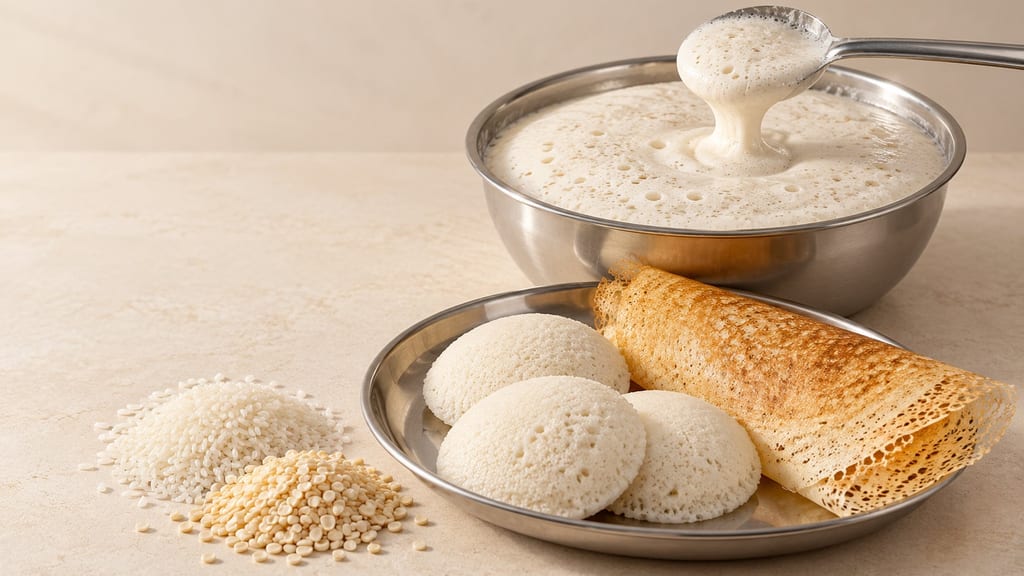
A steel bowl of risen idli batter beside steamed idli and dosa.
A bowl that doubles by morning
Drop a spoonful of idli batter into water the morning after it was made. If the batter has done its work, it floats. It has also roughly doubled in volume and gone light and airy. Nothing was added to make it rise: a household recipe needs only rice, white urad dal and salt, plus water, left overnight at around 30 °C.
Idli is one member of a wide family of fermented batters. Appam is made from rice and coconut, injera from teff, kisra from sorghum, dhokla from rice and Bengal gram. Each is mixed wet, left for hours or days while microbes work on it, and cooked last. The microbes are mostly lactic acid bacteria, which make acid and, in some species, gas. The acid sours the batter and the gas lifts it. The cooking ferments nothing; it sets the foam into a cake, a pancake or a sheet.
The questions are the same for every batter in the family. Where do the microbes come from, how long does the batter need, and how can a cook tell when to stop?
Idli and dosa: grind, wait, steam
Idli and dosa share a batter. Rice and black gram, called urad dal in the kitchen, are soaked in separate bowls, ground, mixed with water and 2% salt, and left to ferment. The ratio of rice to black gram depends on the source: the BC Centre for Disease Control gives 3:1 for dosa and 4:1 for idli, a household recipe uses 2 cups of rice to 1 of dal, and a Kolkata study compared 2:1, 3:1 and 4:1 by weight.
The grind differs from bowl to bowl. For idli the rice is ground coarse and the black gram fine; for dosa the rice is ground fine too. The household recipe takes the rice to a coarse paste and the dal to a fine one, adds water until bubbles form, and aims for a thick dropping consistency. Oil goes on the idli moulds, not into the batter.
Then comes the wait. The BC Centre for Disease Control puts fermentation overnight, typically at least 12 hours, at around 30 °C, and suggests a preheated oven switched off with its light on for cold kitchens. The household recipe sets the batter in a warm place for 8–10 hours, until it rises and turns sour, and counts about 24 hours for the whole process from the first soak. Idli is then steamed for 5 to 8 minutes; dosa is spread on a hot pan.
The batter changes measurably in that time. In the Kolkata study, pH ranged between 5.9 and 4.21 across the fermentation, total acidity from 0.44 to 0.91%, and density from 0.93 to 0.59 g/cm³, a sign that the batter ends up full of gas. Riboflavin and thiamine peaked at 0.76 and 0.73 mg per 100 g in the 3:1 blend, and folic acid reached 0.75 mg per 100 g after 10 hours.
Two studies 54 years apart name the organisms. Culture work in 1965 found Leuconostoc mesenteroides responsible for the souring and the gas, with Streptococcus faecalis and Pediococcus cerevisiae (the names used then) appearing later, and called it the first record of leavening by a lactic acid bacterium alone. In 2019, sequencing at the National Centre for Cell Science in Pune found that lactic acid bacteria made up 86% of the bacteria in idli batter, with Weissella the most important genus. The two studies used different methods and do not contradict each other.
Appam: a batter that has barely started to sour
Appam sits at the other end of the clock. At Sultan Qaboos University in Muscat, a team mixed 100 g of rice flour, 50 g of coconut milk powder, 15 g of white sugar and 2 g of salt with water and left the batter for 5 hours at room temperature, 29 ± 1 °C. Every treatment was run three times.
The batter started at pH 7.0. After 5 hours the plain batter had reached 5.9. That is a small fall: the Kolkata idli batter reached 4.21. The Omani team put the difference down to time, since idli batter is kept for 8–12 hours and the appam batter for 5.
The experiment was really about dates. A batter with date paste reached pH 6.0 after 5 hours, no further than plain. One with date syrup reached 5.8 within 4 hours, and its count of mesophilic aerobes, bacteria that grow in air at moderate temperatures, rose from 4.67 to 6.90 log10 colony-forming units per gram, from roughly 47,000 to roughly 7.9 million. The syrup sped things up, but not by much.
The lesson for the family is that fermented covers a wide range. A cereal batter can sit at pH 5.9 after a morning on the counter or at 4.21 after a night, and both can be cooked as ferments.
Injera: days in the bowl, then a second fermentation
Injera makes the others look quick. In Ethiopia, teff flour is mixed with water and ersho, a starter kept back from earlier batches, and left at room temperature for 24 to 72 hours. Then a portion of the batter is cooked and stirred back in. This is absit, and it drives a second fermentation of 2 to 24 hours.
The batter is baked on a griddle called a mitad, at 90 to 95 °C for 2 to 3 minutes. The finished injera is about 6 mm thick and about 60 cm across. In households it is kept for up to three days at room temperature in a straw basket called a messob.
Studies of injera that the Cornell AgriTech team cites give a sense of the microbiology. One followed 34 batters for 96 hours, sampling every 6 hours, and identified 107 lactic acid bacteria and 68 yeasts. Another measured ersho in 40 samples from four households and found a pH consistently around 3.5, far more acidic than the idli batter at 4.21.
Sorghum, rice and gram, and the batters left out
In Sudan, kisra is made from a fermented sorghum dough. Sequencing of kisra and a second sorghum food, hulumur, found bacterial communities dominated by lactic acid bacteria, with Pediococcus, Weissella and lactobacilli among them, and different fungi in the two foods. Weissella, the genus that led the idli batter, turns up here as well. The sampled foods do not define a starter that someone else could reuse safely.
Dhokla follows the idli sequence with a different pulse. In the dhokla work, rice and Bengal gram dal were soaked separately, ground, mixed and left to ferment spontaneously before steaming. The researchers measured biogenic amines, compounds that form as microbes break down proteins. They rose during fermentation and fell after steaming. Those figures belong to one experimental formulation; they are not a safe protocol.
Not every batter in this family ferments. Neer dosa is cooked fresh. Puto in the Philippines and vitumbua in East Africa are fermented or leavened rice batters, but how cooks make them is not covered here.
Two ways to start a batter
Idli and injera start from opposite assumptions. Idli batter relies on yeasts and wild lactic acid bacteria already present on the ingredients. In the 2019 sequencing study, grains whose surfaces had been sterilised did not ferment, which points to microbes carried on the grain itself. Injera relies on ersho, so each batch seeds the next.
Idli cooks can borrow that idea. A study at ICT Mumbai added dried batter from an optimally fermented 12-hour idli batch to a fresh one, and cut the fermentation from 12 hours to 3. The faster batter had 50% more thiamine, 11% less phytate and 16% less trypsin inhibitor than a conventional 12-hour batter. The BC Centre for Disease Control, whose guideline gives a similar 12–14 to 3 hour range, recommends against backslopping idli, because a non-active culture can support mould growth.
The gas has an identified source. In the 2019 study, radiolabelled carbon dioxide from glucose tied the leavening to the heterofermentative hexose monophosphate pathway: lactic acid bacteria that ferment sugar to lactic acid, carbon dioxide and other products. The batter traps the gas, and the cooking sets the structure around it.
What the bowl cannot tell you
Doubling, floating, sourness and bubbles are quality cues. They show that a batter has been working. They do not show that it is safe to eat.
The BC Centre for Disease Control gives numbers for idli and dosa, written for operators. Soak rice and black gram separately for 4 to 6 hours; at room temperature, limit soaking to 4 hours, and prefer refrigerated soaking at 4 °C or below. Steam idli for 5 to 8 minutes and cook to 74 °C for at least 15 seconds. The batter keeps about 1 day at room temperature and about 5 to 7 days refrigerated. Injera, by comparison, is kept up to three days at room temperature. Those durations belong to their foods and their kitchens, and they are not interchangeable.
The Centre’s review covers five outbreaks. In 2017, 74 people at a Sri Lankan refugee camp in Tamil Nadu developed gastroenteritis linked to dosa from a street vendor. In 2012, 132 students at a school in India were hospitalised after eating idli, and E. coli was found in samples.
What none of these sources supplies is a safe fermentation window for a batter made at home. Until someone measures that, the Centre’s numbers are the clearest controls we have, and a batter that smells wrong is not a batter to rescue.
Community
No community contributions have been published for this entry yet.
Share what you made
Sign in to contribute. Published comments and photos are free to read.
Sources
BC Centre for Disease Control, Environmental Health Services
Safety of Fermented Foods: Assessing risks in fermented food processing practices and advice on how to mitigate them, Section 3.4 Dosa and idliCited in: A bowl that doubles by morning; Idli and dosa: grind, wait, steam; Two ways to start a batter; What the bowl cannot tell you
Applied and Environmental Microbiology, American Society for Microbiology
Diversity and Succession of Microbiota during Fermentation of the Traditional Indian Food IdliCited in: Idli and dosa: grind, wait, steam; Two ways to start a batter
Applied Microbiology
Role of Leuconostoc mesenteroides in leavening the batter of idli, a fermented food of IndiaCited in: Idli and dosa: grind, wait, steam
Journal of Food Science and Technology
Preparation of idli batter, its properties and nutritional improvement during fermentationCited in: Idli and dosa: grind, wait, steam; Appam: a batter that has barely started to sour
Journal of the Science of Food and Agriculture
Use of the backslopping method for accelerated and nutritionally enriched idli fermentationCited in: Two ways to start a batter
My Weekend Kitchen
Rice idli recipe: homemade idli batterCited in: A bowl that doubles by morning; Idli and dosa: grind, wait, steam
Journal of Pure and Applied Microbiology
Effect of Dates on Fermentation of Appam BatterCited in: A bowl that doubles by morning; Appam: a batter that has barely started to sour
Food Protection Trends
Food Safety Recommendation for Traditional Fermented Food by Small-Scale Producers: Injera as a Case StudyCited in: A bowl that doubles by morning; Injera: days in the bowl, then a second fermentation; Two ways to start a batter; What the bowl cannot tell you
Journal of Food Science and Technology / PubMed Central
Preparation of antinutrients-reduced dhokla using response surface process optimisationCited in: Sorghum, rice and gram, and the batters left out
Annals of Microbiology
Pyrosequencing scrutiny of bacterial and fungal communities in two Sudanese sorghum-based fermented foodsCited in: Sorghum, rice and gram, and the batters left out
Gaps
- The 2019 idli sequencing paper was read as an abstract, so its sample numbers and batter ratios are unconfirmed.
- The injera microbiology figures reach us through a review, not the original papers.
- No source here sets a safe fermentation window for a home batter; the Centre’s figures are operator guidance.
Updated 2026-10-29