
Techniques
A cloth soaked in salt water builds a rind
Montaigne saw cheeses wiped with salt-water linen in the 1500s. The wipe still decides which microbes settle on the rind, what the cheese smells of and what can grow on it.
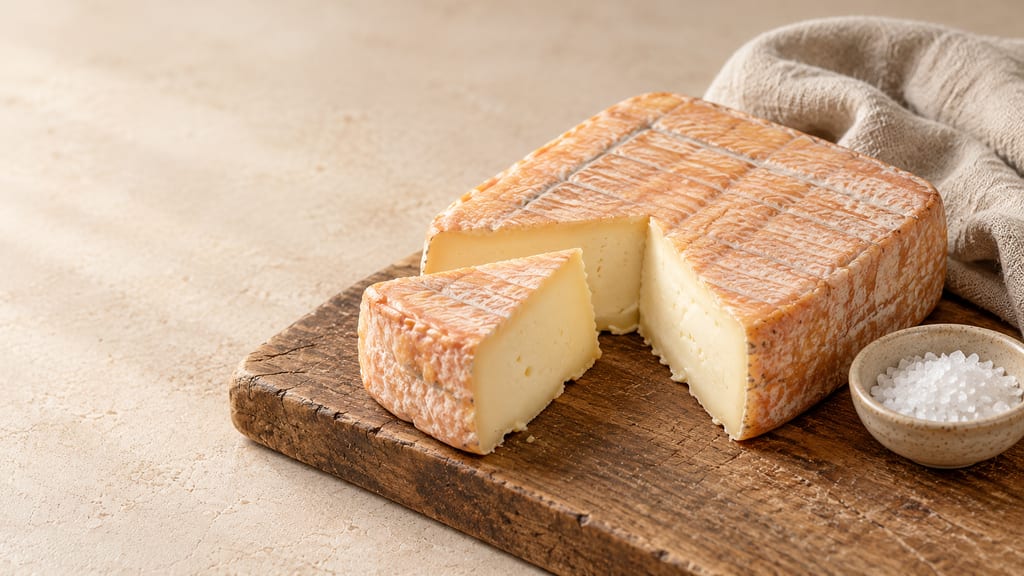
A square Taleggio with a pink-brown, damp-looking rind, cut open to show the pale paste beneath.
A linen cloth in a cave
Michel de Montaigne, travelling in Italy in the second half of the sixteenth century, wrote down how a square cow's-milk cheese was made. It was set on straw and rye, salted and carried to caves to ripen. There it was turned and cleaned with a linen cloth soaked in salt water. The cloth is the important part. Wiped over and over, the cheese stops being a plain block of curd and becomes a surface that someone tends.
That surface defines a whole family. Washed-rind cheeses, also called smear-ripened, are not defined by their milk, their shape or their country. They are defined by a rind that is kept wet, salted and slightly slippery so that a particular community of microbes can live on it. The rind turns orange or pink, the smell becomes unmistakable, and the cheese ripens from the outside inward. Taleggio is the example followed here, with Époisses and Munster alongside.
Tired herders and monastic cellars
The old family name of Taleggio, stracchino, comes from the dialect word stracch, meaning tired. It was used of the herders coming back from the pastures. The earliest written mention that Italian cheese tasters cite is an 1872 treatise by Gorini. A regional account puts the origin in the tenth or eleventh century, as a way of keeping surplus milk, and cites a thirteenth-century reference to a stracchino quadro di Milano. The cool, damp caves of Valsassina and Val Taleggio have been compared with the French caves where Roquefort ripened. The protected designation dates from 1996. Neither the old tradition nor the caves are a proven first origin.
Monks left their mark on the family too. One theory, offered as a theory, is that communities who gave up meat favoured strong, savoury cheeses. Alsatian Munster is dated to as early as the seventh century and attributed to Irish monks in the Vosges who were taught by visiting Italian Benedictines. Époisses is tied to a Cistercian community in Burgundy. One account puts its beginnings in the early 1500s or the 1600s, another in the fourteenth century. Monks are said to have made it for nearly two centuries. By the early 1900s more than 300 farms made it, and wartime nearly ended it. In 1956 Robert and Simone Berthaut breathed new life into it, and it received its appellation in 1991. These are traditions told by cheese writers, and the dates do not agree.
A rind is a habitat
In 2014 a Harvard team led by Rachel Dutton sequenced the microbes on the rinds of 137 cheeses from 10 countries. Twenty-four genera of bacteria and fungi turned out to be the dominant members. The rinds fell into three community types, and the types formed regardless of geography. Dutton's conclusion is that the environment the cheesemaker creates drives the community. The team also rebuilt the community types in a simple laboratory system. For a washed rind, that environment is salt, moisture, a cool room and a regular wash.
Yeasts open the door, bacteria follow
The starter bacteria that made the curd turned lactose into lactate, and some of the bacteria that later dominate the rind cannot grow on a surface that acid. Yeasts come first. Debaryomyces hansenii, Geotrichum candidum, Candida catenulata and Yarrowia lipolytica average about ten thousand colony-forming units per square centimetre on a smear-ripened rind, and their counts peak in the first days at up to ten million. They feed on lactate, and by consuming the acid they deacidify the surface.
One 2006 study of a model cheese is reported to have found lactose used first, in step with the exponential growth of D. hansenii, and about 90 percent of the lactate gone after 21 days at 10 °C. A model cheese in a laboratory is not a Taleggio rind, so treat those figures with caution. A later mathematical model of curd deacidification in a pilot chamber, run at 8, 12 and 16 °C and at 85, 93 and 99 percent relative humidity, followed the yeast and the lactose and lactate in core and rind.
Once the pH has risen, the smear bacteria take over. Brevibacterium, Corynebacterium, Arthrobacter, Glutamicibacter and Microbacterium appear, with Staphylococcus, Halomonas and Psychrobacter. Corynebacteria tolerate a pH of 4.9 and 8 percent salt and may make up as much as 70 percent of the bacteria in the smear. Microbacterium cannot grow below pH 5.8, which keeps it out until the deacidification is well along. By about day 12 the bacteria have climbed to a billion to ten billion colony-forming units per square centimetre, far more than the yeasts. A microbiology review places Geotrichum before the coryneform bacteria in this order.
A Taleggio study by Italian cheese tasters shows what the sequence leaves behind. The surface sits at about pH 6.2 and the centre at 5.0 to 5.3. The surface carries micrococci, yeasts and moulds, and breakdown of protein is the most visible of their effects. The outside is working on the inside.
Where the smell comes from
The smell of a washed rind is mostly sulphur. Surface microbes make sulphur compounds from two amino acids, methionine and cysteine, and the compounds concentrate at the rind. Methanethiol, hydrogen sulphide, dimethyl sulphide, S-methylthioacetate and ethional are typical of smear cheeses, and the key ones give the garlic notes of an intense example.
The best-studied producer is Brevibacterium linens. In 1979, eight strains isolated from cheese were all found to make methanethiol, dimethyl disulfide and 2,3,4-trithiapentane, and four also made S-methylthioacetate, described as an important aroma component of smear-coated cheeses. In 2004 the enzyme behind much of it was identified. Methionine-gamma-lyase splits L-methionine into methanethiol, alpha-ketobutyrate and ammonia. When the gene for it, mgl, was disrupted in the type strain ATCC 9175, thiol activity fell by 62 percent and total volatile sulphur output by 97 percent.
Other microbes add their own notes. Microbacterium, which appears late in ripening, also makes methanethiol. In one study Geotrichum candidum was associated with sulphur compounds, while D. hansenii was linked to alcohols and carboxylic acids. Yeasts also strip the amino group from amino acids, which yields keto acids and ammonia. All of this comes from laboratory strains and smear cheeses in general. Measurements of ammonia or sulphur compounds in Taleggio or Époisses themselves were not found.
What goes into the wash
In Taleggio's valleys the wash is salt water. Roughly every seven days during ageing the cheeses are sponged, which keeps the rind moist, soft and rosy and removes mould hyphae. The salt works twice. It favours organisms that tolerate it and holds back those that do not. The balance matters: too much salt can leave the smear whitish, and a surface that dries out points to too little.
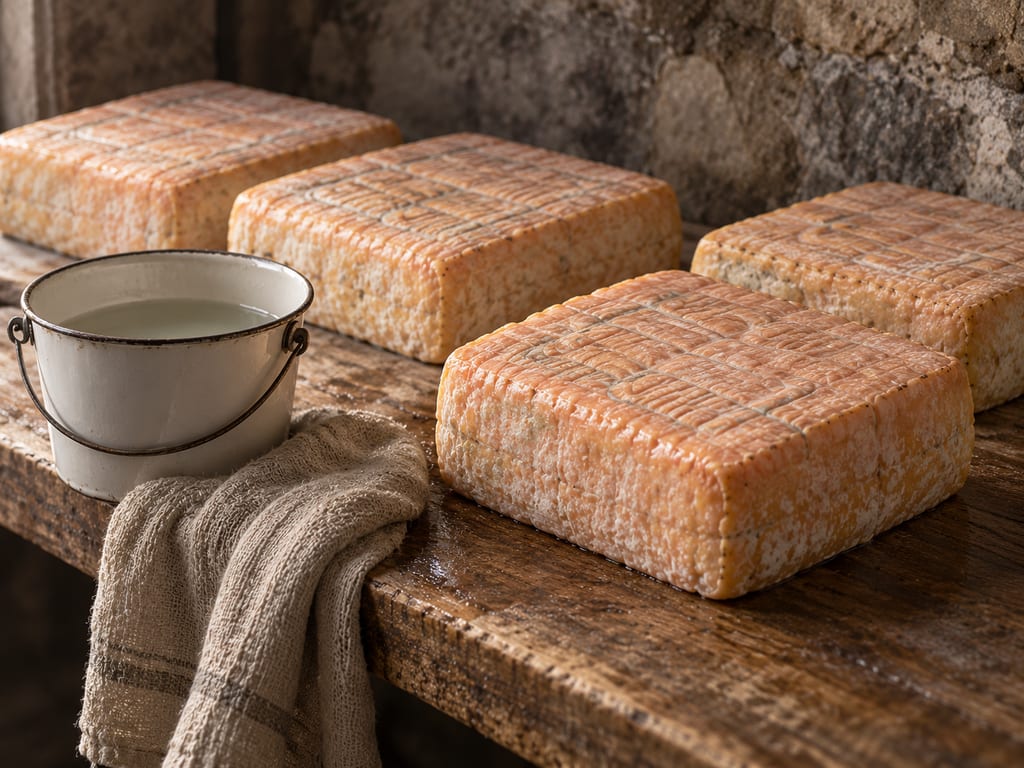
The cloth also moves microbes from one cheese to the next. Some makers do this on purpose. In old-young smearing, mature cheeses are washed with saline and that saline is reused on young ones to hand over a ready-made rind community. Food-safety authorities criticise the practice and it is used less often now. Where it is still used, brushes are cleaned and the brine is renewed between ripening ages. Industrial brining before ageing runs at 19 to 21 percent salt by weight for 4 to 18 hours at 10 to 14 °C as general practice, and Taleggio uses 8 to 12 hours.
In Burgundy the wash for Époisses is salt water and marc de Bourgogne, a brandy distilled from grape pomace. No dyes may be used in its production, so the red-orange colour comes from the growth on the surface.
Taleggio in the cellar
Protected Taleggio ages for at least 35 days, and some ripeners prefer 45 to 50. The ageing rooms are kept at 85 to 90 percent relative humidity and 2–6 °C. The wheels sit in wooden crates on cotton cloth, and the wash comes about once a week.
The consortium reported 4,478,000 wheels in 2014, up from 4,163,423 in 2012 and 4,330,000 in 2013. About a fifth of them were exported, and roughly 8 litres of milk go into each kilogram of cheese. The scale has changed a great deal since the caves, and the washing has not gone away.
The risk that rides on the cloth
Listeria monocytogenes can grow well on red-smear surfaces, and old-young smearing raises the chance of spreading it from one cheese to another.
Laboratory work shows how uneven the risk is. In one study, 43 soft-ripened cheeses, 12 from raw milk and 31 pasteurised, were inoculated with a thousand Listeria cells per gram and held for 12 days at 8 °C. Growth differed a great deal from cheese to cheese. Raw-milk cheeses supported less growth, and growth rose with the abundance of Streptococcus thermophilus. The authors link industrial starter use to higher risk, but they found no clear mechanism. That result measures how fast an introduced Listeria grows, not how likely it is to get in.
A challenge study on the surface of artificially contaminated smear- and mould-ripened cheese found that water activity was not related to Listeria growth. Its authors argue for separate European rules for surface-ripened cheese and for results given per unit of surface area. A Swiss study inoculated cheeses from nine dairies with Listeria innocua as a stand-in. Acetic acid, lactose and glucose correlated with its growth, and the authors propose protective strains from the cheeses' own microbiota.
At the table
Taleggio is served at room temperature. The rind may be eaten, or scraped or lightly brushed first. Italian tasters pair it with onion soup made with dark beer, and with a red wine such as Valcalepio.
Époisses is eaten once it has reached room temperature, not warmed. At about 40 days of ageing the texture is described as like a pudding. Regional advice for Taleggio is to keep it in the refrigerator wrapped in a damp cloth for about a month, or to freeze it for up to six months.
What a rind cannot tell you
An orange rind and a strong smell are normal for this family. They are not evidence that a cheese is safe, and no surface appearance can show it. The American Cheese Society treats ripening as a controlled stage of cheesemaking with its own contamination risks, and raw milk, starter, the make, the ripening cheese and the finished cheese each need evidence suited to that stage.
What the research does establish is that the wash is a form of microbial management. The yeasts, the salt and the cloth shape which bacteria settle, and those bacteria make much of the aroma. What is still missing is measurement on the cheeses themselves: how much ammonia and sulphur a Taleggio or an Époisses really carries, and how Listeria behaves on them through a normal ripening.
Community
No community contributions have been published for this entry yet.
Share what you made
Sign in to contribute. Published comments and photos are free to read.
Sources
Paul S. Kindstedt, Microbiology Spectrum / American Society for Microbiology
The Basics of CheesemakingCited in: Yeasts open the door, bacteria follow
American Cheese Society
Best Practices Guide for Cheesemakers, 2025Cited in: What a rind cannot tell you
Organizzazione Nazionale Assaggiatori di Formaggi
Taleggio, che storia (InForma issue 13)Cited in: A linen cloth in a cave; Tired herders and monastic cellars; Yeasts open the door, bacteria follow; What goes into the wash; Taleggio in the cellar; At the table
Wolfe, Button, Santarelli and Dutton, Cell 158(2), 2014
Cheese rind communities provide tractable systems for in situ and in vitro studies of microbial diversityCited in: A rind is a habitat
ScienceDaily / Harvard University, 17 July 2014
Cheese rinds help researchers study microbial ecosystemsCited in: A rind is a habitat
culture: the word on cheese
Bon Fromage: Epoisses, the Creamy KingCited in: Tired herders and monastic cellars; What goes into the wash; At the table
France Today
Praise be to Cheeses: The Influence of Monastic Orders on French FromageCited in: Tired herders and monastic cellars
Ritschard and Schuppler, Foods 13(2):214, 2024
The Microbial Diversity on the Surface of Smear-Ripened Cheeses and Its Impact on Cheese Quality and SafetyCited in: Yeasts open the door, bacteria follow; Where the smell comes from; What goes into the wash; The risk that rides on the cloth; What a rind cannot tell you
Cuer, Dauphin, Kergomard, Dumont and Adda, Applied and Environmental Microbiology 38(2):332-334, 1979
Production of S-Methylthioacetate by Brevibacterium linensCited in: Where the smell comes from
Amarita, Yvon, Nardi, Chambellon, Delettre and Bonnarme, Applied and Environmental Microbiology 70(12):7348-7354, 2004
Identification and Functional Analysis of the Gene Encoding Methionine-gamma-Lyase in Brevibacterium linensCited in: Where the smell comes from
Falardeau, Yildiz, Yan, Castellarin and Wang, Applied and Environmental Microbiology, 2023
Microbiome and Physicochemical Features Associated with Differential Listeria monocytogenes Growth in Soft, Surface-Ripened CheesesCited in: The risk that rides on the cloth
Schvartzman, Gonzalez-Barron, Butler and Jordan, Frontiers in Cellular and Infection Microbiology, 2014
Modeling the growth of Listeria monocytogenes on the surface of smear- or mold-ripened cheeseCited in: The risk that rides on the cloth
Roetschi and colleagues, Foods 13(21):3473, 2024
Antilisterial Properties of Selected Strains from the Autochthonous Microbiota of a Swiss Artisan Soft Smear CheeseCited in: The risk that rides on the cloth
Riahi, Trelea, Picque, Leclercq-Perlat, Helias and Corrieu, Journal of Dairy Science 90(5):2525-2537, 2007
A Model Describing Debaryomyces hansenii Growth and Substrate Consumption During a Smear Soft Cheese Deacidification and RipeningCited in: Yeasts open the door, bacteria follow
Gaps
- No study in this record measures ammonia or sulphur compounds in Taleggio or Époisses, or follows Listeria on Taleggio through ripening.
- The 2006 deacidification figures come from a summary of a model-cheese study that was not read in full.
- Dates and monastic attributions for Munster and Époisses rest on press accounts that disagree with each other.
Updated 2026-10-29