
Techniques
Let the air in: how blue cheese grows from the inside
A blue cheese is a mould grown inside solid curd, so the cheesemaker has to let air in. Needles, open curd, cellars and caves do it, and six protected cheeses do it six different ways.
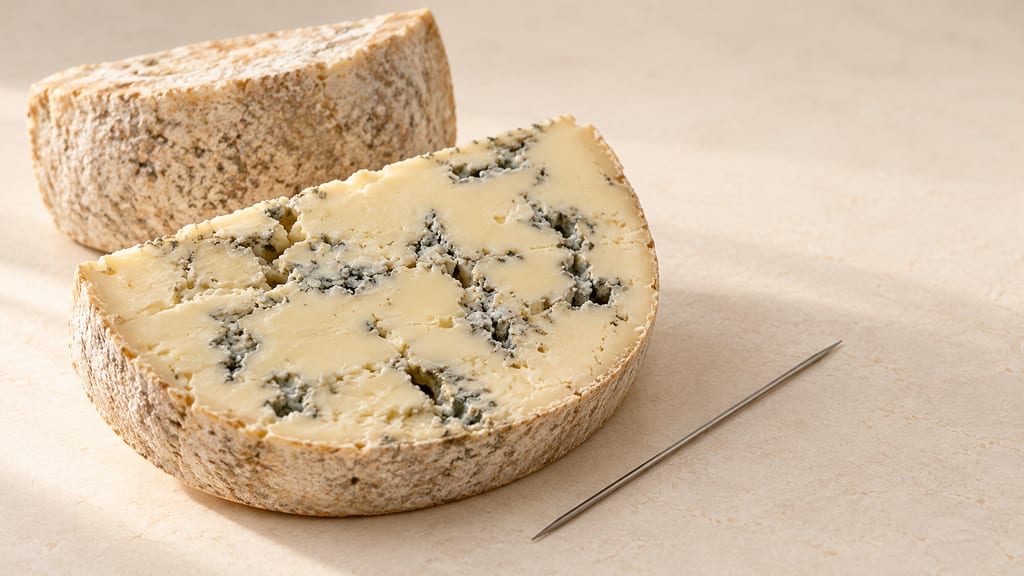
A blue cheese cut in half: the mould grows along the openings in the paste, where air could reach it.
Two days between needle and cave
A Roquefort cheese may not wait long between the needle and the cave. The current specification, approved in November 2025 and homologated in February 2026, says the piercing is done in the cave or in a workshop, and that no more than two days may pass before the cheese reaches the cave. Two more days are allowed after public holidays. The rule makes sense once you know what piercing is for.
A blue cheese is a solid mass of curd with a mould growing inside it, and the mould needs air. The blue veins are spores, called conidia, that carry a dark pigment, melanin, and they multiply in air-filled cavities in the cheese. Where there is no cavity, there is no vein. The Roquefort text names two steps that make the cavities. The curd is drained without pressing, which leaves regular openings between the pieces. The finished cheese is then pierced, which lets air in. The specification calls both indispensable to the development of Penicillium roqueforti.
The usual picture of a blue cheese, a pale body marbled with mould, is better read the other way round. The marbling is a map of where the air could get in.
Needles, wires and open curd
Every blue cheese in this story solves the same problem, and each does it with its own tools. Bleu d’Auvergne was once pierced by hand with large skewers and is now pierced by machine; the producers’ association gives no timing. Stilton makers pierce at about six weeks, with stainless steel needles about the size of skewers, and may pierce again later. The Stilton specification names the timing and method of piercing as part of the local expertise. The Gorgonzola rules as printed in 2001 say the paste is pierced several times to develop the Penicillium strains that make the green veining. Secondary descriptions of Danablu mention piercing with copper wires or rods, a detail that was not checked against the regulation.
Cabrales is the odd one out in the sources read. A trade summary calls Penicillium the essential micro-organism, says it develops naturally and says spores are not added. It does not mention piercing, so whether Cabrales makers pierce is not established here.
Caves that breathe
Roquefort’s caves are dug entirely into scree at the foot of the limestone cliffs of the Combalou, in the village of Roquefort-sur-Soulzon. Natural fissures in the rock, called fleurines, carry fresh, humid air into them. The cliffs face north-east and cool that air, and the aquifer in the rock humidifies it. The specification describes the whole arrangement as an immense generator of damp, cold air. Maturation and cutting of Roquefort may take place only in Roquefort-sur-Soulzon.
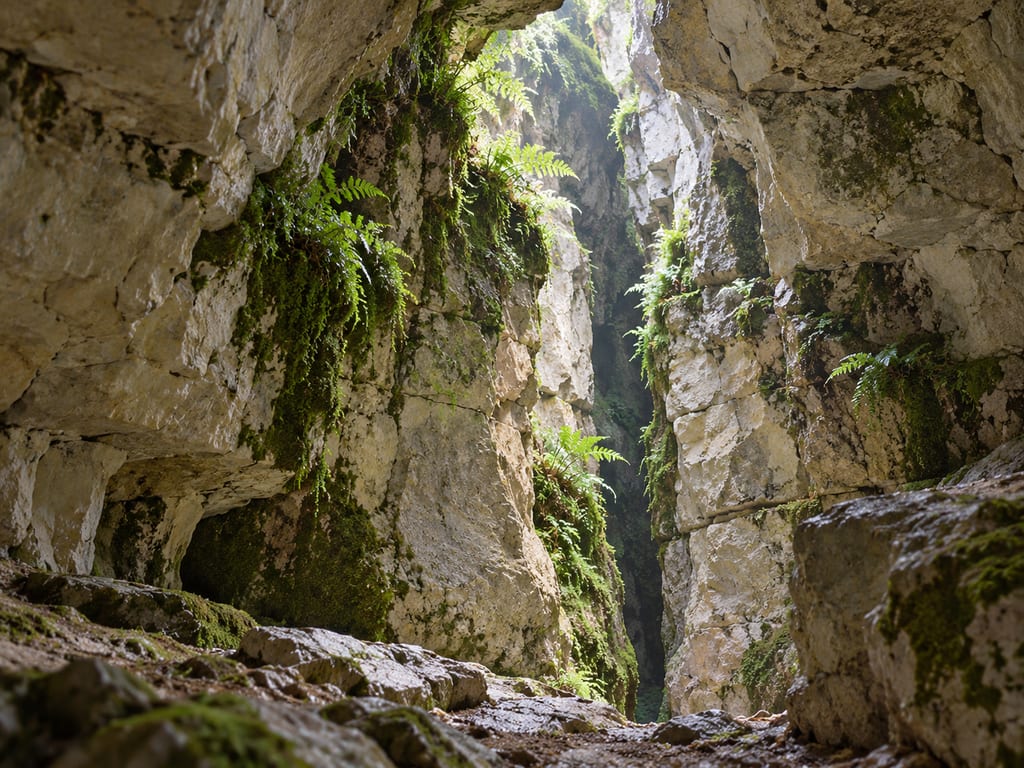
The specification’s history starts with an attestation in the cartulary of the abbey of Conques, in Aveyron, in 1070. In 1666 the Parlement de Toulouse confirmed the exclusive right of Roquefort-sur-Soulzon to ripen the cheese. In the 18th century it was being called the king of cheeses. A law of 26 July 1925 made it the first cheese recognised as an appellation, and a judgment of the Millau court on 12 July 1961 delimited the zone of the caves.
A raw-milk cheese with a 90-day minimum
Roquefort is made only from raw, whole sheep’s milk, from Lacaune ewes at least a year old that are fed on grass and forage. Systems that move the flock between summer and winter pastures are excluded. A producer who stores milk on the farm may keep it for no more than 38 hours at 4 °C. Rennet goes in at 28 to 34 °C, no later than 48 hours after the oldest milking. The curd is drained without pressing and salted dry. The culture comes as powders or cultures prepared from traditional strains isolated in the microclimate of the caves.
The finished cheese is a cylinder 19–20 cm across and 8.5–11.5 cm high, weighing 2.5–3 kg, with at least 52 g of fat per 100 g of dry extract, the part of the cheese left once the water is removed. The milk may come from a large part of Aveyron and from parts of Aude, Lozère, Gard, Hérault and Tarn.
Ripening takes at least 90 days, counted from the day of manufacture. For at least two weeks of that time the bare cheese is exposed in the caves. After that it matures slowly under protective wrapping, either in the caves or in temperature-controlled rooms. The only temperature in the ripening rule is a limit: the maturation temperature may not be lower than −5 °C. That is a floor, not a target. The specification states neither a cave temperature nor a humidity, so this article gives none.
What the mould does to the curd
Inside the cheese, Penicillium roqueforti acts as a secondary starter that gives an intense, spicy flavour. It does so through two kinds of activity. Proteolysis is the breakdown of protein, and lipolysis is the breakdown of fat. Together they release volatile and non-volatile compounds responsible for the mouldy aromas. The compounds themselves are not named, and what the protein breakdown produces is the less well-mapped half.
The fat half has a proposed route. A lipase, a fat-splitting enzyme, frees fatty acids from the fat, and that release is the rate-limiting step in making methyl ketones, a family of volatile compounds. Medium-chain fatty acids are shortened by one carbon unit on their way to a series of methyl ketones. A 3-oxoacid in the chain loses a carbon dioxide group, a step called decarboxylation, and ends up as a methyl ketone. The proposal is that this happens in the peroxisome, a compartment of the fungal cell, rather than in the mitochondria.
That route comes from experiments in which the mould was grown on margarine, not cheese. In that system the amounts of methyl ketones ran in the order 2-heptanone, then 2-nonanone, then 2-pentanone, then 2-undecanone. Those are results from a margarine system, and they show what the mould can do with fat. They are not measurements of what a ripe blue cheese contains. The authors call their findings supportive of the widely accepted view, and for cheese itself the mechanism is not settled.
One mould, two lineages
The mould in the cheese has been domesticated twice. A 2020 study found that cheese strains of Penicillium roqueforti were domesticated in two independent events. It sorted strains into four populations: Roquefort, non-Roquefort cheese, and two groups that live outside cheese. The Roquefort population came from an old domestication event. The non-Roquefort cheese population came more recently, from the selection of a single clonal lineage. The estimates are about 760 generations ago for Roquefort and about 140 for the other. The authors call the generation time of the mould too uncertain to turn those figures into years, so they carry no calendar dates.
A 2017 study of 240 strains, typed with eight microsatellites (short repeated stretches of DNA used as markers), found eight genetic clusters. Two main clusters differ by two stretches of DNA that arrived by horizontal transfer, meaning they moved between organisms rather than being inherited from a parent. They are called Wallaby and CheesyTer. Both are present in all non-Roquefort cheese strains and absent from all Roquefort strains. Two of the eight clusters are dominated by strains from Roquefort PDO cheeses.
The two groups also behave differently. Non-Roquefort strains showed faster lipolysis, and Roquefort strains made more spores on bread. The blue in a Roquefort and the blue in other blue cheeses is therefore not the work of one interchangeable organism.
Bleu d’Auvergne and Stilton
Bleu d’Auvergne is made from cow’s milk, 20–25 litres for each cheese, from a single herd or a local blend. The milk of the protected cheese must not be mixed with ordinary milk. Lactic ferments, including Penicillium roqueforti, are added in the vat while the milk is held at 30–34 °C. The curd is cut to the size of a grain of corn and moulded in cylinders 20 cm across. It is salted by hand after around 48 hours. The cheeses then spend at least four weeks in cool, humid cellars; the association gives no cellar temperature or humidity.
Stilton is made only from pasteurised cow’s milk, in Leicestershire, Derbyshire and Nottinghamshire. The curds are kept in a temperature- and humidity-controlled environment, and the cheese is pierced at about six weeks. The specification summary sets no minimum ripening period and gives no temperatures. It does describe typical ages: a Blue Stilton is around six weeks old at grading, within a range of 6–12 weeks, a Mature Blue at 10–15 weeks and a Vintage at more than 15 weeks. The length of maturing, it adds, varies from season to season.
Gorgonzola, Cabrales and Danablu
Gorgonzola is the case where the numbers disagree. The most detailed specification available is a 2010 printout of the 2001 rules with a proposed amendment, which is not the current text. The rules in force when it was printed call for whole cow’s milk, with the curd set at 28–32 °C using calf rennet. The cheese is salted dry for several days at 18–20 °C and matured for two or three months at 5–8 °C. The proposal would allow pasteurised milk, set at 28–36 °C with lactic ferments, penicillium spores and selected yeasts, with salting at 18–24 °C and a minimum of fifty days at 2–7 °C and 85–95% humidity.
Later figures for the minimum ripening differ. A 2017 ministerial decree is reported to give 50–150 days for the mild dolce style and 80–270 days for the tangy piccante. One producer gives a minimum of 80 days for piccante, and a 2002 EU summary is reported to give 50 days for mild and 80 for tangy. How these line up with the rules in force today is not settled.
Cabrales, the Spanish cheese, is made essentially from whole raw cow’s milk, or from mixtures of two or three types of milk: cow, ewe and goat, with no proportions given. Trade accounts say it ripens for a minimum of two months in natural caves, then for two to five months on wooden shelves. The caves are at 8–12 °C and 90% humidity.
Danablu is a Danish blue, and it is a PGI, not a PDO. A protected geographical indication is a looser tie to a region than a protected designation of origin. Commission Implementing Regulation (EU) No 269/2013 amends its specification. Published descriptions disagree on its minimum ripening, putting it at five weeks in one account and eight to twelve weeks in another.
What the numbers can and cannot compare
Set side by side, the specifications do not line up. Roquefort gives a temperature floor of −5 °C and no cave temperature. Cabrales gives 8–12 °C for its caves, and Gorgonzola gives 5–8 °C in one text and 2–7 °C in another. Stilton gives none. The minimum ages run from four weeks to 90 days. Each is a rule from its own text for its own cheese, written to protect a regional product, and none of them is a general recipe or a general safety limit.
The same goes for what the eye can check. A vein shows that a mould is growing. It does not show which mould it is, and neither the colour, the smell nor the taste shows whether the cheese is safe. A ripening minimum is a quality rule, not a safety deadline.
Much remains open: a Roquefort cave temperature, the current Gorgonzola minimum, any Stilton minimum, the primary texts for Cabrales and Danablu, and whether the methyl-ketone route seen on margarine is the one that runs in a ripening cheese.
Community
No community contributions have been published for this entry yet.
Share what you made
Sign in to contribute. Published comments and photos are free to read.
Sources
Institut national de l’origine et de la qualité; French Ministry of Agriculture
Cahier des charges de l’AOP « Roquefort » (2026)Cited in: Two days between needle and cave; Caves that breathe; A raw-milk cheese with a 90-day minimum; What the numbers can and cannot compare
Bleu d’Auvergne PDO association
Stages of production – Bleu d’Auvergne PDOCited in: Needles, wires and open curd; Bleu d’Auvergne and Stilton; What the numbers can and cannot compare
Molecular Ecology 29(14): 2639–2660 (Dumas et al., 2020)
Independent domestication events in the blue-cheese fungus Penicillium roquefortiCited in: One mould, two lineages
PLoS ONE 12(3): e0171387 (Ropars et al., 2017)
Blue cheese-making has shaped the population genetic structure of the mould Penicillium roquefortiCited in: One mould, two lineages
Journal of Fungi 9(4): 459 (Chávez, Vaca and García-Estrada, 2023)
Secondary Metabolites Produced by the Blue-Cheese Ripening Mold Penicillium roqueforti; Biosynthesis and Regulation MechanismsCited in: Two days between needle and cave; What the mould does to the curd
The Scientific World Journal, art. 215783 (Walker and Mills, 2014)
2-Pentanone Production from Hexanoic Acid by Penicillium roqueforti from Blue Cheese: Is This the Pathway Used in Humans?Cited in: What the mould does to the curd
ONAF
Disciplinare DOP Gorgonzola (2001 amendment with proposed modification; printed 3 October 2010)Cited in: Needles, wires and open curd; Gorgonzola, Cabrales and Danablu; What the numbers can and cannot compare
Defra (UK Government)
Stilton PDO product specification summaryCited in: Needles, wires and open curd; Bleu d’Auvergne and Stilton; What the numbers can and cannot compare
Foods & Wines from Spain
Cabrales PDOCited in: Needles, wires and open curd; Gorgonzola, Cabrales and Danablu; What the numbers can and cannot compare
EUR-Lex
Commission Implementing Regulation (EU) No 269/2013 (amending the specification for “Danablu (PGI)”)Cited in: Needles, wires and open curd; Gorgonzola, Cabrales and Danablu; What the numbers can and cannot compare
Gaps
- The Roquefort specification states no cave temperature or humidity, and the current Gorgonzola, Cabrales and Danablu texts were not read in full.
- The route from fat to methyl ketones was shown on margarine rather than cheese, and the compounds from protein breakdown are not identified.
- Whether Cabrales is pierced is not stated in the sources read.
Updated 2026-10-29