
Techniques
Twenty litres of gas: how Swiss cheese gets its holes
Propionic bacteria make the gas in Emmentaler, and hay particles decide where the holes start. Follow the gas through the warm cellar and a defect case, then on to Gruyère, Jarlsberg and Baby Swiss.
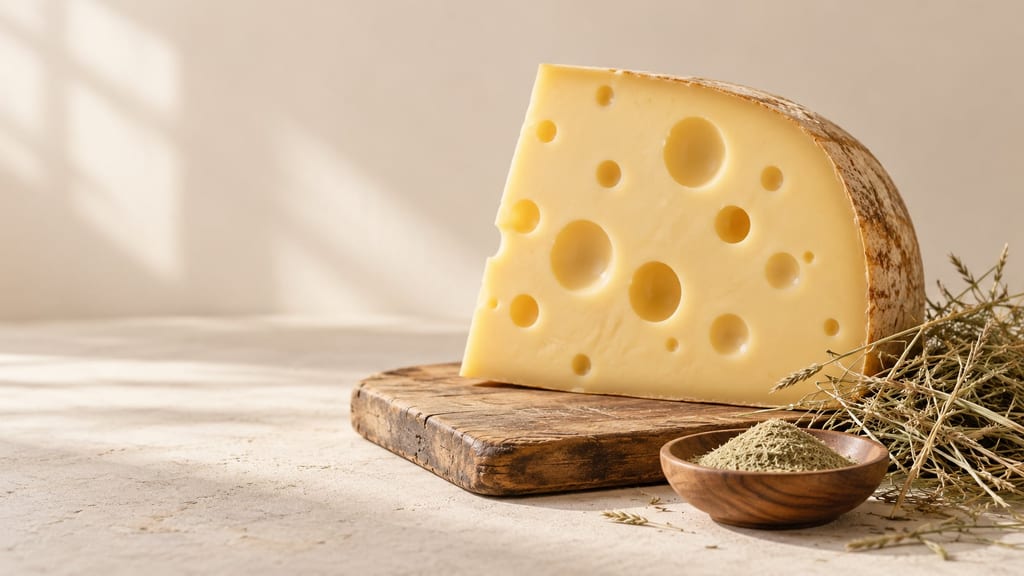
An Emmentaler wedge with eyes of different sizes, beside the dried hay and fine hay powder that help start them; an illustration made for this article.
Where 120 litres of gas go
A wheel of Emmentaler weighing 80 kg makes about 120 litres of carbon dioxide as it ripens. About 60 litres stay dissolved in the cheese, about 40 litres diffuse out of it, and about 20 litres end up in the holes. Those holes, which cheesemakers call eyes, are what is left of a gas budget that mostly goes elsewhere.
The 2001 Agroscope description of Swiss-type cheese gives wheels of 60–130 kg with 1,000–2,000 eyes of 1–4 cm. Getting that pattern takes three things: bacteria that make gas, a cheese body that holds it in pockets, and a warm cellar that lets the gas build before the cold slows it. A fourth thing, particles that decide where the pockets begin, turned out to be the one modern dairies had removed.
A few hundred cells in a vat
The starting population is tiny. A vat holding about 1,000 litres of milk receives a few hundred colony-forming units of propionic bacteria. A ripe Emmentaler carries 100 million to 1 billion of them in every gram.
The species usually named in these cultures is Propionibacterium freudenreichii, a short, Gram-positive rod. It grows best at 30 °C and at a pH of 6.0–7.0, it still grows at 14 °C, and it copes with oxygen without needing it.
It cannot start the job alone. The lactic acid bacteria of the starter go first and turn more than 90% of the lactose into lactate. Propionic bacteria then feed on the lactate. Three lactate molecules give two propionate, one acetate, one carbon dioxide and ATP, the cell's energy currency. Carbon dioxide already appears during the lactic stage, and its production climbs steeply once propionic fermentation begins.
The cheese keeps a record of this chemistry. Lactate peaks at 133 mmol/kg after 20 days and is still above 40 mmol/kg after 12 months. Acetate reaches 48 mmol/kg and propionate 63 mmol/kg. Makers can also steer the pace: adding 12–18% water raises the pH after lactic fermentation to 5.20–5.30, which speeds the propionic stage.
The warm room
Temperature sets the timetable, and two sources give it in slightly different words. The 2001 Agroscope report puts the start of propionic fermentation about 30 days after manufacture. The wheels sit at 20–24 °C for roughly seven weeks, and fermentation then continues at a slower rate at 10–13 °C. The report names the warm room as 22 °C and the cold ripening room as 10–13 °C.
The Emmentaler AOP's own pages describe a fermentation cellar at about 19–24 °C, which triggers propionic fermentation. Wheels stay there for six to eight weeks. They then move to a storage cellar at about 12 °C, where hole formation stops, and mature for at least 120 days. The two accounts overlap closely. The AOP pages start slightly cooler, at 19 °C, and give a range of weeks rather than a single figure.
Inside the wheel, the eyes follow the same clock. About 30 days after manufacture only a few eyes have appeared. New eyes form fastest at about 50 days, which is also when the eyes already present swell most quickly. By 60–70 days the cheese produces carbon dioxide at the same rate as it loses it. When the wheels move from the 22 °C room to the cold room, diffusion falls and the pressure inside rises: 1,500–2,500 Pa while the eyes form at 22–24 °C, and 4,000–8,000 Pa in storage as the temperature drops from 22 to 12 °C.
Hay dust and the places holes begin
Gas alone does not make a hole. It needs somewhere to gather. The 2001 report found that eye count rises with an uneven curd, a physically open one and the presence of hydrogen-forming microbes, and that makers raise it with centrifugation, thermisation of the milk or vacuum during pressing.
In 2015 Guggisberg and colleagues at Agroscope, EMPA and Lucerne University tested a plainer explanation: dust from hay. They made eight experimental Emmental cheeses from microfiltered milk and added powdered hay to seven of them in graded amounts. They followed ripening for 130 days with X-ray computed tomography. Eye number and size depended on the dose: the hay particles acted as nucleation sites, the points where gas collects and a hole starts.
That result explained a problem producers had met. Loose-housing barns that separate feeding from milking, and cleaner milk, had removed natural microparticles such as hay powder from the vat. By the early 21st century, eye formation in Emmentaler AOP production had become inadequate. As of 2025, producers are allowed to add natural hay powder to the curd.
A 2026 follow-up by Guggisberg, Bisig and Fröhlich-Wyder at Agroscope used model cheeses containing synthetic hollow fibres and capillaries. X-ray analysis showed at least one capillary inside every eye. The authors conclude that structural elements without capillaries cannot work as starting points for eyes, and they tie the capillary effect to the role of hay particles.
The work divides neatly. Hay sets where and how many eyes form. Propionic bacteria supply the gas. The 2026 study does not involve the bacteria at all, and it gives no temperatures or times.
When the gas is a defect
Not every hole is an eye in the good sense. Agroscope studied a case of declassified Emmental with irregular eyes. The cheese contained cadaverine at 853 mg/kg. Isolates were Klebsiella pneumoniae, and qPCR found enterococci and Lentilactobacillus parabuchneri. The production record showed the curd cooked at 50 °C instead of 52–54 °C and moulded at 44 °C instead of 52 °C.
Mixed-acid fermentation by enterobacteria can produce defective eyes even during pressing or in the first few days of aging, well before the propionic stage. The authors describe their microbiome results as not conclusive, so the case shows what can go wrong without proving a single cause.
For anyone reading a cut cheese, the lesson is plain. The size and spacing of holes cannot tell you which microbes made the gas, and they say nothing about whether a cheese is safe.
A cheese with three birth dates
Emmentaler was being sold beyond its home region in the 16th century. A written account from 1557 records a gift of the cheese from Burgdorf to Felix Platter. Valley cheese dairies came later: the first was built in 1815 at Kiesen, in Bern, by Johann Emanuel Effinger. A Swiss Cheese Union formed in 1901 and regulated Emmentaler, Gruyère and Sbrinz. A consortium followed in 1997, the first regulations in 2002, and AOP recognition in 2006.
The origin is less certain. Agroscope's German page places the cheese's roots somewhere in the Emmental of the 13th century. A cheese reference work cites a mention from 1542. The producer's history page gives 1557 as its written account and names no earlier date. These are different kinds of claim: a loose origin, a reference and a dated record. Without the underlying documents for the first two, 1557 is the only date here tied to a described document.
What the rules ask of an Emmentaler
The Emmentaler AOP specification is mostly about inputs. Cows are fed fresh grass and hay, and genetically engineered feed and preserved silage are prohibited. Raw milk is processed within 24 hours. Genetically modified rennet and cultures are prohibited. Each wheel takes 1,200 litres of milk and weighs about 100 kg. Ingredients are limited to milk, rennet, native bacterial cultures, water and table salt. Quality assessment covers the number and size of the holes.
Aging runs from 4 to 30 months. Classic and mild cheese ages at least 4 months, Réserve at least 8 months and cave-aged cheese at least 12 months. Output is about 32,000 tonnes a year. The producers use selected bacterial cultures plus a proof-of-origin culture from Liebefeld Kulturen AG.
The cheesemaking follows a set of temperatures. The milk is warmed to about 32 °C. The curd is heated from 31 °C to 52–54 °C over 30–60 minutes and stirred for 20–60 minutes. The 2001 report adds that the curd is pressed near 50 °C for many hours.
One rule does not sit comfortably beside the 2001 report. That report lists thermisation of the milk, a mild heating, among the ways to raise eye count in Swiss-type cheese. The current rules say raw milk is processed within 24 hours and that no heating processes are allowed. The report predates the first Emmentaler regulations by a year and AOP recognition by five, and it covers Swiss-type cheese as a family. Whether Emmentaler makers ever thermised their milk is not settled here. The producer's own cheesemaking account has the milk warmed to about 32 °C in the vat, so what the rule means by heating is not defined in the material available.
Cousins with fewer holes, or different ones
Gruyère shows that a Swiss-style cheese can do with almost none. Modern Gruyère has few if any eyes, although in the 19th century that was not always so. The milk is heated to 34 °C in a copper vat and the curd is cut to the size of a pea. The curd is cooked at 43 °C and quickly raised to 54 °C. Swiss caves hold 13–14 °C and 94–98% humidity. The French PGI allows holes from the size of a pea to that of a cherry.
Jarlsberg is Norwegian and carries a trademark, not a protected designation. One account has Swiss-type cheese reaching Vestfold in the 1830s and a county report noting it in 1855. Another dates the modern cheese to 1956, when Ole Martin Ystgaard of the Dairy Institute at the Agricultural University of Norway tasted the cheese. Industrial production began in 1957, TINE registered the trademark in 1972, and the formula is a trade secret. One source names P. freudenreichii; the other says only propionic acid bacteria.
Leerdammer, from the Netherlands, was developed by Cees Boterkooper and Bastiaan Baars and launched in 1977. It is a semihard cheese from pasteurised cow's milk, aged about 3–12 months, and its holes come from bacteria that produce carbon dioxide as it ripens. The Bel Group now makes it exclusively. No source names the culture it uses.
These three rest on secondary and encyclopedia accounts, and none of them gives figures that could be compared with Emmentaler's.
Baby Swiss in a home kitchen
The closest home version is Baby Swiss as an American cheesemaking supplier describes it. Its method lists MM100 or C101 as the lactic starter, plus a product sold as Propionic Shermanii. The supplier's listing for that product calls it essential for producing the holes.
MM100 contains three Lactococcus entries: L. lactis subsp. lactis, subsp. cremoris and subsp. lactis biovar diacetylactis. It comes from Danisco Choozit and is stored in the freezer. The dose is approximately half a teaspoon for 6–12 gallons of milk, reduced by 25–50% for raw milk.
The stage figures below are a cheese-making supplier's method, in the supplier's own Fahrenheit. After initial aging at 10–13 °C, the cheese goes through an eye-development stage at 18–21 °C for 3–4 weeks. That warm stage is shorter and a little cooler than the Emmentaler cellar's six to eight weeks at about 19–24 °C. The method does not give the length of the initial aging.
A household batch is a different product from an Emmentaler wheel. It has its own milk, its own scale and no protected specification.
What the holes tell you
Eyes are gas, caught where a particle gave it a place to start. Bacteria make the gas, the warm cellar sets its timing, and in Emmentaler the hay, or its added powder, sets the places. When the chain goes wrong, as in the case of the irregular Emmental, the holes look like eyes and mean something else.
Several things remain open. No source here tests whether the capillary effect works in Jarlsberg or Leerdammer, or compares the eye counts and temperatures of Gruyère and Emmentaler. No source gives a storage or safety limit for propionic-ripened cheese at home, so the look of the holes cannot stand in for one.
Community
No community contributions have been published for this entry yet.
Share what you made
Sign in to contribute. Published comments and photos are free to read.
Sources
H.-P. Bachmann, U. Bütikofer and D. Isolini, Swiss Federal Dairy Research Station / Agroscope, 2001
Swiss-Type CheeseCited in: Where 120 litres of gas go; A few hundred cells in a vat; The warm room; Hay dust and the places holes begin; What the rules ask of an Emmentaler; What the holes tell you
Agroscope Transfer No. 358, 2025
Using State-of-the-Art Analysis to Explain Atypical Cheese DefectsCited in: When the gas is a defect; What the holes tell you
Emmentaler AOP Switzerland
How milk becomes cheeseCited in: The warm room; What the rules ask of an Emmentaler; Baby Swiss in a home kitchen
Emmentaler AOP Switzerland
What is governed by the specifications?Cited in: What the rules ask of an Emmentaler
Agroscope
Emmentaler AOPCited in: A cheese with three birth dates; What the rules ask of an Emmentaler
DairyReporter, 29 May 2015
Mystery of disappearing Swiss cheese holes solved!Cited in: Hay dust and the places holes begin
D. Guggisberg et al., International Dairy Journal 47 (2015) 118-127
Mechanism and control of the eye formation in cheeseCited in: Hay dust and the places holes begin
Agrarforschung Schweiz, 23 March 2026
Capillary effect confirmed: why hay particles are key for eye formation in Emmentaler cheeseCited in: Hay dust and the places holes begin; What the holes tell you
Norwegian University of Life Sciences (NMBU)
Savouring successCited in: Cousins with fewer holes, or different ones
New England Cheesemaking Supply Company
Swiss Cheese Recipe (Baby Swiss)Cited in: Baby Swiss in a home kitchen
New England Cheesemaking Supply Company
MM 100 Mesophilic Starter CultureCited in: Baby Swiss in a home kitchen
New England Cheesemaking Supply Company
Propionic Shermanii (Swiss) by BienaCited in: Baby Swiss in a home kitchen
Gaps
- The 2015 and 2026 hay papers were read as an abstract and press summaries, and the 2025 permission to add hay powder comes from a research magazine, not the regulation itself.
- The 2001 thermisation and the current rule against heating, and the three origin dates, are not resolved by these sources.
- The Baby Swiss stage figures come from the research archive, and no source gives a home storage or safety limit for propionic-ripened cheese.
Updated 2026-10-29