
Techniques
Six jars of soy milk and a spoonful of someone else's yogurt
Dairy yogurt sets because milk has casein and lactose. Soy, oat and nut milks have neither, so makers borrow cultures, add starch and agar, and still get gels that are thin or separate. What the research shows.
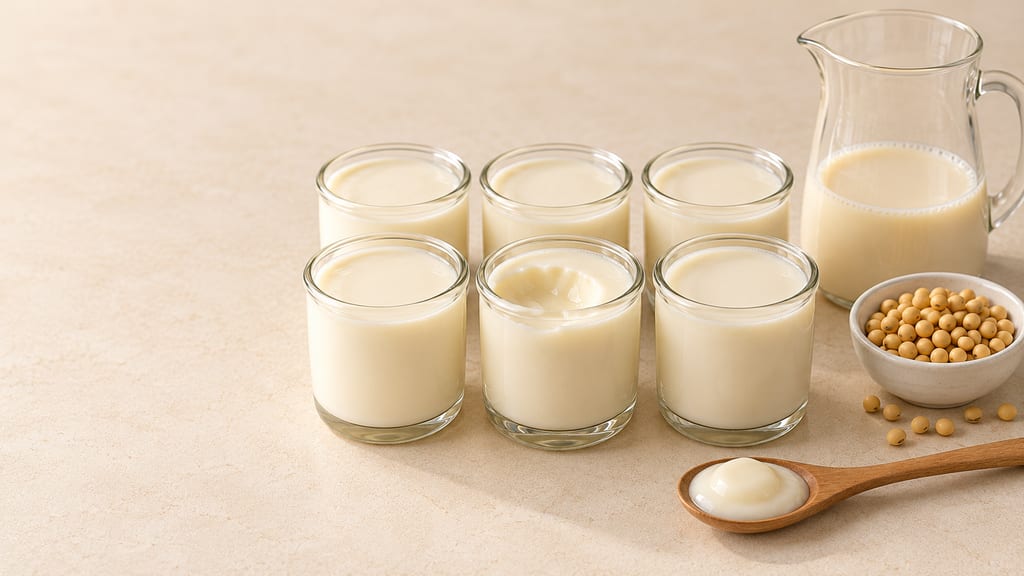
Six small jars of set soy yogurt beside a jug of soy milk and a bowl of dried soybeans.
Six jars and a store-bought starter
In March 2014 a home cook filled six 8-ounce jars with soy milk, used a vanilla almond yogurt as her starter and put them in an incubator. Heating the soy milk in the microwave took far longer than the four minutes she had expected. Once she took the rack out, the bottom of the incubator ran cooler than the top, so she left the jars a little longer. They cultured for about 12 hours. Her post gives no temperatures.
She called the batch a success, though less tangy than store-bought yogurt. She also read that a starter can be reused up to six times in a row and set one jar aside for that, but the post describes one batch and a plan, not a second round. It records no pH and no bacterial count.
That makes it one kitchen's evidence rather than a method. It is still a fair introduction, because every choice in it, from the starter to the heat to the hours, is something food scientists are working on, and with plant milks the answers differ from dairy's.
What milk has that soy and oat milk lack
Dairy yogurt is a tidy system. Milk carbohydrate is almost entirely lactose, which the bacteria turn into lactic acid. About 80% of the protein in cow's milk is casein, and casein gels as the acid pulls the pH down toward its isoelectric point, the pH at which the protein molecules stop repelling each other and link up into a continuous network. That network holds water and gives yogurt its body.
Plant milks supply different sugars: sucrose, inulin, fibre and the α-galactosides raffinose and stachyose, which are common in them. In one set of soy experiments the milk was supplemented with 1% lactose to help the bacteria grow. The proteins are the bigger problem. Plant proteins are not easily precipitated by acid, and an acidified plant milk tends to form a weak, discontinuous gel that releases watery serum. Plant yogurts in a survey of commercial products held 0.6 to 4.6 g of protein per 100 g, against 5.1 g in the dairy yogurt.
The acid itself also comes out lower. In that survey, L-lactic acid reached 0.42 and 0.43 g per 100 g in two soy yogurts, 0.36 in coconut, 0.28 in cashew, 0.29 in almond and 0.10 in hemp, compared with 1.11 in dairy. The plant yogurts measured pH 3.99 to 4.56, and the plant products also listed acidity regulators, citric acid and sodium citrate, so a low pH on a label does not show how much acid the bacteria made.
The reviewers who compared these systems add a caution of their own: very little research has defined how lactic acid bacteria work on the proteins of plant foods. Soy's β-conglycinin is the protein those bacteria break down most effectively, and that is about as far as the general rules go.
Borrowing cultures from dairy
Dairy yogurt is made with two bacteria, Streptococcus thermophilus and Lactobacillus delbrueckii subsp. bulgaricus, run until the pH is below 4.5 and counts pass 8 log10 colony-forming units per gram. The first grows fast and breaks down little protein. The second is more proteolytic and feeds the first with peptides. Plant yogurt makers have tried this pair in oat, potato, soy, lupin, pea and tigernut bases. Soy yogurt is typically made with S. thermophilus and Lacticaseibacillus casei.
Commercial labels show how loose the practice is. Hemp products listed L. bifidus and L. acidophilus, a coconut product S. thermophilus and L. bulgaricus, and cashew and almond products only 'live vegan cultures'. Starter choice matters because strains isolated from the same material can outperform others; Lactiplantibacillus plantarum T6B10, isolated from quinoa, is one example. Some lactic acid bacteria also make exopolysaccharides, sugar polymers that raise viscosity and reduce serum loss in soy and oat milk.
Researchers at the Technical University of Denmark took that idea outside the dairy world. They screened plants from Danish fields and forests for lactic acid bacteria and announced in January 2020 that the strains they isolated could acidify a soy drink and give it a texture like traditional yogurt. They added spent brewer's grain to supply fibre and mask the soy flavour. The project was funded by the EU's Climate-KIC and worked with Carlsberg, Naturli' and Novozymes. The announcement gives no counts or measurements.
Building the body that casein gives for free
Since the protein will not carry the gel, makers lean on starch, heat and thickeners. Heating gelatinises starch, which helps prevent phase separation. The examples in the literature range widely: quinoa starch heated to 63 °C, soy heated at 90 °C to reach 11% solids, almond treated at 172 MPa and then 85 °C for 30 minutes, lupin given a UHT treatment of 140 °C for 10 seconds. A survey of 78 commercial plant yogurts, cited in one review, found that 80% used thickeners.
The soy method from a dairy-free culture supplier shows the same thinking at kitchen scale. It starts with a 1 litre carton of soy milk and adds half to one teaspoon of powdered agar, a seaweed gelling agent, plus either a teaspoon of white sugar or a tablespoon of pasteurised honey. Raw honey is ruled out because it may have an antibiotic effect.
A soy batch, step by step
The supplier's page heats the mixture to 87 °C and holds it there, for 10 minutes on the recipe card and 5 minutes in the text, without letting it boil. It then cools the mixture to below 42 °C, whisks in a dairy-free starter that the page does not name, and sets the yogurt maker to 38 °C with a 24-hour timer. The jar then goes into the refrigerator for at least 6 hours. The page gives no shelf life.
Set beside the 2014 account, which cultured for about 12 hours in an incubator with a cool floor, the two accounts show a range of choices rather than a standard. Both are home methods. Neither presents a tested safety control, and neither carries over to oat, pea or any other base without fresh testing.
What pH can and cannot tell you
Food safety guidance leans on one number. Acid foods have a natural pH of 4.6 or below, and Clostridium botulinum spores do not grow below pH 4.6. The page that says this is aimed at commercial canners and does not mention home fermentation.
The research on plant yogurts gives pH values but no safety endpoint specific to them. Fermented plant yogurts are usually below pH 4.5, and in refrigerated storage the pH falls a further 0.5 to 1.0 units. In some studies the lactic acid bacteria stayed above 8 log10 colony-forming units per millilitre after 20 to 30 days at 4 °C. These are quality figures, about viability and sourness. The sources do not give a pH, time or storage limit that makes a particular plant yogurt safe, and none sets a shelf life.
Regulation is thin as well. A 2026 review of plant-based dairy and meat alternatives notes that European legislation has few limits on foodborne hazards in dairy and milk alternatives. Plant raw materials are generally microbiologically safe, mainly because of their low water activity, but nuts more often carry pathogenic microorganisms. Soy is also a food allergen. Sourness, thickness, aroma and bubbles are quality signs and do not show that a batch is safe,.
What is still unknown
None of the sources here fixes the starter, the heat, the hours and a safety endpoint together for a single plant base. The soy recipe does not name its culture, and the announcement about the Danish plant-derived strains gives no measurements. The reviews describe a field in which the way lactic acid bacteria work on plant proteins is still being worked out.
For a reader, the practical point is narrow. A culture has to be validated for the base it is used on, and a sourer, thicker jar does not prove a batch was done right. Anyone making plant yogurt at home is following a home method, not a tested one.
Community
No community contributions have been published for this entry yet.
Share what you made
Sign in to contribute. Published comments and photos are free to read.
Sources
Foods
Plant-Based Alternatives to Yogurt: State-of-the-Art and Perspectives of New Biotechnological Challenges (Montemurro, Pontonio, Coda and Rizzello, 2021)Cited in: What milk has that soy and oat milk lack; Borrowing cultures from dairy; Building the body that casein gives for free; What pH can and cannot tell you
Microbial Biotechnology
Fermentation of plant-based dairy alternatives by lactic acid bacteria (Harper, Dobson, Morris and Moggré, 2022)Cited in: What milk has that soy and oat milk lack; Borrowing cultures from dairy; Building the body that casein gives for free; What is still unknown
Foods
Composition, Physicochemical and Sensorial Properties of Commercial Plant-Based Yogurts (Grasso, Alonso-Miravalles and O'Mahony, 2020)Cited in: What milk has that soy and oat milk lack; Borrowing cultures from dairy
DTU Food, Technical University of Denmark
Vegan 'yogurt' made with lactic acid bacteria from plants (DTU National Food Institute, 14 January 2020)Cited in: Borrowing cultures from dairy; What is still unknown
Luvele
How to make soy milk yogurt at homeCited in: Building the body that casein gives for free; A soy batch, step by step; What is still unknown
The Green Life Housewife
Homemade soy yogurt in my incubator (23 March 2014)Cited in: Six jars and a store-bought starter; A soy batch, step by step
University of Georgia Cooperative Extension
Understanding pH and its Importance in Food Safety (6 March 2024)Cited in: What pH can and cannot tell you
Food Science & Nutrition
Food Safety and Nutritional Aspects of Plant-Based Dairy and Meat Alternatives: A Review (Sohlberg, Pasonen, Alakomi and Suomi, 2026)Cited in: What pH can and cannot tell you; What is still unknown

Gaps
- The sources give pH values for plant yogurts but no safety endpoint, fermentation time or shelf life specific to them.
- The starter strain in the soy method and the identity of the Danish plant-derived strains are not stated.
- No photograph of a home plant-yogurt process with a verified licence was found.
Updated 2026-10-29