
Techniques
The white rind has to be grown: culturing and ripening cashew camembert
A plant-based camembert has no milk to sour, so the cook adds bacteria and a mould and waits two weeks. What the Warsaw trials and a home recipe show, and why raw nuts and fresh cheese have caused outbreaks.
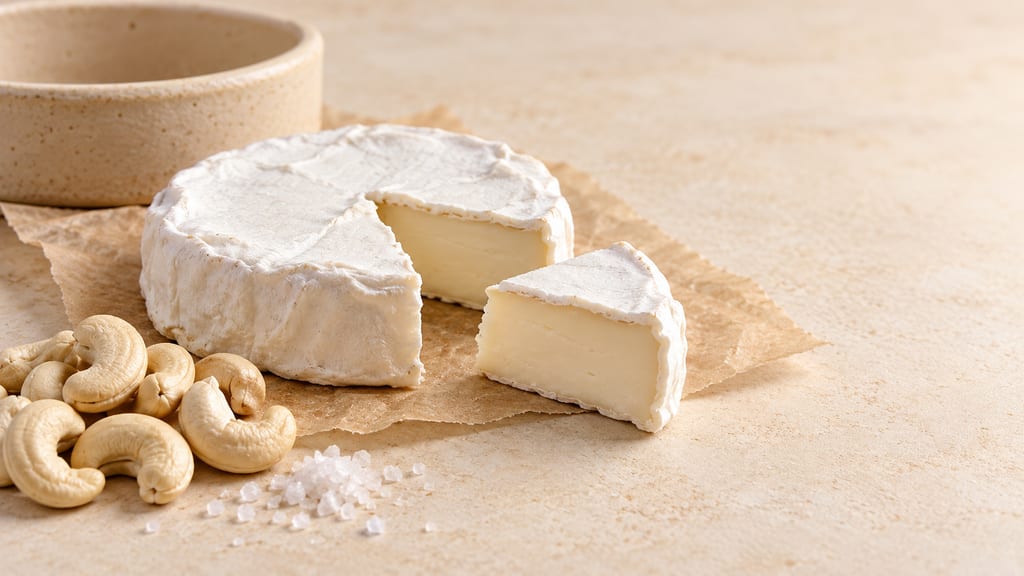
A cashew-based camembert-style cheese with a white mould rind and a cut wedge, beside raw cashews.
The first instruction is to wait
The most important instruction in a German recipe for cashew camembert is to wait. The nuts are boiled for 3–4 minutes and blended into a smooth paste, and then the paste has to cool to about 36 °C before anything else goes in. Any hotter and the mould culture dies. Everything after that depends on a thermometer reading, because this cheese is not curdled or pressed into being. It is grown, on a bed of nuts, by organisms the cook adds on purpose.
The ingredient list is short. For two cheeses of 200–250 g, the recipe takes 200 g of cashews, 150 g of almonds, a teaspoon of salt, 125 ml of rejuvelac or Brottrunk (German for "bread drink"), 100 ml of cooled boiled water and half a teaspoon of liquid Penicillium candidum, or a measure or two of the powder. The nuts soak overnight, are boiled, and are blended with the water and part of the salt.
Then comes the long part. The rejuvelac is mixed with the mould culture and stirred in at 36 °C. The paste rests for 12 hours at room temperature, goes into a damp cloth under a weight, and spends another 12 hours in the refrigerator. The outside is salted, and the cheese sits for 24 hours on a draining mat in the fridge. After that it is turned every day and dried every second day. The recipe calls it ripe after two to two and a half weeks. It gives no refrigerator temperature, no pH, no storage life and no safety advice beyond keeping everything clean.
Two kinds of microbe, two jobs
A cheese like this needs two teams. Lactic acid bacteria sour the paste, and a mould spreads a white felt across the surface. The home recipe adds both, and so does the most thorough laboratory study of the subject, which comes from the Warsaw University of Life Sciences.
The Warsaw group made cheeses from cashews, pistachios, peas, hemp, soy flour, chickpeas and several mixtures. For acid they used Streptococcus salivarius KKP 3251, Lactococcus lactis KKP 3020 and two commercial mixed cultures. For the rind they used Geotrichum candidum and a traditional strain of Penicillium candidum that the paper labels P. camemberti. The two Penicillium names are not rivals: commercial white-mould cultures are sold under either.
The schedule was close to the home recipe. The nut mass was cooled to 35 °C or below, and a spoonful of culture (100 mg) went in. It stood for 4 hours at room temperature, then moved to a refrigerator at 12 °C. The cheeses were turned and dried on days 1 to 3, salted on day 4, and assessed on days 4, 7, 10 and 14. The humidity of the ripening space, the water activity of the cheeses and the amount of salt were not reported, and all three matter to a surface mould.
By day 14 the bacteria had settled at nearly the same level on both nuts: a log count of 9.19 per cubic centimetre in cashew cheese, roughly 1.5 billion cells, and 9.18 in pistachio. The mould was a different story. Cashew cheese carried a log count of 5.27, about 190,000 cells per cubic centimetre, and pistachio 6.65, about 4.5 million, some 24 times as many. Nut bases gave the most complete white rind of any material tested. The base changes how well the mould grows.
Soured, but only gently
Dairy cheese makers read acidity from pH, where lower means more acid. The Warsaw cheeses did not become very acidic. Cashew cheese measured pH 5.51 and pistachio 5.46, chickpea 5.59 and pea 6.08. The cashew cheese held about 10 g of lactic acid per kilogram. The authors counted the differences between bases as insignificant, and the paper does not make clear on which day these readings were taken.
The plant-to-water ratios in these cheeses ranged from 1:3 to 3:2, with cashews at 1:1. The study did not test for Listeria or Salmonella, so a pH of 5.5 says nothing about whether either would have grown.
What is already on the shelf
The cheeses in the Warsaw study were made for research. A team from the Technical University of Denmark, Université Paris-Saclay and the Federal University of Rio Grande do Sul looked instead at what shops sell. They collected 11 soft-ripened plant-based cheeses from the European market, mostly with a bloomy rind, and cashew was the main ingredient.
The microbes inside were familiar. The dominant bacteria were Lactococcus lactis and Leuconostoc mesenteroides, and the fungi were Geotrichum candidum and Penicillium camemberti. Most of the species the team found also turn up in dairy cheese. The fat content looked like that of dairy cheese too, though the fatty acids differed, with more of the mono- and polyunsaturated oleic and linoleic acids.
How these cheeses hold together, melt and stretch is a separate question, reviewed in 2025 in a paper on structure, texture and functionality. It gives no figures for cashew cheese in particular.
Seventy-two hours with a grain-water starter
Rejuvelac, the fermented grain-soaking water used in the German recipe, has its own article; here it matters only as a starter. A team at Western University in London, Ontario, made cashew cheese with a quinoa rejuvelac and sampled it from the start to 72 hours. The rejuvelac was dominated by Pediococcus and Weissella, and the brie-style and blue-style products that grew from it became dominated by Lactococcus, Pediococcus and Weissella. Viable counts reached roughly 100 million to a billion colony-forming units per gram, or per millilitre; the paper's text and its figure legend disagree on the unit. A rejuvelac is a variable community, not a fixed blend, so these results describe one quinoa batch rather than a standard starter.
The same study measured cashew allergenicity and found that it fell significantly in every type of finished product. That is one measurement of one process. It does not establish that fermenting cashews removes the allergen, and nobody with a nut allergy should read it as a reason to eat these cheeses. Cashew and almond are both tree-nut allergens.
Raw nuts and a fresh cheese: the outbreak record
Cashew cheese has a documented safety record, and part of it is bad. In 2013 and 2014, 17 people in three US states fell ill with Salmonella Stanley after eating a raw cashew cheese. The health agency noted that its long shelf life meant tubs could still be sitting in refrigerators. In 2021, a cashew brie sold in the United States was linked to Salmonella Duisburg: 20 people became ill and five were hospitalised. The product was recalled on 22 April 2021, and the US Food and Drug Administration identified the cashews as the source.
The 2022 outbreak in Europe was listeriosis. A vegan cheese made from almond milk and organic cashew nuts was linked to cases in France, where four pregnant women and one immunocompromised person were ill between April and December 2022, in Belgium, where a three-year-old was affected, and in Germany and the Netherlands. The product was recalled in April and again in July 2022, and an inspection found irregularities in the company's microbiological controls. The investigation by Institut Pasteur, Santé publique France and Sciensano was published in 2024.
These were commercial products, and the German recipe is not one of them. It boils the nuts, but gives no pH, no storage life and no measure of how quickly its cheese turns acid, and none of the studies above tested pathogens in a home batch. Public-health guidance in British Columbia describes plant-based cheese as a fermentation of ground nuts or nut liquids made with commercial lactic acid bacteria. A rejuvelac or a bread drink is a different starter, and how fast either one acidifies cashew paste has not been measured.
What a home cook can take from this
The cultures can be named, the white rind has been grown on several bases, and a schedule of a day of culture and about two weeks of ripening has been run both in a laboratory and in a home kitchen. What is missing is the number that would make a home batch safe to judge: a measured pH, reached by a stated time, with a storage life behind it. Nobody has published it, and guidance documents give different time limits for how quickly a cultured product must turn acid.
Until it exists, the timings in the recipe and the Warsaw trials are about quality, not safety. A white bloom does not prove that the intended mould has grown, a clean smell does not show the cheese is safe, and two and a half weeks in the refrigerator is a ripening time, not a deadline. The experimental schedule belongs to its own bases and cultures, and neither it nor the home recipe is a safety reference for the next batch.
Community
No community contributions have been published for this entry yet.
Share what you made
Sign in to contribute. Published comments and photos are free to read.
Sources
Foods 13(14):2305, 2024 (PubMed Central)
Plant-Based Alternatives to Mold-Ripened Cheeses as an Innovation among Dairy AnaloguesCited in: Two kinds of microbe, two jobs; Soured, but only gently; What a home cook can take from this
Food Research International 191:114724, 2024 (DTU Orbit)
Nutritional and microbial profiles of ripened plant-based cheese analogs collected from the European marketCited in: What is already on the shelf
Viva las Veganas
Camembert-style plant cheese methodCited in: The first instruction is to wait; What a home cook can take from this
Nutrients 12(3):648, 2020 (PubMed)
Nutritional, Microbial, and Allergenic Changes during the Fermentation of Cashew "Cheese" Product Using a Quinoa-Based Rejuvelac Starter CultureCited in: Seventy-two hours with a grain-water starter
Critical Reviews in Food Science and Nutrition 65(29):6671-6687, 2025
Plant-based cheese analogs: structure, texture, and functionalityCited in: What is already on the shelf
US Centers for Disease Control and Prevention
Salmonella Stanley outbreak, 2013-2014: advice to consumersCited in: Raw nuts and a fresh cheese: the outbreak record
US Centers for Disease Control and Prevention
Cashew brie cheese and Salmonella, April 2021Cited in: Raw nuts and a fresh cheese: the outbreak record
Institut Pasteur
Risk of listeriosis associated with vegan cheesesCited in: Raw nuts and a fresh cheese: the outbreak record
BC Centre for Disease Control, 2024
Fermented Foods Safety GuidanceCited in: Raw nuts and a fresh cheese: the outbreak record; What a home cook can take from this
Gaps
- No source measures pH, acidification speed or pathogen survival in a home cashew camembert, and published guidance gives conflicting time limits for how fast a cultured product must acidify.
- The European market survey was read as an abstract, so its mould counts, pH and pathogen results are unknown.
- No safe endpoint or storage life for finished plant-based cheese is established.
Updated 2026-10-29