
Techniques
The cake that brews: dried starters from the Himalayas to the Philippines
Marcha, thiat, ragi, nuruk and qu are dried cakes of grain and microbes that turn rice or millet into drink. Each carries moulds, yeasts and bacteria, and each is passed on a pinch at a time.
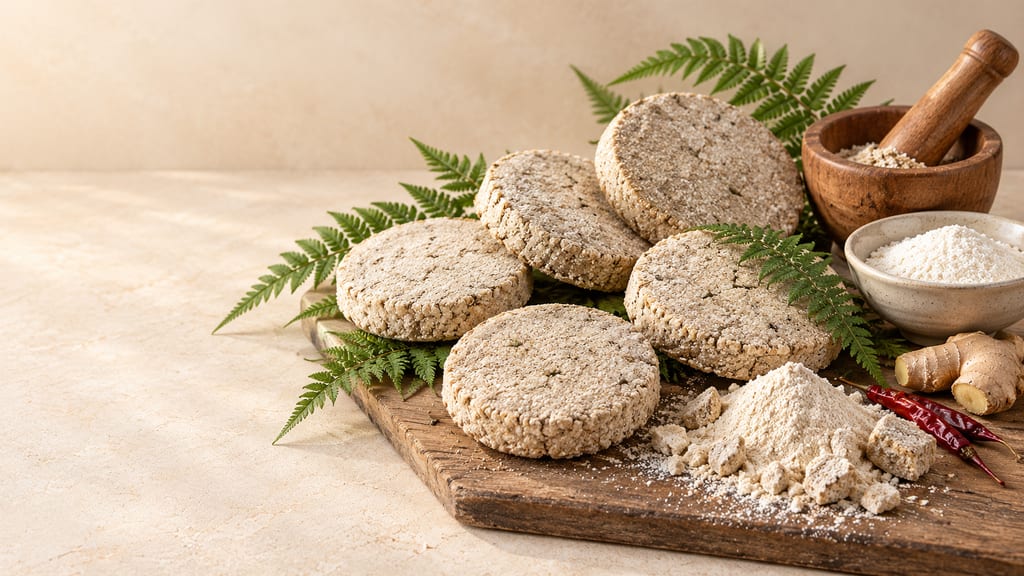
Hand-shaped rice-dough starter cakes on fern fronds beside a wooden mortar, as the Himalayan method is described; an illustration, not a photograph of a particular batch.
Every batch begins with a pinch of the last one
Marcha starts with rice. In the eastern Himalayas the grains are soaked overnight and pounded into flour, then worked together with wild herbs, spices and a small share of powder from an earlier batch of marcha: 1–2% of the mix. That pinch is the point of the whole method. Nobody adds a bought culture. The moulds, yeasts and bacteria that the rice, the herbs and the old cake carry are handed forward from one batch to the next. Himalayan women are credited with keeping one such community going this way for more than 1,500 years, though that figure traces back to a single earlier citation and has not been dated independently.
The herbs are named plants, and they differ by account. One description of marcha lists Plumbago zeylanica, Buddleja asiatica and Vernonia cinerea, with ginger and dry red chili. The mix is crushed in a wooden mortar with a wooden pestle and shaped into round to flat cakes. The cakes are covered or wrapped in fern fronds, left at room temperature, and then dried in the sun. What comes out is a hard, dry cake that can sit on a shelf until someone needs it for the next pot of drink.
Fern, sun and the clock: where the accounts differ
Two published descriptions of marcha agree on the outline and part ways on timing. One has the shaped cakes resting in their fern leaves at room temperature for 24 hours and then drying in the sun for 3–5 days. The other gives 2–3 days of fermenting and 2–3 days of sun drying. Each figure is that study's own account of local practice. It is not known whether the gap reflects different households, seasons or recipes, and how much it matters to the finished cake is unrecorded.
The neighbours follow the same pattern with different materials. Phab, from Bhutan, is made from powdered maize and wrapped in dry paddy straw, with a maize and rice husk base. Thiat, from Meghalaya, is made from soaked glutinous rice ground with the leaves and roots of Amomum aromaticum. It takes 1–2% old thiat as its inoculum, is mixed with water into a dough and shaped into flat to round balls. It ferments for 1–3 days and dries in the sun for 3–5 days, and no leaf wrapping is mentioned. Thiat is the starter for kiad, a Meghalaya drink. For phab, paa, pee and phut no times are recorded at all.
One idea, many names
Marcha is made in Nepal, in the Darjeeling hills, in Sikkim and in Bhutan. Paa, pee and phut come from Arunachal Pradesh. A survey of 35 starters from these communities covered 26 marcha, 2 phab, 2 paa, 3 pee and 2 phut. Further out, the same kind of cake has a different name in almost every language: hamei and humao in India, mana and manapu in Nepal, men in Vietnam, ragi in Indonesia, bubod in the Philippines, chiu or chu in China and Taiwan, loogpang in Thailand, nuruk in Korea. A review of food micro-organisms for the FAO describes them as mixed-culture dough inocula, made as dried powders, flat cakes or hard balls, and used to start fermentation in starchy foods.
A shared function does not make a shared community. Qu, nuruk, ragi, marcha and bubod are regional categories, not interchangeable species, and a name in one valley says little about what grows in the cake in the next. The Chinese tradition is old: a sixth-century farm manual by Jia Sixie, the Qimin yaoshu, describes shaped starter cakes, drying, cleaning and repeated additions of cooked grain. Modern huangjiu and xiaoqu baijiu still depend on qu, and a 2021 comparison found Saccharomyces cerevisiae and Pichia kudriavzevii important in it. Nuruk is wheat-based, and a study of 42 nuruk samples recovered S. cerevisiae from 18 of them. Koji is a separate thing: rice colonised by Aspergillus oryzae.
Three kinds of organism, two jobs
The word amylolytic names the job the cake is kept for. Rice and millet are mostly starch, and starch has to be broken into sugars before yeasts can make alcohol from it. The cake carries organisms that do both steps. In the Himalayan work, saccharifying and alcohol-making are credited to the moulds and yeasts. Earlier work on kodo ko jaanr found that the bacteria in dry starters have no amylolytic activity, and the bacterial survey of 35 starters did not test its isolates for starch breakdown or ethanol. They are the third group in the cake, and what they do in the drink has not been measured.
Studies elsewhere in Asia show the same division of labour. In bubod, the Philippine starter used for the rice wine tapuy, work published in 1990 found the yeast Saccharomycopsis fibuligera supplying strong starch-breaking activity and Saccharomyces cerevisiae carrying the alcoholic fermentation. In 29 commercial starters from Vietnam, the strongest alcohol producers were S. cerevisiae, while the starch-degrading isolates came from several kinds of mould. In Thai loog-pang, a 2002 survey found S. fibuligera widespread, and also found that the most abundant organism in a cake was not necessarily the one producing the most ethanol. Abundance in a cake is not a measure of what the organism does in the pot.
What is actually in a cake
Bacteria were isolated from 35 dry starters from the eastern Himalayas, and the 201 isolates were grouped into 68 representative strains. About 59% of the bacteria were lactic acid bacteria, among them Enterococcus faecium, Pediococcus acidilactici, Pediococcus pentosaceus, Lactobacillus plantarum, Leuconostoc mesenteroides and Weissella cibaria. About a third were not lactic acid bacteria, including Bacillus subtilis and Bacillus cereus. Another 9% were Gram-negative bacteria. The Gram-negative and other opportunistic isolates were probably contaminants from the substrate, water, utensils or wrapping, though that was not tested.
A second study sequenced the bacterial and fungal communities of marcha and thiat. The bacteria differ sharply between the two. In marcha, the Acetobacteraceae made up 50.6% and the Leuconostocaceae 25.5%. In thiat, the Enterobacteriaceae made up 84.6%. The fungi differ too. Marcha yeasts split between Wickerhamomyces, Candida and Kazachstania at 25% each, with Saccharomyces at 12.5%; species named include Wickerhamomyces anomalus, Candida quercitrus and Kazachstania exigua. In thiat, the moulds were Aspergillus at 15.7%, Aureobasidium at 3.9% and Mucor at 2.7%, and 77.7% could not be identified; the species named were Aspergillus penicillioides, Aureobasidium pullulans and Mucor circinelloides.
The sample was small, and the results appear to rest on one cake of each kind. These percentages describe those cakes. Lists of fungi and bacteria from Indian starters more widely name the moulds Mucor circinelloides, Mucor hiemalis and Rhizopus chinensis, the yeasts Saccharomycopsis fibuligera, Saccharomyces cerevisiae and Pichia anomala, and the bacteria Pediococcus pentosaceus and Lactobacillus brevis. The yeast that does the saccharifying in Philippine bubod appears here too.
From cake to cup
Making the cake and using it are separate jobs. In Darjeeling and Sikkim, the finger millet drink kodo ko jaanr begins with millet cooked for about 30 minutes and cooled, then inoculated with about 2% marcha. In the households observed, saccharification took 2–4 days and the fermentation after it 3–4 days in summer or 5–7 days in winter. Those are observed times from particular kitchens. They are not a tested recipe, and they set neither a safe endpoint nor a standard alcohol strength. Alcohol measured in the grain is also not the alcohol in each cup that is served.
Thiat serves the kiad of Meghalaya. In Indonesia and Malaysia, ragi starts tapai, rice or cassava fermented until it is a soft solid sitting in a sweet, alcoholic liquid. A drink recipe that calls for a starter does not say how to make the starter, and a starter's making does not describe the drink. The two should be read apart.
What nobody has pinned down
For all the care in these descriptions, the practical numbers are thin. Beyond the 1–2% inoculum, no source gives quantities for any of these cakes. No seasonal calendar is recorded. The shelf life of dried cakes is tied to the wrapping (fern or plantain leaves, paper, synthetic bags), the storage conditions, the temperature and the humidity, but no figures come with that. A cake that looks dry and sound is not thereby shown to be safe, and smell, taste and bubbles will not tell a reader what grew in it.
The open questions are practical ones: which organisms in which cake do the saccharifying, which are only passengers, and how the answer shifts between valleys, seasons and households. The pinch of last year's batch carries the community forward. Until someone measures what else it carries, these accounts describe a living tradition and do not amount to a recipe for a home starter.
Community
No community contributions have been published for this entry yet.
Share what you made
Sign in to contribute. Published comments and photos are free to read.
Sources
Frontiers in Microbiology (Pradhan and Tamang, 2019)
Phenotypic and Genotypic Identification of Bacteria Isolated From Traditionally Prepared Dry Starters of the Eastern HimalayasCited in: Every batch begins with a pinch of the last one; Fern, sun and the clock: where the accounts differ; One idea, many names; Three kinds of organism, two jobs; What is actually in a cake; From cake to cup; What nobody has pinned down
FAO Commission on Genetic Resources for Food and Agriculture (Alexandraki, Tsakalidou, Papadimitriou and Holzapfel, 2013)
Status and trends of the conservation and sustainable use of micro-organisms in food processesCited in: Every batch begins with a pinch of the last one; One idea, many names; Three kinds of organism, two jobs; What is actually in a cake; What nobody has pinned down
Scientific Reports (Sha, Anupma, Pradhan, Tamang and others, 2017)
Analysis of bacterial and fungal communities in Marcha and Thiat, traditionally prepared amylolytic starters of IndiaCited in: Every batch begins with a pinch of the last one; Fern, sun and the clock: where the accounts differ; What is actually in a cake; From cake to cup; What nobody has pinned down
Food Microbiology (Thapa and Tamang, 2004)
Product characterization of kodo ko jaanr: fermented finger millet beverage of the HimalayasCited in: Three kinds of organism, two jobs; From cake to cup
Journal of the Brewing Society of Japan (Kozaki and Uchimura, 1990)
Microorganisms in Chinese Starter "Bubod" and Rice Wine "Tapuy" in the PhilippinesCited in: Three kinds of organism, two jobs
LWT - Food Science and Technology (Dung, Rombouts and Nout, 2007)
Characteristics of some traditional Vietnamese starch-based rice wine fermentation starters (men)Cited in: Three kinds of organism, two jobs
Jia Sixie, sixth century CE; primary Chinese text (Chinese Text Project)
Qimin yaoshu, volume 7Cited in: One idea, many names
Food Research International (Hu and colleagues, 2021)
Study on microbial communities and higher alcohol formations in the fermentation of Chinese Xiaoqu Baijiu produced by traditional and new mechanical technologiesCited in: One idea, many names
Journal of Microbiology and Biotechnology (Song and colleagues, 2013)
Analysis of Microflora Profile in Korean Traditional NurukCited in: One idea, many names
Agriculture and Natural Resources, formerly Kasetsart Journal (Limtong, Sintara, Suwanarit and Lotong, 2002)
Yeast diversity in Thai traditional fermentation starter (Loog-pang)Cited in: Three kinds of organism, two jobs
Gaps
- Beyond the 1–2% inoculum, no quantities, seasonal calendars, validated endpoints, storage times or safety controls are documented for any of these dried starters.
- The 24-hour and the 2–3-day fermentation of marcha cakes are both reported and not reconciled, and the community sequencing appears to rest on a single cake of each kind.
Updated 2026-10-29