
Techniques
The red mould that colours wine, tofu and capsules
Monascus has coloured rice wine and bean curd in East Asia for centuries, and it also makes a compound identical to lovastatin. Food, dye and supplement carry different risks, as a contaminated batch in Japan showed in 2024.
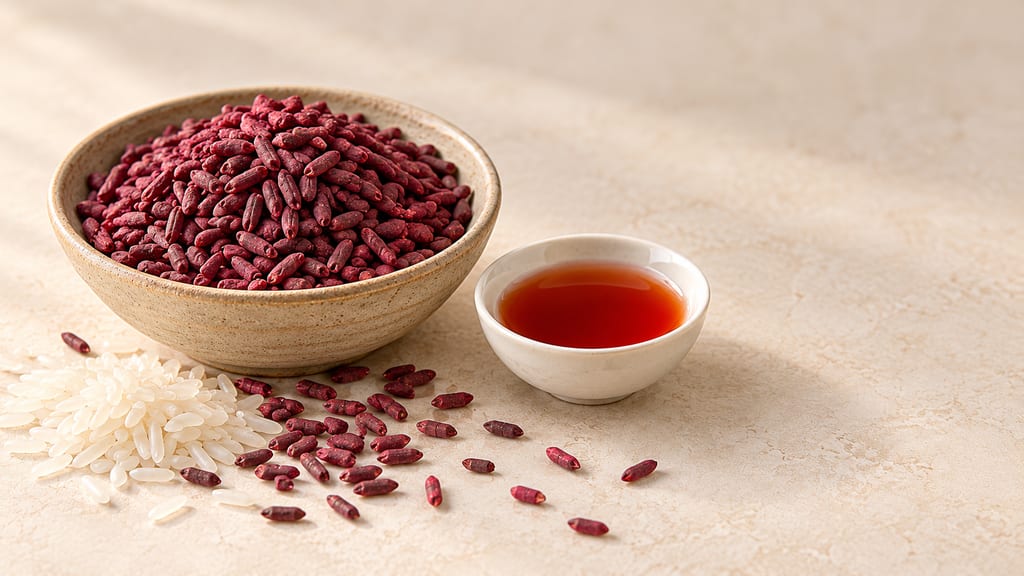
Dried red yeast rice: cooked rice grains stained deep red by the mould Monascus.
A mould that makes a drug
A bowl of dried red rice grains, the kind sold to colour wine and bean curd, holds a mould that can make monacolin K. In its lactone form that compound is identical to lovastatin, a cholesterol-lowering drug prescribed at 10–80 mg a day. The grains and the drug share a source, and that overlap is the reason a simple-looking food has such a tangled reputation.
Red yeast rice is not made with yeast. It is cooked rice that a mould of the genus Monascus has grown through until each grain turns a deep red. The names for it, red yeast rice, red mould rice, hongqu and, in Japan, beni-koji, cover at least three different products: a traditional ingredient, an industrial colourant and a concentrated supplement. They share a genus of mould and little else, since strain, substrate, dose and purpose all differ. A finding about one cannot be carried over to another, and this article keeps them apart.
Even the word koji misleads. Monascus belongs to a different genus from Aspergillus, and the phrase red rice koji can name a product made with Aspergillus oryzae that has nothing to do with Monascus.
Fujian and the old texts
Red yeast rice has a long paper trail, most of it second-hand. Researchers at Zhejiang Chinese Medical University in Hangzhou, surveying its traditional uses in 2019, name the Local Chronicles of Gutian from the Tang dynasty (618–907), Materia Medica in Daily Use from the Yuan (1271–1368) and the Tiangong Kaiwu from the Ming (1368–1644). Beyond their titles, what these texts say about red rice is known only second-hand.
The Tiangong Kaiwu, a 17th-century work attributed to Song Ying, gives a method. Polished rice is soaked for 7 days, steamed, seeded with Shaoxing wine lees and cultured for about 1 week.
Dates in this field are soft. The Ming materia medica Bencao Gangmu appears in the same literature, and the reviews disagree on when it was written: one review gives 1596 in one section and 1590 in another, while the Hangzhou review places it in 1552–1578. The evidence does not settle which is right.
A 2021 review of red yeast rice as a traditional food in Japan and East Asia supplies several of the dates in this article. Its authors work at KOBAYASHI Pharmaceutical in Ibaraki, Japan, the manufacturer named in the 2024 supplement incident described below. That is worth knowing when weighing its claims, and most of its food-history dates are phrased as things that are said to be so.
From rice wine to red bean curd
In the kitchen, red yeast rice works as a colour, a flavouring and a preservative. It tints meat, fish and soybean products, and it preserves and flavours fish sauces, rice wines, red soybean curd, pickled vegetables and salted meats.
Red rice wine, called anchu or laojiu, is said to have originated in Fujian and to have reached Taiwan about 200 years ago. A Chinese research group's 2022 batch of hong qu glutinous rice wine gives a sense of the scale: 4 kg of glutinous rice and 400 g of hong qu starter in a clay vat, held at 20 °C for 30 days. At day 30 the wine measured 19.77% alcohol by volume.
Red fermented bean curd, tofunyu or funyu in Japanese, is said to have originated in China about 1,500 years ago and to have been eaten there for more than 1,000 years. On Okinawa, tofuyo is cited from a text of 1832 as a fragrant, tasty food. A red-rice tradition on the island is placed, with a hedge, at 1850–1900, and a miso made with Monascus is dated to 1985. None of these dates is firm enough to treat as an origin.
How a mould paints rice
Rice is what the mould eats and what it dyes. Strain, substrate and growing conditions change how much pigment a batch carries and which other compounds come with it. In a 2013 study at Xihua University in Chengdu, the strain Monascus purpureus AS3.531 was grown on rice in two ways, as a solid-state ferment and submerged in liquid. The solid-state culture did best at 35 °C and pH 5.0, the submerged one at 32 °C and pH 5.5, and 2% glycerol (weight per volume) raised pigment output.
The two methods made nearly the same amount of pigment. They did not make the same amount of citrinin, a mould toxin: the submerged culture produced far more than the solid-state one. The authors concluded that fermentation mode is the main factor for citrinin and a minor factor for pigment.
A 2019 comparison grew six strains of Monascus purpureus on brown rice and on millet. Most strains lost 54–60% of the dry matter on rice and 46–48% on millet, which is the mould's appetite measured in weight. One strain, MOPU GS1, made 1.3 mg of lovastatin per gram of dry rice and 1.6 mg per gram of millet, with citrinin below the detection limit. The other strains made citrinin at levels that varied widely. Millet gave more lovastatin and less citrinin, while rice remained better for pigment.
A strain that makes lovastatin without detectable citrinin exists, so the choice of strain matters a great deal, and the colour of the rice does not tell you which strain you have. Place shows in the numbers too. Samples from Gutian, Nanping and Pinnan in Fujian had more monacolin K than samples from six other Chinese habitats.
As a dye, red qu moved into industry in the 20th century, and the sources disagree on when. One section of the 2021 review dates the industrial use of the colourant to 1945, and another says it began in the 1950s.
The supplement shelf and its limits
Supplements take the second identity of red yeast rice and make it the point. In an opinion adopted on 25 June 2018, the European Food Safety Authority's expert panel found that severe adverse reactions had been reported at intakes as low as 3 mg of monacolins a day. It treated 10 mg a day, the amount used in a 2013 health claim, as a safety concern. The case reports it reviewed include muscle effects, among them rhabdomyolysis, a breakdown of muscle tissue, as well as liver and nervous-system effects.
The industrial process behind a supplement is controlled. Rice is sterilised, soaked and inoculated with Monascus purpureus, then incubated and stirred in a temperature-controlled chamber for some days, with no temperature or duration given in the opinion. Industrial strains named there include N301 and N310. The finished rice is usually dried at 50–60 °C.
In June 2022 the European Commission amended Annex III of Regulation (EC) No 1925/2006. A daily portion of a product must provide less than 3 mg of monacolins from red yeast rice. Labels must state the number of portions that make up the maximum daily intake and the monacolin content per portion, with a warning not to consume 3 mg of monacolins from red yeast rice or more a day. The product is not for pregnant or lactating women, children below 18 or adults above 70, and not for use with cholesterol-lowering medication or with other red yeast rice products.
Citrinin has its own limits. The European Food Safety Authority's contaminants panel set a tolerable daily intake of 0.2 µg per kg of body weight per day. The EU maximum cited in the 2018 opinion was 2 mg/kg under Regulation (EU) No 212/2014. Regulation (EU) 2019/1901 of 7 November 2019 then set 100 µg/kg for food supplements based on rice fermented with Monascus purpureus, and its preamble notes that very high citrinin levels can be found in certain samples of these products.
Taiwan took a different route. Its standard for red-qu health foods, promulgated on 24 December 2007, defines the product as dried rice grown with Monascus, sold as powder, capsules or tablets. A government survey of red-qu foods bought in 2009 found every red-qu wine among its samples below the detection limit of 50 ppb by liquid chromatography, while other product classes included positives. That is a small group of wines, and below the detection limit is not zero.
Japan, 2024: a contaminant, not the mould's own toxin
On 22 March 2024 Kobayashi Pharmaceutical announced that consumers had reported kidney problems after taking its supplement made with beni-koji. The company said it had received its first kidney complaints in January. Hospital admissions and deaths were reported, and the early figures differed between reports. Japan's health ministry stopped updating its case counts after 17 March 2025, and Osaka City published a final report on 19 March 2025.
On 18 September 2024 the Ministry of Health, Labour and Welfare, working with the National Institute of Health Sciences, linked the harm to puberulic acid. Contamination by a second mould, Penicillium adametzioides, during fermentation had produced it. When a Monascus fungus was incubated alongside, monacolin K was converted into two other compounds, called Y and Z. The ministry's finding was that puberulic acid can cause renal dysfunction, while Compound Y and Compound Z do not. The explanation does not name citrinin.
The distinction matters for reading the story. The ministry's account runs through a contaminating mould and its chemistry, not through Monascus's own toxin and not through the colour of the rice. A fermentation can go wrong in ways that the pill and its label give no sign of.
What a reader can take from this
Supplement evidence does not carry over to the food. A study of capsules does not show that wine or a condiment is harmful, and it does not show that they are beneficial either. Hongzao, the red-rice condiment, is one thing, hongqu jiu, red-qu wine, is another, and dried red qu sold as a supplement is a separate regulated class.
A home batch is a different matter. Every study above used an identified strain, a controlled substrate and chemical analysis. Citrinin production depends on the strain, so what one strain does says little about another or about a mould that arrives on its own. A safe batch would need a food-grade strain with a documented specification and validated testing for citrinin, and an ordinary kitchen has neither. That is why this article gives no way to propagate it.
Colour, smell, taste and bubbling settle none of it. They do not identify the strain, show that citrinin is absent or show that a second mould has stayed out, and a batch can look right while carrying a compound nobody tested for.
Community
No community contributions have been published for this entry yet.
Share what you made
Sign in to contribute. Published comments and photos are free to read.
Sources
Acta Biologica Hungarica 64(3):385–394, 2013 (Zhang, Li, Dai, Zhang and Yuan; Xihua University, Chengdu, and Sichuan Jiannanchun Group, Mianzhu)
Effect of submerged and solid-state fermentation on pigment and citrinin production by Monascus purpureusCited in: How a mould paints rice; What a reader can take from this
Journal of Food Science and Technology 56(7):3364–3373, 2019 (Marič and colleagues)
Comparison of lovastatin, citrinin and pigment production of different Monascus purpureus strains grown on rice and milletCited in: How a mould paints rice; What a reader can take from this
Official Journal of the European Union
Commission Regulation (EU) 2022/860 of 1 June 2022 amending Annex III to Regulation (EC) No 1925/2006 as regards monacolins from red yeast riceCited in: The supplement shelf and its limits
EFSA Journal 16(8):e05368, 2018 (EFSA Panel on Food Additives and Nutrient Sources added to Food, adopted 25 June 2018)
Scientific opinion on the safety of monacolins in red yeast riceCited in: A mould that makes a drug; The supplement shelf and its limits; What a reader can take from this
Molecules 26(6):1619, 2021 (Fukami and colleagues). The authors work at KOBAYASHI Pharmaceutical Co., Ltd., Ibaraki, Japan, the manufacturer named in the 2024 beni-koji supplement incident.
A Review of Red Yeast Rice, a Traditional Fermented Food in Japan and East AsiaCited in: Fujian and the old texts; From rice wine to red bean curd; How a mould paints rice
Frontiers in Pharmacology 10:1449, 2019 (Zhu and colleagues; Zhejiang Chinese Medical University, Hangzhou)
Red Yeast Rice: A Systematic Review of the Traditional Uses, Chemistry, Pharmacology, and Quality Control of an Important Chinese Folk MedicineCited in: A mould that makes a drug; Fujian and the old texts; From rice wine to red bean curd; How a mould paints rice
Official Journal of the European Union (text read at legislation.gov.uk)
Commission Regulation (EU) 2019/1901 of 7 November 2019 on maximum levels of citrinin in food supplements based on rice fermented with Monascus purpureusCited in: The supplement shelf and its limits
Ministry of Health, Labour and Welfare, Japan
Ministry of Health, Labour and Welfare, Japan: page on the 2024 health harm linked to beni-koji supplementsCited in: Japan, 2024: a contaminant, not the mould's own toxin
Taiwan Food and Drug Administration, Annual Report of Food and Drug Research 1, 2010, pp. 109–116
Citrinin in red-qu foods sold on the market (survey of products bought May–July 2009)Cited in: The supplement shelf and its limits
Laws and Regulations Database of the Republic of China (Taiwan)
Red-qu health food specification standard (紅麴健康食品規格標準), promulgated 24 December 2007Cited in: The supplement shelf and its limits; What a reader can take from this
Foods 11(8):1097, 2022 (Liu, Yang, Guo, Li, Zheng, Shi and Zhu)
Microbial Communities and Flavor Compounds during the Fermentation of Traditional Hong Qu Glutinous Rice WineCited in: From rice wine to red bean curd
Gaps
- Final totals of hospital admissions and deaths in the Japanese 2024 incident were not retrieved.
- The older texts behind the history were not read directly, and the dates for the Bencao Gangmu and for industrial colourant production conflict.
- Citrinin amounts are left out because the two Monascus papers use different units, and the 2022 EU regulation was read through a mirror, so its application date and later amendments are unchecked.
Updated 2026-10-29