
Techniques
Five days to two years: how miso, doenjang and doubanjiang mature
Sweet miso can be ready in under three weeks; Hatcho miso is said to take two summers and two winters. What salt, temperature and microbes do in between has been measured in pieces that do not yet fit together.
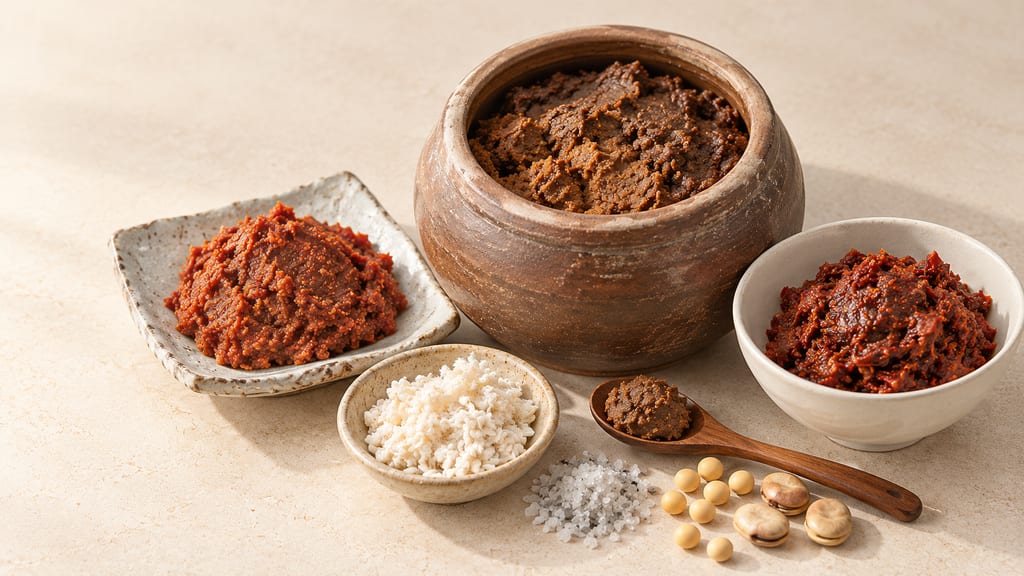
Three matured bean pastes side by side: red Japanese miso, Korean doenjang in an earthenware crock and Chinese doubanjiang.
Five days or two years
Ask how long miso takes to mature and Japan's agriculture ministry gives you a range, not a number. Sweet rice miso, the pale kind, takes 5 to 20 days. Salty rice miso is brewed for what the ministry calls a long period. Across the whole family the span runs from several days to two years. Three ingredients, koji, soybeans and salt, can make a paste that is ready in under three weeks or one that is still in the barrel after two years.
That range is the story. No single factor fixes the clock. Salt, temperature, the bean and the style of miso all pull on it, and the studies that measured them mostly measured one at a time. The same idea turns up in three countries. In Japan, grain koji is grown first and then mixed with cooked soybeans and salt. In Korea, doenjang starts from meju, a fermented soybean block that carries its own microbes instead of a grain koji. In China, doubanjiang is a broad-bean paste that matures over months and sometimes years.
What the koji starts and the salt holds back
Koji is grain, usually rice, grown with the mould Aspergillus oryzae. In miso it is made separately and then mixed into steamed soybeans with salt. Its enzymes keep working in the paste. Amylases break rice starch into sugar, and proteases break soybean protein into amino acids, which is where much of miso's savoury depth comes from. Salt suppresses the growth of undesirable bacteria while this goes on.
The ministry labels the stage "fermentation and maturation" and names three players: Aspergillus oryzae, lactic acid bacteria and yeast. Public-health guidance from British Columbia fills in the order of events. Once the paste is mixed, the koji's growth is held back, its enzymes carry on breaking down protein and carbohydrate, and yeasts and lactic acid bacteria are present. Packed for ageing in the absence of air, the lactic acid bacteria come to predominate, and the pH falls from about 6.0 to about 5.0.
One of those bacteria has a name worth knowing. Tetragenococcus halophilus tolerates salt, and the ministry calls it indispensable for salty fermented foods such as miso and soy sauce. The yeasts make ethanol. Making koji and maturing the paste are different operations run by different organisms, and the second is where most of the finished paste is decided.
How much salt
The ministry's table sets salt by style: 5 to 7 percent for sweet rice miso, 11 to 13 percent for salty rice miso, and 10 to 12 percent for soybean miso. The table prints no unit, and the text beside it gives soybean miso as 10 to 11 percent, so these are rough bands rather than specifications. The British Columbia guidance asks for more than 4 percent salt in the mash. It also gives a target for the finished paste: a water activity of 0.85 or lower, usually about 0.80. Water activity measures how much of the water in a food is free for microbes to use, on a scale where pure water is 1.
A household recipe from Edible Schoolyard Japan uses 10 percent of the combined weight of cooked soybeans and koji. The ratio is 1 part cooked beans, 1 part koji and 0.2 parts salt, so 0.5 kilograms of dried beans and 1 kilogram of bought koji take 0.2 kilograms of salt. Nineteen-twentieths of the salt goes into the koji and the rest is sprinkled over the top.
The most detailed look at salt comes from a 2025 study of miso made from chickpea and lupin instead of soybeans. It used sea salt at 3 grams or 12 grams per 100 grams of product. The starters were Aspergillus oryzae, the yeasts Debaryomyces hansenii, Zygosaccharomyces rouxii and Candida versatilis, and the bacteria Lactiplantibacillus plantarum, Leuconostoc mesenteroides and Tetragenococcus halophilus. Final pH was higher at 12 percent salt for every legume. Chickpea ended at 4.797 with 3 grams and 4.830 with 12. Lupin was the most salt-dependent: its soluble protein measured 46.473 and 10.827 milligrams per 100 grams at the two salt levels.
Time, from days to summers
Sendai's producers say their miso is fermented and matured for four months or more. The city is also home to Oensogura, built by Masamune Date and believed to be Japan's first miso factory. Maruya, the maker of Hatcho miso, describes a paste that spends two summers and two winters in the barrel. That is the company's own account, and nothing else here confirms it.
Households and community groups work on slower clocks. The Edible Schoolyard Japan recipe says to keep the crock in an unheated space for at least 6 months, long enough to go through one summer, and to move it to the fridge after a year or when it is ready. A women's association's four-day miso-making event in 2024 packed its miso into barrels for a year of ageing. The British Columbia guidance gives the whole span in one line: ambient incubation of 1 month to more than a year.
Salt and time travel together in these figures. The sweet miso that is done in 5 to 20 days carries the least salt, and the salty and soybean styles carry about twice as much and take far longer. The tables list the two side by side. None of them separates salt from the other differences between the styles, so how much of the pace is salt's doing is not known.
Temperature, the number most sources leave out
Neither of the ministry's descriptions of miso names a maturation temperature. The household and public-health sources say only "unheated" and "ambient". The longest controlled run is the 2025 chickpea and lupin study, which held its chickpea and lupin miso at 20 ± 1 °C for 18 months in 140 millilitre glass jars and sampled them at 0, 3, 6, 12 and 18 months. By the last sample, lactic acid ranged from 0.059 to 0.690 grams per 100 grams across the batches, and glucose from 2.495 to 12.992 grams per 100 grams. Salt level and legume differed between batches, so the spread says little about temperature itself.
Temperatures do appear around the koji, and they are there for safety. The British Columbia guidance has koji added at or below 35 °C. Koji grows best between 27 and 38 °C and should stay below 40 °C. Cooling has to be controlled because Bacillus spores can produce toxin. Those figures concern the koji and the mixing, not the long ageing that follows.
For the ageing itself, the temperature is the season. A crock left in an unheated space follows the weather, which is why the household recipe counts summers. Korean doenjang, in the next section, was aged outdoors and the researchers recorded the swing.
Korea: the block comes first
Doenjang begins with meju, a block that is itself a ferment. A 2024 study of Korean doenjang followed meju through three stages. The blocks spent 7 days at 28 °C and 70 to 80 percent humidity, then 43 days in open air at 0 to 10 °C. After that they went into a brine of 27.5 percent solar salt for 2 months, and the resulting doenjang was kept outdoors from May 2021 to January 2022. Over those months the highest average temperature was 29.1 °C and the lowest was -6.8 °C. One batch of meju was also kept in a 37 °C room, and the study compares high- and low-temperature series.
The microbes shifted with the route. On day 0, Weissella made up 89.6 percent of the bacteria in the meju. By day 50, in the high-temperature meju, Bacillus accounted for 93.6 percent. In the doenjang, Leuconostoc, Logiolactobacillus and Tetragenococcus gradually became dominant. Among the fungi, Debaryomyces was commonly dominant, and by day 184 the two routes had diverged: Fusarium reached 16.70 percent in the high-temperature series and Wickerhamomyces reached 31.75 percent in the low-temperature one.
An earlier study of doenjang-meju found a different order of arrival inside the block. Bacillus and Mucor came first, Aspergillus eventually dominated, and aeration was important.
China: yeasts that rise and fall
Pixian doubanjiang, a paste of broad beans, shows how long a ferment can run. A Chinese study sampled it from 1 week to 6 years and tracked the fungi by sequencing. Saccharomycetaceae and related yeasts rose and then fell, with most peaks between 3 and 6 months. The 6-year sample had a clearly smaller fungal community than the younger ones.
Fungal activity peaks within the first half-year, and the oldest paste was the quietest. The abstract gives no temperatures and does not say when the paste tastes best.
Why the paste darkens
Miso is sold by colour, and the colours step up with the style: light yellowish-white for white sweet miso, brownish-red for red sweet miso, and dark brownish-red for soybean miso. The federation of miso makers names brewing time as the main reason for the differences: the longer the brew, the darker the paste. How the soybeans are steamed or boiled, the steaming time, and the amounts of raw material and koji also count.
Korean research points in the same direction with temperature and salt. Doenjang aged for 60 days at 10, 20 and 30 °C lost lightness as it aged, and browning increased with longer ageing and higher temperature. Doenjang made with purified salt browned faster than doenjang made with solar salt, at a salt level of 12 percent (w/v).
The brown itself is mostly melanoidins, pigments that form when sugars react with amino acids. Koji enzymes release both from the starch and protein. A review of the chemistry says melanoidin structure is still unclear and that colour is cumulative, the sum of many small pigments.
No study has measured colour against salt, time and temperature together. The federation links colour to time, the Korean work links it to temperature and salt type, and the review explains the pigment. The full relationship has not been measured. A darker paste is not proof that it is older, hotter or saltier, and colour alone is a weak guide to how a batch was made.
What a home batch can and cannot tell you
The household recipe shows the whole sequence in small: cook the beans, mash them, mix in koji and salt, pack them into a crock, wait through a summer. It names no koji strain and no measured temperature, and its storage advice is one kitchen's practice, not a tested limit. The British Columbia guidance does not recommend backslopping, which means seeding a new batch with an older one, because it can bring in wild Aspergillus.
The durations in this article are quality times, not safety deadlines. Smell, taste, bubbles and surface appearance never establish safety. A batch that is ready at six months is not safe because six months have passed, and a batch that has gone a year is not safe because it has gone a year.
What is known is a set of parts. Koji enzymes and salt-tolerant microbes build the flavour. Salt slows or shifts them. Time and temperature move the colour and the microbial succession along. What is not known is how the parts add up for one batch, because no one has measured salt, time, temperature and colour in the same crock.
Community
No community contributions have been published for this entry yet.
Share what you made
Sign in to contribute. Published comments and photos are free to read.
Sources
Japan Ministry of Agriculture, Forestry and Fisheries, Traditional Foods in Japan
MisoCited in: Five days or two years; What the koji starts and the salt holds back
Japan Ministry of Agriculture, Forestry and Fisheries
An Introduction to Japanese Fermented Foods, Part 2Cited in: Five days or two years; What the koji starts and the salt holds back; How much salt; Time, from days to summers; Temperature, the number most sources leave out; Why the paste darkens
Japan Federation of Miso Manufacturers Cooperatives
The Process of Creating MISOCited in: Why the paste darkens
Edible Schoolyard Japan
Miso Recipe by ESYJCited in: How much salt; Time, from days to summers; Temperature, the number most sources leave out; What a home batch can and cannot tell you
BC Centre for Disease Control, Fermented Foods Guidance (L. McIntyre)
Section 3.10 Koji foods: miso, soy sauce and amazakeCited in: What the koji starts and the salt holds back; How much salt; Time, from days to summers; Temperature, the number most sources leave out; What a home batch can and cannot tell you
JA Yumeminami
Local miso-making event at the Shirakawa Women's AssociationCited in: Time, from days to summers
Miyagi Miso Shoyu Manufactures Cooperative
Sendai Miso: production method and historyCited in: Time, from days to summers
Foods 14(23): 4131 (2025), Santos R, Parente B, Mota M, Raymundo A, Prista C
Fermentation Process Evaluation of a Sustainable and Innovative Miso Made from Alternative LegumesCited in: How much salt; Temperature, the number most sources leave out
Journal of Microbiology and Biotechnology 34(4): 863-870 (2024), Jo E, Lee H, Song Y, Cha J
Taxonomic Variations of Bacterial and Fungal Communities depending on Fermentation Temperature in Traditional Korean Fermented Soybean Food, DoenjangCited in: Korea: the block comes first
Journal of the Korean Society of Food Science and Nutrition 39(1): 116-124 (2010), Chang M, Kim I-C, Chang H-C
Effect of Solar Salt on the Quality Characteristics of DoenjangCited in: Why the paste darkens
International Journal of Food Microbiology 185: 112-120 (2014), Jung JY, Lee SH, Jeon CO
Microbial community dynamics during fermentation of doenjang-meju, traditional Korean fermented soybeanCited in: Korea: the block comes first
Food Science 38(16): 51-56 (2017), Zhao H, Xu W, Yang G, Liu Y, Yue P, Zhang L
Fungal Community Analysis by High-Throughput Sequencing in Pixian Soybean Paste during Post-FermentationCited in: China: yeasts that rise and fall
Glycoconjugate Journal 38(3): 283-292 (2021), Murata M
Browning and pigmentation in food through the Maillard reactionCited in: Why the paste darkens
Maruya Hatcho miso, company self-description
Maruya, Hatcho miso (English page)Cited in: Time, from days to summers
Gaps
- No source measures colour, time and temperature for a single batch of miso or doenjang, so the link between them is unquantified.
- No source gives a Japanese miso maturation temperature or Chinese sun-ripening temperatures, and the ministry's salt table prints no unit.
- Four of the Korean, Chinese and review sources were read as abstracts, and the Hatcho ageing claim is the company's own.
Updated 2026-10-29