
Techniques
Three days of mould, then months in the barrel: the slow half of soy sauce
Koji takes three days to grow. The salted mash that follows takes months, in some styles two years, and the strength of the brine decides which microbes work in it. What is known about moromi, and what is not.
Wooden barrels with metal hoops in a producer's yard, the kind of vessel in which soy sauce mash matures for months (generated illustration).
Three days of mould, months of waiting
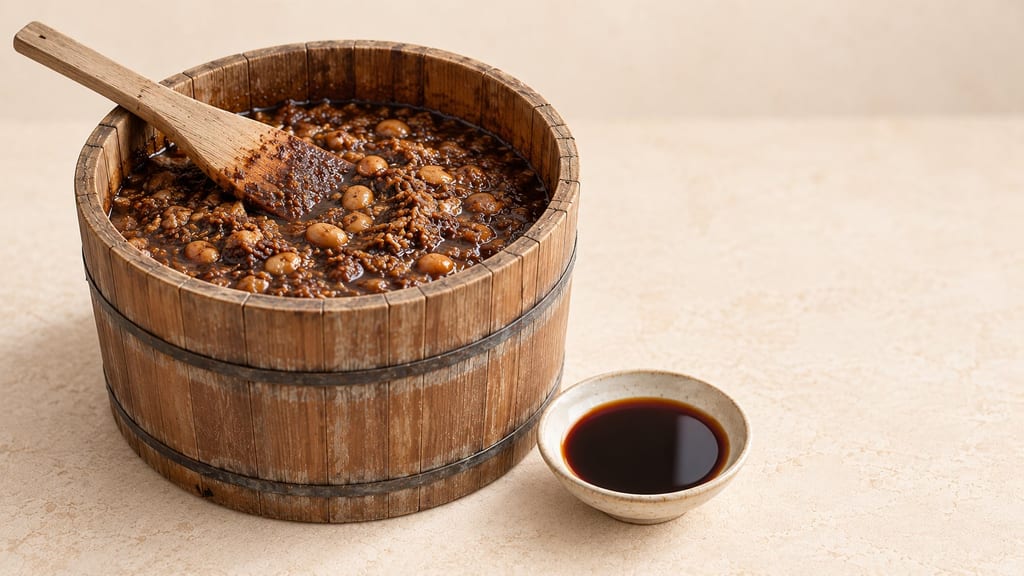
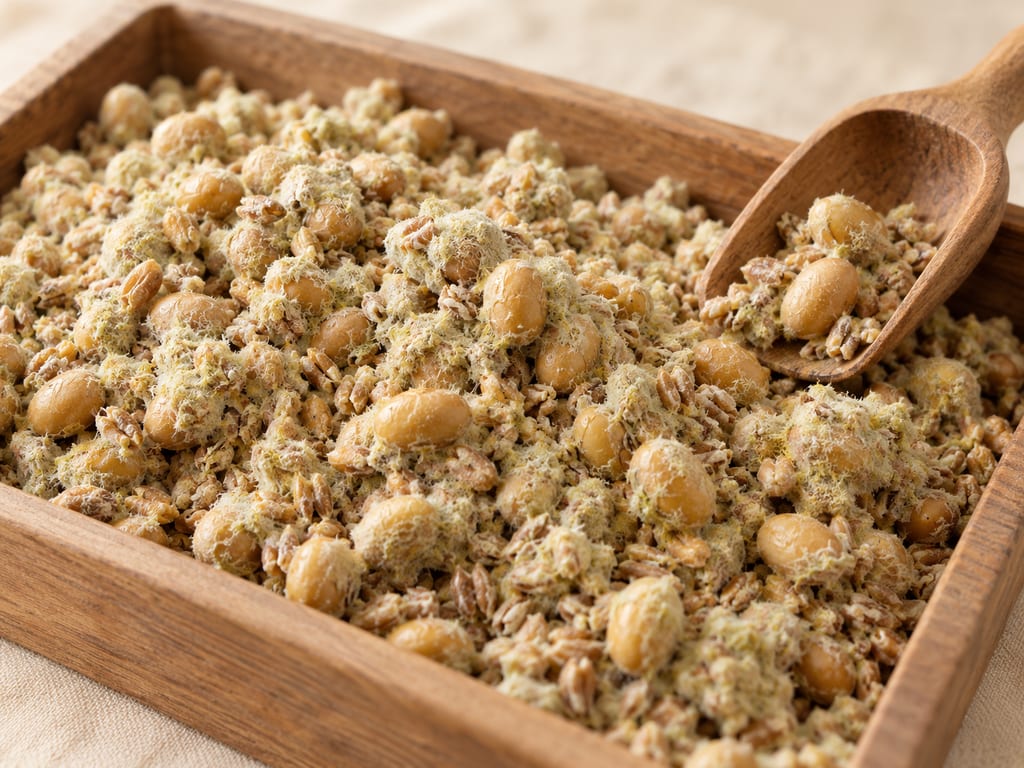
Making the koji for soy sauce takes about three days. Steamed soybeans and roasted, crushed wheat are inoculated with koji mould and left to grow. Then the real wait begins. The koji goes into tanks with salt water, and the mixture, called moromi, sits for months: about six to eight in the traditional Japanese method, and one and a half to two years or longer in the style known as saishikomi.
The traditional method, honjozo, accounts for about 80% of the soy sauce made in Japan. Kikkoman names three organisms behind soy sauce: the koji mould Aspergillus sojae, a lactic acid bacterium, Tetragenococcus halophilus, and a yeast, Zygosaccharomyces rouxii. The mould does its work in the koji. In the mash, the bacterium acidifies the salty liquid, and the yeast makes alcohol and aroma from the fermentable material the koji has supplied. After that comes pressing, settling and heating, and the mash becomes sauce.
Salt decides who gets to work
Salt is the control on the whole process. Kikkoman says the brine holds back bacterial growth, prevents spoilage and adds saltiness. In the dark koikuchi style the koji is soaked in salt water to start fermentation. In the light usukuchi style the salt content is raised, which slows fermentation and aging.
How much salt is another matter. The Japanese government descriptions and the two Japanese producer pages give no brine percentage for koikuchi. One figure appears in food-safety guidance from the BC Centre for Disease Control: its list of control points for soy sauce asks for 18% salt to promote the growth of the desired microbes.
Research papers use their own numbers. In 2022, Shi and colleagues mixed soy koji with salt solution at a ratio of 1 to 2 and compared a high-salt brine of 18% with a low-salt brine of 12%. A third batch used the 12% brine and a high-pressure treatment of 300 MPa at 4 °C for 5 minutes. Low-salt fermentation is rarely used, they point out, because harmful lactic acid bacteria grow in it, so producers commonly ferment at high salt and dilute afterwards. Spoilage bacteria can grow in soy sauce with less than 15% salt.
Zheng and colleagues, in a paper published on 21 March 2024, put the concentration of sodium chloride in soy sauce at around 18–20% w/v, which means 18 to 20 g of salt per 100 mL. Their own comparison used 20% for the high-salt method and 12% for the low-salt one, and the high-salt method usually takes about three times as long. Their reduced-salt process used 10% saline and a 35-day cycle.
These figures do not add up to one standard. Each belongs to a guideline or an experiment with its own set-up, and none is a koikuchi brine recipe. They also disagree about the cost of less salt. A 2019 review by Devanthi and Gkatzionis says lower salt speeds microbial growth but compromises flavour, while Zheng and colleagues present their reduced-salt method as one that improves flavour and quality.
A crowd that has to take turns
Tetragenococcus halophilus and Zygosaccharomyces rouxii are the predominant microbes in moromi, and their growth requirements differ, so they can work against each other.
Other bacteria drop out along the way. Pediococcus, a lactic acid bacterium, is inhibited by salty brine. In the reduced-salt process of Zheng and colleagues, lactic acid bacteria are added early to stabilise the pH and the total acid. After approximately five months of fermentation, they write, the microbes have produced a significant number of flavour compounds. That sits inside the six to eight months of the traditional method.
Eight months, three months, two years
The time a mash is left depends on the style. The Japanese government describes honjozo moromi as stirred repeatedly and aged about six to eight months. Koikuchi takes approximately eight months and shiro approximately three. Saishikomi takes one and a half to two years or longer. Tamari takes longer, with no figure given, and no period is given for usukuchi.
The styles also differ in where they are made and what they are made from. Koikuchi accounts for at least 80% of production and is made mainly in eastern Japan. Usukuchi, mainly from the Kansai region, is lighter in colour and aroma through technique. Tamari is made only in the Tokai region, in Aichi, Gifu and Mie, and is built around soybeans with a small amount of wheat. Saishikomi is made in small volumes in Yamaguchi and parts of Kyushu, and is richer and more viscous, with slightly lower salt content. Shiro, made mainly in Aichi, is lighter than usukuchi.
In China, Zheng and colleagues describe two routes. A high-salt, liquid-state method is mainly fermented continuously at low temperature, and it gives richer flavour and takes longer. A low-salt, solid-state method is mainly fermented at high temperatures for a short time, and it gives poor flavour and a dark colour. No temperature is stated for either.
One producer counts 500 to 700 days
Yuasa Soy Sauce ferments in cedar barrels and describes its traditional method in days rather than months. Its page gives 500 to 700 days in one section and about 700 days of stirring in another. Stirring, the producer says, introduces oxygen into the barrel. The same page dates its resumption to 1990 in one place and a restart to 2002 in another.
This is one producer’s account of its own practice, and the page contradicts itself on duration and on dates. It runs far past the six to eight months of the government outline, and it should not be read as a rule for soy sauce.
Pressing, settling and heat
At Kikkoman the moromi is poured into three-fold cloths and drains by gravity. It is then pressed slowly for about ten more hours. The press cake goes to livestock feed. The raw sauce rests in a clarifier for about three days, so that oil rises and sediment settles, and only the clear middle layer is taken. A heating device then stops enzyme activity. No temperature is given for that step.
Yuasa works more slowly. The moromi drains under its own weight, boards are placed on top, and it rests unpressed for half a day to a full day. Pressure is then applied gradually over three to four days. The raw sauce stays in barrels for about a month, then is heated and cooled in a settling tank for about two weeks.
What is known, and what is not
Koji is not an acidic ferment. Its final pH is above 4.6. The BC Centre for Disease Control asks for steamed soybeans and roasted wheat to be cooled within 2 hours before inoculation and for a commercial koji starter, because reusing a backslopped culture can bring in wild Aspergillus moulds that produce toxins. Histamine and other biogenic amines have been associated with soy sauce and miso. Ethyl carbamate forms as a byproduct; Shi and colleagues call it a group 2A carcinogen and name citrulline as its main precursor.
The published descriptions leave large gaps. They give no moromi temperature, no household method with quantities and monitoring points, no validated endpoint and no storage limit. Nothing supports smell, taste or bubbling as a safety check. This article therefore offers no recipe and no schedule for a home batch.
What can be said is narrower. Moromi is a salt-controlled mash in which a mould-made base is turned into sauce by bacteria and yeast over months or years, in vessels that producers control. Researchers are testing ways to cut the salt or the time: a lower-salt brine, lactic acid bacteria added early, a pressure treatment. Cutting the salt is the best studied of these, and the papers disagree on what it costs.
Community
No community contributions have been published for this entry yet.
Share what you made
Sign in to contribute. Published comments and photos are free to read.
Sources
Japan Ministry of Agriculture, Forestry and Fisheries
Soy sauce manufacturing methodsCited in: Three days of mould, months of waiting; Eight months, three months, two years; One producer counts 500 to 700 days
Japan Ministry of Agriculture, Forestry and Fisheries
Soy sauce, miso and other seasoningsCited in: Salt decides who gets to work; Eight months, three months, two years
Yuasa Soy Sauce
Traditional methodCited in: One producer counts 500 to 700 days; Pressing, settling and heat
Kikkoman
Soy Sauce Museum: Making soy sauceCited in: Three days of mould, months of waiting; Salt decides who gets to work; Pressing, settling and heat
Kikkoman Institute for International Food Culture
Brewing technologyCited in: Three days of mould, months of waiting
Foods 13:971 (MDPI), 2024
A Method of Reducing Salt Content in Fermented Soy Sauce Improves Its Flavor and QualityCited in: Salt decides who gets to work; A crowd that has to take turns; Eight months, three months, two years; What is known, and what is not
Fermentation 8:97 (MDPI), 2022
The Bacterial and Fungi Microbiota of Soy Sauce-Supplied Lactic Acid Bacteria Treated with High-Pressure ProcessCited in: Salt decides who gets to work; A crowd that has to take turns; What is known, and what is not
Food Research International 120:364-374, 2019
Soy sauce fermentation: Microorganisms, aroma formation, and process modificationCited in: Salt decides who gets to work; A crowd that has to take turns
BC Centre for Disease Control
Fermented Foods Guidance, Section 3.10: Koji foods: miso, soy sauce and amazakeCited in: Salt decides who gets to work; What is known, and what is not
Gaps
- No moromi temperature, household method, validated endpoint or storage limit was found in the material reviewed.
- The Japanese government and producer descriptions give no koikuchi brine strength; the 12%, 18% and 20% figures come from a guidance document and research papers with different set-ups.
- The Yuasa page contradicts itself on duration and dates, and the historical records behind its account were not inspected.
Updated 2026-10-29