
Techniques
Tofu under a coat of mould: how sufu is made, and what no one has proved safe at home
Sufu is tofu grown with mould and ripened for months in salty brine. A laboratory protocol, a Shanghai summer staple and a survey of unsafe samples show how it works and what is still unsettled.
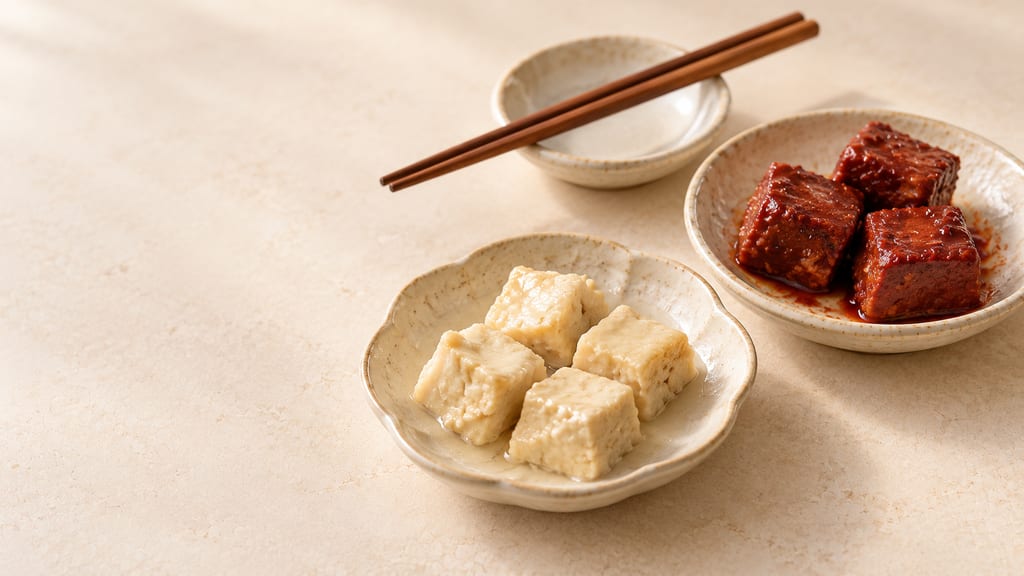
White and red fermented bean curd, two of the colours sufu takes on, set out in small dishes.
Half a millilitre of spores
A piece of tofu 3.5 cm by 3.5 cm and 1.5 cm thick gets about half a millilitre of spore suspension from a sprinkler, at 100,000 spores per millilitre. Three days later it has stopped being plain tofu. It carries a coat of mould. The pieces then go into a brine of 4% salt and 3% ethanol, made by diluting 95% alcohol, and stay there for 180 days at room temperature, between 23 and 27 °C.
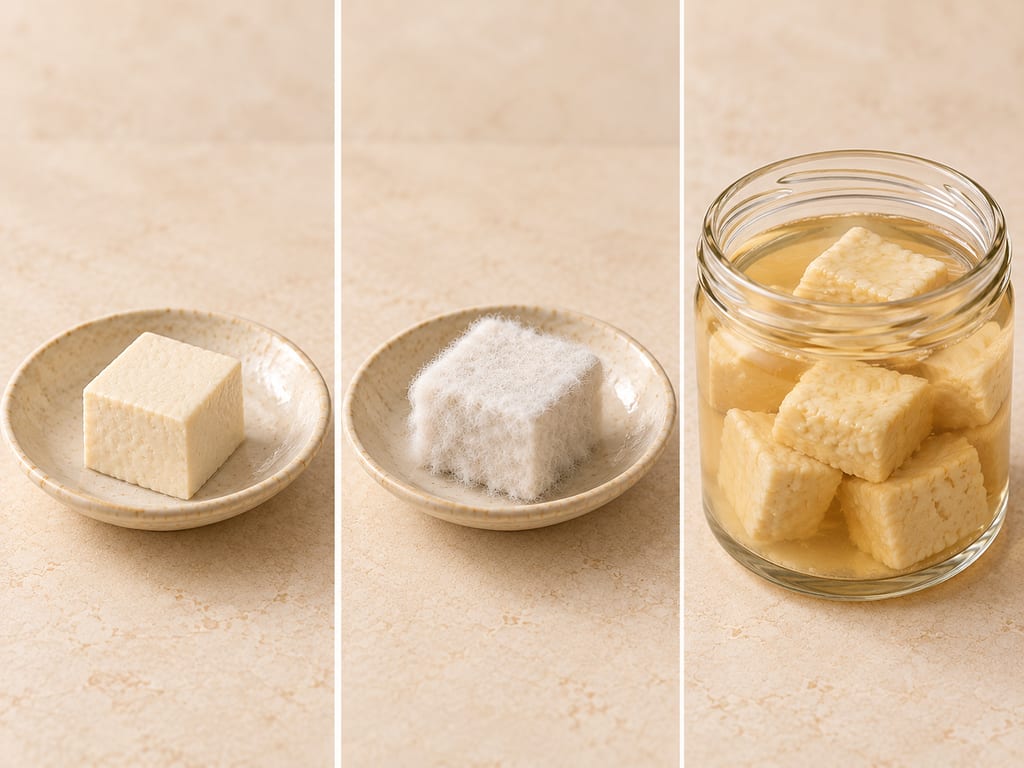
That is the protocol of a 2023 study by researchers at Jiangnan University in Wuxi, China, who made sufu with Mucor racemosus, a strain first isolated from sufu made in Mouding, in Yunnan Province. It shows the shape of the whole food in two numbers: mould for days, brine for months.
What follows is what sufu is, where it comes from, what the mould and the brine do to a block of soy curd, and why nobody can yet hand you a tested recipe for a home kitchen.
Tofu, pehtze and the dressing
Sufu, also called furu, is made by growing fungi on tofu in a solid-state fermentation, which means on the solid curd rather than in a liquid. The mould-covered intermediate is called pehtze. The pehtze is then aged in brine that contains salt and alcohol. The starters named in the literature belong to three genera: Actinomucor, Mucor and Rhizopus.
What happens after the pehtze decides what comes out of the jar. The dressing, the mixture the pieces age in, determines whether the result is red, white or grey. Researchers list four routes to sufu: mould-fermented, naturally fermented, bacterial and enzymatically ripened. So sufu is a family of foods, and the stages of one version cannot be borrowed for another.
A food with a long paper trail
Sufu originated in China. Written records of it date to the Wei Dynasty, 220–265 AD. That is a date of first attestation, not the day someone invented it.
Food scientists group it with miso and shoyu from Japan, tempe from Indonesia and Chinese douchi as a mould-fermented soybean product. A 2024 survey of the world's ethnic fermented foods proposes Northeast Asia as one possible birthplace of fermentation, tied to early pottery and salt-making. It also contrasts an Eastern habit of fermenting mainly to improve the taste of plant foods with a Western one of fermenting mainly to make animal foods last.
What the mould and the brine do
The mould works mostly through enzymes. Proteases, the enzymes that cut proteins into smaller pieces, turn up in both the outside and the inside of sufu during manufacture, so protein breakdown runs through the whole block and not only the furry surface. Amino acids become the main nitrogen compounds in it. Succinate, histamine and trimethylamine levels correlate positively with protease activity.
Histamine is a biogenic amine, and biogenic amines are what safety surveys of sufu measure. The same breakdown that builds flavour therefore also produces the compounds that raise a safety question.
Salt decides which microbes survive. Counts of several microbial groups rise from tofu to pehtze and fall after the pehtze is salted. With 8% and 11% salt, aerobic bacteria and bacterial spores fall during ripening, but they do not disappear. Bacillus cereus, a spore-forming bacterium, stays in the product through ripening.
A summer jar in Shanghai
In Shanghai, fermented bean curd is a summer food. Fengxian district is known for it, and its best-known maker is the Dingfeng Brewery Food Company, whose bean-curd fermentation technique went onto the city's Intangible Cultural Heritage Representative List in 2007. The company makes more than 20 varieties, red and white among them.
The city describes it as a summer staple, eaten with rice porridge, its saltiness said to help digestion in the hot months. That is one producer in one city, not a rule for sufu everywhere.
What the safety figures say
A survey of finished products found total biogenic amines above 900 mg/kg in 19 white sufu samples. Putrescine turned up in every sample and was the amine present at the highest concentration. The authors judged 25 of 33 fermented bean curd samples unsafe, against 8 of 30 samples of fermented soya beans. Those are survey figures. They do not tell a cook how to make a safe batch.
Nobody has published a tested household method, and nobody offers a validated check for the mould, an alcohol level to aim for, a storage limit or a shelf life for any variant. The 180-day protocol above worked with a defined strain, a counted spore dose and a stated brine, and copying its numbers into a kitchen does not copy those controls. The look, smell and taste of a jar cannot tell you whether it is safe.
The open questions are practical ones: which controls a home cook would need, and what a safe endpoint looks like for each of the red, white and grey forms.
Community
No community contributions have been published for this entry yet.
Share what you made
Sign in to contribute. Published comments and photos are free to read.
Sources
International Journal of Food Microbiology (Han, Rombouts and Nout, 2001)
A Chinese fermented soybean foodCited in: Tofu, pehtze and the dressing; A food with a long paper trail
Foods (Xie et al., 2023)
Evaluation of Sufu Fermented Using Mucor racemosus M2: Biochemical, Textural, Structural and Microbiological PropertiesCited in: Half a millilitre of spores; What the safety figures say
Food Control (Han, Cao, Rombouts and Nout, 2004)
Microbial changes during the production of Sufu - a Chinese fermented soybean foodCited in: What the mould and the brine do
Journal of Agricultural and Food Chemistry (Yang, Ding, Qin and Zeng, 2014)
Safety assessment of the biogenic amines in fermented soya beans and fermented bean curdCited in: What the safety figures say
LWT - Food Science and Technology (Liu, Han, Deng, Sun and Chen, 2018)
Changes in proteases and chemical compounds in the exterior and interior of sufu, a Chinese fermented soybean food, during manufactureCited in: What the mould and the brine do
Frontiers in Microbiology (Tamang, Watanabe and Holzapfel, 2016)
Review: Diversity of Microorganisms in Global Fermented Foods and BeveragesCited in: A food with a long paper trail
Journal of Ethnic Foods (Lee, Ahn and Son, 2024)
Ethnic fermented foods of the world: an overviewCited in: A food with a long paper trail
Gaps
- The 2001 review, the 2014 amine survey, the 2018 protease study and the 2024 overview were read as abstracts only.
- The 2023 study gives no temperature for the three-day mould stage and does not say whether its brine percentages are by weight or by volume.
- No validated household batch, mould acceptance test or storage limit exists in the sources for any sufu variant.
Updated 2026-10-29