
Techniques
Strings in Ibaraki, balls in Burkina Faso: the Bacillus bean ferments
Natto's sticky threads, Thai thua nao, Himalayan kinema and West African sumbala all begin with Bacillus working on cooked beans. How they differ, where the numbers disagree, and why no tested kitchen schedule exists.
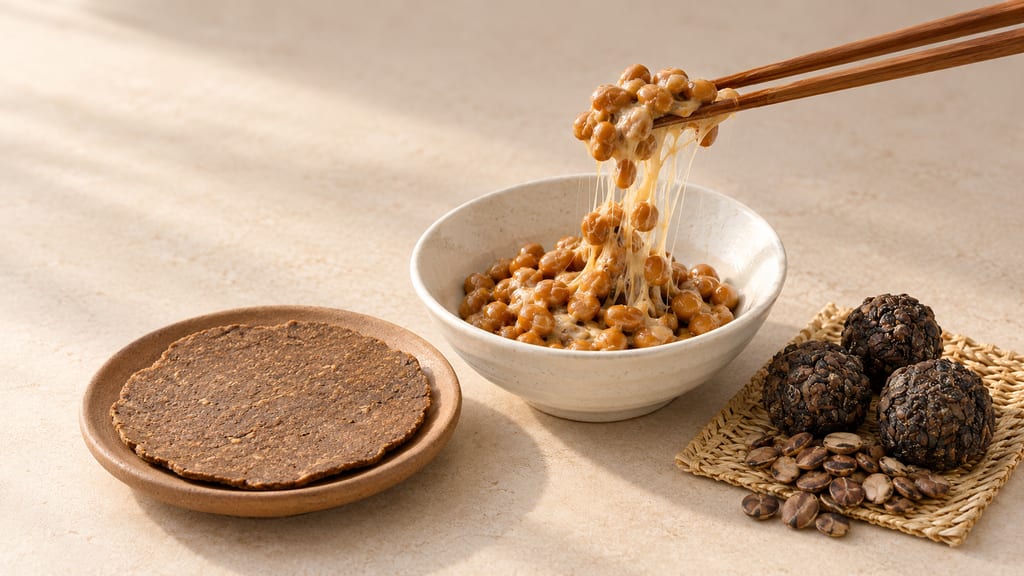
Natto stirred until it forms strings, beside a thua nao patty and balls of fermented locust-bean seeds: three Bacillus bean ferments from three regions.
A spoonful that pulls back
Lift a spoonful of natto and it follows you in a rope. The threads are poly-gamma-glutamic acid, a compound the bacteria form during fermentation, and they mark the sticky type of Japanese natto, called itohiki. A salted type also exists, known as shiokara natto, with daitokuji and hama as other names.
Natto needs no cooking before it reaches the bowl. It is usually eaten with rice, mixed with soy sauce, mustard and green onions. In Ibaraki it also tops ochazuke, and because it is salty it is served with alcohol as an appetiser.
The bacterium behind it is Bacillus subtilis, and its work on beans is not a Japanese monopoly. Northern Thailand, the Eastern Himalayas, Myanmar and Korea each have a bean ferment of the same kind, and in West Africa the seeds of the African locust bean, Parkia biglobosa, are fermented in a similar way from Burkina Faso to Benin. These foods belong to one family, built on bacteria that break proteins down rather than on acid, but they are not the same food, and nobody should assume that a starter from one will reproduce another.
Rice straw, a legend and small beans
Nobody can say where fermented soybeans began. Their origin remains unclear, and written history of such products reaches back nearly a thousand years, to 1052. That date covers fermented soybean products in general, not natto in particular.
Japan's agriculture ministry records a more vivid story, which it labels a legend: the warrior Minamoto no Yoshiie and the Heian period (794–1185). The documented history starts later. By the Edo period (1603–1867) natto was a common household food, served in soups or with soy sauce, and from 1889 the Mito Railway sold it.
Mito's natto owes something to flood planning. The Mito clan encouraged early-maturing soybeans that could be harvested before the typhoons, to prepare for flooding of the Naka River. The beans came out too small for soy sauce or miso, so they went into natto. Ibaraki also makes soboro natto, natto mixed with dried daikon strips, and a pickle of leftover natto kept with daikon, salt, soy sauce and mirin for about a month. Both are local practice, not rules for natto in general.
Early natto was steamed beans wrapped in rice straw, which carried wild Bacillus subtilis and soaked up the ammonia smell. Once a pure culture had been isolated, the straw method was dropped and commercial natto manufacturing began. Some makers now wrap beans in pasteurised straw and still add a commercial culture, as a mark of tradition.
Why the starter matters
Wild straw carries many bacteria, and few of them make natto. A 2011 screen of 424 spore-forming strains collected from rice straw found that only 59 could ferment natto. Those 59 formed a tight cluster within the Bacillus subtilis subspecies subtilis group, so the ability to make natto belongs to a particular group of strains.
That is why the BC Centre for Disease Control's guidance for natto producers requires a commercially purchased culture and advises against spontaneous fermentation with rice straw, citing safety concerns. A wild Bacillus that grows on beans is not necessarily one that makes natto.
Two descriptions of the same factory
The Japan Natto Cooperative Society Federation and the BC Centre for Disease Control both describe how natto is made at scale, and their numbers do not match. They describe different kinds of practice. The Federation describes how Japanese factories work, with times that vary by manufacturer and container. The Centre lists the control points an operator must hold. Neither is a home recipe. Both are given here as each source's own practice, and where they differ the Centre's guidance is the reference for safety.
Soaking is the first split. The Federation soaks beans in more than three times their weight of water, at about 15 °C for 17–18 hours in winter or about 25 °C for 7–8 hours in summer. The Centre calls for tap water at 0–4 °C for one to two days, until the beans weigh 2.2–2.5 times their dry weight, and says not to acidify the soak water.
Steaming is where the Federation gives no figures; it uses a pressure cooker, and times and temperatures vary by manufacturer. The Centre specifies 15–20 psi for 20–30 minutes, which corresponds to 121 °C.
Inoculation is the sharpest disagreement. The Federation sprays starter onto hot beans at about 70–90 °C. The Centre has the beans cooled to 40 °C first, and requires them to fall below 60 °C within two hours before culture.
Incubation then runs at 38–42 °C for 16–24 hours in the Federation's account, depending on the container. The Centre sets 40–50 °C for about 18–24 hours, with humidity held at 85–90% and later 75%, and expects the core of the beans to reach 48–52 °C by hour 14. Afterwards the Federation cools the natto to room temperature and then holds it in a refrigerated room at 5 °C or under. The Centre requires cooling to 10 °C or lower within four hours and a maturation of 8–24 hours at 10 °C or lower. For commercially made natto the Centre gives a shelf life of 7–12 days below 10 °C, or months frozen at −18 °C.
Thua nao and pe poke: the Southeast Asian cousins
In northern Thailand the equivalent is thua nao, sold in markets as patties of fermented soybeans. Production has been surveyed in Chiang Mai, Chiang Rai and Mae Hong Son. Nine samples from eight markets in Chiang Rai and Payao gave 45 strains of Bacillus subtilis of the natto type, which Japanese researchers compared with Miyagino, a natto starter.
Pe poke, from Myanmar, has been studied for its microbial communities. That research describes the product's microbes. It does not show that a generic natto starter would reproduce its character.
Kinema and the Himalayan names
In the Eastern Himalayas the bean ferment is kinema. A 2022 survey from Sikkim University pooled eighteen sun-dried samples from India, Nepal and Bhutan and read their DNA. Firmicutes made up 93.36% of the community and the family Bacillaceae 81.03%. Bacillus subtilis was the most abundant species, followed by Bacillus glycinifermentans.
The traditional method is a home process: soak the beans overnight, boil them, drain them, wrap them in fern fronds or paddy straw and pack them in bamboo baskets. They then ferment for one to three days above an earthen kitchen.
Other hill communities have their own versions: axone or akhuni among the Naga, hawaijar in Manipur, tungrymbai in Meghalaya, bekang in Mizoram and peruyaan in Arunachal Pradesh. Work on selected Bacillus starters for these foods tries to understand and control production. It does not show that any given Bacillus isolate is suitable for food.
Korea's cheonggukjang sits in the same family. It is a shorter bacterial soybean tradition, closer to the alkaline-bean ferments than to a long salty sauce brew.
Locust-bean seeds in West Africa
In West Africa the beans are the seeds of the African locust bean, Parkia biglobosa. The seeds are cooked, dehulled, cooked again and fermented while still moist. The products go by many names: soumbala or sumbala, dawadawa or dadawa, iru, nététou and afitin. Names and formulations vary.
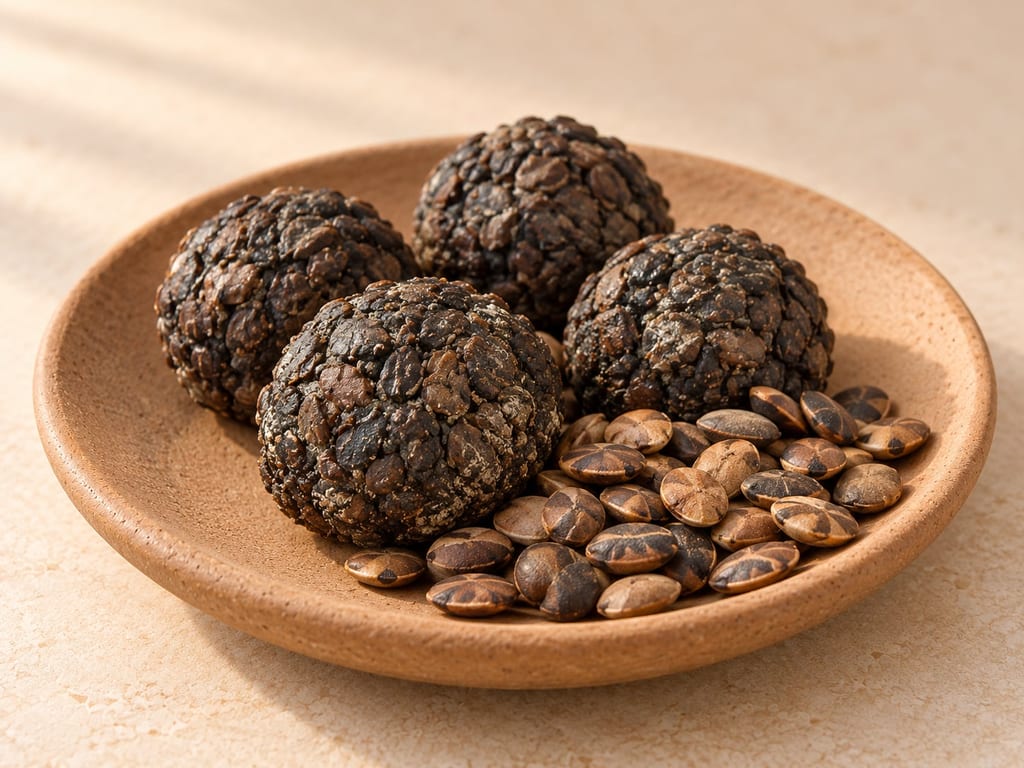
Accounts differ on the raw material of dawadawa. An atlas of African fermented foods assigns it to Parkia biglobosa, while a review of legume ferments cautions that the raw material has to be checked rather than inferred from the name.
The chemistry is the one the family shares. In soumbala made with Bacillus subtilis and Bacillus pumilus, free amino acids, lysine among them, rose sharply between 24 and 48 hours of fermentation, and the pH rose too. Each isolate produced its own amino acid profile. A 2000 Nigerian study measured a pH above 7 in iru, ugba and ogiri.
In Benin, afitin, iru and sonru are three separate products with different processes, even though all come from the same seeds. Other alkaline seed and leaf ferments follow the same logic. A selected Bacillus subtilis inoculum has been used to speed up ugba, ogiri-egusi has been tested with Bacillus subtilis under controlled temperature and humidity, and okpehe is being tried with selected Bacillus starters. Ntoba mbodi, a cassava-leaf ferment, sits at a pH of about 8.5 with Bacillus prominent.
The contrast with an acid bean ferment makes the point. Ethiopia's siljo is a faba-bean ferment started with mustard, and it was already at pH 4.5 after 36 hours. It is a different path and not a Bacillus soy process.
What the strings do not prove
Stringiness, smell and taste do not identify the species, the strain or a safe batch. The hazards named for natto are Bacillus cereus and Clostridium perfringens, both of which can grow in soybeans cooked or cooled improperly. Naming the species in a ferment is not a safety assessment either, and Bacillus cereus has been detected in some samples of these foods.
A study of 19 Bacillus cereus isolates from afitin, iru and sonru shows how wide the range can be. The highest amounts of cereulide, a Bacillus cereus toxin, that isolates formed in fermented locust beans were 6 ± 5, 97 ± 3 and 0.04 ± 0.02 µg per gram of beans, a spread of more than a thousandfold. Which value belongs to which product is not settled.
Nobody has published a tested temperature-time schedule, pH endpoint, shelf life or storage limit for natto made at home. Laboratory protocols exist, such as a 50 g study that soaks beans for 16 hours at 20 °C, steams them for 30 minutes at 131–133 °C and incubates them for 18 hours at 39 °C and 90% humidity, but they are not household preparation. Some household instructions in circulation call for a room-temperature soak of 9–12 hours, a boil of two to three hours and 22–24 hours at 38 °C. That schedule conflicts with the 0–4 °C soak and the commercial culture the Centre requires, and nothing shows it to be safe.
Where this leaves the cook
Bacillus ferments beans across Asia and West Africa, and the foods differ in their beans, their microbes and their methods. Natto is the one that moved from straw-wrapped beans to an isolated pure culture and a commercial industry. The Himalayan and West African versions are mostly described as traditional practice, studied through the microbes found in them.
What remains unknown is the part a home cook most needs: a tested schedule, with a safe soak, an incubation temperature and a storage limit. Until someone publishes one, these foods are best bought from makers who control the process, or studied rather than copied at home.
Community
No community contributions have been published for this entry yet.
Share what you made
Sign in to contribute. Published comments and photos are free to read.
Sources
BC Centre for Disease Control
Fermented Foods Guidance, Section 3.8: NattoCited in: A spoonful that pulls back; Rice straw, a legend and small beans; Why the starter matters; Two descriptions of the same factory; What the strings do not prove; Where this leaves the cook
Ministry of Agriculture, Forestry and Fisheries, Japan
Ibaraki NattoCited in: A spoonful that pulls back; Rice straw, a legend and small beans
Japan Natto Cooperative Society Federation
How natto is madeCited in: Two descriptions of the same factory
Applied and Environmental Microbiology
Phylogenetic Analysis of Bacillus subtilis Strains Applicable to Natto (Fermented Soybean) ProductionCited in: Why the starter matters
Japan International Research Center for Agricultural Sciences (JIRCAS)
Research results 2007: Bacillus subtilis (natto) strains from thua naoCited in: Thua nao and pe poke: the Southeast Asian cousins
Frontiers in Microbiology
Metagenomic-Metabolomic Mining of Kinema, a Naturally Fermented Soybean Food of the Eastern HimalayasCited in: Kinema and the Himalayan names; Where this leaves the cook
Journal of Applied Microbiology
Degradation of proteins during the fermentation of African locust bean (Parkia biglobosa) by strains of Bacillus subtilis and Bacillus pumilus for production of SoumbalaCited in: Locust-bean seeds in West Africa; Where this leaves the cook
Food Microbiology
Formation of cereulide and enterotoxins by Bacillus cereus in fermented African locust beansCited in: What the strings do not prove
International Journal of Food Microbiology
Afitin, iru and sonru, three traditional fermented condiments from African locust bean in BeninCited in: Locust-bean seeds in West Africa
Gaps
- No tested home temperature-time schedule, pH endpoint, shelf life or storage limit is available for any Bacillus-fermented soy food.
- The locust-bean studies were read as abstracts, so their temperatures and durations, and the mapping of cereulide values to products, are not established.
- The raw material of dawadawa is described differently in different accounts and is unresolved.
Updated 2026-10-29