
Techniques
A minute without air: how a tank of bubbles makes vinegar
Cut the air to a vinegar tank for 60 seconds and acid formation stops. The story of submerged acetification: an Austrian patent, the machines built since, and why every number belongs to its own tank.
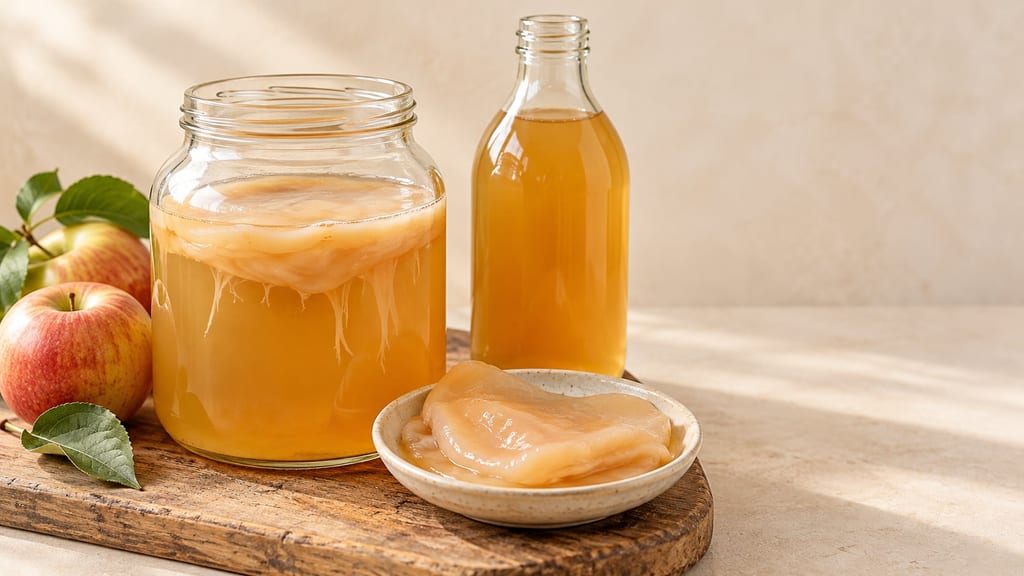
A still life of unfiltered vinegar and a vinegar mother, the surface culture that a submerged tank does without.
Sixty seconds without air
A United States patent granted in 1955 to Otto Hromatka of Salzburg and Heinz Ebner of Linz contains a figure that is easy to miss. About 14 hours into a vinegar run, the inventors interrupted the air supply for 60 seconds. Acid formation stopped.
The organisms that care are acetic acid bacteria. They make vinegar by oxidising ethanol, the alcohol in wine, cider or spirits, into acetic acid and water, and they need oxygen to do it. Vinegar therefore takes two stages. Yeast turns sugar into alcohol first, and the bacteria take the alcohol the rest of the way. Whatever the method, the working question is how to get air to the bacteria.
Submerged acetification answers it by suspending the bacteria in the liquid and driving air through in fine bubbles. It is easiest to understand next to the two methods it is usually set against.
Surface, trickle and bubble
The classic surface method is associated with Orléans, in France. The bacteria grow where the liquid meets the air, and the culture that forms there is the vinegar mother. Oxygen reaches the cells mainly across that one boundary.
The rapid-generator process, described in NC State Cooperative Extension's vinegar guide, works differently. The vessel has two chambers. The upper one is packed with wood shavings or corncobs. Air is forced upward through the packing, and the liquid trickles down over it and is recirculated. The guide gives the endpoint as alcohol reduced to half a percent.
Submerged acetification drops the packing. The bacteria float free in the wine with no porous support, and fine bubbles carry the air to them. One Austrian producer says that keeping the culture in suspension prevents the formation of what it calls a vinegar nut.
The patent from 1949
The patent is titled “Method for the production of vinegar acids by oxidative fermentation of alcohols”. Its Austrian priority date is 3 May 1949. The American application was filed on 11 December 1951 as a continuation-in-part of one filed on 7 April 1950, and the patent was granted on 3 May 1955.
Hromatka and Ebner set a submerged column against both older routes: surface fermentation and the trickle-bed process known as quick vinegar. Their examples ran at 30 and 31 °C, with air supplied at between 5 and 60 litres an hour depending on the example. In the claimed embodiment the bubbles measured 5–15 micrometres.
In the second example, a feed of about 6.9% alcohol by volume at 31 °C was fully converted in about 20 hours, with a reported yield of 96%. The inventors put the maximum rate of acidification at 0.5% per hour, about ten times the rate of quick vinegar, and expected about 20 times the output of quick vinegar from an apparatus of the same size over the same time. In the fourth example they changed the gas after 12 hours to 30% oxygen and 70% nitrogen at 33 litres an hour, and oxidation was complete at 22 hours.
A patent proves a filing, not a birthplace. It does not say who first bubbled air through vinegar, or where. Orléans, the 1949 filing and the German company Frings are three separate threads: a place linked to a surface method, an Austrian patent, and a later maker of equipment. None of them is the origin of the other two.
Inside an acetator
Acetator is a trademark of Frings, a German supplier of industrial vinegar equipment. Frings says the name has become a worldwide term for vinegar fermenters, and this article uses it for the machine in that sense.
A 1979 drawing credited to Mecca and colleagues, reproduced by Embrapa, shows the parts of a stainless-steel acetifier. A large vessel holds an air turbine at the bottom and cooling tubes. The labelled parts are the air turbine, an air compensator, a condensate collector, a foam-control device, an alcohol meter, a cooling coil, a thermometer, a pump that feeds wine in and a pump that takes vinegar out.
A current producer, Hengstenberg, describes the same arrangement in plainer terms. A fan and an aerator make small, fine bubbles at the bottom of the tank. Mash is fed in from above, and vinegar is drained continuously while new mash is added.
Frings builds acetators in standard sizes that can be combined, and a Super-Charged version raises output without enlarging the tank. Its equipment list reads like the 1979 drawing with modern controls: a high-performance aerator, an internal stainless-steel cooling coil with a frequency-controlled cooling-water pump, an alcohol probe, a controller, a vertical defoamer, and an exhaust-air condenser or two-stage scrubber.
Essig, an Austrian producer, sells a smaller plant in three sizes. The Pro Small has a 230 litre tank holding 150 litres and a 370 watt drive. The Pro Professional has a 1,000 litre tank holding about 700 litres and a 1,200 watt drive, and weighs 146 kg. Parts that touch the liquid are 1.4301 stainless steel with acid-resistant, food-safe seals, the aeration is double with variable air supply, and the cooling water must be below 14 °C.
Each part answers a consequence of the same oxidation. The reaction releases heat, so the tank has a cooling coil. Air driven through a liquid foams, so it has a defoamer. Ethanol and acetic acid can leave with the exhaust air, so the equipment literature describes recovery or treatment of it.
One cycle, and whose numbers they are
Embrapa describes a repeated-batch cycle. The tank is seeded with about 10% unpasteurised vinegar. Wine at 8–10% alcohol by volume is recommended, and 10–12% in modern practice. An initial acetic acid content below 1% is advised, because above 3% it is toxic to the bacteria in the early phase. When the alcohol has fallen to about 0.2%, 40–45% of the vinegar is withdrawn and replaced with the same volume of wine. A cycle takes 30–40 hours. Evaporation losses are 3–5%, against about 10% in the rapid process, and wine below 4% alcohol gives vinegar below 4% acetic acid.
Producers quote their own figures. Hengstenberg runs its acetator at 28 °C, which it calls particularly comfortable for the bacteria, aims at about 5% acidity and adds water to reach it. It calls a low alcohol content in the mash very important but gives no number. Essig says conversion takes 12 to 36 hours, depending on raw material, starting alcohol and tannin, that acidities up to 10% are possible, and that finished vinegar holds less than 0.1% alcohol by volume. Its Pro Professional is rated at 300 litres a day at 7% acid.
These figures do not add up to one recipe. Each belongs to its own tank and its own wine. They also come from different kinds of source: a 1979 equipment description, the laboratory and pilot examples in a 1955 patent, and current producers' claims, which are not controlled measurements. The units differ as well. The patent measures acid in grams per 100 cm³, about the same as percent weight in volume, while Embrapa gives alcohol as percent by volume. Embrapa's account gives no final acidity for its submerged process. The 4–5% in its text belongs to the slow process.
What goes wrong
Oxygen is the first thing to fail. A laboratory study of acetic acid bacteria found that even a short depletion of oxygen during precultivation could reduce the reproducibility of results. It is an observation from a reactor, in the same spirit as the patent's 60 seconds, and neither is an instruction for a jar on a counter.
Loss of cooling or monitoring also changes both the culture and the product. Foam can carry over, and acid mist and alcohol vapour leave with the exhaust.
Measured alcohol and acidity decide when a batch is finished. Embrapa's cycle turns at about 0.2% alcohol, Essig's product ends below 0.1%. Taste, smell, bubbles and appearance do not decide it. After the endpoint, oxygen exposure still has to be managed, and a sealed bottle of unfinished product could build pressure if fermentation continues.
What a tank does not tell a kitchen
Everything above comes from an industrial plant, a patent's laboratory and pilot runs, or an instrumented reactor. None of these sources tests a household version, and none gives an apparatus, a schedule or a set of limits that a kitchen could use. A sealed vessel with an air pump is not shown to behave like a tank with a turbine, a cooling coil and a defoamer, and the numbers here should not be carried over to one.
What the story leaves is a question rather than a method. Every vinegar is a negotiation over air. A mother floating in a jar and a bubbling stainless tank are two answers to it, and the patent's minute without air shows what happens when the answer fails.
Community
No community contributions have been published for this entry yet.
Share what you made
Sign in to contribute. Published comments and photos are free to read.
Sources
Embrapa Uva e Vinho
Sistema de Produção de Vinagre — Vinho para acetificaçãoCited in: Surface, trickle and bubble; Inside an acetator; One cycle, and whose numbers they are; What goes wrong; What a tank does not tell a kitchen
Process Biochemistry
Aerobic submerged fermentation by acetic acid bacteria for vinegar production: Process and biotechnological aspectsCited in: Sixty seconds without air; What a tank does not tell a kitchen
Process Biochemistry
Ensuring constant oxygen supply during inoculation is essential to obtain reproducible results with obligatory aerobic acetic acid bacteria in vinegar productionCited in: What goes wrong
Heinrich Frings GmbH & Co. KG
Acetators for your industrial productionCited in: Inside an acetator; What goes wrong
Hengstenberg
Insights into our vinegar productionCited in: Inside an acetator; One cycle, and whose numbers they are
Google Patents
Method for the production of vinegar acids by oxidative fermentation of alcohols (US 2,707,683 A)Cited in: Sixty seconds without air; The patent from 1949; One cycle, and whose numbers they are; What goes wrong; What a tank does not tell a kitchen
Fischerauer Feinstes GmbH (Essig)
Submerged vinegar plant PROCited in: Surface, trickle and bubble; Inside an acetator; One cycle, and whose numbers they are; What goes wrong; What a tank does not tell a kitchen
Gaps
- No household submerged acetification method or apparatus is supported by the sources read.
- No cleaning procedure or calibration schedule for a whole acetator was found.
- Embrapa gives no final acidity for its submerged cycle, and the producer figures are claims rather than measurements.
Updated 2026-10-29