
Techniques
Sweet tea, open air and a floating mat: how kombucha and jun ferment
Kombucha turns sweet tea into a sour, fizzy drink; jun does it with green tea and honey. How both are made, where health agencies set their limits, and why jun's origin story has no source behind it.
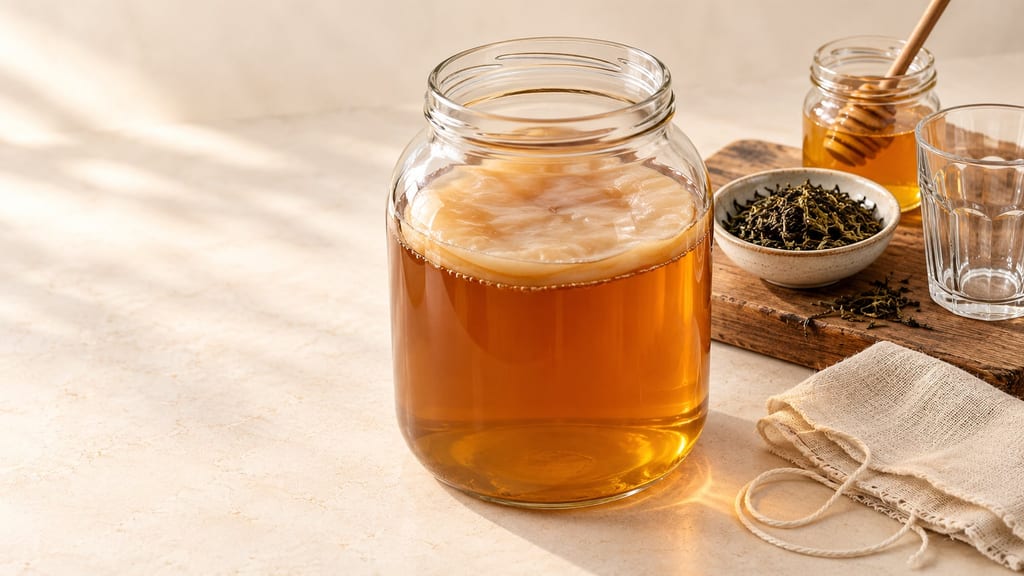
A wide glass jar of sweet tea, uncovered so the bacteria get air, with the pale cellulose mat that forms at the surface.
A glaze that dissolved in the tea
A woman of 58 and her husband, 63, each drank about 250 mL of home-brewed kombucha every morning for six months. They brewed it in a ceramic pot that had been imported from Spain 25 years earlier. By the end of those months both had lead poisoning, with blood lead of 5.95 and 4.49 µmol/L.
Tests on the pot and the culture showed where the lead came from. An extract from the pot held 198 mg/L of lead, against a British Standard limit of 4.0 mg/L. The tea carried 173 mg/kg, and the fermenting mat 329 mg/kg dry weight, where the permitted limit is 0.5. Lead had leached out of the glaze because the tea was so acidic.
That acid is the whole point of the drink, and microbes in the jar make it. How they make it, how health agencies decide when a batch is done, and what nobody can document about jun's past are the subjects of this story.
Two kinds of microbe and one open jar
Kombucha and jun are sweetened tea fermented by a mixed community of yeasts and acetic acid bacteria. The yeasts go first. They break down the sugars in the tea, in kombucha the sugars derived from sucrose, and release ethanol and carbon dioxide. The acetic acid bacteria then oxidise that ethanol to acetic acid. The second step lowers the ethanol as it raises the acidity, which is why the tea turns sour.
Researchers have named a long list of organisms in these cultures. The bacteria include *Komagataeibacter*, *Acetobacter*, *Gluconobacter* and *Gluconacetobacter*. The yeasts include *Zygosaccharomyces*, *Schizosaccharomyces*, *Brettanomyces*, *Saccharomyces*, *Pichia* and *Hanseniaspora*. Which of them dominate varies from jar to jar.
The bacteria need oxygen, and that sets the first rule of the technique. The BC Centre for Disease Control (BCCDC) requires the first fermentation to be aerobic and the vessel to stay uncovered, in practice a cloth over the top to keep out pests. A tight lid belongs to a later stage.
Home brewers call the culture a SCOBY, and the word covers two different things: the liquid from a previous batch and the cellulose mat that grows at the surface. A starter can be either one or both. BCCDC describes liquid starter as usual, with or without a piece of the mat; a Rockefeller University teaching page describes a small amount of active culture, a mat disc, liquid or both. A thick mat does not certify a batch. BCCDC has the mat removed when fermentation is complete, and any visible mould means the batch is thrown away.
Kombucha by the numbers
BCCDC's preparation for kombucha is specific. Steep 4–5 g of tea per litre in boiled water for at least 5 minutes, and dissolve 50–150 g/L of sugar, which is 5–15 %. Cool the liquid from 60 °C to 20 °C within 2 hours, and never let it take longer than 6 hours before the culture goes in. Add 100–200 mL of previous liquid starter per litre once the tea has cooled.
Primary fermentation then runs 7–21 days, typically 10, with 20–22 °C as the optimum and 10–26 °C as the range. The span of days is wide because the calendar is not the finish line. BCCDC's flow chart says to keep fermenting until the acidity reaches a set pH, a measurement covered below.
Jun: green tea, honey and a shorter clock
BCCDC treats jun as a separate preparation, and its recipe differs at every step. Steep 2 teaspoons of green tea per 2 L for 3–5 minutes, remove the leaves, and cool the tea to 20–22 °C. Stir 250 mL of honey into the 2 L until it dissolves. Add a starter, either a SCOBY or blackslop; the guideline gives no amount. Primary fermentation takes 4–7 days at 21–26 °C. A secondary stage in airtight bottles lasts 1–3 days, and then the bottles go into the refrigerator.
BCCDC also gives a reason for the honey. Cane sugar is half glucose and half fructose; honey is about 30 % glucose, under 40 % fructose and around 20 % a mix of other sugars. BCCDC reads that difference, together with the yeasts, as producing a higher alcohol content, and notes that jun tends to be more carbonated than kombucha. That is a regulator's explanation, not a measured result.
The measured results come from a 2023 thesis at the Federal University of Paraíba in Brazil. There jun means green tea and honey and nothing else, and the culture is trained on honey before use. Adaptation batches used 120 g/L of honey and 250 mL of starter. The main 9.5 L batch used 7.890 L of tea, 949.8 g of honey, which is again about 120 g/L, 1.610 L of starter and 209.17 g of SCOBY. It sat in a 15 L bioreactor under a voile cloth at room temperature, in the dark, and was sampled daily for 5 days. The starter measured pH 2.71 and 6.2 °Brix. In the thesis's alcoholic jun, alcohol reached 3 and 4.3 °GL after 14 days, measured by ebulliometry, which infers alcohol from the boiling point of the sample. A degree GL is the same as a percentage by volume.
A Vietnamese team is tuning jun in a different direction, adding soursop fruit. They varied green tea at 5, 7 and 9 g/L, honey at 110, 130 and 150 mL/L, SCOBY at 30, 50 and 70 g/L, and a first stage of 2, 4 or 6 days. After that came soursop at 150, 200 or 250 g/L for 1, 2 or 3 days. Their best combination was 7 g/L tea, 130 mL/L honey and 50 g/L SCOBY for 4 days, then 200 g/L soursop for 2 days. They measured °Brix, pH, total acid, polyphenols, colour and sensory quality. Alcohol is not among the measures listed, so the drink cannot be called non-alcoholic.
Jun's missing past
Ask where jun comes from and the answer is usually a story set in Tibet or the Himalaya. The Paraíba thesis says jun and a drink it calls Himalayan kombucha are reported to be as old as kombucha itself, though little studied and documented, and it cites Rana and colleagues (2021) for that.
A producer that sells jun and writes about it is blunter. The origin stories, it says, are mostly unsourced, and the Tibetan claim is not backed by Tibetan sources. It gives a Chinese name, Hongchajun, and describes its own drink: Dragon Well green tea, raw honey and a jun SCOBY, fermented for 3 days, bottled, and chilled for about a week. It gives no alcohol figure. Sellers elsewhere repeat the Tibetan origin, and no independent record for it has turned up.
So the name is documented and the lineage is not. Green tea and honey ferments labelled jun exist, and BC guidance, a Brazilian laboratory and a commercial producer each describe them differently. Whether a jun culture is a separate lineage or a kombucha culture kept on honey has not been settled by any independent microbiological or historical work found so far.
Kombucha's 220 B.C. and a 1913 culture from Latvia
Kombucha's own history comes with a date. BCCDC places its origins in north-east China, Manchuria, in 220 B.C., with later spread to Japan and Russia. A 2022 review of kombucha research gives the same date for its use in China, along with a story that a Dr Kombu brought it to Japan around 414 A.D., and a Russian name, Tea Kvass. Both state the date without qualification, and no primary record from before 1913 has turned up to support it.
The Rockefeller University teaching page tells it differently: the drink comes from Japan, and its name may be completely wrong, since kombu is a kelp. In that account the doubt is about the word.
The firmest documents are from the twentieth century. In 1913 Gustav Lindau described a culture in a paper titled Über Medusomyces Gisevii, in the Berichte der Deutschen Botanischen Gesellschaft, volume 31, pages 243–248. His material came from Mitau, now Jelgava in Latvia, by way of Paul Gisevius. Between about 1926 and 1928 the drink became a fashion in Central Europe, a period the historian Uwe Spiekermann has traced.
Spiekermann's trail shows the East Asian link arriving early in the paper record rather than in antiquity. A 1914 reference calls the culture a Manchurian-Japanese fungus, and a 1928 text by Wiechowski judges the Japanese origin claims in advertising to be fabricated. Manchuria is best read as a contested historical association, not a verified birthplace.
The acid test
BCCDC's finish line for kombucha is a pH of 4.2 or lower. That is an endpoint, not a starting value; the guideline gives no starting pH. If the batch does not reach 4.2, fermentation has failed and the product is discarded. It also says not to ferment below pH 2.5, and a kombucha or jun below 2.5 is not recommended, although reports of acidosis in kombucha drinkers remain rare.
For jun the same guideline gives three figures that do not match. Final acidity should be between pH 2.5 and 3.5, with 4.2 as the maximum, and in another place jun counts as finished between 2.5 and 4.0. After flavouring with fruit or juice, the pH should stay under 4.2 and above 2.5. The guideline does not say which of the three applies.
Raw honey can carry botulism spores, and BCCDC's reasoning is that an acidity below pH 4.6 should prevent them from fruiting. A 4.6 benchmark also appears in secondhand summaries of US state rules, which treat kombucha as a specialised process. Those summaries have not been checked against the rules themselves.
Brazil's Normative Instruction No. 41 of 2019 sets its own frame: commercial kombucha must fall between pH 2.5 and 4.2.
Alcohol, fizz and the bottle
Acidity is one limit and alcohol is another. Canada's guidance is that kombucha should contain less than 1.1 % alcohol by volume, and British Columbia's non-alcoholic limit is 1 %. Under the Brazilian rule, a non-alcoholic kombucha holds at most 0.5 % by volume and an alcoholic one 0.6–8.0 %. The Paraíba jun, at 3 and 4.3 °GL, sits above both non-alcoholic limits and inside the Brazilian alcoholic range.
The bottle adds pressure. Residual sugar means BCCDC requires refrigeration, and it warns that some jun and kombucha products can explode if they are not refrigerated. Its labelling advice reads that the product may contain alcohol and is not suitable for young children or during pregnancy. Packaging must be acid resistant, and vessels must be food-grade and non-reactive. The lead case at the top of this story shows what happens when they are not.
Sweetness, sourness, bubbles and a thick mat do not show that a batch is safe, and neither does the number of days on the jar. The guidance relies on a pH reading and an alcohol measurement.
What is settled and what is not
The technique is easy to state: sweet tea, a starter, air, time and a pH check. The numbers around it belong to particular rules. BCCDC's figures are one jurisdiction's guidance and Brazil's are another's; neither is a universal limit, and kombucha and jun should not be merged into one recipe.
What is not known is larger than it looks. Nobody has shown where jun comes from, or whether a jun culture is a separate lineage. The 220 B.C. date for kombucha has no primary record behind it that anyone has located. No measurement of alcohol in a typical household batch of jun has been found, and the Vietnamese soursop work lists no alcohol figure at all. The best-documented history of kombucha so far begins in 1913, in a botanical society's journal, with a culture sent from Latvia.
Community
No community contributions have been published for this entry yet.
Share what you made
Sign in to contribute. Published comments and photos are free to read.
Sources
BC Centre for Disease Control, Environmental Health Services
Fermented Foods Guideline, Section 3.11 Kombucha and JunCited in: A glaze that dissolved in the tea; Two kinds of microbe and one open jar; Kombucha by the numbers; Jun: green tea, honey and a shorter clock; Kombucha's 220 B.C. and a 1913 culture from Latvia; The acid test; Alcohol, fizz and the bottle; What is settled and what is not
Rockefeller University RockEDU
Kombucha as a Model for FermentationCited in: Two kinds of microbe and one open jar; Kombucha's 220 B.C. and a 1913 culture from Latvia
Foods (MDPI), open access in PubMed Central
Kombucha Production and Microbiological ResearchCited in: Two kinds of microbe and one open jar; Kombucha's 220 B.C. and a 1913 culture from Latvia
Universidade Federal da Paraíba
Obtenção de Jun alcoólico: acompanhamento cinético, tratamento térmico e saborização com polpa de acerola (Malpighia glabra L.)Cited in: Jun: green tea, honey and a shorter clock; Jun's missing past; The acid test; Alcohol, fizz and the bottle; What is settled and what is not
Journal of Agriculture and Environment (Vietnam)
Evaluation of some factors affecting fermentation of soursop (Annona muricata L.) Jun teaCited in: Jun: green tea, honey and a shorter clock; What is settled and what is not
Medical Journal of Australia 169(11):644–646, 1998
Lead poisoning from drinking Kombucha tea brewed in a ceramic potCited in: A glaze that dissolved in the tea; Alcohol, fizz and the bottle
Uwe Spiekermann
Eingehegter Wunderpilz: Die Kombucha-Mode in den späten 1920er JahrenCited in: Kombucha's 220 B.C. and a 1913 culture from Latvia; What is settled and what is not
Gaps
- Jun's origin and whether its culture is a distinct lineage are undocumented; no primary historical or independent microbiological source has been found.
- The Vietnamese soursop study was read as an abstract only, with no values and no alcohol data, and the 4.6 benchmark comes from secondhand summaries of US rules.
- BCCDC's numbers are one jurisdiction's guidance, and no specialist food-safety review has been done.
Updated 2026-10-29