
Full-cream milk
Full-fat fluid milk, available with different heat treatments and fat distributions; the linked Quark method permits homogenized or UHT forms.
 FermenteaWhere food goes to change
Equipment · Industrial and laboratory plant
A modern filling system that transfers commercially sterile liquid into sterile packaging and closes it while keeping the product, downstream equipment, package and filling zone under controlled aseptic conditions.
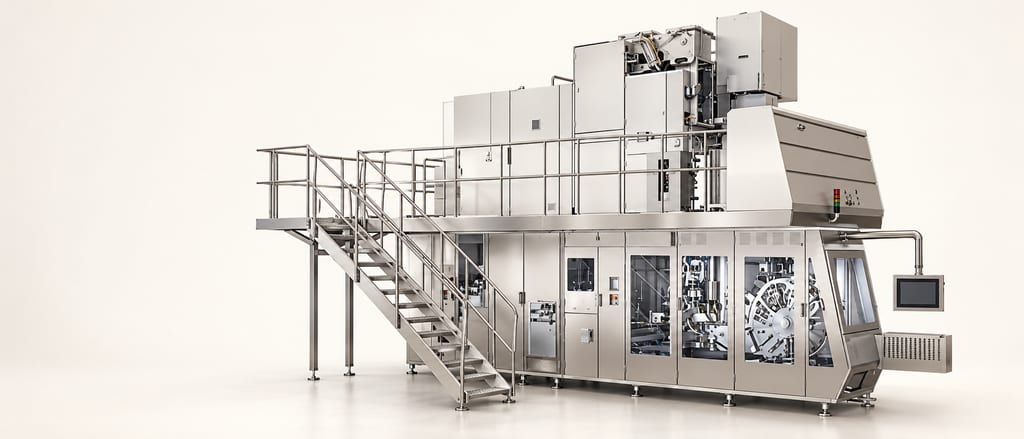
An aseptic filling line packages liquid food after a separate processing stage has brought the product to its scheduled condition. The FDA's inspection guide distinguishes the product sterilisation system and its holding tube, equipment downstream from that tube, packaging equipment, and the packaging material itself. Commercial sterility depends on controlling all of these linked parts, not on a filler in isolation.
Aseptic surge tanks may buffer sterile product before filling, while protective barriers help prevent contamination at downstream pumps, valves and shafts. The precise arrangement is specific to the process and package.
Filling machines bring packaging material into a controlled sterile zone, meter product into the prepared package and close or seal it without losing aseptic conditions. Packaging systems differ: the FDA guide describes metal containers, web-fed and preformed paperboard, plastic cups, thermoform-fill-seal packs and bag-in-box systems, each with its own sterilisation approach.
One contemporary carton example is Tetra Pak's A3/Flex. Its manufacturer describes a peroxide bath that treats packaging material inside and out, a temperature-controlled bath, a closed loop controlling sterile air in the aseptic zone, and integrated control of sterilisation, filling and sealing. These features illustrate one design, not a specification shared by every filler.
Before production, equipment and packaging areas must be brought to the conditions specified by the established scheduled process; during operation, the factors that maintain those conditions are monitored. The FDA guide treats loss of a critical factor as a process deviation and calls for the affected product and equipment to be handled under the applicable process.
That is why a line's capacity, package format, sterilisant and operating limits cannot be transferred from one machine or product to another. Ordinary bottling, a hot liquid poured into a clean container, and aseptic filling are different operations.
This page describes modern industrial equipment. The inspected sources do not establish an older traditional form or a single origin for aseptic filling lines.
A breach in product, downstream equipment, packaging equipment or packaging-material control can compromise the processed food.
Hazard sourceUse the product- and packaging-specific scheduled process established by a process authority; maintain specified sterile conditions and handle deviations as directed.
Control sourceAseptic processing is a validated industrial system. A filler alone, kitchen heating or an ordinary sealed bottle does not establish commercial sterility.
A filler is only one part of the system: product, downstream equipment, packaging equipment and packaging material each require control.
Source →Heating liquid in a kitchen and pouring it into an ordinary bottle does not reproduce aseptic production.
Source →The inspected sources do not establish a specific place of origin or a representative place of use for this equipment category. Manufacturer-specific examples do not establish the geography of the broader type.
Full-fat fluid milk, available with different heat treatments and fat distributions; the linked Quark method permits homogenized or UHT forms.
No community contributions have been published for this entry yet.
Sign in to contribute. Published comments and photos are free to read.
U.S. Food and Drug AdministrationTechnical description · Process control · Safety
Aseptic Processing and Packaging for the Food IndustryThe guide separates control of product, equipment downstream from the holding tube including the filler, packaging equipment and packaging material.
It describes package sterilisation approaches for metal cans, paperboard, plastic cups, thermoform-fill-seal and bag-in-box systems.
A process deviation requires management under the applicable scheduled process and may require equipment re-sterilisation.
Cited in: A filler is one part of an aseptic system; Sterilise, fill and close the package; Why the operating process matters
Tetra PakContemporary equipment example
Tetra Pak A3/FlexManufacturer describes an aseptic carton filler with a peroxide bath and temperature control for packaging material.
Manufacturer describes a closed loop for controlled sterile air in the aseptic zone and integrated control of sterilisation, filling and sealing.
Cited in: Sterilise, fill and close the package; Why the operating process matters