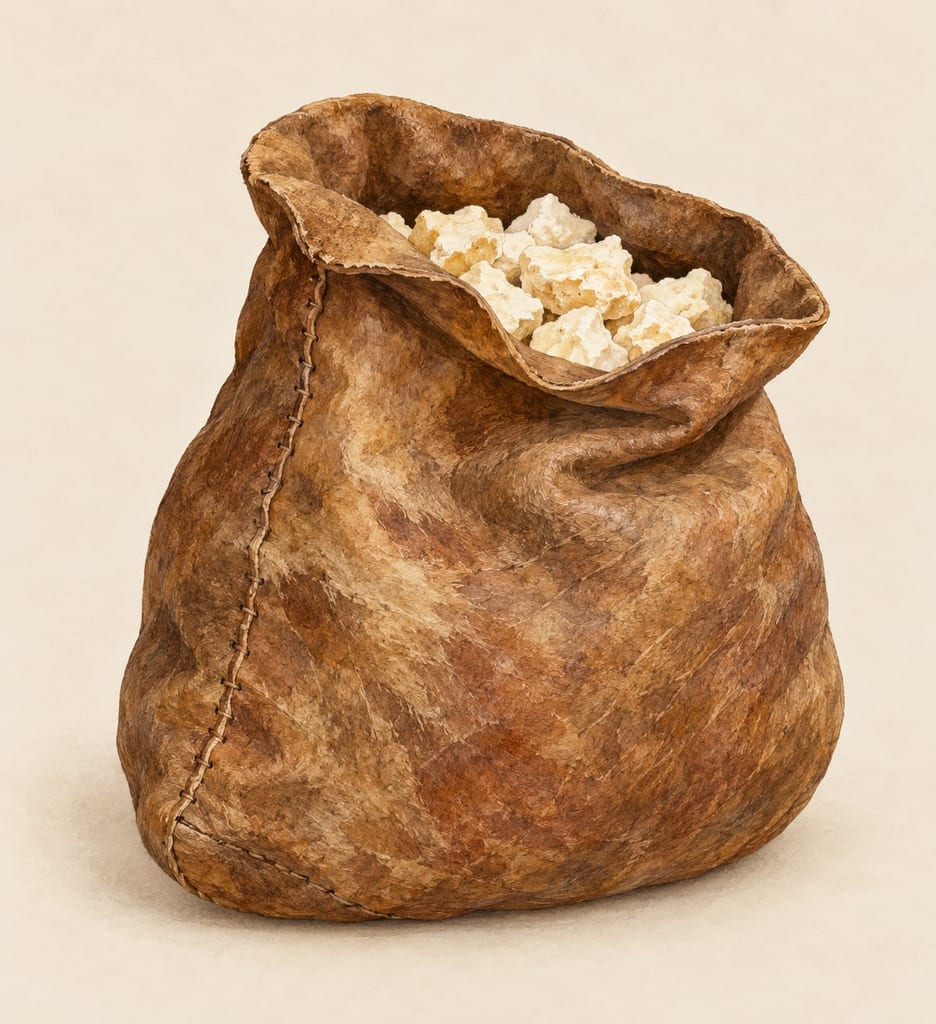
Hide bags for storing aarchy
In Altai, dried aarchy was traditionally stored in bags sewn from animal hides. The surviving description establishes the material and use, but not a standard shape or present-day practice.
 FermenteaWhere food goes to change
Equipment · Bark vessels
Birch-bark container · Birch-bark tuyes
Ket sources describe frozen lingonberries in birch-bark containers; Shor sources describe salted wild garlic in birch-bark tuyes. Their exact forms are not documented.
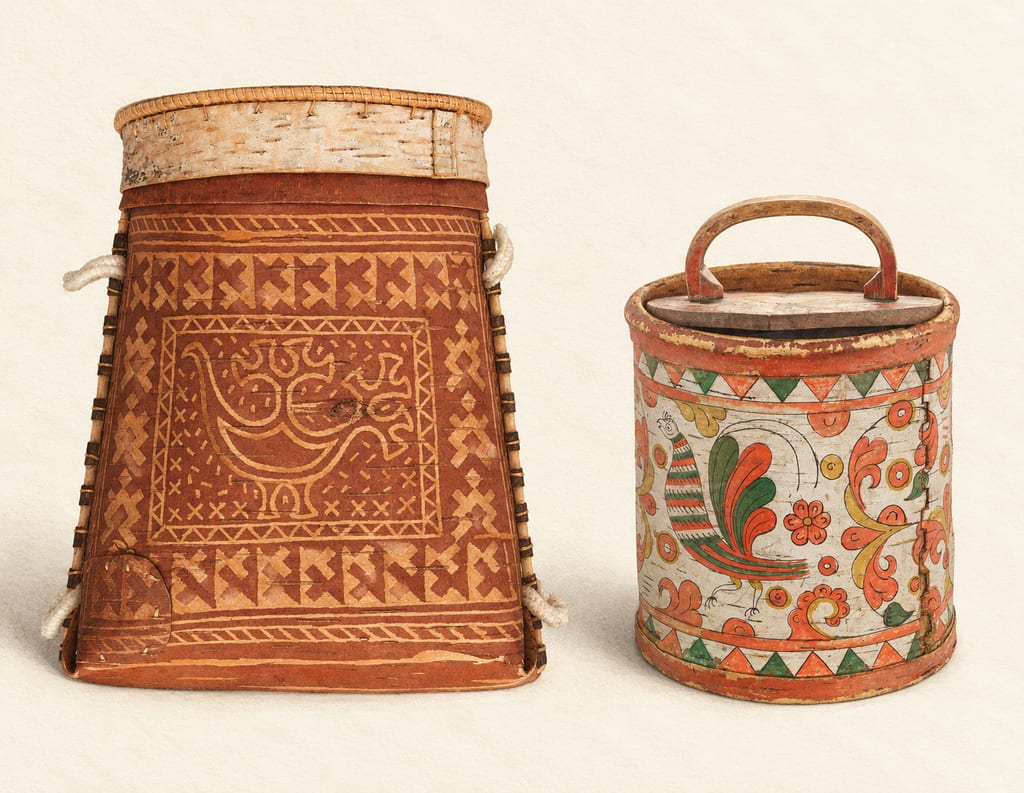
Birch-bark containers appear in two distinct food-storage records. The source dossier reports that Ket people kept lingonberries frozen in large birch-bark containers. Separately, it describes the Shor preparation kolba: wild garlic chopped and salted in birch-bark tuyes, with glass jars used later. The Shor record links a named food preparation to its container; it does not establish that the storage itself was fermentation.
The accounts are people-level attestations. They do not give the exact village, dimensions, shape, lid, seam, bark layers or method of manufacture. The two uses therefore belong together as evidence for birch-bark food containers, but should not be collapsed into a single reconstructed design.
Museum collections document bark-vessel forms elsewhere in Siberia and northern Russia. An Oktyabrskoye Museum and Exhibition Center object made by Agafya Voldina in 1998 is identified as Khanty, from the Khanty-Mansi Autonomous Okrug. Its record lists birch bark, pine root and nylon thread and describes sewing and scraping. It documents a fitted-lid box and broader Khanty tuyes forms, including cylindrical or oval examples.
A separate Northern Dvina basin tuyes in the Museum of Russian Heritage collection is dated to the first half of the nineteenth century and recorded as birch bark and wood. Shchelykovo Museum describes yet another burak/tues form with inner and outer bark sheets, a wooden base and lid. These records demonstrate regional variation. They are comparative objects, not evidence that Ket or Shor containers shared those construction details.
The Ket association is placed broadly in central Siberia and the Yenisei region; the Shor association is in southern Siberia. The Atlas passages do not pinpoint a manufacturing site or claim exclusive regional invention. These records describe passive storage containers, not heating equipment: no fire, fuel or air path is documented, and no structural load rating is given. Only birch bark is identified for the Ket and Shor vessels; materials recorded for other communities' museum examples should not be transferred. No capacity, care routine, sanitation procedure or tested food-contact specification is established.
A supplied research dossier, citing the Interactive Atlas of Indigenous Small-Numbered Peoples, reports that Ket people kept lingonberries frozen in large birch-bark containers and that Shor people prepared kolba, chopped and salted wild garlic, in birch-bark tuyes. The Atlas page describes glass jars as a later container for kolba. These are two separate people-level attestations; neither source specifies exact vessel dimensions or a shared design. Regional museum objects provide comparative examples of bark containers, not proof that the Ket or Shor vessels had those forms.
The sources describe passive storage containers, not heating equipment; no fire, fuel or air path is documented. They also give no structural load rating or current food-contact validation. Birch bark is named for the Ket and Shor containers; materials in comparative museum objects apply only to those separate specimens.
Hazard sourceThe sources do not establish a shared Ket and Shor vessel design, dimensions, closure, construction method or modern food-contact suitability.
Source →People-level association for the frozen-lingonberry record; no specific container-making locality or exclusive geographic origin is established.
People-level association for kolba stored in birch-bark tuyes; the cited passage does not identify a village or manufacturing site.
In Altai, dried aarchy was traditionally stored in bags sewn from animal hides. The surviving description establishes the material and use, but not a standard shape or present-day practice.
No community contributions have been published for this entry yet.
Sign in to contribute. Published comments and photos are free to read.
Interactive Atlas of Indigenous Small-Numbered Peoples of the North, Siberia and the Far EastEthnographic attestation · Use · Geography
Ket material cultureThe research dossier cites the Atlas for the Ket practice of keeping lingonberries frozen in large birch-bark containers.
The page is about Ket material culture and supports a people-level rather than village-level association.
Cited in: Two Siberian records, not one standard vessel; Geography and limits of the record
Interactive Atlas of Indigenous Small-Numbered Peoples of the North, Siberia and the Far EastEthnographic attestation · Use · Geography
Shor material cultureKolba is chopped and salted wild garlic kept in birch-bark tuyes; the page notes glass jars as later containers.
The page does not give exact vessel dimensions, design, village or construction details.
Cited in: Two Siberian records, not one standard vessel; Geography and limits of the record
Artefact, Ministry of Culture of the Russian Federation; Oktyabrskoye Museum and Exhibition CenterComparative object record · Materials · Form · Geography
Tuyes box with a birch bark lidThe 1998 Khanty object is documented as birch bark, pine root and nylon thread, sewn and scraped, in Khanty-Mansi Autonomous Okrug.
The record describes Khanty tuyes forms and uses; this is comparative material and is not identified as a Ket or Shor vessel.
Cited in: What other regional tuyes records show; Geography and limits of the record
Artefact, Ministry of Culture of the Russian Federation; Museum of Russian HeritageComparative object record · Materials · Form · Date · Geography
Tuyes boxThe object is dated to the first half of the nineteenth century and associated with the Northern Dvina basin.
Its record lists birch bark and wood and documents a separate regional example, not the exact Ket or Shor containers.
Cited in: What other regional tuyes records show; Geography and limits of the record
Shchelykovo State Memorial, Natural and Landscape MuseumComparative form · Materials · Use
Burak, or Tues, early 20th c.The museum describes a Russian burak/tues with inner and outer bark sheets, a wooden base and a fitted lid.
This is another regional comparison and is not evidence that Ket or Shor containers used the same construction.
Cited in: What other regional tuyes records show