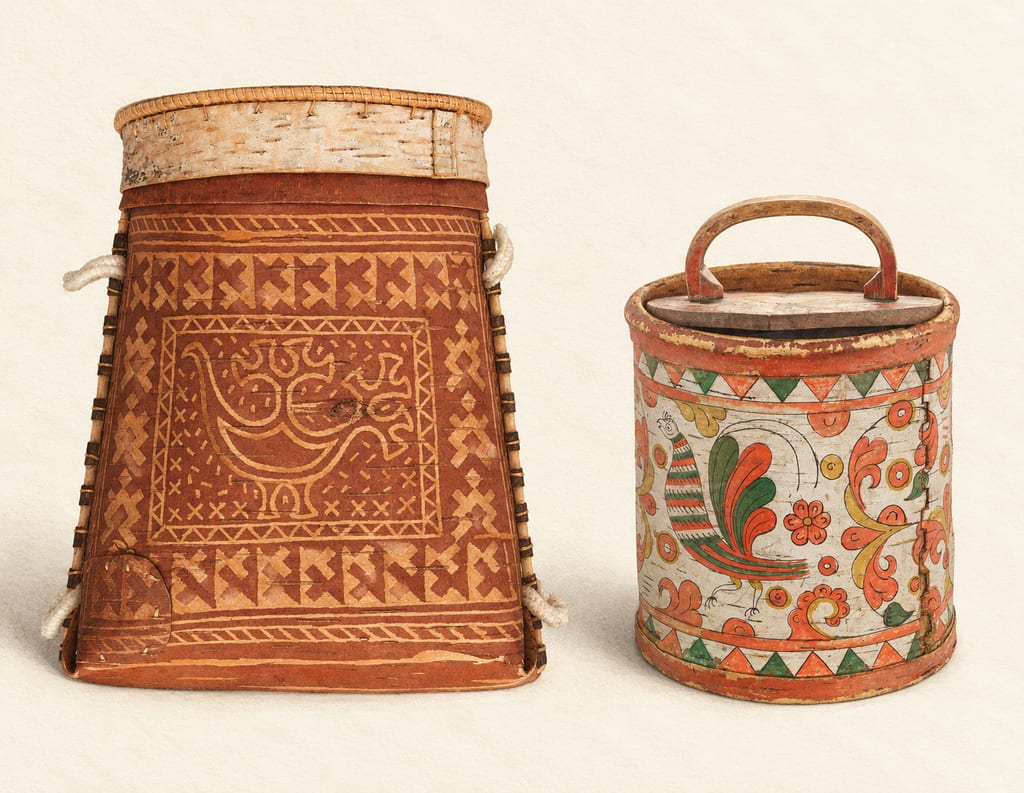
Birch-bark containers
Ket sources describe frozen lingonberries in birch-bark containers; Shor sources describe salted wild garlic in birch-bark tuyes. Their exact forms are not documented.
 FermenteaWhere food goes to change
Equipment · Bags, sacks and casings
аарчы · Aarchy storage bag
In Altai, dried aarchy was traditionally stored in bags sewn from animal hides. The surviving description establishes the material and use, but not a standard shape or present-day practice.
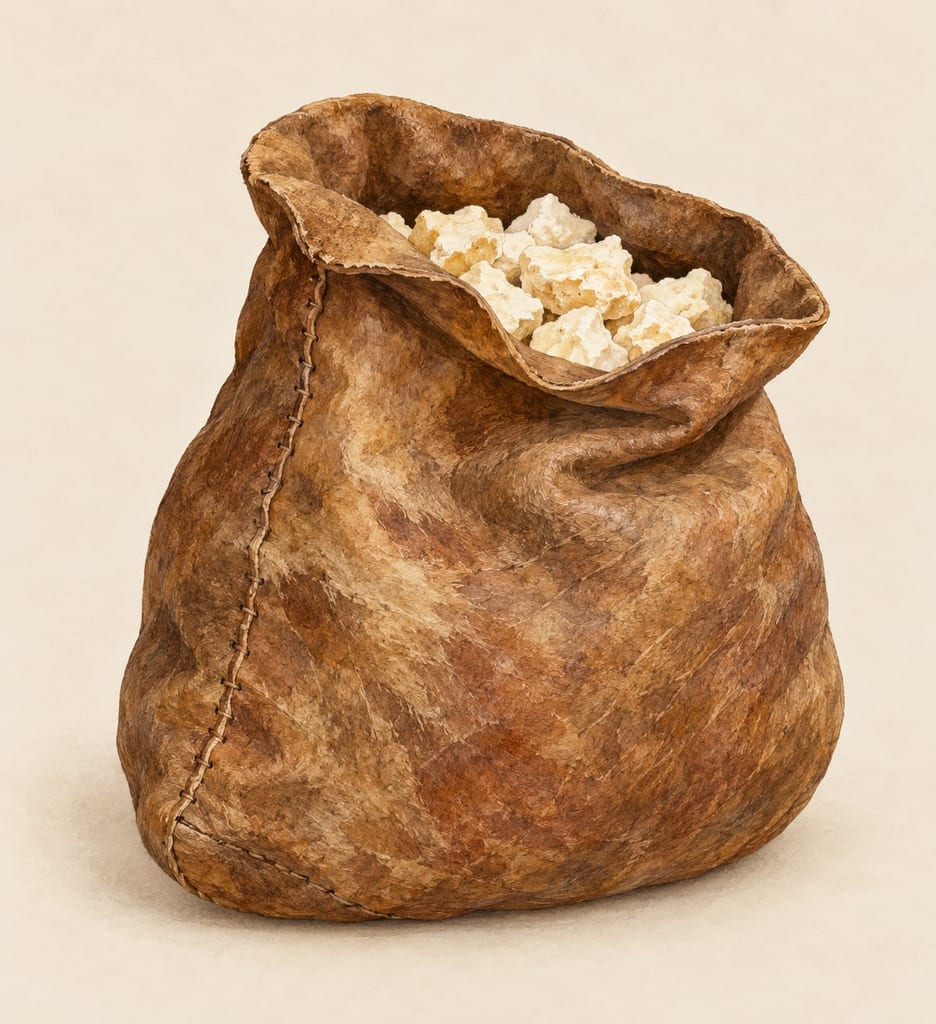
The Altai Ethnographic Dictionary identifies aarchy as a curd made from fermented chegen or ayran. It can be eaten fresh or mixed with milk; for longer keeping, the curd was spread thinly on cloth outdoors and left to dry. The dictionary says the finished product was traditionally stored in bags sewn from animal hides, citing Diakonova (2001:71). This is a storage form for dried curd, not the vessel in which milk ferments or curds are first made.
The source establishes the bag's material and purpose but does not describe a single standard design. It gives no dimensions, hide species, lining, seam pattern, mouth shape or closure. The page therefore treats the hide bag as a documented category of food-storage equipment, not a measured reconstruction of one particular surviving object.
Aarchy belongs to a sequence of Altai dairy foods. The dictionary describes boiling and straining cultured chegen or ayran to obtain the curd; drying it produces a more durable form, while the atlas separately describes making kurut from aarchy. These are food-processing stages. The hide bag enters after drying as a reported storage container, not as a starter vessel, press or fermenter.
The sources do not say that fresh moist aarchy was put into the hide bag, nor do they supply a moisture threshold, storage duration or room conditions. They also do not establish whether a bag was reused or treated between batches. Those practical details should not be inferred from the word “hide” or from the existence of other leather containers.
The Russian Museum of Ethnography records a 2006 Altai-Kizhi taazhuur from Yelo, made of leather and wood. It is a liquid flask in the museum's collection, not a dry-curd storage bag. Its photograph provides a genuine regional reference for leather material and craft context, but its shaped body, neck, wooden stopper and decoration are not evidence for the form of the aarchy bag.
This distinction matters because Altai leather vessels served different jobs. A flask for carrying milk or other liquids has different openings and geometry from a sack used to store dried curd. The sources consulted here do not document a surviving aarchy bag closely enough to specify those features.
The available record supports a traditional Altai association among dried aarchy, animal-hide bags and longer-term storage. It does not say when this bag form first appeared, whether it is still used, or whether all households used the same method. Nor does it specify protective treatment, cleanliness, resistance to moisture or the food's keeping time.
This account describes a documented historical practice rather than a modern preservation protocol. A present-day food-safe container and a historical hide bag are not interchangeable recommendations; the sources provide no test of a hide bag for current home use.
The 2025 Altai Ethnographic Dictionary describes aarchy as curd obtained by boiling and straining fermented chegen or ayran. It says the curd can be eaten fresh or mixed with milk, and for long storage was spread thinly on cloth outdoors until dry; traditionally the finished product was stored in bags sewn from animal hides. Its entry cites Diakonova (2001:71). This documents the food stage and storage material, not the bag's exact shape or the conditions that made any particular bag suitable.
The dictionary supports animal-hide bags as traditional storage for dried aarchy, but not a specific closure, size, lining, waterproofing or shape.
Source →The museum Taazhuur photograph is a different Altai leather vessel for liquid dairy; it must not be treated as the same object or copied as the standard form of a dry-curd bag.
Source →The documented historical use is not validated modern preservation advice and does not establish shelf life or safe storage conditions.
Source →The Surazakov Institute sources describe Altai aarchy and traditional hide-bag storage. They do not locate a particular household or workshop, or establish one exclusive geographic origin.
Ket sources describe frozen lingonberries in birch-bark containers; Shor sources describe salted wild garlic in birch-bark tuyes. Their exact forms are not documented.
No community contributions have been published for this entry yet.
Sign in to contribute. Published comments and photos are free to read.
S.S. Surazakov Research Institute of AltaisticsFood storage · Material · History · Geography
Алтайский этнографический словарь (Altai Ethnographic Dictionary)The entry for aarchy describes curd obtained by boiling and straining fermented chegen/ayran; for long storage it was dried thinly on cloth outdoors and traditionally kept in bags sewn from animal hides. The entry cites Diakonova 2001:71.
The source does not specify bag dimensions, construction pattern, closure, lining, hide species or current household use.
Cited in: A bag for dried aarchy; Keep the food stages distinct; A related Altai leather vessel is not the same bag; What remains unknown
S.S. Surazakov Research Institute of AltaisticsMethod context · Geography · Limits
Этнографический атлас (Ethnographic Atlas)The atlas distinguishes aarchy from its later dried-curd product kurut and describes straining and pressing steps; these are food-processing stages, not specifications for the storage bag.
Cited in: Keep the food stages distinct
Russian Museum of Ethnography, Online CollectionsComparative object · Regional material culture · Image
Сосуд - фляга. Алтай-кижи (алтайцы), object РЭМ 12424-20A 2006 Altai-Kizhi taazhuur flask from Yelo is catalogued as leather and wood. It is a liquid vessel and a comparative reference for regional leather material culture, not an aarchy dry-storage bag.
Cited in: A related Altai leather vessel is not the same bag; What remains unknown