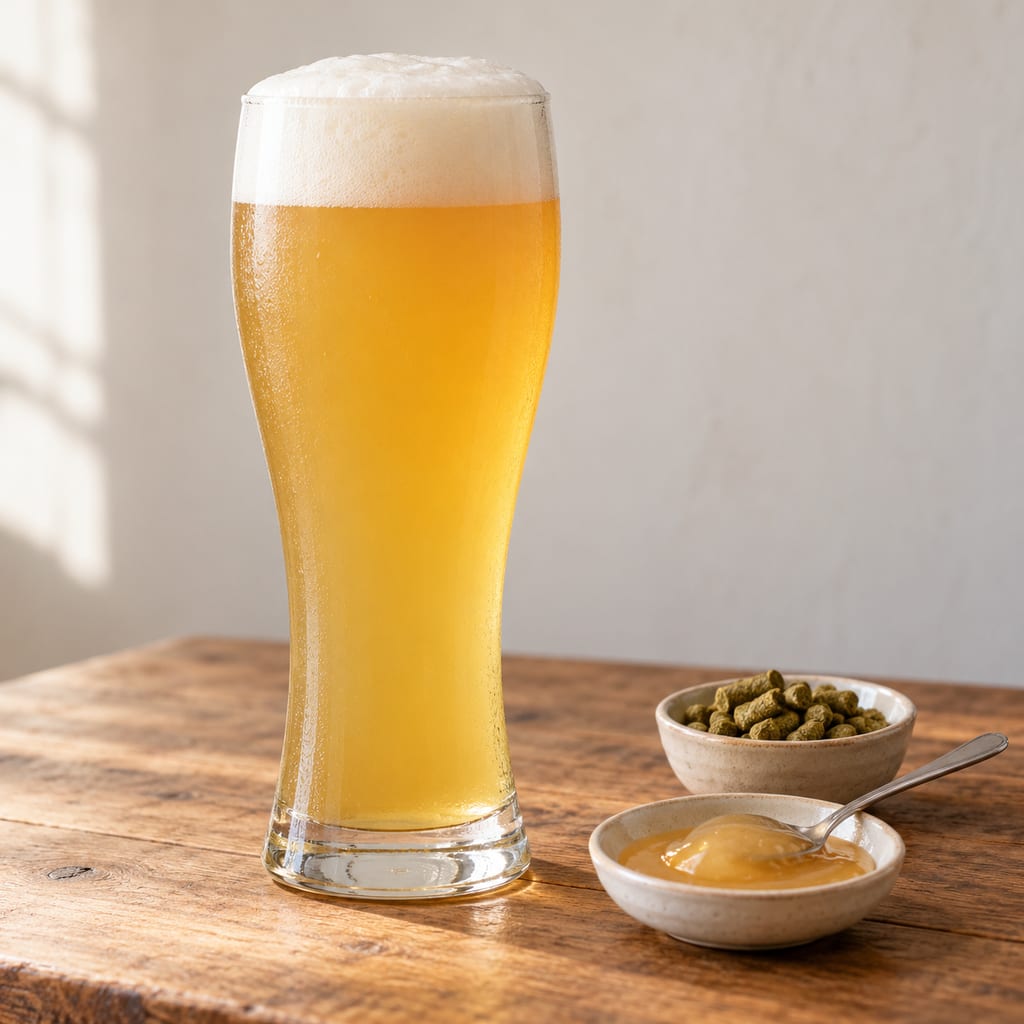
Weizen, extract method
A German-style wheat beer made with wheat extract, a short hop boil and a hefeweizen yeast, using cold water to top up the fermenter.
 FermenteaWhere food goes to change
Equipment · wort-chiller
A counterflow wort chiller cools hot wort through separate, counter-moving coolant passages. Tube-in-tube and coil-in-jacket designs vary by materials and fittings; capacity and performance are model-specific.
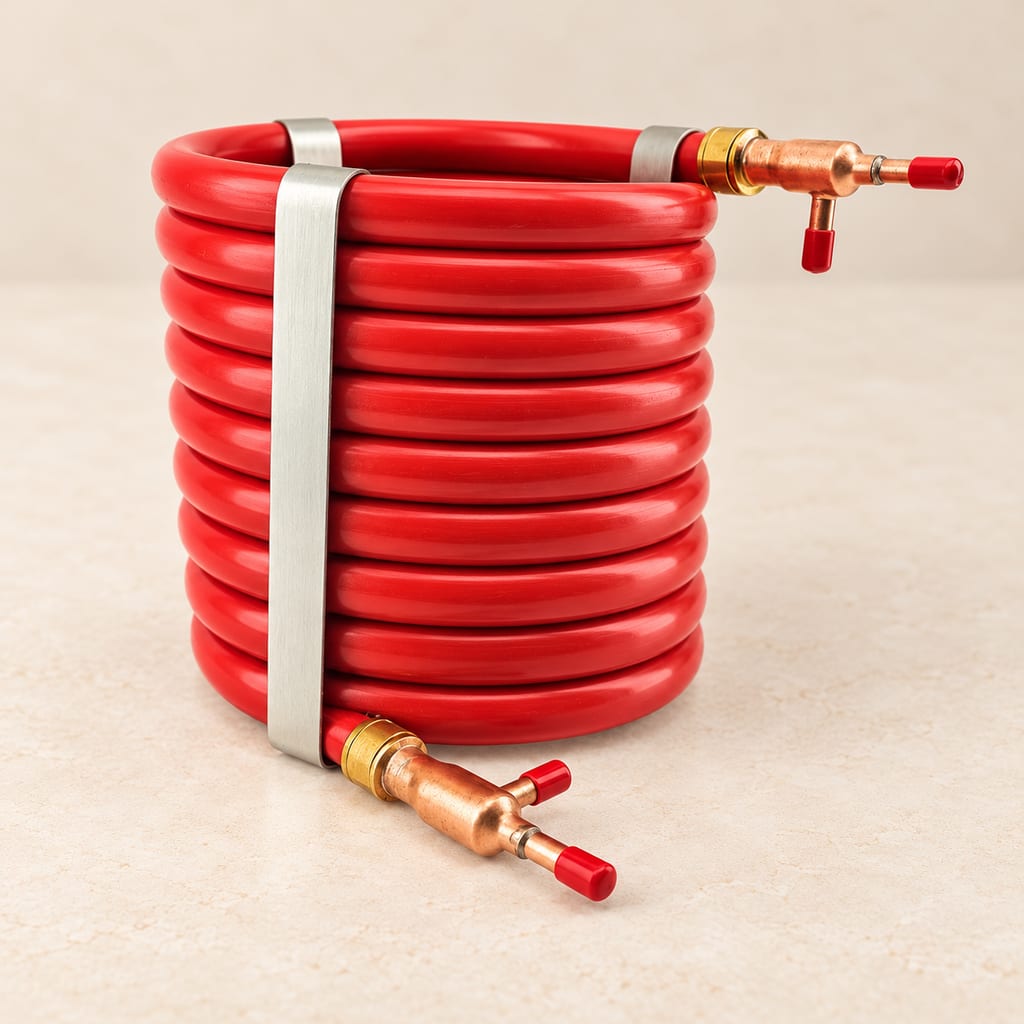
A counterflow chiller separates hot wort from cooling water with a heat-transfer wall and moves the two fluids in opposite directions. A common design runs wort through an inner tube while coolant travels through a surrounding jacket; coiled tube-in-tube products and other passage arrangements also exist. The name describes the opposing flow, not one standard shape or material.
A plate chiller also transfers heat between separate streams, often in opposite directions, but its passages are formed by plates. It is a different equipment format and is not the subject of this page.
Wort and coolant pass along adjacent but separate routes, moving in opposite directions across a shared wall. The temperature difference drives heat from the wort into the cooling stream. How much the wort cools depends on the heat exchanger's surface and passages, both flow rates, inlet temperatures and the brewer's arrangement; no single performance figure applies to all products.
Some systems gravity-feed wort, while others are used with a separate pump. Manufacturer manuals describe model-specific flow paths, hoses and operating sequences. For example, Brewtools gives operating instructions for its own counterflow cooler and says it is not designed for one-pass use; that limitation belongs to that product and setup.
Compare the maker's stated materials, passage dimensions, connectors, intended flow, cleaning method and compatibility with the rest of the brewing setup. Ask how wort will be moved, how cooling water will be supplied, and where both outlet streams will go. A product's advertised rate or temperature result is meaningful only with its stated wort volume, inlet temperatures, flow rates and setup.
Because wort travels inside an enclosed passage, follow the exact maker's instructions for flushing and cleaning. The inspected manuals differ in their operation: some describe flow-through transfer, while Brewtools' own cooler documentation specifies recirculation and says its model is not designed for one-pass use. Do not transfer one maker's procedure to another unit.
A counterflow unit requires independent paths for wort and coolant and a way to move each stream. Some setups therefore need a pump or recirculation loop, but those components are not inherent to every chiller. Product dimensions, flow restrictions, cleaning requirements and batch ratings must be checked against the actual model.
Industrial brewing sources describe larger wort-cooling systems such as plate or shell-and-tube exchangers. Those sources establish that countercurrent heat exchange is used in brewing, but industrial designs and performance figures do not establish the capacity or results of a homebrew counterflow coil. The associated AHA recipe only says 'wort chiller' generically; it does not name this design.
Cooling performance depends on the model, wort and coolant flow, inlet temperatures and operating arrangement. A maker's test or rating applies to its described setup, not every counterflow chiller.
Source →The inspected sources do not establish a specific place of origin or a representative place of use for this equipment category. Manufacturer-specific examples do not establish the geography of the broader type.
A German-style wheat beer made with wheat extract, a short hop boil and a hefeweizen yeast, using cold water to top up the fermenter.
No community contributions have been published for this entry yet.
Sign in to contribute. Published comments and photos are free to read.
GrainfatherMethod · Comparison
Counterflow Chiller vs Immersion Chiller - what's the difference?Defines the opposing wort and cooling-fluid passages; vendor comparison claims are not taken as neutral performance evidence.
Cited in: What it is
ExchileratorMethod · Materials · Safety
MAXX Counterflow Wort Chiller ManualThis model uses copper inner tubing and a PEX outer passage, with model-specific flow and hot-output instructions.
Cited in: What it is; How the exchange works; Choosing and using one
BrewtoolsMethod · Care · Limits
Counterflow CoolerInstructions and one-pass limitation for this specific counterflow cooler; its operating requirements are not generalized to all models.
Cited in: How the exchange works; Choosing and using one
Keg KingMaterials
Counter Flow Chiller Stainless SteelA current stainless-steel counterflow product example.
Cited in: What it is
ASHRAEContext
ASHRAE Handbook, Chapter 39: BeveragesIndustrial wort cooling methods are contextual and are not treated as a homebrew model rating.
Cited in: Limits and evidence
American Homebrewers AssociationContext
Brewing with Extract: German-Style Wheat Beer (Weizen)The associated recipe mentions a wort chiller generically and does not identify a counterflow design.
Cited in: Limits and evidence