
Equipment · Instruments
Digital kitchen scale (reads to 0.1 g)
A digital kitchen scale with 0.1 g display increments helps weigh very small seasoning quantities. Its resolution is not a promise of ±0.1 g accuracy: usable range, minimum load, setup and performance depend on the model.
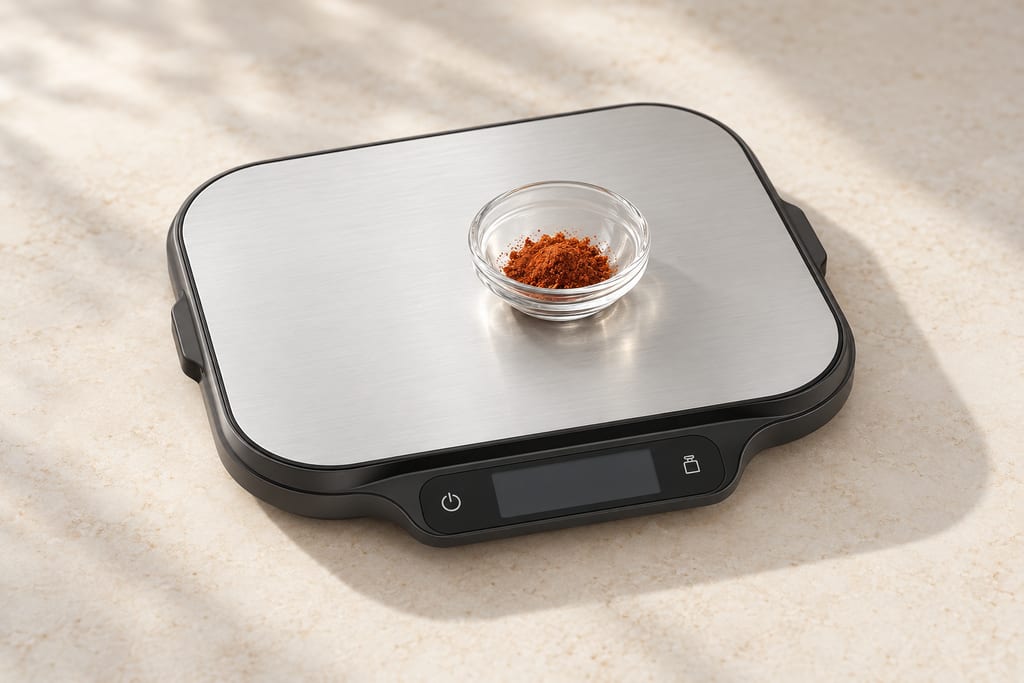
A small step on the display
A digital kitchen scale converts a load on its platform into a displayed weight. A model described as reading to 0.1 g changes its display in tenths of a gram. That increment is useful when a recipe calls for a small quantity of spice, yeast or another concentrated ingredient that would be hard to portion consistently by eye. The preserved condiment research names a 0.1 g-reading scale for tiny spice measures and gives a larger premix as an alternative.
Scales in this category do not all work over the same range. CASO's KitchenDuo offers an ordinary kitchen range up to 15 kg in 1 g increments and a precision range up to 1 kg in 0.1 g increments. Soehnle's Cooking Star is a spoon-shaped model with a 500 g maximum and 0.1 g increments, intended for small amounts drawn from a jar. GEFU's PREZISO uses 0.1 g steps from a stated minimum weight of 1 g through 1 kg, then 1 g steps up to 3 kg. These are examples, not interchangeable specifications for every scale.
Why measure a tiny seasoning
A very small spice quantity can be important to a recipe's balance while remaining difficult to portion with a spoon. The condiment archive's mustard guidance makes the practical choice explicit: use a scale reading to 0.1 g or prepare a larger premix and weigh a portion. A premix can make small additions easier to handle, but its ingredients and proportions must be recorded so later batches remain comparable.
The displayed 0.1 g step is resolution, not a universal statement that the instrument is accurate within 0.1 g. Maximum load, minimum stated weight and increments can change between modes on the same product. Read the specifications for the intended range rather than assuming that a scale with a fine step can also weigh any arbitrarily small sample reliably. If a recipe gives a gram amount, weighing in the specified unit preserves its formulation more consistently than converting by volume.
Set up and care
Place a platform scale on a firm, flat and level support before use. The CASO KitchenDuo manual gives that setup requirement and says to avoid hot, wet or very damp locations; it also warns against dropping the device. Use the manufacturer's instructions for switching modes, selecting units and taring a container, since the controls and weighing range differ by model.
A bowl or small dish lets dry ingredients be contained and added without spilling; tare functions can remove the displayed container weight where the model provides one. Keep the weighing surface and controls clean, dry them as the manual permits, and avoid loading beyond the stated range. A spoon scale is a different form: its detachable weighing spoon may be convenient for small loose ingredients, but cleaning guidance is model-specific. None of these devices measures salt concentration, acidity, water activity or fermentation progress; it records mass only.
Sources for this section
Present-day scope
Kitchen scales are manufactured in varied current forms, including broad weighing platforms, compact precision units and spoon scales. Manufacturer examples from Germany show scales marketed for cooking, baking, herbs and spices. This record describes the contemporary instrument category in recipe work; it does not assign a historical invention, traditional material or single regional origin.
History
The preserved research archive records the 0.1 g scale in the context of tiny spice quantities and recommends a larger weighed premix as an alternative. Current manufacturer pages document contemporary examples, but no source establishes an invention date or single place of origin for digital kitchen scales as a class.
Equipment details
Made of
- Stainless-steel, glass, plastic and silicone surfaces — model-dependent construction
Examples vary: CASO's KitchenDuo has a stainless-steel weighing surface; GEFU's PREZISO lists plastic, stainless steel and silicone. No single material describes every scale.
Limits
A 0.1 g display increment describes the displayed step, not independently verified accuracy or repeatability. The cited models specify different minimum weights, ranges and step sizes; check the exact model instructions and use.
Source →The CASO KitchenDuo changes between a normal 15 kg range in 1 g steps and a precision range up to 1 kg in 0.1 g steps; the two ranges should not be conflated.
Source →The supplied condiment research offers a larger weighed spice premix as an alternative when a 0.1 g-reading scale is unavailable; this is a formulation technique, not evidence that every tiny spice amount must be measured at 0.1 g.
Source →Places
Unknown
Relationship not established · Place not establishedThe inspected sources do not establish a specific place of origin or a representative place of use for this equipment category. Manufacturer-specific examples do not establish the geography of the broader type.
Community
No community contributions have been published for this entry yet.
Share what you made
Sign in to contribute. Published comments and photos are free to read.
Sources
CASO Design / CASO GmbHCurrent model specifications · Use and range
KitchenDuo | Kitchen scalesKitchenDuo has a normal range up to 15 kg in 1 g increments and precision range up to 1 kg in 0.1 g increments; it has tare, unit and hold functions and a stainless-steel surface.
Cited in: A small step on the display; Why measure a tiny seasoning; Present-day scope
CASO GmbHSetup · Operation · Care
Operation Manual for CASO KitchenDuoThe manufacturer specifies a firm, flat, horizontal setup surface and cautions against hot, wet or very damp locations and dropping the scale.
Cited in: Set up and care
Leifheit AG / SoehnleCurrent model comparison · Small quantity form
Digital kitchen scale Cooking StarThe Cooking Star spoon scale has 0.1 g increments, 500 g maximum load, tare and hold functions, and a removable dishwasher-safe spoon.
Cited in: A small step on the display; Set up and care; Present-day scope
GEFUCurrent model comparison · Range limits
Precision and kitchen scales PREZISOPREZISO lists a minimum weight of 1 g, 0.1 g increments through 1 kg, then 1 g increments to a 3 kg maximum; it lists plastic, stainless steel and silicone materials.
Cited in: A small step on the display; Why measure a tiny seasoning; Present-day scope
FermenteaRecipe context
The Condiment Table: Ketchup, Mayonnaise, Mustard and the Sauces of the WorldThe supplied and published condiment guide recommends a scale reading to 0.1 g for tiny spice quantities or a larger weighed premix.
Cited in: A small step on the display; Why measure a tiny seasoning