
World condiments intake
The Condiment Table: Ketchup, Mayonnaise, Mustard and the Sauces of the World
Ketchup, mayonnaise and mustard are three kinds of kitchen engineering. This guide shows how each works, compares real bottles instead of national clichés, then follows the sauces of Asia, the Caucasus, Europe, the Americas and Africa.
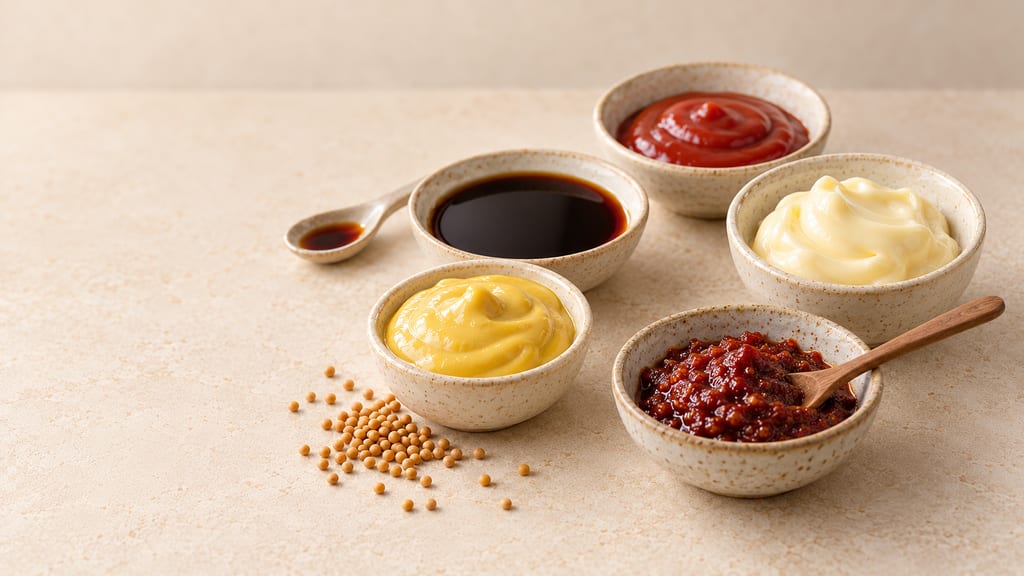
Mustard seed, soy sauce, mayonnaise and tomato ketchup: a few of the condiments on the world's tables.
Three bottles, three kinds of engineering
Line up a bottle of ketchup, a jar of mayonnaise and a pot of mustard and you are looking at three different pieces of kitchen engineering that happen to share a table. Ketchup is a matter of concentration: tomatoes cooked until much of their water has gone, then held in a narrow balance of sweet, sour and salt. Mayonnaise is a matter of structure: oil broken into droplets so fine and so tightly packed that a liquid will stand in a peak. Mustard is a matter of chemistry: a hard seed that tastes of little until it is crushed and wetted, when an enzyme turns it hot. Each fails in its own way. A ketchup is boiled too far, a mayonnaise splits, a mustard loses its bite or never finds it.
Heinz’s British label states the first idea in one line: 148 g of tomatoes for every 100 g of ketchup. The figure makes sense once the water is counted. More tomato goes in than sauce comes out, because cooking and concentration drive off moisture and leave tomato solids, the fruit’s own sugars and acids, and the flavour of cooked tomato. Vinegar, sugar and salt are set against that base, and they do not cancel each other out: a sauce can taste sharp and sweet at once, and salt changes how intense the tomato seems. Because everything left in the pan concentrates as the water goes, the length of the boil is a seasoning decision as well as a question of texture.
Mayonnaise is an oil-in-water emulsion: a large volume of oil dispersed as droplets through a small volume of water that carries the vinegar or lemon juice, the salt and the yolk. Left alone, oil and water separate. Components of the egg yolk act as the emulsifier, gathering at the surface of each droplet and keeping neighbours from merging. The United States standard for anything sold as mayonnaise requires at least 65 per cent vegetable oil by weight, with an acidifying ingredient and an egg-yolk ingredient. So much oil in so little water gives the sauce its body: the droplets crowd together until the whole mass resists flowing. Kewpie, in Japan, says it breaks its oil into particles 2 to 4 thousandths of a millimetre across, and credits that fineness for its smoothness on the tongue.
Mustard works by a reaction the cook sets off. The seed stores sulphur-containing compounds called glucosinolates and, separately, an enzyme called myrosinase. While the seed is whole and dry the two stay apart. Grinding breaks the cells, water lets the enzyme work, and the glucosinolates are converted into isothiocyanates, the volatile compounds that climb into the nose. The seed matters: when the enzyme was extracted from black, brown and yellow mustard seed and compared in the laboratory, the brown seed’s was the most active, and the three differed in how much activity survived heating. So does the method: when the same cultivars were made into Dijon-style and wholegrain mustard, the two methods left different amounts of isothiocyanates and of sinigrin, one of the glucosinolates.
The order of operations therefore changes what ends up in the jar. Heat can switch the enzyme off, which is why a mustard cooked on purpose comes out milder. Acid matters as well. The Woks of Life, written by a family with Chinese American restaurant roots, notes that a little rice vinegar tones down a freshly mixed hot mustard, and the house Dijon-style mustard in this guide is built on the same principle: the ground seed gets a few minutes with water alone before the vinegar goes in.
Compare a bottle with a bottle
A familiar generalisation holds that European condiments are less sweet and more acidic than American ones. It fits some pairs of products and fails for others: American yellow mustard, British salad cream, Bavarian sweet mustard, Dutch-style fry sauce and Japan’s fruity brown sauces all cut across it. As stated it cannot be tested, because a continent has no label. One named product can be tested against another once both are put on the same basis. Nutrition panels allow that for sugar and salt. They say nothing about pH or total acid, so the ‘more acidic’ half of the claim needs a measurement or a blind tasting. Two sauces with the same sugar figure can still taste unalike, because the acid chosen, the total acid, pH, salt, the concentration of tomato or fruit, oil, egg, aroma, particle size, serving temperature and the food beside them all shape the impression.
Heinz is the obvious test, because the same brand sells tomato ketchup on both sides of the Atlantic. The British bottle declares 22.8 g of sugars per 100 g. The standard American bottle declares 4 g in a 17 g tablespoon, which is 4 ÷ 17 × 100 = 23.5 g per 100 g. Setting that 4 g against the 3.4 g on the British 15 g serving exaggerates the gap by ignoring the size of the spoon. American rules round sugars to the nearest gram, so that printed 4 g covers anything from 3.5 to 4.5 g, or 20.6 to 26.5 g per 100 g, and the British figure sits comfortably inside the band. The sweeteners differ, sugar in Britain and two corn syrups in America, but the labels cannot show that either sauce is sweeter. Salt is another matter: 180 mg of sodium in 17 g, multiplied by 2.5 to express it as salt, works out at about 2.65 g of salt equivalent per 100 g, against 1.8 g on the British label.
Salad cream is the clearest warning against equating tartness with low sugar. Heinz Salad Cream begins with water and spirit vinegar, carries 22 per cent rapeseed oil and 3 per cent pasteurised egg yolk, with mustard powder and modified cornflour, and Heinz sells it on its tangy taste. Its label gives 2.6 g of sugars per 15 g serving: 2.6 ÷ 15 × 100 makes about 17.3 g per 100 g. A 5-litre catering tub of Hellmann’s Real Mayonnaise, 78 per cent rapeseed oil, lists 1.3 g of sugars per 100 g, about a thirteenth of the salad cream’s figure. And the specification sheet for Duke’s, an American foodservice mayonnaise, declares it sugar-free.
Mustard spreads wider still. Auran’s makea sinappi, a Finnish sweet mustard, lists sugar first and declares 41 g of sugars per 100 g on one 275 g pack and 42 g on another, while SPAK’s Klasická hořčice from the Czech Republic declares 6.8 g and Prymat’s Polish sarepska 6.7 g: three European mustards a factor of six apart. Some ketchups beyond the Heinz pair sit well above it. Hela’s German curry ketchup, the ‘delikat’ version with what the maker calls a gently sweet-spiced curry note, carries 28.8 g of sugars and 2.0 g of salt per 100 g, and Nestlé India’s MAGGI Rich Tomato Ketchup 30.8 g of total sugars. Kagome’s Japanese ketchup gives 27.9 g of carbohydrate per 100 g and no sugars figure; carbohydrate is a different number from sugars, so it stays out of the comparison.
None of these figures describes a nation’s palate. A label shows what one product contained when it was read, not what everyone in Finland, Germany or India prefers, and a single maker’s range can hold sweeter and plainer, milder and hotter versions side by side: Hela also sells its curry ketchup with 30 per cent less sugar, at 20.9 g per 100 g, and MAGGI sells an Extra Hot Tomato Chilli Sauce beside its Rich Tomato Ketchup. The method that runs through this guide follows from that. Name the bottle, put its numbers on a per-100 g basis, show the arithmetic, and taste blind before calling one sauce sharper or sweeter than another.
What this guide is, and what it is not
This is an atlas of condiments and a bank of recipes for developing your own, not a ranking of any country’s favourite sauces. Its firmest ground is current makers’ labels, food-safety authorities, original food-science papers, national cultural institutions and cooks writing about their own cooking. A maker’s description establishes something about its product; it does not establish what everyone in that country likes. Three kinds of information are kept apart throughout: documented facts about a product or a practice (ingredients, labelled nutrition, how a maker says it manufactures, a tradition attributed to the people who keep it); the house recipes; and published preserving processes. Labels and pages were read in late October 2026 and can change. The pack in your hand outranks any web page, and a maker’s claim to be a nation’s favourite is not a survey.
The house recipes number 71 main formulations, with variations and fourteen flavoured mayonnaises on top. Eight are ketchups and their relatives: whole-tomato, a smooth Heinz-style ketchup, curry, banana, brown sauce, a tonkatsu-style sauce, a hot-and-sweet chilli sauce and a mushroom ketchup. Fourteen are mayonnaises and related emulsions, from a classic and a Japanese-style version to avocado oil, olive oil and garlic, soy, aquafaba, toum, salad cream and a lighter fry sauce. Twelve are mustards and mustard dressings: yellow, Dijon-style, wholegrain, English, deli, German, Bavarian sweet, dill, karashi, Korean, kasundi-style and a mustard-miso. Six come from China and West Asia: a soy-vinegar dip, sesame sauce, a hoisin-inspired sauce, tahini, a zhug-inspired green sauce and plum sauce. Twenty-three come from Japan, Korea and South-East and South Asia, among them ponzu, a miso glaze, tare, a yuzu-chilli paste, ssamjang, fish-sauce dips, sweet chilli sauce, sambals, peanut sauce and chutneys. Eight come from the wider world: chimichurri, ranch, barbecue sauce, harissa, chermoula, romesco, salsa and ajvar.
Each is a plausible starting formulation written for this guide. None has been cooked in a test kitchen, tasted against a commercial target or tested for how long it keeps, and a recipe called ‘style’ or ‘inspired’ discloses nobody’s proprietary formula. The tested canning recipes linked from the preserving chapter are separate processes: their ingredients, preparation, jar size and processing go together, and no new flavour formula inherits their schedules. Quantities are grams by weight unless a recipe says otherwise. Use food-grade vinegar; where a recipe asks for 5 per cent acidity, that is the strength declared on the bottle, not a dilution made by guesswork. Unseasoned rice vinegar, seasoned sushi vinegar and distilled white vinegar are three different ingredients, and concentrated tamarind, soy sauce, miso and chilli pastes vary so much between makers that the exact product belongs in your notes.
The Western trio is only the start. Japan alone has shoyu, miso, ponzu-shoyu, noodle dipping sauces, sesame sauces, its own Worcestershire-style sauces, wasabi, karashi and yuzu kosho, each deserving its own entry. Across Asia many everyday condiments rest on a fermented base, and the guide keeps the two stages apart: stirring a dip from bought fish sauce takes minutes, while making the fish sauce is a fermentation project of a different order. The chapters run in a reading order: ketchup, for the Heinz comparison, concentration and sweet–sour balance; mayonnaise, for emulsions, Kewpie, avocado oil and other speciality versions; mustard, for seed, pungency, regional styles and maturing; the Asian atlas and its recipes; the European, African, American and Oceanian families; and the chapters on preserving and recipe development, which belong before anyone plans a large batch or a cupboard shelf.
House rules for keeping
Oil choice and preservation are separate questions. Avocado, olive, sunflower or rapeseed oil changes the flavour of a sauce and how its emulsion behaves; none gives a home-made egg sauce a commercially validated shelf life by being chosen. For home recipes the broadest practical options are small batches and freezing the sauces that suit it. For an unopened jar at room temperature there are two honest routes: an exact tested canning recipe, or a professional assessment of the complete product and process.
Every egg sauce in the guide uses commercially pasteurised egg or yolk, clean equipment and prompt refrigeration, and is eaten within 24 hours. That is a house rule for untested recipes, not a claim that all mayonnaise lasts a day; a commercial jar is a different product with its own instructions. Other freshly mixed or cooked sauces go into small clean containers in the refrigerator and are used within 48 hours or frozen promptly, unless a label or a more specific requirement is stricter. The 48 hours borrow the UK Food Standards Agency’s general advice on leftovers and are not a measured life for any one sauce. Fresh green sauces and coconut-based sauces taste best eaten sooner still. The refrigerator runs at 0 to 5 °C, ideally 4 °C or colder, and sauces should not sit out at the table for long.
Maturing counts as storage time. An overnight rest does not reset a sauce’s age, and stirring an older perishable ingredient into something new does not make it fresh. Small portions of cooked tomato, pepper, fruit and herb sauces freeze more usefully than mayonnaise, which tends to separate: freezing can damage emulsions and fresh texture, so try a small portion first and freeze while the sauce is fresh, because the freezer does not undo careless handling. Sour taste, a hot jar, a layer of oil or a vacuum seal proves nothing about safety; the preserving chapter explains what does.
Ketchup at a glance
Ketchup is concentrated tomato balanced against vinegar, sugar and salt, and the most useful control a home cook has is the weight of the finished batch. The guide’s two starting recipes reach it by opposite routes. The whole-tomato house ketchup simmers tinned plum tomatoes with onion and garlic, seasons them with vinegar, sugar, salt, allspice and black pepper, then blends, sieves and reduces the sauce to about 600 g. It aims at a rounded ketchup with visible tomato character and no brand in its sights. Cider vinegar pushes it towards a fuller house style; white vinegar, with less onion and allspice, towards a cleaner commercial one; extra clove soon turns it into a spiced fruit sauce. A fresh-tomato batch starts from about 1 kg of ripe plum tomatoes instead of the tin.
The smooth UK-label-target ketchup starts from double-concentrated tomato paste, spirit or distilled vinegar, sugar, salt and a trace of onion powder, and after cooking is weighed back to exactly 500 g, topped up with water if it has reduced too far. Its quantities are chosen so that the arithmetic lands on the British Heinz label: with a paste carrying 16 g of sugars per 100 g, the batch holds 22.8 g of sugars and 1.8 g of added salt per 100 g. Heinz does not publish its spice blend, so allspice and clove stay optional. Both recipes are development formulations. Neither has yet been cooked and tasted against its target or tested for how long it keeps, so both belong in the refrigerator or the freezer, never in a canning jar.
Mayonnaise at a glance
All three starting mayonnaises use commercially pasteurised egg yolk, as every uncooked egg sauce in this guide should. The US Food and Drug Administration’s guidance for food businesses lists mayonnaise among the uncooked dishes in which pasteurised eggs or egg products should replace raw shell eggs, and Food Standards Scotland describes pasteurised egg products as suitable for foods that will not be cooked. After that, the method matters as much as the recipe: dissolve the salt and sugar in the vinegar and water, whisk in the yolk, and add the first oil a few drops at a time before moving to a thin stream.
The neutral classic mayonnaise uses 200 g of refined rapeseed, sunflower or soybean oil to 25 g of yolk, with spirit vinegar, a little Dijon mustard, salt and sugar; oil makes up about three-quarters of the batch, close to the 78 per cent in a catering tub of Hellmann’s Real. The Japanese-style yolk-and-umami mayonnaise raises the yolk to 40 g for the same oil and blends rice, cider and distilled vinegars with a little MSG and mustard powder. It points towards Kewpie, whose Japanese site names egg yolk, vegetable oil and vinegar as the main ingredients and describes a vinegar brewed from apple juice, malt and other ingredients by its own vinegar company, founded in 1962. The home vinegar blend is a stand-in, not the factory’s. The avocado-oil mayonnaise makes refined avocado oil the whole oil phase and adds lemon juice.
Changing the oil changes flavour and colour; it does not make a home emulsion keep longer. None of the three has been kitchen-tested or tasted against a commercial jar. The house rule is to eat them within 24 hours of making, a deliberately cautious convention for untested recipes rather than a shelf life, and not to freeze them, because mayonnaise tends to separate in the freezer.
Mustard at a glance
Every mustard begins with three decisions: which seed, how finely it is ground, and when the acid arrives. The mild American yellow-style mustard whisks yellow mustard powder cold with distilled vinegar, water, salt, turmeric, paprika and a little garlic and onion powder, then simmers it for about ten minutes, deliberately, to calm the pungency and cook out the raw taste of the powder. Sugar is not part of its baseline.
The smooth Dijon-style mustard reverses that logic. Coarsely ground brown seed is wetted with water alone and left for five to ten minutes to develop its heat before the vinegar and salt go in; the paste then rests overnight in the refrigerator, is blended and, for the finest texture, sieved. Its milder variation simply adds all the vinegar and water at the start. The wholegrain mustard soaks brown and yellow seed together for 12 to 24 hours, blends a third of the mixture and folds that paste back through the whole seeds.
A name on a jar is not always an origin. The Burgundian mustard maker Edmond Fallot describes Dijon mustard as a generic denomination, made in France and in countries such as the Netherlands, the United States and Japan. Moutarde de Bourgogne is a protected geographical indication, registered in the European Union in 2009: its seed must be grown, stored and processed within a defined area of the Côte-d’Or, Nièvre, Saône-et-Loire and Yonne, and is mixed with a liquid that is at least 25 per cent Burgundy appellation white wine for the smooth version and 15 per cent for the coarser à l’ancienne. A home mustard can be Dijon-style; Burgundy wine poured into it does not make it Burgundy mustard. All three house mustards are untested refrigerated formulations, to be eaten within 48 hours, a cautious house convention rather than a shelf life, or frozen.
When catsup meant mushrooms
Long before it was red, ketchup was a family of thin, salty, spiced liquids. Friedrich Accum’s Culinary Chemistry, published in London by R. Ackermann in 1821, files catsup among the pickles and gives the name to ‘several kinds of liquid pickles, made of savoury vegetable substances’. His mushroom catsup is an exercise in extraction: salted, mashed mushrooms rest for a couple of days, simmer for at least two hours in a stone jar set in boiling water, and give up a juice that is strained, boiled, settled and bottled with peppercorns, allspice and brandy. His walnut catsup steeps 28 lb of pounded unripe walnuts in two gallons of vinegar.
The tomato catsup, spelt ‘tomata’, is closer to today’s sauce in its fruit and further from it in almost everything else. A gallon of ripe tomatoes is mashed with a pound of salt and the juice pressed out; each quart takes a quarter of a pound of anchovies, two ounces of shallots and an ounce of black pepper, and is simmered, strained, spiced with mace, allspice, ginger and nutmeg, and coloured with cochineal. None of Accum’s catsups contains sugar. The thick sweet-and-sour tomato sauce is a later branch of the family.
The house mushroom condiment borrows that flavour logic and none of the preservation. It puts 500 g of sliced cultivated mushrooms in a covered pan with 100 g of water, 60 g of cider vinegar, 30 g of shallot, 8 g of salt, black pepper and a little mace or allspice, plus 10 g of sugar if a rounder modern sauce is wanted, and cooks them gently until they give up their liquid, then simmers them uncovered for about 20 minutes. Strained, pressed and reduced, the liquid becomes a thin seasoning in the old manner, roughly 250 to 350 g of it; blended with the mushrooms, the whole pan makes a thick modern ketchup of about 450 to 550 g, with evaporation deciding the final weight.
Accum’s book shows how the word was used two centuries ago. It is no authority on safe practice now, and its days of salting at room temperature and its corked bottles stay in 1821: the modern version is cooled promptly and refrigerated or frozen.
Heinz in Britain and the United States
The comparison rests on named products: Heinz’s British page for its tomato ketchup, the nutrition panel for the 460 g bottle sold through Heinz to Home, and the American 20 oz upside-down bottle. The British bottle declares tomatoes (148 g per 100 g of ketchup), spirit vinegar, sugar, salt, spice and herb extracts containing celery, and spice, and Heinz says it contains no artificial colours, flavours, preservatives or thickeners. The American bottle declares tomato concentrate from red ripe tomatoes, distilled vinegar, high fructose corn syrup, corn syrup, salt, spice, onion powder and natural flavoring. A British serving is 15 g and carries 3.4 g of sugars; an American one is 17 g and carries 4 g. Per 100 g, as the opening comparison showed, the sugar figures cannot be told apart.
The salt gap survives the rounding rules. The US regulation, 21 CFR 101.9, rounds sodium above 140 mg a serving to the nearest 10 mg, so the printed 180 mg stands for 175 to 185 mg, or 2.57 to 2.72 g of salt equivalent per 100 g, still well clear of Britain’s 1.8 g. Salt equivalent is a labelling convention, not a measurement of added salt. Multiplying sodium by 2.5 counts every milligram as if it came from salt, including whatever the tomatoes and onion powder bring, and the salt line on a British label is worked out from sodium the same way. The gap is large enough to be worth a tasting, but the bottle’s own label stays the reference.
The tomato line is the most misread. ‘148 g per 100 g’ counts the fresh fruit that went into every 100 g of finished ketchup, the difference having left as water; it does not mean the bottle is 148 per cent tomato. Nor does the American ‘concentrate’ mean less tomato: the two countries declare tomato differently, and concentration changes weight. A New Zealand bottle shows both conventions at once. Wattie’s 300 g tomato sauce declares 81 per cent concentrated tomatoes and adds that this represents 126 g of tomatoes per 100 g, or 19 g per 15 g serving; without that second figure nobody could convert one convention into the other.
The vinegar words are vocabulary too. Spirit vinegar in Britain and distilled vinegar in the United States can both describe vinegar made from an alcohol base, and neither says how much went into the sauce or how strong it was. To test whether one ketchup is ‘more acidic’, matched bottles would need measuring for pH and titratable acidity, then tasting. pH alone does not express all the acid a food holds; titratable acidity is the second measure, a distinction Iowa State University’s wine laboratory sets out for grapes, though its assay is no validated method for ketchup.
These figures describe the products read, not every Heinz pack, foodservice sachet, export bottle or future recipe. The labels prove a difference in formulation and allow a difference in balance; they do not prove a large gap in sugar, and they disclose nothing about acidity, the spice blend or the full manufacturing process.
The American shelf holds both sweetener approaches. Simply Heinz, sold as free of high-fructose corn syrup, prints two alternative ingredient statements, one with cane sugar and one with sugar, without saying which pack carries which; its panel gives 4 g of sugars and 170 mg of sodium per 17 g, exactly 2.5 g of salt equivalent per 100 g. The house US-label variation of the smooth ketchup holds tomato, sugar, vinegar and final weight constant and changes only the salt, tried first on a small portion: about 13 g in a 500 g batch, or 2.6 g per 100 g, approaches the American figure, but the tomato’s own sodium, label rounding and the tasting mean it is a starting point, not a prescription. Table sugar makes an accessible home version without reproducing the corn-syrup blend, and glucose syrup, golden syrup, honey and invert syrup are not automatic substitutes. Simply Heinz is the fairer target for a sucrose ketchup, though it has its own seasoning and salt balance.
What moves a ketchup besides sugar
A useful ketchup specification has at least seven separate controls. The first is the tomato: a cooked, savoury, concentrated base is a different thing from a fresh tomato sauce, even with the same added sugar. The second is the acid. Clean white vinegar, aromatic cider vinegar and malty vinegar leave different impressions, and extra sugar can soften the sharpness a taster perceives without removing any acid. The third is the sweetener: sucrose, glucose-rich syrup and fructose-containing syrup need not taste the same at the same declared weight, since their proportions and the rest of the sauce matter, so ‘contains corn syrup’ does not prove a sauce much sweeter. Salt is fourth, and easily mistaken for stronger tomato.
Spice aroma is the fifth control: tiny differences in clove, allspice, celery, onion, pepper or other extracts can make a sauce seem more familiar, warmer or more savoury. Flow and particle size come sixth, the difference between a glossy sauce that clings to a chip and a grainy reduction that weeps liquid at its edges. The seventh is context. A cold supermarket bottle against a warm restaurant sachet, on chips salted differently, is no controlled comparison. These are variables for making and testing a sauce, not findings that any Heinz factory uses a particular undisclosed spice; an ingredient list constrains a reconstruction without revealing percentages, tomato cultivars, vinegar strength, flavour extracts or the shear and heat the sauce went through.
A label tells you some of this and hides the rest. For sweetness it gives total sugars per 100 g and names the sweeteners, but not the balance of glucose, fructose and sucrose, what any intense sweetener contributes, or how sweet the finished sauce tastes. For salt it gives salt per 100 g, or sodium to convert consistently, but not how salt plays against acid, umami and aroma. It names the vinegar, citrus or food acid, while your own recipe sets the vinegar’s strength; finished pH and titratable acidity appear only if the maker supplies them. It lists tomato paste, fruit pulp, starches or gums, never the processing history, the fine distribution of particles or the precise final concentration. For an emulsion it shows the oil and egg, sometimes with percentages, but not the homogenising conditions, droplet sizes or exposure to oxygen. Declared spices and extracts stop at proprietary ‘spices’, ‘flavourings’ and ‘natural flavours’. Storage instructions and a date belong to that pack alone, never to a home-made copy or to a commercial sauce thinned with fresh ingredients.
Tomato structure deserves its own attention. Breaking is the first step of paste-making, when fresh tomatoes are crushed and, conventionally, heated. Hot breaking is associated with quickly inactivating the enzymes that would otherwise alter the fruit’s pectin, yet a paste’s consistency depends on more than a single pectin figure. A 2021 study compared thermal breaking at 65 and 90 °C with ultrasound-assisted breaking at 22 and 65 °C and found that the method changed the paste’s viscosity and flow: the ultrasound paste broken at 65 °C was the thickest, the thermal paste at 65 °C the thinnest. No tin records that history, so buy one paste, note its brand and batch, and change it only as a deliberate experiment.
Curry ketchup, brown sauce and ‘tomato sauce’
Germany’s curry ketchup is a design of its own, not a spiced afterthought. Hela’s delikat version, met in the opening comparison, is built on water, tomato purée and spirit vinegar, then sugar, dextrose, salt and curry powder, thickened with modified starch and guar gum. The same maker sells hotter curry ketchups labelled leicht scharf, scharf and extra scharf, and a delikat line with 30 per cent less sugar, so ‘German’ does not automatically mean less sweet: curry aroma and sweetness sit at the centre of the style.
The house curry ketchup takes 250 g of finished ketchup, home-made or a consistent bought one, and simmers it for five minutes with 40 g of water, 15 g each of sugar and white vinegar, 4 g of mild curry powder, 1 g of sweet paprika, 0.5 g of onion powder and, if wanted, a very little cayenne, giving about 325 g. Hela’s range justifies the direction without disclosing its recipe, and curry powder alone does not duplicate the company’s spice system or texture. Record which curry powder went in, because blends sold under one name differ; blend and sieve the sauce if it stays gritty; and judge it with a sausage or chips rather than off a spoon. For currywurst, extra water makes it pourable while warm, but once thinned the sauce is fresh prepared food and loses the unopened bottle’s shelf life.
Britain’s brown sauce is a fruit-and-malt relative of ketchup. HP Sauce declares tomatoes, malt vinegar from barley, molasses, glucose-fructose syrup, spirit vinegar, sugar, dates, modified cornflour, rye flour, salt, spices, flavourings and tamarind, and its description mentions clove notes. HP Fruity, a distinct target within the same brand, adds oranges, a mango chutney with its own ingredient list, and pectin, and declares cereals containing gluten. The house brown sauce simmers 200 g of passata and 120 g of water with 100 g of chopped dates, 90 g of malt vinegar, 40 g of white vinegar, 45 g of light brown sugar, 25 g of molasses or dark treacle, 20 g of ready-to-use tamarind pulp, 5 g of salt and small amounts of ginger, allspice and clove until the dates are very soft, then blends and sieves it to about 600 g.
Tamarind products vary widely, so with an unfamiliar brand start with half and add the rest after tasting a cooled sample. If the sauce tastes like sticky fruit chutney, the next batch needs fewer dates and less molasses and more vinegar and tomato; if it tastes like sweetened vinegar, build fruit body before adding sugar. It leaves out HP’s cereal flours but keeps malt vinegar, which matters to anyone avoiding gluten; made with white vinegar it becomes a different sauce and should be called one.
In Australia and New Zealand the red bottle is sold as tomato sauce, the table condiment rather than an Italian sauce for pasta, and one name can cover several recipes. A label record for MasterFoods Tomato Sauce lists tomatoes from paste at 79 per cent, sugar, salt, acetic acid, onion and spice extract, with 24.5 g of sugars per 100 g, while a retailer listing shows 77 per cent with citric acid; the sauce is meant for pies, sausages and burgers. Wattie’s 300 g bottle names acetic acid as its only food acid. A label record for the 565 g bottle shows 70 per cent concentrated tomatoes, acetic and citric acids, and 4.4 g of sugars per 15 g, which is 29.3 g per 100 g (4.4 ÷ 15 × 100). The 575 g pack gives 2.9 g per 15 g, or 19.6 g per 100 g, and retailer listings show 4.4 g for a 560 g bottle, 2.1 g for a 540 g version with half the sugar and 2.7 g for a 555 g Lite. The online records may reflect different packs or reformulations, so anyone setting out to copy ‘Wattie’s’ must first name the bottle and its date.
Japan’s ketchup and its brown sauces
In Japan, ketchup is as much a cooking ingredient as a dip. Kagome’s tomato ketchup lists tomato, three sugars (sugar, glucose-fructose syrup and glucose), brewed vinegar, salt, onion and spices, with 3.3 g of salt equivalent per 100 g; its 27.9 g of carbohydrate must not be relabelled as sugar. Kagome’s own recipes put six tablespoons into an omurice, finished with a quick demi-glace-style sauce of ketchup, Worcester sauce, water and butter, and six into a Napolitan, the Japanese spaghetti dish, frying the ketchup at the edge of the hot pan until it has reduced to about two-thirds. A ketchup in this direction rewards attention to tomato–onion savouriness, and has to be judged in the dish as well as cold.
Bull-Dog, which has made sauce since 1905 and was incorporated in 1926, sells three standard lines: Worcester; chuno, whose name means medium-thick; and tonkatsu, for breaded pork cutlets. It builds them on vegetables and fruit such as tomatoes, onions and apples with seven or more spices, says about 30 per cent of its sauce is vinegar, and explains how it developed its own Japanese family of Worcester-based sauces, so an authentic Japanese sauce is not simply an anchovy-laced British Worcestershire. The lines differ in thickness, fruit and spice for the dish they serve, and are not interchangeable with ketchup. Bull-Dog publishes its own tonkatsu recipe to show the sauce at work.
The house tonkatsu-style sauce is a shortcut assembled from bottles: 80 g of ketchup, 30 g of Worcestershire sauce, 25 g of unsweetened apple purée, 10 g each of light brown sugar and soy sauce and 5 g of water, warmed for two or three minutes to dissolve the sugar, giving about 160 g. British Worcestershire sauce can be far more assertive than the Japanese sauce this reaches for, so the first trial uses 20 g and adds the rest after tasting. The house suggestion is a small amount beside a crisp cutlet and shredded cabbage, adjusting sweetness and sharpness in that setting. The mixture may contain fish, wheat and soy; choose a vegetarian Worcestershire sauce where that matters.
Otafuku’s okonomi sauce, from Hiroshima, shows that a brand name is not a formula. The Japanese retail page lists oyster and meat extracts, yeast extract, kombu and shiitake among its ingredients; the export page declares the sauce vegan and publishes a different list. Read the exact domestic or export label for allergens and vegetarian status. Dates link the two: Otafuku added them in 1975 and describes the sauce as characterised by a mellow sweetness and the rich flavour of dates. The house okonomiyaki-inspired variation trims the Worcestershire sauce to 20 g, raises the water to 15 g and adds 20 g of very smooth date purée to the tonkatsu-style base, moving towards that fruit body without claiming the brand’s extracts, fruit blend or thickening.
Chilli ketchup in India, banana ketchup in the Philippines and the Caribbean
Nestlé India’s MAGGI range separates three needs. Rich Tomato Ketchup, whose sugar figure appears in the opening comparison, declares 1,026 mg of sodium per 100 g, about 2.57 g of salt equivalent. Hot & Sweet Tomato Chilli Sauce sits beside it, and a Rich Tomato Sauce (No Onion No Garlic) serves those who avoid both: tomato–chilli balance, sweetness and dietary needs are independent decisions. The house hot-and-sweet tomato chilli sauce blends 180 g of the smooth house ketchup with 50 g of chopped red chilli, 35 g of water, 25 g of sugar, 20 g of white vinegar, an optional 5 g of garlic and 0.5 g of salt, simmers it for about ten minutes and brings it to about 300 g. Heat is left open because chillies vary too much for one weight to promise one sensation, and a sweeter, more intense chilli sauce is not the same as ketchup with a dash of hot sauce. For a no-onion, no-garlic version the base ketchup must lose its onion powder too; leaving out the garlic is not enough.
In the Philippines the fruit itself changes. UFC Banana Catsup is made from bananas and spices and marketed on its tamis-anghang, Tagalog for sweet-spicy, and NutriAsia, which owns the brand, sells a Hot & Spicy version it calls ten times hotter than the classic. Neither discloses proportions that would support a precise copy. The house banana ketchup blends 250 g of ripe banana with 150 g of water, 90 g of white vinegar, 55 g of white or light brown sugar, 35 g of onion, 5 g each of garlic and salt, 2 to 8 g of fresh red chilli and a little ginger and allspice, then simmers it for 20 to 30 minutes, stirring carefully as it thickens, to a thick, pourable 500 g or so. The banana gives body; vinegar and spice pull it towards a savoury condiment.
Variety and ripeness change sweetness and body, so settle which banana is available before fine-tuning the sugar. Red colouring is optional and left out, and tomato paste added to the pan makes a banana–tomato hybrid that should be recorded as one. Banana ketchup is not only Filipino. Baron, in Saint Lucia, makes one presented as a Caribbean preparation of herbs and spices; a retailer’s label for it lists water, 29 per cent banana, sugar, salt, modified corn starch, acetic acid, onion, garlic and hot pepper, with no herb named, so check the bottle. Recreating it is a separate tasting exercise, not a matter of relabelling the Filipino-style recipe ‘Caribbean’.
Building a ketchup you can repeat
The kit is plain: a scale, a heavy stainless-steel saucepan, a flexible spatula, a blender rated for hot liquid, a fine sieve and small clean containers. A thermometer helps when cooling and checking storage. A digital pH meter is useful for later experiments, but a reading does not turn an invented recipe into a tested canning process. Then choose a route. The whole-tomato route cooks tomatoes and aromatics, then blends, sieves and reduces them, leaving room for seasonal fruit at the cost of more variation and a longer cook. The concentrate route disperses a consistent tomato paste in weighed water, vinegar and sugar, cooks it briefly and sets the final weight: the easier way to a repeatable sauce. On either route the finished weight is the specification, and ‘simmer for 20 minutes’ is not one, because a wide pan evaporates far faster than a narrow one.
A sauce meant to finish at 500 g that finishes at 400 g has concentrated everything it kept by 500 ÷ 400 = 1.25. In the smooth house ketchup, 114 g of sugars in 500 g is 22.8 g per 100 g; in 400 g it is 28.5 g, and the 9 g of salt rises from 1.8 to 2.25 g per 100 g. The sauce turns sweeter, saltier and sharper at once. The cure is a scale: weigh the empty pan, weigh the sauce, then add water or reduce further.
The whole-tomato house ketchup crushes 800 g of tinned peeled plum tomatoes, with their juice, together with 70 g of onion and 2 g of garlic, and simmers them for 20 to 30 minutes until the onion is completely soft, adding a little water if the pan catches. In go 100 g of 5 per cent white or cider vinegar, 75 g of white sugar, 7 g of salt, 0.15 g each of allspice and black pepper and, if wanted, a very small pinch of clove, for about ten minutes more. It is blended without trapping steam in a closed jug, sieved and reduced to about 600 g. A fresh-tomato batch uses about 1 kg of ripe plum tomatoes; record the variety and starting weight, and remember that variability in a refrigerator recipe is no licence to can it. For less sweetness, cut the sugar in the next batch, and change one thing per trial.
The smooth ketchup whisks 150 g of double-concentrated tomato paste, ideally unsalted, with 95 g of 5 per cent spirit or distilled vinegar, 90 g of sugar, 9 g of salt (less if the paste is salted), 0.5 g of onion powder, optional allspice and clove, and about 155 g of water. It simmers for about ten minutes, which is flavour cooking and not a preservation treatment, then is blended, weighed back to 500 g and chilled before being compared with the target bottle at the same temperature. The arithmetic is open: 9 g in 500 g is a nominal 1.8 per cent added salt before the paste’s own sodium, and a paste with 16 g of sugars per 100 g brings about 24 g, so 90 g of added sugar makes about 114 g, or 22.8 g per 100 g. That is a calculation, not a claim that Heinz adds exactly 18 per cent sugar.
With a different paste, the sugar to add is the batch’s target minus what the paste and any other ingredient bring by their labels. A refractometer’s °Brix reading counts every dissolved solid, so it cannot stand in for added sugar. The 95 g of vinegar is a cook’s starting choice: not Heinz’s percentage, not a finished pH and no proof of shelf stability. Allspice and clove are explorations, not claims about the proprietary seasoning, so make the first batch without them.
Frying tomato paste in oil, the opening move of many cooked sauces, works against a table ketchup: browned paste and a film of fat take it away from a clean, smooth condiment. Extra-virgin olive oil, balsamic vinegar and roasted garlic may make an excellent house sauce and make a Heinz copy harder. Thickeners are another trap. The British Heinz label declares none, while Hela and Otafuku use starch and gums, so a little starch suits a starch-thickened target and proves nothing about Heinz; it also changes how heat travels through a jar in canning. The first trial should solve concentration, blending and reduction without one. Every house ketchup and brown sauce in this guide is an untested development formulation that belongs in the refrigerator or freezer.
Fridge, freezer or a tested jar
Every house ketchup has three possible homes. The first is the refrigerator: clean equipment, small portions cooled promptly, 4 °C or colder, and use within 48 hours or freeze the surplus early. That is an operating limit drawn from the UK Food Standards Agency’s general advice on leftovers, not a measured life for ketchup. Thaw frozen portions in the refrigerator and use them within 24 hours of thawing completely. Some acidified ketchups will keep their quality far longer, but that does not justify giving an invented recipe a month on the strength of its taste, a single pH reading or a comparison with a commercial bottle. Clean jars, a hot fill, vinegar and a sealed lid do not by themselves make a tested shelf-stable process.
The second home is the freezer. Freeze in small portions so that one meal or tasting does not mean thawing a whole bottle, leave room for expansion, label the recipe version and date, and keep it at about −18 °C. Smooth tomato sauces suit this route, though some separate or change thickness and need stirring after thawing. Freezing stores food; it does not kill bacteria, which can revive as food thaws, so it cannot rescue mishandled sauce. For development work, freeze a few small containers from one batch straight away: they make steadier reference samples than a working jar opened again and again, provided the thawing and any change in texture are noted.
The third home is the cupboard, and only a tested recipe reaches it. The National Center for Home Food Preservation publishes a USDA-derived tomato ketchup that yields six to seven US pints: ripe tomatoes, onions, cayenne, 5 per cent cider vinegar, cloves, cinnamon, allspice, celery seed, sugar and salt, then a prescribed concentration, headspace, pint jars and a boiling-water process adjusted for altitude. Follow it whole. Its processing time does not transfer to the smooth Heinz-style ketchup, banana ketchup, brown sauce, a starch-thickened sauce or an extra-thick reduction, because the ratio of tomato to onion, any added fruit, the acidity and the way heat penetrates the jar are all part of the process. Choose the tested recipe first, then make only the changes its source allows.
Testing a copy against the bottle
A credible Heinz recreation starts with a target, not a recipe. Photograph the real British or American bottle’s ingredients, nutrition panel, barcode and date code, and note where it was bought and whether it is an import or a foodservice pack. Standardise the base: the same tomato paste, vinegar strength, equipment and final weight for every trial, with every weight written down; a 500 g batch divides for testing without much waste. Compare blind at one temperature, the target and the trial in coded containers, equally chilled, tasted on plain chips salted the same way and separately from a spoon. Score attributes on 0 to 10 scales: sweetness, sourness, saltiness, tomato intensity, warm spice, onion aroma, smoothness and cling. ‘Too much clove, too grainy, sweetness right’ teaches more than ‘tastes wrong’.
Change one variable at a time. Split a batch into small portions to try a little more salt, vinegar or sugar, never all three at once, and record the weight added and the new final weight. Solve texture after the basic balance: compare paste brands or sieving only once a workable range of sweet, sour and salt has emerged, and do not make up for weak tomato with sugar alone. Repeat the best formulation on a second day, because reproducibility matters more than one encouraging spoonful, and bring in a second taster who does not know which sample is which. Then name the result honestly, ‘Heinz-style, UK target, version 3’ or ‘house ketchup inspired by the US original’: an ingredient list cannot establish a perfect match, and no blind tasting or laboratory equivalence study stands behind these recipes.
The most informative next experiment uses five samples: original British Heinz, original American Heinz, Simply Heinz, and the same home base at two salt levels. That separates country, sweetener and salt far better than any comparison of Europe with America. Product pages change, and the physical package outranks the web page for the bottle you are cooking with.
Six things that make one mayonnaise differ from another
A mayonnaise is a crowd of small oil droplets held apart in a watery phase that carries the acid, the salt and everything else that dissolves. Components of the egg yolk keep those droplets from running back together into a layer of oil. How thick the sauce is depends on several things at once: how much oil there is, how small the droplets are, what the egg brings and what the watery phase contains. It is not simply oil thickened with egg. Rahmati and colleagues showed how much the emulsifier matters when they replaced egg with soy milk: stability and the way tasters judged the sauce both changed as the share of soy rose.
Anyone developing a mayonnaise, or trying to understand why two jars differ, does better to separate six variables than to talk about ‘style’. The first is the oil: which plant it comes from, whether it is refined, and how fresh it is. A neutral refined oil leaves the egg and the acid seasoning exposed; an aromatic oil becomes a principal flavour of its own. The second is the egg: yolk only, whole egg, or yolk with whole egg, and in what actual quantity. More yolk generally gives a richer egg impression, and whole egg brings more water with it. The third is the acid: the type of vinegar, its stated acidity, any citrus juice and the total amount. Distilled white vinegar, wine vinegar, cider vinegar and lemon juice do not taste alike and cannot be swapped one for another without changing the sauce.
The fourth variable is sweetness, counted as the added sugar plus the sugar that arrives inside mustard or other additions. A little sugar can round off acidity without making the sauce taste sweet. The fifth is savoury seasoning: salt, mustard, monosodium glutamate (MSG), yeast extract and spices. These often explain a recognisable brand character that oil and egg alone cannot. The sixth is structure, set by the shear of the mixing, the fraction of oil, any starch or gum, and the temperature the sauce is kept at. Two sauces with very similar ingredient lists can feel quite different in the mouth.
Kewpie’s Japanese mayonnaise shows how far structure and packaging reach. The company describes its commercial oil droplets as two to four thousandths of a millimetre across, that is 2 to 4 micrometres, and a bottle designed to keep oxygen out. Its own account also names a vinegar specially developed from apple juice and malt, and the domestic sauce uses egg yolk, not whole egg. The familiar internet shorthand that Kewpie is simply a rice-vinegar mayonnaise is therefore incomplete, and the fine droplets and protective bottle together explain why changing ingredients alone does not reproduce its texture or how well it keeps.
Making the base, and rescuing a split one
The house base starts from commercially pasteurised yolk, or pasteurised whole egg sold for uncooked preparations, handled as the carton directs. Read the carton: some egg products are salted or sugared, which changes the recipe. Food Standards Scotland’s August 2026 guidance for caterers names pasteurised egg products as the appropriate choice for uncooked or lightly cooked food, alongside clean handling and chilling. It describes the Salmonella risk from British Lion and Laid in Britain eggs as very low but not one that can be excluded, and pasteurised egg is the consistent choice for a recipe set meant to be read anywhere. A digital scale, a bowl, a whisk and a clean jar are enough equipment.
The neutral classic is 200 g of fresh neutral refined oil (rapeseed, sunflower or soybean), 25 g of unsalted, unsweetened pasteurised yolk, 20 g of distilled or spirit vinegar labelled 5 per cent acidity, 10 g of drinking water, 5 g of smooth Dijon mustard, 2 g of fine salt and 3 g of sugar, for a nominal 265 g. Like every mayonnaise here it is an untested development formula: not kitchen-tested, not tasted against a target, not tested for keeping. Dissolve the salt and sugar in the vinegar and water, whisk in the yolk and mustard, then add the first 20 to 30 g of oil a few drops at a time, whisking all the while, until the mixture turns glossy and cohesive. The rest of the oil goes in as a thin stream. If the sauce becomes too stiff to whisk, add 2 to 3 g of water and write the addition down.
Taste it on a piece of bread or a cooked potato, and change one thing at a time: 1 to 2 g more vinegar for tang, 1 g of sugar for roundness, or a small extra pinch of salt. Then move it promptly to a clean covered container and refrigerate it. The vinegar in this formula is set for flavour; nobody has shown that it gives a particular final pH or kills bacteria, and vinegar added to taste cannot be relied on to do either. That is why every uncooked egg sauce here starts from pasteurised yolk. The order of work follows the classic French one: L’Atelier des Chefs, a Paris cookery school, also begins with yolk and mustard and brings the oil in gradually.
The crowded, yolk-coated droplets explain how to adjust the sauce. In a stable mayonnaise, more oil makes it stiffer, because the extra droplets crowd into the same watery phase; a little water gives them room and the sauce slackens. The base carries 200 g of oil in 265 g (200 ÷ 265 × 100 = 75.5 per cent). The first oil goes in by drops because at the start there is little watery phase and a great deal of new droplet surface to cover, and oil poured fast meets other oil before the yolk can coat it. A watery, separated sauce is a different case: its oil has escaped and pooled, and adding more oil commonly makes it worse. Start a new emulsion instead: whisk 10 g of pasteurised yolk with 5 g of water in a clean bowl and feed the broken mixture into it slowly, as if it were oil.
Equipment decides the rest. A hand blender’s head must fit the vessel and stay submerged; a large countertop blender can fail on a small batch because the liquid never reaches the blades. In a blender, blend everything except the oil, then bring the oil in gradually with the head under the surface. The social-media method of putting every ingredient in the jar at once works with some combinations of jar, blender and egg quantity and fails with others; slow addition is the method that transfers. Nor is there any reason to leave eggs out for hours to satisfy a recipe’s call for room-temperature ingredients. The aim is ingredients that are workable and an emulsion that is controlled: brief preparation, then prompt chilling.
What the name allows, and why salad cream is another sauce
In the United States mayonnaise is a defined food. The federal standard of identity, 21 CFR 169.140, requires at least 65 per cent vegetable oil by weight, an acidifying ingredient (vinegar diluted to no less than 2.5 per cent acidity, calculated as acetic acid, or lemon or lime juice) and egg-yolk-containing ingredients, a phrase that admits liquid and frozen whole eggs as well as yolks. Salt, sweeteners and MSG are permitted: an American mayonnaise may contain whole egg and sugar, never less oil. A low-oil sauce thickened with starch, or an eggless spread, can be a fine thing to eat without being the regulated product, and the distinction matters whenever mayonnaise is set beside salad cream, Dutch fritessaus or a vegan dressing. Commercial jars sit well above the floor: the Hellmann’s catering tub pairs 78 per cent rapeseed oil with free-range pasteurised egg and egg yolk together at 8.9 per cent, and the specification for Duke’s foodservice gallon targets 80 per cent total fat.
Heinz Salad Cream shows what lies below the line. Beside 22 per cent rapeseed oil and 3 per cent pasteurised yolk, the label lists water, spirit vinegar, sugar, mustard powder, modified cornflour, salt and riboflavin for colour, with 3.6 g of fat per 15 g serving, or 24 g per 100 g. It is sweet as well as sharp: 2.6 g of sugars per 15 g serving comes to about 17 g per 100 g (2.6 ÷ 15 × 100 = 17.3). A bottle that tastes that tart and carries that much sugar is a plain counterexample to the idea that European condiments are always the less sweet ones. With about a third of the oil the American standard demands, salad cream is a separate sauce, not a thin mayonnaise.
Remia’s Fritessaus Classic, the Dutch chip sauce, is built the same way. Its ingredient listing begins with water, rapeseed oil and sugar, then modified maize starch, with egg yolk further down. A lower-oil emulsion needs another source of body: cooked starch or gum carries the texture, while sugar and vinegar season a large watery phase hard. That is why taking oil out of a mayonnaise and adding water only yields a runny dressing, and why thinning an ordinary mayonnaise does not reproduce a starch-thickened product.
The house salad cream, for a yield of about 300 g depending on what boils off, cooks 12 g of cornflour in 110 g of cold water with 40 g of sugar, heating gently and stirring until it bubbles and turns into a smooth thick paste, then stirring for about a minute more to cook the starch. Off the heat, it cools promptly in a shallow bowl. Once it is cool, 45 g of distilled vinegar, 6 g of mustard powder, 3 g of salt and 18 g of pasteurised yolk are blended in, then 65 g of neutral oil, about 22 per cent of the raw ingredients (65 ÷ 299 × 100 = 21.7). If the result is too stiff, add small weighed amounts of water; if it is too sour, change the next batch instead of stirring in unrecorded spoonfuls of sugar. The yolk is never heated, which is why it must be pasteurised. This is an exploration of flavour and texture, not a Heinz copy and not a cooked-egg preservation process; Heinz uses its own starch and manufacturing system, and a home sauce can be very good while differing in gloss and flow.
A lighter chip sauce in the direction of fritessaus keeps the cornflour, yolk and salt but uses 30 g of vinegar instead of 45 g, 25 g of sugar instead of 40 g, 3 g of mustard powder instead of 6 g, 75 g of oil and 125 g of water, for a nominal 291 g before cooking loss. It is made the same way. It is not a Remia replica; it shows how starch body, lower oil, sugar and acid balance one another, and it should be tasted against a named Dutch product, never offered as the way the Dutch like all mayonnaise.
One name, many jars: Europe and the Americas
The jars below describe themselves, not their countries. A maker’s page establishes what that product contains and how it is positioned; whether a whole population prefers that flavour would need a separate, representative study, and nothing here ranks national popularity. In the United States, the Hellmann’s Real foodservice mini jar of 1.2 oz lists soybean oil, whole egg and egg yolk, vinegar, a little sugar and lemon. A cook aiming at it would start with neutral soybean oil and restrained seasoning, and check the exact item first, since a catering jar is not necessarily the retail bottle. Duke’s, of Richmond, Virginia, lists no sugar on its retail Real Mayonnaise and uses distilled and cider vinegars; the retail page says ‘eggs’, while the foodservice gallon lists egg yolks among soybean oil, water, distilled and cider vinegar, salt, oleoresin paprika, natural flavours and calcium disodium EDTA. A sugar-free, vinegar-forward trial is better justified than the blanket idea that American mayonnaise is sweet.
In Britain the Hellmann’s Real 5-litre catering tub gives 78 per cent rapeseed oil and 8.9 per cent free-range pasteurised egg and egg yolk, followed by water, spirit vinegar, sugar, salt, lemon juice concentrate, flavouring, the antioxidant calcium disodium EDTA and paprika extract. For that reference the oil is refined rapeseed; a cold-pressed rapeseed oil would give an aromatic sauce and a different result. In France, Amora’s Mayonnaise de Dijon in a 605 g jar lists rapeseed oil, white-wine vinegar, Dijon mustard at 5.5 per cent and egg yolk at 5.1 per cent, with sugar and xanthan gum as well. French commercial mayonnaise is therefore neither automatically sugar-free nor the same thing as a chef’s hand-whisked sauce; the useful lesson is a mustard-led mayonnaise. In Belgium, D&L’s professional lemon mayonnaise lists rapeseed oil, 7.5 per cent egg yolk, mustard, vinegar and 1.2 per cent lemon juice, with 1.4 g of sugars per 100 g: a full-bodied lemon and mustard sauce for chips, fish or vegetables.
Majonez Kielecki, from the WSP Społem cooperative in Kielce, Poland, comes in a 410 ml jar that lists refined rapeseed oil, a prepared mustard, water and hen’s egg yolks at 7.0 per cent, and its only sugar sits inside the mustard’s own sub-list. A short outer list is no proof of ‘no sugar’; the useful direction is a mustard-forward formula. Sloboda Provansal, made in Russia and sold with 67 g of fat per 100 g, lists sunflower oil, water, sugar, egg yolk, salt, vinegar and mustard oil. A sunflower-oil base with vinegar, mustard and slight sweetness is a better reference for it than any assumption that ‘Provansal’ means an olive-oil sauce from Provence.
Lady’s Choice Real Mayonnaise, sold in the Philippines in a 5.5-litre catering pack, lists soybean oil, eggs, sugar, vinegar, lactic and citric acids and formulation aids. Its balance of sweet and sour is an axis of its own, and its structure differs from a simple homemade emulsion. In Mexico, McCormick sells a Mayonesa con Jugo de Limón positioned on lime, and the brand’s American serving material pairs it with elotes, grilled corn on the cob. A citrus-accented mayonnaise is a recipe in its own right, not a matter of adding more distilled vinegar.
Read across the table, the jars warn against one easy conclusion. A tart product can contain a good deal of sugar: acidity, sugar, salt, egg richness, the aroma of the oil and viscosity all interact in the mouth, and a sharper sauce may hold more sugar than a milder-tasting one. The products support distinct regional and brand styles, not a single scale running from European to American sweetness. The practical comparison is to buy the exact products, put their nutrition figures on the same per-100 g basis and taste them blind, alone and with the food they are meant for. Product pages are imperfect too: the British Hellmann’s catering page has shown formatting anomalies in its energy fields, and some retail pages omit the full ingredient list. During a replication trial, a photograph of the bottle actually bought takes priority over any web page.
Kewpie in Japan, the United States, Europe and China
Kewpie is several products under one name. The domestic Japanese mayonnaise lists edible vegetable oil, egg yolk, brewed vinegar, salt, seasonings (amino acids) and spice extract; no sugar appears on the cited domestic item, and the eggs are pasteurised. Aiming at it means emphasising yolk, a complex vinegar and savouriness; sugar-heavy shortcut recipes drift away from it. The 12 fl oz bottle made in the United States lists soybean oil, egg yolks and several vinegars, and currently lists both MSG and sugar, so older claims that American Kewpie contains no MSG cannot be trusted for this item. Identify the exact version before trying to copy it.
In Europe, a Dutch distributor’s record for the 355 g Japanese-style pack lists rapeseed oil at 71 per cent and egg yolk at 15 per cent, well above the 8.9 per cent of egg and yolk in the Hellmann’s tub, followed by water, distilled vinegar, salt, sugar, apple and red-wine vinegars, mustard powder and flavourings, with no MSG. The 500 ml European pack has been listed with MSG (E621). The rich yolk and blended acid are the useful clues; the European sauce is neither the American formula nor evidence of the Japanese one. In China, Kewpie’s local range includes separate egg-yolk-flavour and sweet-flavour salad dressings beside Thousand Island and tartar products. ‘Asian mayonnaise’ is too broad a target: choose a named sweet or savoury version.
The house Japanese-style mayonnaise follows the richness, not a factory recipe: 200 g of neutral refined oil, 40 g of pasteurised yolk, 15 g of unseasoned rice vinegar, 5 g each of cider vinegar, distilled vinegar at 5 per cent acidity and water, 2.5 g of salt, 0.5 g of MSG and 0.5 g of dry mustard powder, for about 274 g before any optional sugar. The yolk comes to about 14.6 per cent of the batch (40 ÷ 274 × 100), against 25 g in the neutral base. The aqueous ingredients are whisked with the yolk and the oil emulsified in gradually. Rice vinegar is a choice a home cook can buy, not a claim about the Japanese factory’s blend; check its label for acidity and for added sugar and salt, since seasoned sushi vinegar will not do.
For the domestic Japanese bottle, start with no sugar and taste against the real thing; for the American or European versions, try 1 to 2 g. Refined rapeseed oil is the relevant oil for the European reference and soybean oil for the American one. The largest structural difference from the usual shortcut is the yolk-rich starting emulsion, not sugar and vinegar stirred into a finished jar. That shortcut, 100 g of commercial mayonnaise with 2 g of cider vinegar, 0.2 g of MSG and 0 to 1 g of sugar after tasting, makes a more savoury, slightly sharper sauce for the table, but it keeps the shop jar’s yolk ratio and droplets, and once mixed it no longer carries the jar’s storage date.
Mustard, lemon, lime and sunflower: one variable at a time
Four house variations each move one part of the neutral base, so that they can be tasted against it and the difference traced. The French-style mustard mayonnaise replaces the 5 g of Dijon with 15 g, the 20 g of distilled vinegar with 15 g of white-wine vinegar labelled 5 per cent acidity, and the 3 g of sugar with none, for 267 g. If the mustard is very salty, start with 1.5 g of added salt and adjust after tasting. It is an assertive sauce for eggs, cold vegetables and sandwiches, not an attempt at Amora’s starch-and-gum system or its egg percentage. Remember that more mustard also brings more acid, salt and water: it is not simply more heat.
The lemon mayonnaise, aimed at Belgian-style chips and fish, uses 200 g of refined rapeseed oil, 30 g of pasteurised yolk, 15 g of distilled vinegar at 5 per cent, 10 g of lemon juice, 5 g of water, 8 g of Dijon, 2 g of salt and 2 g of sugar, for 272 g. The extra yolk and the lemon are choices of taste, not percentages inferred from a factory. Taste it on unsalted chips first and then on salted ones, because salt on the food changes how sharp the sauce seems. A little finely grated lemon zest at the table adds aroma without adding liquid.
The sugar-free cider-vinegar mayonnaise takes its hint from Duke’s: 200 g of refined soybean oil, the vinegar split into 10 g of distilled and 10 g of cider vinegar, no sugar and only 2 g of Dijon, for 259 g, with a very small pinch of paprika only if wanted after the first tasting. It is not a Duke’s clone, since the maker does not disclose its exact egg system, natural flavouring or process. Taste for acid first and salt second before deciding that the missing sugar needs correcting; a sandwich filling may already supply the sweetness.
The lime mayonnaise for Mexican-style dishes replaces the base’s 20 g of vinegar with 12 g of distilled vinegar at 5 per cent and 8 g of lime juice, cuts the sugar to 1 g and can take 0.5 g of finely grated lime zest stirred in last, for 263 to 264 g. It coats grilled corn and makes a base for chilli mayonnaise; a commercial ‘with lime’ product may contain much less juice and other flavourings. The sunflower variation follows the Russian jar with refined sunflower oil, 10 g of Dijon and the base’s 3 g of sugar, for 270 g, using prepared mustard instead of a guessed dose of concentrated mustard oil, whose composition and suitability vary. Served beside the neutral base, it shows whether the oil, the mustard or the sugar makes the difference a taster prefers.
Avocado, olive and the choice of oil
An avocado-oil mayonnaise is one whose oil phase is avocado oil; it contains no avocado flesh and need not taste of guacamole. Primal Kitchen’s, as Whole Foods Market lists it, adds organic vinegar, eggs and egg yolks, salt, rosemary extract and mustard seed extract. Chosen Foods’ version lists avocado oil, water, egg, vinegar, prepared mustard, salt and rosemary extract, and states that its eggs are pasteurised. ‘100% avocado oil’ on such a jar means that the oil used is avocado oil, not that the jar is all oil, and a product sold ‘with avocado oil’ may be a blend: read its full list. These jars show that avocado oil works in a factory sauce, not that a home batch inherits the factory’s keeping quality.
A mayonnaise lasts in three separate senses: the emulsion stays whole, the oil stays free of stale flavours, and the sauce stays microbiologically safe. Oil choice and antioxidants such as rosemary extract bear on the first two. None of them establishes the third. Refined avocado oil is the sensible first choice for a familiar, neutral mayonnaise; virgin avocado oil keeps a more pronounced fruit character and may change the colour. Chosen Foods’ own description of that difference concerns the oil itself and says nothing about how long a sauce containing water and egg can be kept.
The house avocado-oil mayonnaise uses 200 g of fresh refined avocado oil, 25 g of pasteurised yolk, 15 g of distilled vinegar at 5 per cent, 8 g of lemon juice, 8 g of water, 5 g of Dijon and 2 g of salt, for 263 g, made by the base method; 1 to 2 g of sugar goes in only if tasting calls for it. A twin batch made with exactly the same formula but ordinary refined rapeseed oil shows what the avocado oil contributes, which teaches more than comparing two unrelated recipes. For a hint of virgin oil, start with 160 g refined and 40 g virgin; if it pleases, raise the virgin share next time. If a batch tastes stale, change the oil instead of hiding it with acid or chilli, and record the oil’s brand, batch and opening date.
The other oils follow the same logic, and none of them promises a longer life. Refined rapeseed is a neutral base that lines up with several British and European products, refined soybean with several American ones, and refined sunflower makes a useful regional comparison; each can fill the whole 200 g oil phase. Aromatic oils go in as fractions. Cold-pressed rapeseed has a distinct seedy, nutty character, deliberately unlike refined-oil brands: try 40 g with 160 g of neutral oil. Mild olive oil gives a Mediterranean flavour gentler than most extra-virgin oils, at 100 g with 100 g of neutral. Extra-virgin olive oil brings fruit, pepper and sometimes bitterness, at 30 to 50 g. Walnut or hazelnut oil is a strong speciality flavour and another allergen, at 20 to 30 g. Toasted sesame oil is a finishing aroma, not a base, at only 5 to 10 g.
A clearly olive-flavoured mayonnaise can be exactly the intended result, but a bitter oil does not turn mild because it is emulsified. Small components can change structure as well as taste: when Flamminii and colleagues added an encapsulated olive leaf phenolic extract to a mayonnaise of about 80 per cent oil, its viscosity and lubricating behaviour changed and both enriched versions spread less easily. That was leaf extract, not the oil’s own phenolics, and it gives no support to the easy explanation that every bitter blender mayonnaise means the machine ‘burned’ the oil. Taste the oil on its own first.
The house olive-oil and garlic mayonnaise uses 150 g of neutral refined oil with 50 g of mild extra-virgin olive oil, no sugar, and 3 g of finely crushed fresh garlic stirred in once the emulsion has formed, for 265 g; start at 1 g and raise it in a later batch if the garlic should stay in the background. This is garlic mayonnaise. Catalan allioli, as El Comidista sets it out, can be made from garlic and oil alone, a harder emulsion to build, while many modern versions use yolk. Blending fresh avocado into mayonnaise makes yet another sauce: 100 g of finished mayonnaise, 60 g of ripe avocado flesh and 5 g of lime juice, seasoned at the table and eaten at once. The fruit adds water and a new raw ingredient, browning and safety are separate questions, and neither the plain mayonnaise’s acidity nor a commercial avocado-oil jar’s date transfers to it.
Holding oil without egg: soy milk, aquafaba and toum
An eggless sauce removes one hazard and brings in a different formulation; it is no more shelf-stable than a yolk one. Soy milk, aquafaba, garlic, cooked starch and fresh vegetables all still need careful handling. Rahmati and colleagues replaced the egg in mayonnaise with soy milk made from full-fat soy flour, at levels from 25 to 100 per cent. Stability and viscosity fell as the soy share rose, though against an egg control viscosity held up to 75 per cent replacement and tasters’ acceptance up to 50 per cent. The exact formulation and process of a study matter; a home sauce borrows its principle, not its result.
The house soy-milk sauce blends 70 g of plain unsweetened commercially processed soy milk with 15 g of distilled vinegar at 5 per cent, 5 g of Dijon, 2 g of salt and 3 g of sugar in a narrow vessel, then streams in 170 g of neutral refined oil with the blender running until creamy, for 265 g. Stop before the motor warms the sauce, and chill it promptly. Soy drinks differ in protein and formulation, so keep to one brand while developing it; oat and almond drinks are not one-for-one substitutes. Soy is an allergen, and mustard may be one as well.
Aquafaba, the liquid from cooked chickpeas, works too. Raikos, Hayes and He made vegan mayonnaise from canned-chickpea liquid with droplets averaging below 4 micrometres; over 21 days at 4 °C its physical stability did not depend on the ratio of aquafaba to oil. Those 21 days measure a stable emulsion, not a safe one. He and colleagues, working on standardising aquafaba production, tied the way it is produced to the quality of the emulsion it makes. The house aquafaba sauce blends 50 g of liquid from a newly opened can of chickpeas with 15 g of distilled vinegar, 5 g of Dijon, 2 g of salt and 3 g of sugar, then takes 180 g of neutral oil in a narrow stream, for 255 g.
Unsalted aquafaba makes the seasoning easier to repeat; if the can contains salt, reduce the added salt. Establish the emulsion with a small portion of oil before adding the rest. If it stays thin, stop pouring, because another can’s liquid may simply be weaker or work differently. For a sauce that can be repeated, record the brand, the ingredient list and the drained weight of the liquid, instead of trusting ‘three tablespoons of bean water’ as a universal egg replacement.
Toum, the garlic sauce of Lebanon, is commonly built from garlic, oil, lemon and salt, and holds its oil on pounded garlic alone; it is eaten with grilled foods and wherever a strong garlic accent is wanted. The house version, for 298 g, processes 50 g of peeled garlic with 3 g of salt to a very fine paste, scraping down carefully, and works in a little of the 25 g of lemon juice. Then 200 g of neutral oil goes in extremely slowly while the machine runs, alternating with small additions of the remaining lemon juice and 20 g of cold water, until the sauce turns white and cohesive. A small processor works better than an oversized bowl for that quantity. Stop if the machine is warming the mixture. The ratio is a home proposal, not Maureen Abood’s published formula, though her recipe is a good guide to the culture and technique, and the long storage claims that sometimes accompany toum recipes online are not adopted here. Garlic held in oil carries a botulism risk at room temperature, so this toum is chilled at once and kept to the mayonnaises’ 24-hour window.
One base, fourteen sauces
The flavoured mayonnaises work as a kit: 100 g of finished mayonnaise and one small addition, mixed with a clean utensil, tasted with the food it is meant for and used promptly. Quantities are starting points, especially where the addition’s salt or heat varies. Chipotle takes 8 g of mashed canned chipotle in adobo and 3 g of lime juice for a smoky chilli sauce; use less chipotle for a mild batch. Sriracha takes 10 g with 2 g of lime juice, a sweet garlic-and-chilli direction in which brands differ considerably. Gochujang takes 8 g with 3 g of rice vinegar for a fermented chilli richness; taste before adding salt. Wasabi needs only 2 to 4 g of prepared paste, started small and added shortly before serving for its pungent aroma.
White miso, 8 g with 3 g of rice vinegar, is savoury and salty enough to need no added salt. Black-garlic paste, 8 g with 3 g of lemon juice, gives a sweet, dark garlic note and preserves nothing. Fresh herbs, 5 g of parsley, chives or tarragon washed, thoroughly dried and finely chopped, with 2 g of lemon juice, make a short-lived green sauce. Curry mayonnaise uses 1 g of curry powder, 5 g of mango chutney and 2 g of lemon juice, the chutney bringing sugar and acid together. Sesame mayonnaise, 4 g of tahini, 3 g of toasted sesame oil and 3 g of rice vinegar, is looser and contains sesame. Horseradish, 8 g of prepared root with 2 g of lemon juice, is a sharp sauce for roast meat or fish. The tartar-style sauce takes 12 g of finely chopped, well-drained pickled cucumber, 4 g of capers and 2 g of herbs; draining controls the water, and fresh herbs change how it must be handled.
Ketchup anchors a family of its own. Burger sauce adds 15 g of ketchup, 8 g of finely chopped drained relish and 4 g of yellow mustard, sweet, sharp and led by the pickle; adjust the ketchup before reaching for sugar. A pink cocktail sauce in the direction of salsa golf takes 25 g of ketchup and 2 g of Worcestershire sauce, with citrus at the table if wanted. A Puerto Rican-style mayoketchup takes 30 g of ketchup, 0.3 g of garlic powder and 2 g of lime juice, the garlic marking it out. These pink sauces should not be collapsed into one recipe: the Peruvian cook Olenka’s salsa golf adds capers and orange zest to mayonnaise, ketchup and Worcestershire, and Goya serves its Puerto Rican corn sticks, surullitos, with MayoKetchup. Each documents a particular use, not a canonical ratio for every country.
Most additions stay near a tenth of the base by weight, so the emulsion stays in charge; the ketchup sauces go to between a quarter and a third and run looser. Dry spices add little water, so they make a comparison easier to repeat than fresh aromatics; that is a convenience of formulation, not a sign that they are sterile or extend safety. Roasted garlic, fresh chilli, herbs, dairy, fish, meat and avocado pulp are each a new ingredient with its own handling needs. Each mixture is a new food with a new clock: a commercial base’s open-jar date does not survive the addition of herbs or chilli. Mix only what the meal needs, keep the plain base cold under its own label, and use the flavoured portion within the house 24-hour window.
How long a mayonnaise keeps, and what does not lengthen it
‘Lasts longer’ can mean three things. Physical stability means the sauce stays emulsified instead of separating; more yolk, added starch, a better blender or a different oil may improve it. Flavour stability means the oil avoids stale or rancid notes and the aromatics stay pleasant; fresh oil and less exposure to oxygen and light may improve it. Microbiological safety means the hazards stay controlled for the whole intended storage period, and nothing in the first two demonstrates it. Food Standards Scotland’s shelf-life guidance, version 1.2 of March 2025, weighs formulation, the type of acid, water activity, processing, packaging, contamination and storage conditions together instead of offering one universal storage time.
The handling policy for every mayonnaise here follows from that. Use commercially pasteurised egg, make small batches, refrigerate promptly at 4 °C or colder and plan to use the sauce within 24 hours. That window is a deliberately cautious working limit for unvalidated formulations, not a measured shelf life or a guarantee, and a sauce that has been contaminated or left warm is discarded sooner. At the table, put out a small portion and keep the main container cold; never return used dipping sauce to the jar, and never top up a part-used container with a new batch. The policy matches the controls that food authorities set out: the NSW Food Authority’s guidance on raw and lightly cooked egg products pairs refrigeration and short storage with process controls instead of claiming that acid alone makes fresh egg sauces safe, and the US Food and Drug Administration advises substituting pasteurised eggs or egg products for raw shell eggs in foods such as mayonnaise that will not be thoroughly cooked. Those authorities support the controls; they do not certify these recipes.
For a sauce that must last weeks, keep a commercial plain mayonnaise under its own labelled storage instructions and flavour only the portion needed; that keeps the base’s known handling and the experiments small, and it is more honest than inventing a multi-week date for a home mixture. A maker’s after-opening date belongs to its own validated formula and manufacture: Chosen Foods’ two-month refrigerated instruction, for example, is printed for its vegan product. A genuinely homemade sauce with a longer stated life needs a defined formula, calibrated measurements and an assessment of that product. A pH meter can document batches, but a number alone does not show what happens to pathogens, to new additions or to the method, and pH 4.6, a boundary drawn for other preservation questions, is no universal certificate for an egg sauce. Laboratory work shows why. Keerthirathne and colleagues found that pH and temperature together changed how Salmonella Typhimurium survived in mayonnaise, and Li and colleagues found that acid-tolerant Salmonella strains stayed culturable in mayonnaise for longer than acid-sensitive ones. Acid type, temperature and strain all moved the outcome. None of this licenses leaving homemade mayonnaise on the counter so that the vinegar can ‘sterilise’ it.
Several popular shortcuts fail for the same reason. Switching to avocado oil changes the oil phase and the flavour, but the oil says nothing about the water and egg phase. Rosemary extract or vitamin E may slow oxidation in a formulated product, which is not pathogen control, and a sprig of rosemary is not a commercial extract specification. More mustard, garlic, chilli or vinegar added by taste changes the flavour without establishing the final pH, the acid concentration or any kill. Whey, kombucha or an active starter adds microorganisms and changes the composition, and no validated fermentation exists for these recipes.
Vacuum packing lowers the oxygen in the headspace and sterilises nothing. Hot-filling or water-bath canning a finished mayonnaise heats a thick emulsion that may split, and these formulas have no tested canning schedule: do not can them. A commercial preservative dosed from an online recipe depends on formula, dose, pH and validation that no shortcut supplies. Freezing stops growth while the sauce stays properly frozen, but the National Center for Home Food Preservation names mayonnaise among the foods that separate when frozen, and freezing does not undo earlier mishandling. It is a poor default for a smooth table sauce, however useful it is for other condiments.
When a batch goes wrong, and how to taste one
Most faults trace back to one variable. A sauce that is thin and oily from the start usually had its oil added before a stable emulsion formed, or was made in the wrong vessel: whisk 10 g of pasteurised yolk with 5 g of water in a clean bowl and feed the failed mixture in slowly. A sauce that is very stiff but glossy has a high oil fraction and too little free water: whisk in water 2 g at a time and record the total. One that is smooth but too sharp has too much acid, or the wrong type, for its sugar and salt; change the next batch in a controlled way, and for immediate eating a little sugar can round it without removing acid. One that is sweet and bland has too much sugar or too little acid, mustard or salt: change one variable at a time, and check it with the food before changing the whole batch.
Bitterness or staleness comes from the oil itself, too large an aromatic fraction or strong garlic. Taste the oil on its own, replace stale oil and reduce the aromatic share in a new batch. A sauce that turns watery after pickles or herbs go in has taken on their water: drain pickles and dry herbs first, and do not assume that a thickener repairs storage safety. Separation after freezing is freeze-thaw damage; make a fresh small batch, since an emulsion that looks restored proves nothing about how it was handled before. Batches that will not repeat usually mean that the eggs, mustard, oil or vinegar changed, or that volumes were used: weigh everything, record the labels and keep to the same products.
A small trial separates the preferences. Divide one base into four labelled 50 g portions; keep one unchanged, add 0.5 g of sugar to the second, 1 g of the chosen vinegar to the third and 0.5 g of mustard to the fourth. The comparison isolates sweetness, acidity and mustard without confusing them, and every sample stays under the same short-use handling. To copy a brand, record its exact name, market, country of manufacture, pack size, ingredient list, date and serving temperature. Score sweetness, sharpness, egg richness, mustard character, savouriness, thickness, lubricity and aftertaste separately, tasting with a neutral food and with the intended dish: a sauce judged ideal alone may swamp an egg sandwich or vanish against salty chips. Keep measurements apart from tasting notes. pH is not perceived sourness, viscosity is not automatically creaminess, and added sugar is not total sugar. A finished recipe deserves the label ‘inspired by’ a product or style until repeated blind comparisons show an actual match, and even a perfect match in flavour does not reproduce the factory’s microbiological validation.
Europe has no single mustard taste
American yellow mustard is the quickest counterexample to the idea that American condiments are always the sweeter ones. French’s current yellow mustard in the United States lists vinegar, water, mustard seed, salt and seasonings, with no added sweetener. Colman’s prepared English mustard contains sugar; Händlmaier’s Bavarian sweet mustard lists brown sugar straight after water; Auran’s Finnish sweet mustard lists sugar first, before water, mustard powder, vinegar and turmeric extract. Each of these fits the food it is eaten with at home, and each label establishes what that product contains, not what every American, Briton, German or Finn prefers.
Mustard’s heat and its sourness are separate sensations. Sourness is a taste: the acid of the vinegar on the tongue. The heat is a chemical irritation from isothiocyanates, felt in the nose and at the back of the throat. A freshly mixed English or Japanese mustard can feel ferocious without tasting particularly vinegary, while a cooked yellow mustard can be distinctly sour and comparatively mild. Sugar, salt, the variety of seed, the grind, the timing of the acid and cooking all move these sensations independently. A useful comparison asks which of them has changed, instead of calling everything ‘stronger’.
Three seeds and an enzyme
Three species matter in the kitchen: white or yellow mustard, Sinapis alba; brown or oriental mustard, Brassica juncea; and black mustard, Brassica nigra. White mustard is associated with the glucosinolate sinalbin, while brown mustard’s principal glucosinolate is sinigrin. When the seed is broken and wetted, the enzyme myrosinase acts on these precursors, and brown mustard can generate allyl isothiocyanate, the compound behind its characteristic pungency. That is why dry mustard powder smells of little while the same powder stirred with water turns fierce within minutes. Cultivar and processing change the result: in Cools and Terry’s trials the Canadian cultivar Centennial tended to contain more glucosinolates than the French AZ147, and Canadian cultivars gave wholegrain mustards richer in isothiocyanates and sinigrin, so ‘brown seed’ on a packet says little about strength.
The enzyme is not an on-off switch at one temperature or pH. Okunade and colleagues extracted myrosinase from black, brown and yellow seed and found the brown extract the most active, at 2.75 units per millilitre, ahead of black at 1.50 and yellow at 0.63. Heated alone at 70 °C for 10 minutes, the yellow-seed enzyme kept none of its activity, the black 59 per cent and the brown 35 per cent. Separate work with mustard meal found that changing the pH altered how much allyl isothiocyanate was released. These were laboratory systems, not mustard in a pan, and they supply neither a domestic shelf life nor a universal best temperature. The direction is still plain: the yellow seed that the mildest mustards rely on had the least active enzyme and the one least able to survive heat.
Colour is no guide to the seed. Turmeric can turn any paste bright yellow, and some Brassica juncea cultivars have pale seeds. A packet marked ‘mustard powder’ may be pure mustard flour, a blend of seed types, or mustard with turmeric or other ingredients. S&B’s foodservice mustard powder lists mustard flour and turmeric; the Colman’s foodservice powder examined lists mustard flour alone. The Woks of Life notes that Chinese dry mustard powder is usually mustard with some turmeric, and that English dry mustard powder makes a perfectly good Chinese hot mustard. Read a powder’s label before substituting it by weight. Makers also give their own waiting times. Colman’s foodservice instructions specify cold water and ten minutes; S&B specifies water and four to five minutes for its powder. Treat each as a direction for that product, not as evidence for one fixed rule such as fifteen minutes for every powder.
Eight controls, and the conventions of the house recipes
Eight controls decide how a home mustard turns out. Seed type and freshness come first: a mild yellow-seed powder suits American yellow style, while brown-seed powder or a hot blend gives stronger heat in the nose; keep the unused dry ingredient tightly closed and follow its date and storage instructions. Grinding sets texture: fine milling makes a smooth paste, keeping some seeds whole makes a grainy one, and grinding all the seeds after soaking does not reproduce wholegrain texture. Hydration matters because a water-first mix lets the enzyme act before the paste is strongly acidified; the controllable kitchen experiment is the same powder hydrated with water against powder mixed with vinegar from the start. Time before the acid changes pungency, as a step of flavour, not fermentation or a pathogen kill; follow a powder maker’s directions where they exist.
Temperature can inactivate the enzyme and change the volatile pungent fraction, so a fresh hot paste is hydrated without heat, while deliberate cooking suits a milder cooked style. Vinegar type changes aroma: distilled or spirit vinegar gives a relatively clean acetic note, cider or wine vinegar its own. Wine is a different ingredient again and cannot stand in for vinegar where preservation is concerned. Sweeteners differ: white sugar gives straightforward sweetness, brown sugar or a little molasses a darker flavour, honey aroma as well as sweetness. Maturation is the last: a mustard can change markedly after mixing, so taste a refrigerated sample again the next day before deciding what it is.
The house mustards share a set of conventions. Work with a scale, a small blender or spice grinder, a nonreactive saucepan, a fine sieve if a smooth result is wanted, and clean lidded containers, in small batches, because the flavour shifts after mixing and grinding loses appreciable material. For tiny spice quantities use a scale reading to 0.1 g, or make a larger premix and weigh out a portion. Every vinegar means food-grade vinegar labelled 5 per cent acidity: ‘rice vinegar’, ‘white vinegar’ and ‘vinegar essence’ do not guarantee that strength, and concentrated cleaning vinegar is never a substitute. Wine, lemon juice and mango carry their own variable acidity and replace no tested acidification process.
Quantities are ingredient masses, not guaranteed packed yields. If a cooked mustard loses water, cool it enough to weigh safely and bring it back to the stated final mass with freshly boiled water; that makes flavour trials repeatable and establishes neither a safety-critical pH nor a shelf-stable process. Cool cooked mustards promptly and refrigerate them, and do any overnight soaking or resting of uncooked whole-seed mixtures in the refrigerator. All the house mustards are for refrigerated use, except the small freshly mixed pastes meant for the same meal, and none is a canning recipe. None of the twelve has yet been through a test kitchen, a tasting against its target or a keeping trial, and however fierce, their heat is no evidence of preservation.
Yellow, spicy brown and English: water first, acid next, heat last
French’s yellow mustard in the United States is built from vinegar, mustard seed, salt, turmeric, paprika and other flavourings: moderate heat, bright colour, a smooth body and a pronounced vinegar note, with no sugar needed for the style. The house American yellow-style mustard, about 250 g, whisks 40 g of pure yellow mustard powder cold with 90 g of distilled vinegar, 112 g of water, 5 g of fine salt, 1.5 g of ground turmeric and half a gram each of paprika, garlic powder and onion powder until there are no pockets of powder. It is brought slowly to a gentle simmer, stirred often, and cooked for about ten minutes until it loses its raw powder taste and coats a spoon, blended briefly if needed, cooled and brought back to 250 g with boiled water.
Acid from the start, the weakest enzyme and a spell of heat together aim at a mild, sour, bright mustard; compare it after chilling. For a less sour version make a separate fresh batch with 70 g of vinegar and 132 g of water, which is still a refrigerated experiment, not a preserved mustard. It borrows the architecture of yellow mustard and is not a French’s copy. If it comes out too hot, the fix is a genuinely mild yellow-seed powder, not an English hot blend; sugar is optional, not part of the baseline.
French’s Spicy Brown lists distilled vinegar, mustard seed, water, salt, spices, turmeric and natural flavours, and the brand pairs it with pastrami and corned beef: a stronger mustard character and a less polished texture, in which a little bran or hull is a cue to texture, not a requirement. The house spicy brown deli mustard, about 250 g, cracks 60 g of brown and 10 g of yellow seed and combines them with 80 g of distilled vinegar, 93 g of water, 5 g of salt, 1 g of ground coriander and half a gram each of garlic powder and turmeric, then rests overnight in the refrigerator and is blended to a slightly coarse spread. Let the chilled texture settle before adjusting with a little water, and taste it on its food, since its balance beside pastrami or a rich cheese tells more than a spoonful alone. For more bite next time, hydrate the ground seed in the water for ten minutes before the acid goes in, keeping every mass the same.
English mustard comes in two forms. Colman’s powder is mixed with cold water and briefly rested for a fresh, direct heat; the prepared Colman’s jar in Britain lists 21 per cent mustard flour with sugar, salt, wheat flour, turmeric, citric acid and xanthan gum, a smooth hot mustard with some sweetness. The house fresh English mustard stirs 15 g of cool water, and up to 5 g more, gradually into 10 g of Colman’s or another English mustard powder until it forms a thick cream, breaking up lumps, then rests for the maker’s time, ten minutes for Colman’s. Made close to the meal and served a little at a time with roast beef, ham or a sandwich, it neither tastes nor keeps like the jar, which carries sweetness, acid and texture agents.
A sweetened prepared-style experiment, 150 g, hydrates 30 g of English mustard powder in 40 g of water for ten minutes, dissolves 20 g of sugar and 4.5 g of salt in the remaining 30 g of water and 25 g of 5 per cent vinegar, then combines everything with 0.5 g of turmeric and refrigerates it. It uses vinegar instead of copying Colman’s citric-acid system and adds no raw flour, which a home version does not need: a family resemblance, not a clone. Because the enzyme needs water, the order of mixing matters throughout, but it is a variable to taste side by side with every mass held the same, not a fixed law.
Dijon, Burgundy and the wholegrain jar
‘Dijon’ proves neither that the seed grew near Dijon nor that the mustard was made there. Edmond Fallot, a family mustard house in Burgundy since 1840, calls Dijon mustard a generic denomination, made in many countries, and records that as mustard growing declined in Burgundy, seed was bought abroad, notably in Canada and the United States, until a programme to relaunch Burgundian seed won support after earlier attempts had failed. Supermarket Dijon need not contain wine: Maille’s Original Dijon in the United States lists water, mustard seed, vinegar, salt, citric acid and sodium metabisulphite, and no wine. Maille’s freshly pumped Dijon Originale sold in its British shops is a distinct product with 20 per cent white wine. Its smooth texture, concentrated mustard flavour and sharp acid with little deliberate sweetness are what a home Dijon-style aims at.
Moutarde de Bourgogne is another matter: a protected geographical indication registered in the European Union in 2009. Its specification requires the seed to be grown, and every stage of manufacture to take place, within a defined area covering the Côte-d’Or, Nièvre, Saône-et-Loire and Yonne, and requires a Burgundy appellation white wine to make up at least 25 per cent of the dilution liquid for the sieved, smooth version (tamisée) and 15 per cent for the à l’ancienne version. Acetic acid from added vinegar may make up no more than 4 per cent of that liquid. The sieved paste must hold at least 24 per cent dry matter from the seed and 9 per cent seed fat, with less than 2 per cent hull left after sieving and grinding; the unsieved à l’ancienne needs at least 20 per cent dry matter and 5 per cent fat, and keeps its grains partly crushed. A home mustard made elsewhere can be called Dijon-style; it cannot acquire the Burgundy origin by adding a bottle of Burgundy wine.
The house smooth Dijon-style mustard, about 250 g before straining, coarsely grinds 70 g of brown seed and stirs in 50 g of the 104 g of water, leaving it five to ten minutes for pungency to develop. Then come 70 g of white-wine or distilled vinegar, 6 g of salt and the remaining 54 g of water, and the mixture rests covered in the refrigerator overnight to soften the seed. It is blended as smooth as the machine allows and can be worked through a sieve for a finer paste, at a cost in yield and seed solids. Taste after blending and again, chilled, within the house 48-hour working window counted from first mixing; add water in 5 g steps only if it is too stiff for its use, recording the total. A batch meant for longer maturation or storage needs a complete published preserving recipe. Two variations change one thing each. The wine version replaces 30 g of the water with dry white wine, adding aroma and possibly some alcohol, without matching Maille’s pumped formula or earning any designation. The less-hot version mixes the seed with all the vinegar and water from the start, skipping the water-first rest.
Wholegrain, or à l’ancienne, mustard is defined by coarse grinding and visible seed fragments, and France’s mustard decree sets it apart from smooth mustard. The house version, about 250 g, combines 40 g of brown and 25 g of yellow seed with 75 g of cider or white-wine vinegar, 98 g of water, 7 g of sugar and 5 g of salt, and refrigerates it covered for 12 to 24 hours. About a third is then blended into a paste with its share of the liquid and folded back. That partial blend is the technique: grinding all the soaked seed gives a smooth paste however coarse the start, while crushing a third binds the rest and leaves whole grains. If it stays very loose, crush another small portion; if it is too firm, add 5 g of water and reassess after chilling. Beer can replace 40 g of the water, changing the aroma and adding a possible gluten allergen without preserving anything, and 12 g of honey can replace the 7 g of sugar with 5 g less water. Serve it in a cheese sandwich, in a potato dressing or beside roast meat.
Sweet and sharp mustards of northern and central Europe
Germany’s medium-hot mustard, mittelscharf, is not a sweet mustard. Develey’s, in a 200 ml tube, lists mustard seed, spirit vinegar, salt, spices, caramelised-sugar syrup and spice extract, and declares 3.4 g of sugars per 100 ml: a balance of mustard bite, acidity and modest sweetness. Bavarian sweet mustard is the other pole. Händlmaier’s sweet Hausmacher mustard contains brown sugar made with glucose syrup and beet molasses, and its retailer label declares 38 g of sugars per 100 ml; the maker sets it beside Weißwurst, Leberkäse, Nürnberger sausages, cold roast pork and meatloaf, calls it a classic of more than 100 years, and now also sells a version with 30 per cent less sugar. Coarse texture, substantial sweetness, caramel and molasses notes and restrained heat define it.
Austria’s Kremser mustard, from Mautner Markhof, is described by its maker as coarsely crushed and sweet and piquant, and its current page lists 17 g of sugars per 100 g: a sweet coarse mustard, but not automatically at the Bavarian sugar level or with the same spices. Poland’s sarepska is a mixed-seed mustard with noticeable bite and some sweetness; Prymat’s, in its 1 kg GastroLine catering pack, mixes white and black mustard seed with water, spirit vinegar, sugar, salt, flavouring and turmeric extract, and declares 6.7 g of sugars per 100 g. Use one exact product as the tasting target, since sarepska is no single formula. SPAK’s classic Czech mustard lists drinking water, mustard seed, spirit vinegar, sugar, salt, riboflavin and spices, describes a thick, creamy paste, and declares 6.8 g of sugars and 2.8 g of salt per 100 g; its rounded acidity and mild sweetness will not be reproduced by extra turmeric, which changes flavour as well as colour and is not riboflavin.
Auran, of Turku, lists sugar first in its Finnish sweet mustard, before water, mustard powder, vinegar and turmeric extract, with 41 or 42 g of sugars per 100 g depending on the pack, and suggests it with pea soup or a good sausage. An unsweetened Dijon formula will not make that condiment. The figures keep their own basis: Develey and Händlmaier declare per 100 ml, the others per 100 g, and a millilitre-labelled mustard cannot be ranked directly against a gram-labelled one without its density. Ingredient lists and values also change with pack, market and reformulation, so photograph the actual jar used in any comparison.
Between the poles sits the house medium-hot German-style mustard, about 250 g: 35 g of yellow and 30 g of brown seed finely ground and mixed with 65 g of distilled vinegar, 103 g of water, 10 g of sugar, 6 g of salt and half a gram each of turmeric and ground coriander, refrigerated overnight and blended smooth. For a milder cooked trial, simmer the blended mustard gently for five minutes, cool it and restore its 250 g with boiled water; tasted beside the uncooked batch, it shows that a medium-hot mustard is not defined by its seed ratio alone. It illustrates a style and does not copy Develey’s undisclosed spice blend or process.
The house Bavarian-style sweet mustard, about 250 g, grinds 35 g of yellow and 20 g of brown seed coarsely, not to flour, then heats them gently with 80 g of light brown sugar, 60 g of cider or distilled vinegar, 51.5 g of water, 3 g of dark molasses and 0.5 g of salt until the sugar dissolves, and simmers and stirs for about ten minutes; a very small pinch of allspice, below 0.2 g, is optional. Cool it, bring it back to 250 g with boiled water if needed, and judge it chilled with a sausage or a pretzel. The brown sugar alone comes to 32 g per 100 g of finished mustard (80 ÷ 250 × 100). For a sweeter result, raise the brown sugar in a new trial and keep the final mass by cutting the water. It is no numerical clone of Händlmaier, whose sugar is declared per 100 ml and whose seed mix, spices and processing are not disclosed.
In Sweden mustard also carries oil. ICA’s recipe for hovmästarsås, the sauce traditionally served with gravad lax, mixes Swedish mustard and Dijon with sugar, salt, black pepper and white-wine vinegar, then takes two decilitres of oil drop by drop or in a fine stream under vigorous stirring until the sauce thickens, and finishes with chopped dill. There is no egg; the mustards hold the oil, much as yolk does in mayonnaise, and the result is a prepared sauce made with mustard, not a substitute for a jar. The house Swedish-style dill sauce, about 250 g, whisks 70 g of mild sweet prepared mustard, 20 g of Dijon, 25 g of white-wine vinegar, 25 g of sugar, 1 g of salt and 4 g of water until the sugar dissolves, takes 90 g of neutral oil gradually, less oil than some traditional recipes, and folds in 15 g of finely chopped fresh dill. Serve it with cooked salmon, potatoes or another cold dish, and lower the sugar next time if the mustard is already very sweet. The dill makes it a new perishable sauce, whatever the date on the mustard jar.
Hot pastes, sweet dressings and kasundi
Japanese karashi comes two ways. S&B’s powder makes a direct hot mustard; its ready-prepared tube also contains water, oil, starch, sorbitol and other formulation ingredients. Choose powder for fresh pungency and the tube for convenience and a different texture; plain rehydrated powder is not a copy of the tube. Chinese American takeout has its own pure hot mustard. The Woks of Life, writing from its family’s restaurant days, identifies the yellow packets as Chinese hot mustard, sets it alongside duck sauce with fried foods, and recalls that the restaurant covered the mustard as soon as it was made so it would not dry out. That is one Chinese American restaurant tradition, not the regional cuisines of China.
The house hot paste is 10 g of hot mustard powder mixed with 15 to 20 g of water into a smooth thick paste and rested for the maker’s hydration time, four to five minutes for S&B’s powder, then served in small amounts; the same paste does duty as karashi. Its restaurant-style variation stirs 3 g of neutral oil, 3 g of rice or distilled vinegar at 5 per cent and 0.3 g of salt into the hydrated paste for a smoother, rounder result, the vinegar mellowing the heat a little. The Woks of Life gives its own first-person account and fully developed recipe; this is one proposal beside it.
Sweetness and acid can be the point. Maangchi’s gyeoja-naengchae, a cold salad with mustard dressing, combines hydrated mustard powder with vinegar, sugar and salt over cucumber, pear and other salad ingredients: noticeable heat balanced by sweet and sour, thinner than a sandwich mustard. The house Korean-style dressing, about 100 g, is an original gram-based reading of that combination, not her proportions: 10 g of hot mustard powder hydrated in 15 g of water for five to ten minutes, then 18 g of sugar and 2 g of salt dissolved in 35 g of 5 per cent vinegar and the remaining 20 g of water, combined and refrigerated, to spoon over cold cucumber and pear or a fresh salad. The sweet-sour balance is the sauce; leaving out the sugar would not reveal a more traditional ‘Asian’ flavour.
The house Japanese-style mustard, miso and vinegar dressing, about 150 g, whisks 70 g of sweet white miso with 30 g of 5 per cent rice vinegar, 20 g of water and 20 g of sugar until smooth, then stirs in 10 g of freshly made karashi, for cooked vegetables or shellfish. It simplifies the karashi su-miso described by Hiroko Shimbo in The Japanese Kitchen, whose version also uses dashi. Start with half the sugar if the miso is exceptionally sweet, and taste before adding any salt, since misos vary widely.
Kasundi belongs to another category. Bong Eats describes kasundi, or kashundi, as Bengali mustard, commonly with green mango, eaten with fried snacks, fish, greens and rice, and serves its paat shaak bhaja, jute leaves fried with potato and pumpkin, with kashundi, which it calls a Bengali fermented condiment usually containing mustard. Mustard pungency with sour fruit and regional spices is the flavour; the fermentation is the part a quick sauce cannot claim.
The house mango-and-mustard sauce, about 300 g, cracks 35 g of brown and 20 g of yellow seed and soaks them in 65 g of 5 per cent vinegar and 45 g of water in the refrigerator for two hours. They are blended with 90 g of peeled green mango flesh, 15 g of neutral oil, 12 g of sugar, 7 g of fresh green chilli, 5 g of fresh ginger, 5 g of salt and 1 g of turmeric to a pourable but substantial paste, with a little measured water if the blender cannot turn it. The paste simmers gently for ten minutes, stirred, with the cook’s face kept away from the steam, then is cooled promptly and refrigerated.
Cooking softens the fresh mustard heat. The result is a quick cooked sauce to serve chilled, for a short time, with freshly cooked fritters, vegetables or fish; it does not reproduce the microbial changes of fermented kasundi and is not a shelf-stable pickle. Green mangoes vary in acidity and sweetness, so adjust by tasting, without turning those adjustments into claims about keeping. Neutral oil is used because not every bottle labelled mustard oil is sold as an edible cooking oil, and a fermented kasundi would need a separately supported process.
Keeping mustard: flavour chemistry is not a process
Mustard’s pungent compounds can act against microbes, but that does not preserve every mixture of ground seed, water, vinegar, fruit and garlic. Rhee and colleagues challenged pathogens with mustard flour and acetic acid in 2003 and found complex interactions with temperature: the two together showed no synergy and, in some conditions, antagonism, so the combination killed less effectively than either ingredient’s reputation would suggest. The lesson is that a real formula and process need evaluating, not that a home sauce should be held warm to speed the killing.
Each kind of mustard is handled on its own terms. Dry seed or powder stays dry, tightly closed and stored as the supplier directs, and those directions stop applying once water is added. A fresh powder-and-water paste is made in small amounts near the meal and has neither the formulation nor the processing of a commercial prepared mustard. The house acidified mustards are refrigerated in clean containers, with no room-temperature life and no multi-month refrigerator life established. Mustard with mango, fresh dill, garlic, egg, cream or anything else added is a newly prepared perishable sauce. A commercial prepared mustard follows its own label after opening; taste reveals nothing about its heat treatment, preservatives or shelf-life assessment. Home-canned mustard needs a published canning recipe with its specified vinegar strength, proportions, jar size, headspace, processing and altitude adjustment.
Two published routes exist: Ball’s Dijon Mustard and Ball’s Cranberry Mustard, separate recipes with their own water-bath procedures. Follow the complete current recipe; never attach one of their processing times to a formula here. Ball’s Dijon is a home-preserving style made with yellow seed and an aromatic infusion, and its name promises no match to a French commercial Dijon. Freezing a small portion is at most an experiment in later texture and flavour, and it rescues nothing that was mishandled. A mustard that must keep unrefrigerated or be sold should first be assessed by a qualified food-process specialist, not a guessed vinegar percentage or a vacuum-sealed lid.
Comparing and refining a batch
Choose one exact jar as the target, and photograph its ingredients, market, pack size, best-before date and nutrition panel. A ‘Colman’s-style’ comparison made against the powder one week and the prepared jar the next is not a controlled test. For each batch, record the seed brand and type, the grind, every mass, the order of addition, the hydration time, any heating and the final mass. Compare at the same serving temperature and age, and score vinegar aroma, sourness, sweetness, saltiness, nasal heat, bitterness, graininess, thickness and lingering aftertaste separately, tasting both a tiny plain amount and a measured amount on the same food.
The first experiments should be narrow. To test water before acid, make two otherwise identical 50 g samples and vary only whether the vinegar goes in at the start or after ten minutes. To test the seed blend, compare yellow-to-brown proportions of 3:1, 1:1 and 1:3 with total seed and liquid held constant. To test cooking, divide one batch before heating, cook half and restore its original mass so that evaporation does not confuse the result. To test sweetness, add 0, 2 or 4 g of sugar per 50 g of the same baseline and record the resulting concentration instead of pretending the mass is unchanged. To test texture, compare blending all the seed against blending a third of it. These trials show which variable gives the flavour wanted; they do not validate shelf life, and a sourer or hotter result, however preferable, establishes nothing about microbiological safety.
A table sauce, a dip and a cooking seasoning
East of the Western trio the cupboard grows much larger, and its jars do not swap freely. A table condiment, a dipping sauce and a concentrated cooking seasoning can all do the same practical job, adding salt, acid, heat, sweetness, aroma or savouriness, yet a spoon of one is not a spoon of another. A bottle meant to be poured at the table is already diluted and balanced; a paste meant for the wok carries its salt and fermentation in concentrated form and expects the cook to finish the work.
What follows is a set of representative families from Japan, Korea, Southeast Asia and South Asia, each tied to the maker, cook or authority that documents it. It is not a ranking of what sells most in any country, and a product described here shows what that product contains, not what a nation prefers. Every house recipe from here to the Chinese dips is a development formula: none has been kitchen-tested, tasted against the sauce it aims at or tested for how long it keeps.
Japan’s soy sauces by type and by region
Soy sauce is the base of the Japanese table, and the Japan Soy Sauce Association recognises five types. Koikuchi, the dark, general-purpose sauce, is brewed from soybeans, wheat, salt and water: a koji stage, fermentation in brine, pressing and, usually, heating. It makes up around 80 per cent of domestic production, so it is the likely reading of a Japanese dipping-sauce recipe that simply says soy sauce, and a sensible first bottle. It is not automatically the same thing as Chinese dark soy. The other four types exist for what koikuchi cannot give: a paler colour, a thicker body, a denser flavour or the palest colour of all. Kikkoman’s account of brewing makes the same point from the other side: a brown liquid mixed from salt, colour and seasonings is not soy sauce, because the flavour comes from months of fermentation, not from the ingredient list alone. That difference matters when a shortcut sauce is set beside a brewed one.
Usukuchi is the type most often misunderstood. It originated in the Kansai region and accounts for around a tenth of production. Its name is usually translated as light, but the lightness is in colour and aroma, both deliberately reduced; it uses around 10 per cent more salt than ordinary soy sauce. A cook who reaches for it to cut sodium gets the opposite, so it is never a reduced-salt substitute.
Tamari, mainly brewed in the Chubu region of central Japan (Gifu, Aichi and Mie), is a soybean-dominant sauce, thick, densely savoury and particularly useful with sashimi and for glazing. Some tamari contains wheat, so whether a bottle suits a gluten-free diet is a question for its label, not its category. Saishikomi, made in an arc from the San-in region to Kyushu centred on Yamaguchi, is called re-fermented because soy sauce takes the place of ordinary brine at a brewing stage: it is blended with other soy sauce. The result is rich and concentrated, better used as a finishing condiment than as a stronger dose of the everyday bottle. Shiro, paler even than usukuchi and made only in Hekinan in Aichi, is a very pale, wheat-dominant sauce that lets a pale dish stay pale. It is not dark soy diluted with water.
Soy sauce also shifts by region. A 2016 paper in FOOD CULTURE, the journal of the Kikkoman Institute for International Food Culture, analysed the five best-selling products in each of ten regions from point-of-sale data for 2011 to 2013 (2012 to 2013 for Hokuriku). Kyushu’s sauces were by far the sweetest, nearly twice the next region on a glucose-equivalent measure of sucrose, simple sugars and glycyrrhizin, a liquorice-root sweetener. Sauces from the Tokyo capital region and outer Kanto were saltier and, with those of Tohoku and Chukyo, tended to be the least sweet. A tasting of 62 samples led the authors to conclude that regional sauces differ mainly in salt and umami.
This is historical evidence about products on the market, with limited coverage: the top-selling bottles of more than a decade ago, not a survey of what every Japanese household uses today, and not a record of why people chose them. Levulinic acid, a marker of acid-hydrolysed vegetable protein, showed that not every popular sauce was purely brewed. A later survey of 127 breweries found the familiar story of Kyushu’s sweetness as a legacy of sugar from nearby Satsuma and Amami to be not so simple.
Miso, ponzu, noodle dips and Japan’s brown sauces
Miso is soybeans fermented with salt and a koji of rice, barley or soybean, and it works far beyond soup, in dressings, glazes and sauces. The miso maker Marukome sorts traditional Japanese miso into rice miso (kome), barley miso (mugi), soybean miso (mame) and blends (awase); rice miso is the most common, and in general lighter misos taste mellower and darker ones richer. A pale sweet rice miso and a dark soybean miso are different ingredients, not stronger and weaker versions of one, so buy the style a quick recipe names. Miso-dare and dengaku-style glazes blend miso with sweetness and liquid; the aim is to keep the fermented character of the base and set the sugar to the miso in hand, since no two misos are equally salty. The house sweet miso glaze, warmed with sugar, water and rice vinegar until it coats a spoon, is written for pale rice miso; a variation for stronger miso uses less of it and more water.
Ponzu adds citrus to soy. Ponzu-shoyu is citrus, soy sauce and usually vinegar, sometimes with dashi, and a bottle labelled plain ponzu is not always the same product. Namiko Hirasawa Chen’s version at Just One Cookbook uses no vinegar: it steeps kombu and bonito flakes in soy sauce, mixed citrus juice, boiled alcohol-free mirin and lemon zest in the refrigerator at least overnight, then strains it. The house fresh ponzu is quicker, with yuzu or a lemon and lime mix, a little rice vinegar and sugar, and steeping optional; kombu or bonito adds another layer of savouriness, and a kombu-only version avoids fish.
Tsuyu, or mentsuyu, is soy, dashi and a sweet seasoning, often sold as a concentrate. A noodle dipping liquid is more dilute than a seasoning sauce, so follow the dilution printed on a concentrate rather than pouring it straight. Tare is the broad family of seasoned sauces for grilling and dipping, soy with mirin or sugar and other ingredients reduced or blended for the dish; teriyaki is one use of it, not the whole family. The house soy-mirin tare is simmered until lightly syrupy and brushed on late so its sugars colour without burning; an alcohol-free version exists, and brief simmering does not prove that mirin’s alcohol has gone.
Japan also has its own brown sauces: tonkatsu, chuno, Worcestershire-style and okonomi sauces, a related group of fruit and vegetable, vinegar, sugar and spice sauces with different textures and jobs. Otafuku’s product pages show how far a fruit-rich Japanese brown sauce sits from tomato ketchup, and a ketchup-based blend at home is a shortcut that reproduces none of the maker’s fruit extraction, spice processing or ageing. Ketchup has its own place, cooked into dishes such as omurice, and Japanese ketchup is not a Japanese brown sauce. Kewpie and the other mayonnaises belong with the emulsions; for those, the country of manufacture, the exact product and the current label decide what is in the jar.
Sesame, wasabi, karashi, yuzu kosho and a first Japanese cupboard
Goma-dare is ground toasted sesame with seasonings, usually soy, vinegar and sugar. Some commercial sesame dressings contain mayonnaise and some do not; the house version leaves it out and adds it, if at all, only at serving. Choose the sesame flavour deliberately: a pale tahini gives a different sauce from a deeply toasted Japanese sesame paste. Heat arrives three ways. Wasabi is either a fresh rhizome grated at the table or a formulated paste or powder, and the two are distinct targets. Tube products may blend horseradish with wasabi and other ingredients, as S&B’s own tube label shows; only the ingredient list tells how much of either a paste holds. Karashi, Japanese mustard, is treated with the mustards, where a freshly hydrated powder, a prepared tube and a mustard-miso dressing behave differently.
Yuzu kosho is citrus peel, chilli and salt, a salted paste that Japan’s agriculture ministry records among Fukuoka’s regional foods, familiar across Kyushu, with competing accounts of its birthplace. Kosho here means chilli in regional usage, not black pepper; it is not a pepper sauce. The house version pounds green yuzu zest, green chilli and salt. Its salt is a seasoning level, not a preservation threshold, so it is made small and most of it frozen at once in tiny portions.
For a working first Japanese cupboard, choose a clearly labelled koikuchi soy sauce, one sweet pale miso and one stronger miso, unseasoned rice vinegar, a suitable mirin or an alcohol-free alternative, toasted sesame, fresh citrus and a chilli paste, then add specialty sauces to suit what you actually cook. That is a way to organise a shelf, not a ranking of what Japanese cooks consume.
Korea’s jang, and brewing a base versus mixing a dip
Korean cooking rests on jang, the foundational fermented sauces and pastes: ganjang (soy sauce), doenjang (soybean paste) and gochujang (red chilli paste). In 2024 UNESCO inscribed jang-making in the Republic of Korea on its Representative List of the Intangible Cultural Heritage of Humanity. The inscription concerns knowledge and communal practice, the making, storing and eating of jang, passed down within families from mothers and mothers-in-law to daughters and daughters-in-law; it cannot be reduced to one universal recipe. The sauces vary from household to household, and some families keep aged soy sauce for decades so that their food tastes the same over time.
The useful distinction at home is between making the fermented base and mixing a condiment from it. Gochujang is a fermented chilli paste of grain and soy components, salt and sweetness in formulations that vary; grain saccharification, the turning of starch to sugar, and fermentation create its character, so it is not chilli powder stirred into miso. Maangchi’s full traditional method shows the scale and care the paste demands: a malt-sweetened grain base combined with powdered fermented soybean, chilli powder and salt, then left to mature.
The table sauces made from it are quick. Ssamjang, for wrapping rice and grilled meat in lettuce, mixes doenjang and gochujang with garlic, sesame and often spring onion and a little sweetness, and Maangchi says outright that the ratio and sweetness can vary. Chogochujang thins gochujang with vinegar and sugar into a sour-sweet dip for seafood and vegetables, and its balance should follow the paste, because not every gochujang is equally sweet. Ganjang-based dipping sauces season soy with vinegar, chilli, sesame or aromatics; they are not all the same as Korean soup soy sauce. Gyeoja sauces, sweet-sour mustard dressings, belong with the mustards.
The house ssamjang and chogochujang take the pastes as bought and settle honey and sugar after tasting, since gochujang brands differ in sweetness. Water, raw garlic and fresh onion or spring onion turn a long-keeping paste into a fresh sauce with a different storage life from the unopened jar, so mix only what the meal needs. A homemade fermented paste remains a separate project that has to control substrate, culture, salt, temperature and handling, and saltiness or a pleasant smell is not a safety test.
Brewing from the raw crop, and the step the home cook takes instead
Making a base from the raw crop is work on another scale. In Kikkoman’s account of soy sauce, steamed soybeans and roasted, cracked wheat are inoculated with a food koji culture and become koji over three days, beans and grain through which the mould has grown. The koji is mixed with brine into moromi and aged for several months, then pressed, finally by machine for about ten hours; the raw sauce settles for about three days and is heated to halt its enzymes. That is a multi-stage fermentation; a soy-and-vinegar dip, by contrast, can be made today from a bought brewed sauce.
Miso follows a parallel path: cooked soybeans combined with the right koji and salt, packed and matured under the chosen process, with texture and maturation managed along the way. Rice, barley, soybean and blended misos are different targets, and a quick sweet glaze made from one is a separate mixing and cooking step. Gochujang needs its grain and malt components prepared where the method calls for them, then chilli, fermented soybean material, salt and sweetness combined and matured. An instant blend of chilli and miso can be useful, but it should be called a shortcut, not traditional fermented gochujang.
Fish sauce and fish paste begin with raw material specific to the species, salted under control, matured, then separated and finished. No safe home recipe can be inferred from a factory tour or from a salt percentage alone. A fermented chilli sauce follows a defined vegetable fermentation, monitored, then blended and finished; a fermentation that went well does not by itself make the sauce shelf-stable once it has been diluted, blended or bottled. Throughout, salt holds spoilage back while enzymes, from the koji mould or, in fish sauce, from the fish, break protein and starch into the amino acids and sugars that give the base its depth.
These are manufacturing outlines, not preservation schedules anyone can follow. Getting them right takes the right raw material, culture, salt, temperature and time, and a salty taste or a good smell is no evidence that it worked; the hard part is controlling the whole formulation and process, not finding a jar. The house sauces therefore keep the long-fermented ingredients as named, bought inputs and do only the last step: diluting, sweetening, souring and adding fresh aromatics. That step makes a new, perishable food, which belongs in the fridge under the house 48-hour window, or in the freezer.
Thailand, Vietnam and Laos: fish sauce and its dips
Across much of Southeast Asia, fish sauce does the work soy sauce does in Japan: nam pla in Thailand, nuoc mam in Vietnam, patis in the Philippines. Straight fish sauce is a concentrated seasoning, not a finished dip, and Saeng Douangdara, who writes about Lao cooking, warns that some fish sauces are saltier than others, so any dipping-sauce ratio answers to the bottle in hand.
Thailand’s families include nam pla itself, prik nam pla, nam jim for seafood, nam jim gai, sriracha and the many nam prik chilli pastes; Pailin Chongchitnant’s guide to Thai sauces and her prik nam pla recipe are a good map of them. Prik nam pla is fish sauce with sliced fresh chillies and optional lime and aromatics such as garlic, spooned over rice or eggs; the house version keeps it that strong. Sweet chilli sauce, garlic-chilli sauce and roasted chilli pastes are different sauces, not grades of one. The house Thai sweet chilli sauce thickens chillies, garlic, sugar and 5 per cent vinegar with cornflour, which can change texture in the freezer.
In Vietnam the bases are nuoc mam, nuoc cham, tuong ot chilli sauce, chilli-garlic sauces and fermented shrimp condiments. Nuoc cham is a broad term for dipping sauce; a fish-sauce version balances water, acid, sweetness and salt and is never bottled fish sauce poured out unchanged. Andrea Nguyen builds it in order: a tart-sweet base of lime juice, sugar and lukewarm water, stirred until the sugar dissolves, then the fish sauce and optional garlic, chilli or grated carrot, with a little rice vinegar if it tastes bitter. She wants something pleasant enough to sip. The house nuoc cham follows her order with its own weights; its liquid base freezes, with fresh garlic and chilli added after thawing.
Lao jeow, or jaew, is a family of dips, not one standard sauce, and charred aromatics and a pounded texture matter to all of them. In Saeng Douangdara’s jeow mak len, cherry tomatoes, shallots, garlic and bird’s eye chillies are roasted, then pounded and seasoned with padaek as well as ordinary fish sauce, with coriander and a pinch of MSG; the tomatoes’ acidity balances the salt, and it is eaten with sticky rice. Padaek is a preserved fish preparation and is not the same as clear fish sauce. The house roasted tomato jeow keeps the roasting and pounding and uses fish sauce alone.
Sriracha and fish sauce: choose the target first
Sriracha needs its own comparison. Sriraja Panich, the Thai maker, describes a sauce of selected red peppers, Thai garlic, sugar, vinegar and sea salt, with pickled garlic part of its process. Pailin Chongchitnant publishes her own cooked Thai-style home sauce. Either is a better reference for a Thai target than the assumption that anything called sriracha must stand in exactly for the American bottle with the green cap. Choose the target first, then compare chilli type, garlic character, texture, acidity and sweetness. The house sriracha-style sauce is a cooked, unfermented purée of chilli and garlic that copies neither Sriraja Panich nor Huy Fong.
Fish sauce is a base, not one finished flavour everywhere. Red Boat describes a Vietnamese product of anchovies and salt aged in barrels for twelve months. That tells you about that bottle; it is not a universal recipe for Thai nam pla, Lao padaek, Cambodian prahok, Filipino patis or every Vietnamese nuoc mam. Because brands differ in salt and intensity, the ratio in a dipping sauce should follow the brand, and a recipe written with one fish sauce will need tasting with another.
Cambodia, Myanmar and the fermented shrimp pastes
Cambodia’s fermented fish and shrimp pastes, prahok and kapi, serve both as cooking ingredients and as the base of dips, alongside fish-sauce dips and prepared prahok dips; the country’s government visitor guide is the starting point. A cooked prahok dish containing meat is a meal, not a jar condiment that keeps on the shelf. In Myanmar, ngapi, the fermented fish or shrimp paste, is not one uniform substance. Ngapi yay is a prepared watery dip; balachaung is a relish that adds the crunch of fried seafood and aromatics. A watery dip and a concentrated base keep very differently. Jaclyn Bond’s first-person account of her family’s balachaung documents the relish, but its informal language about keeping it is not adopted here.
Shrimp paste needs the same precision. Malaysian and Singaporean belacan, Indonesian terasi, Thai kapi, Filipino bagoong alamang and Burmese ngapi share a family resemblance but differ in raw material, fermentation, consistency and treatment in the kitchen. Use the paste a recipe names and follow its cooking instructions: a cooked, ready-to-eat product and a paste meant to be cooked are not automatically interchangeable. The National Library of Singapore’s illustrated survey of shrimp paste across the region is a useful place to start.
Malaysia, Singapore and Indonesia: sambal, sweet soy and peanut sauce
Malaysia’s core families are sambal belacan, kicap (soy sauce), chilli sauces and peanut sauces. Belacan supplies fermented shrimp flavour, and a raw chilli-lime sambal and a cooked, oily sambal are different preparations. The house sambal belacan-style relish pounds red chillies with belacan, cooked first if its label requires, then adds lime or calamansi and sugar. In Singapore the same sambal belacan sits beside chilli and ginger sauces made for particular dishes and soy-based dips; there the useful unit is the dish and the community that eats it, not one supposedly national sauce.
Indonesia adds kecap manis, a thick sweet soy, the many sambals, among them sambal terasi with shrimp paste and Bali’s raw sambal matah, and peanut sauces; the tourism ministry’s descriptions of sambal are the starting point. Sweet soy, a cooked chilli paste and a fresh chopped Balinese sambal are separate categories. Matah depends on the aroma of fresh shallot, lemongrass and citrus leaf in oil with chilli, and the house sambal matah-inspired relish keeps it raw, tossed and served soon after making; warm oil poured over raw aromatics is not a preservation step.
The house kecap manis is a shortcut of brewed soy simmered with palm or dark brown sugar; it reproduces neither Indonesian soy brewing nor a brand, and its sugar does not make it safe at room temperature. The house peanut sauce, peanut butter or ground roasted peanuts simmered with water, coconut milk, soy, sugar and chilli paste and finished with lime, is a flexible sauce inspired by the region and copies no particular satay sauce; once hydrated it is perishable.
The Philippines, Brunei and Timor-Leste
The Philippines keeps three bases side by side: suka (vinegar), toyo (soy sauce) and patis (fish sauce). They are mixed at the table into sawsawan, dipping sauces matched to the dish, and bagoong, the fermented shrimp or fish paste, adds a fourth. NutriAsia, the maker of the Datu Puti range, sells vinegar and soy sauce among its products. Banana ketchup, met with the ketchups, is another branch again and no substitute for any of these. The house toyomansi mixes soy with calamansi and chilli; its vinegar sawsawan is a different dip, not a replacement.
In Brunei, cacah is the sour, spicy dip served with ambuyat, and the dip is fundamental to the way the dish is eaten; ambuyat itself is the starch, not the condiment, and sambal families sit beside it. Brunei Tourism describes the pairing. Timor-Leste has its ai-manas chilli preparations, a family of chilli, aromatics and citrus whose exact formulas vary. AMCarmen’s Kitchen documents one cook’s version, which is one household’s recipe, not evidence of a fixed national formula.
Chutneys of India, Pakistan and Bangladesh
In South Asia the word chutney covers at least two processes. In northern and western Indian cooking, a fresh green chutney is coriander and mint blitzed with green chilli, lemon or lime juice and salt: bright, herbal and perishable. A cooked sweet-sour chutney simmers tamarind with dates and jaggery or brown sugar into something closer to a sauce. Jaggery, dates, tamarind, raw mango, chilli and roasted cumin each pull the balance a different way, and achar and preparations of garlic and peanut belong to the same cupboard. Sanjeev Kapoor’s recipes anchor the Indian methods. The house green chutney uses only enough water to turn the blender, freezes in small portions at some cost to colour and aroma, and takes yoghurt only in the portion about to be eaten. The house tamarind-date chutney needs single-strength tamarind pulp, since a concentrate weighed as pulp would throw the balance.
South Indian cooking adds coconut chutney, tomato and onion chutneys, gongura and other leaf preparations, and podi, a powder that is mixed with oil. Coconut chutney is fresh grated coconut ground with roasted chana dal, chilli and ginger, then finished with a tempering: oil heated with mustard seeds and curry leaves and poured over. A coconut-and-water chutney stays a fresh condiment even under hot oil and spices; the tempering adds aroma, not protection. Dry podi and podi already mixed with oil are separate forms that keep differently.
In Bengal and Bangladesh the families are kasundi, green mango and other chutneys, and achar; mustard pungency, raw mango and fermentation distinguish some kasundis, and the cooked adaptation in the mustard section is a different method. In Pakistan, green chutney sits beside mint and yoghurt sauces, raita and achar. Yoghurt changes body, acidity and storage alike; Tea for Turmeric documents a green chutney with optional yoghurt, which shows that even one family need not have one fixed formula. The house raita pairs yoghurt with grated cucumber and mint, and the yoghurt chosen sets its acidity and body.
Sri Lanka, the Himalaya, the Maldives and Afghanistan
Sri Lanka Tourism lists lunu miris, a spicy onion sambol, pol sambol, a coconut sambol, and seeni sambol, a sweet cooked onion relish, as separate dishes, and pickles and relishes sit beside them. Maldive fish appears in some versions, so vegetarian status has to be checked. The house pol-sambol-inspired relish works coconut, red onion, chilli, lime and salt into a fish-free mix. The house tomato-ginger chutney, a cooked relish of tomato, onion, ginger, garlic, chilli and vinegar started with mustard seeds in oil, freezes better than a leafy or yoghurt sauce, but its sourness does not make it a canning recipe; nor is it Bengal’s fermented kasundi.
In Nepal, achar is broader than a bottled long-life pickle: the word also covers fresh dipping sauces for momo dumplings, including tomato-and-sesame ones, as well as chilli preparations made with timur, where the particular vegetable, sesame, chilli and spice decide the result. Adam Liaw has published a chutney of tomato, garlic, chilli and Sichuan pepper, one preparation, not a national standard, and no single nationwide formula or ranking has been established for the tomato-sesame-timur family. Bhutan’s ezay chilli condiments vary, as its honorary consulate’s cultural account notes, with the person, the region, the ingredients and the method.
In the Maldives, rihaakuru is a concentrated paste from the liquid in which tuna is cooked, and relishes and sauces are built from it; Visit Maldives describes its use. It is not a Southeast Asian fish fermentation under another name. Afghan chutney, or chatney, brings together coriander, chilli, vinegar and sometimes walnut; a sharply vinegary herb sauce and a yoghurt accompaniment are different preparations, and a particular family’s version should be credited to that family.
Soy, vinegar and sweet pastes of China, Taiwan and Hong Kong
Under the English word sauce, a Chinese kitchen keeps fermented cooking bases, ready dips, aromatic oils, crunchy toppings and pastes that become sauces only when thinned. That distinction matters more than the colour of the bottle: buying one dark brown jar and treating it as interchangeable with the others can change a dish completely. The six house formulas in this part, from the dumpling dip to the tkemali, are untested kitchen prototypes, adjustable starting points rather than copies of a commercial product or one authoritative traditional recipe.
Lee Kum Kee’s guide separates three styles. Light soy sauce (shēngchōu) is fluid, salty and savoury, for marinades, cooking and dips. Dark soy (lǎochōu) is for colour: brewed longer, often with a touch of sugar or molasses, its colour deepened with added caramel, somewhat sweeter in character and often combined with light soy in the pan. A separate sweet soy carries a slight treacle taste. Use dark soy in small amounts to control colour, and do not assume every dark sauce is sweeter or less salty by a fixed amount; formulations differ. As with usukuchi, light does not mean low salt; the company sells a separate reduced-salt soy with around 25 per cent less sodium than its standard light sauce, and only the label gives the actual figure.
Black vinegars differ by grain and place, and the chef Xueci Cheng describes them partly from her visit to Baoning’s vinegar museum. Zhenjiang (Chinkiang) vinegar, made mainly from glutinous rice, is fragrant and gently sweet; Shanxi mature vinegar, mainly sorghum, is sharp and smoky and can be aged for up to 20 years; Baoning vinegar from Langzhong in Sichuan, mainly bran with Chinese medicinal ingredients, is herbal and less sour, and made by a process similar to Shanxi’s. Most are made by solid-state fermentation, the grain mash fermenting as a damp solid. Dark colour says nothing about acidity, a black vinegar brings malty or smoky aroma as well as sourness, and balsamic gives a different flavour, so a recipe should name the style.
The house dumpling dip mixes Zhenjiang vinegar with light soy, water, sugar, ginger and sesame oil: soy for salt and savouriness, vinegar for acid and grain aroma, water to give a dipping volume without raising salt or acid in step. It is a balanced starting point, not a claim that every Chinese dumpling dip contains soy, sugar or sesame oil. Tianmianjiang, literally sweet flour sauce, is a dark paste based on wheat, sometimes with fermented soybeans; The Woks of Life uses it in Beijing-style zhajiang noodles. English labels reading sweet bean sauce can mislead, since some brands contain no soybeans at all, and it is distinct both from hoisin and from the sweet red-bean paste of desserts.
Oyster sauce, hoisin and the fermented bean bases
Oyster sauce (háoyóu) is a concentrated savoury-sweet cooking sauce for stir-fries, braises and marinades. Lee Kum Kee’s UK Premium Oyster Sauce lists oyster extract at 40 per cent, itself 90 per cent oysters, then sugar, water, salt, modified corn starch and wheat flour. It contains molluscs, a mushroom-based vegetarian sauce is a different product, and the share of oyster and the sweetness vary between brands and grades.
Hoisin (hǎixiānjiàng) is a sweet, salty, dark prepared sauce, an assembled condiment rather than plain fermented bean paste, used as a dip, a glaze or a seasoning; check its sweetness before adding more sugar. Lee Kum Kee’s UK hoisin begins with sugar and water and runs through soy sauce, sweet potato powder, rice vinegar, sesame paste, garlic and salted chillies, and is sold as gluten free and vegan. The company’s Hong Kong foodservice hoisin uses a fermented soybean paste containing wheat flour. That shows two market and pack formulations, not a difference in taste between British and Hong Kong diners; for a target flavour or an allergen, the bottle in hand decides. The house hoisin-inspired sauce, Japanese miso simmered with brown sugar, water, soy, rice vinegar, sesame paste, garlic and a pinch of five-spice, does not claim to be hoisin: miso gives fermented savouriness, sugar the sweet structure, sesame and spice the aroma.
Doubanjiang, the Sichuan chilli-bean paste, brings salt, chilli and fermented depth and is usually a concentrated cooking base. Lee Kum Kee’s Chilli Bean Sauce, which it also calls Toban Djan, is 48 per cent salted chillies, with water, fermented soybean paste, 9 per cent fermented broad bean paste, sugar, starch, chilli powder, garlic and soybean oil. Begin sparingly, reduce other salt, and do not take one blended jar for the flavour of every aged Pixian paste.
Douchi are fermented black soybeans, not the black turtle beans of Latin American cooking; whole beans and a diluted ready stir-fry sauce need different quantities, and the label should be read for wheat and animal ingredients. The UK Black Bean Garlic Sauce, 25 per cent beans, is labelled suitable for vegetarians and vegans, yet the company’s small sachet of sauce for black bean chicken (45 g on the Hong Kong page, sold as a 50 g pack elsewhere) lists anchovy fish extract. A familiar name does not settle vegetarian status, and the same care applies to oyster-sauce substitutes and to seafood-based shacha.
Chilli oil, XO, shacha and sesame paste
Chilli oil carries flavour in fat; a chilli crisp puts more of the weight on crunchy solids. Lee Kum Kee’s Chiu Chow Chilli Crispy runs from soybean oil and chillies through shallots, garlic, pickled mustard tubers and three kinds of mushroom to sesame, with no peanut, Sichuan pepper or seafood in its list, and a product name guarantees neither their presence nor their absence. Compare heat, crunch, salt and the ratio of oil to solids separately. XO sauce, from Hong Kong, is an aromatic, textured seafood condiment: Lee Kum Kee’s seafood XO combines dried shrimp, dried scallop and Chinese ham with chilli, shallot and garlic in soybean oil, plus shrimp paste and anchovy extract. A small spoonful seasons noodles, rice or vegetables. It is a different thing from a vegetarian chilli crisp, and allergens should be read from each formula, never inferred from the letters XO.
Shacha (shāchájiàng) is a grainy, savoury sauce often sold in English as barbecue sauce. Bull Head’s 250 g jar, from Tainan, is made with dried fish and other seafood roasted with garlic, galangal and spices, for hot-pot dips, fried noodles, braised meat, cold dishes, grilled meat and rice dishes; a separate vegetarian version leaves out the fish, and a separate hot-and-spicy version shows that the name alone does not say how hot it is. The company’s history ties its founder, Liu Lai-chin, to Chaozhou and to Taiwan, the Chaoshan link behind the sauce. Expect concentrated seafood and aromatics, not a tomato barbecue sauce.
Chinese sesame paste (zhīmajiàng) is a strongly roasted paste for noodle sauces, hot-pot dips and dressings, made from toasted white sesame; The Woks of Life finds it darker, nuttier and stronger than tahini, which it describes as made from raw hulled seeds. Some brands add peanuts, so choose pure sesame or a deliberate blend, and stir the separated oil back into the jar before measuring. The rule that Chinese paste is toasted and tahini raw is unreliable: Soom states that its tahini is made from hulled, dry-roasted seeds. Compare roast, bitterness, grind, thickness and any added ingredients, and taste the paste before treating one as a replacement for the other.
The house roasted sesame sauce for noodles or hot pot takes water over several additions; the mixture stiffens before it loosens, and only then do light soy, black vinegar, sugar, sesame oil and garlic follow. Kept spoonable it is a hot-pot dip; thinned further it dresses noodles. More water thins coating and intensity together, while more oil only makes the sauce richer. With tahini in its place, leave out the sesame oil at first and taste the roast.
Georgia’s cherry-plum sauces and Caucasian chilli pastes
From the Caucasus to the Levant, fruit acidity, herb freshness, garlic pungency, sesame richness and chilli heat work independently. One cuisine can set intensely sour pickles beside sweet fruit reductions, and calling a whole region sweet or sour throws away the distinctions that matter. Tkemali is Georgia’s plum sauce, made with garlic and herbs. Georgia Travel, the country’s official tourism site, describes red, yellow and green cherry-plum versions, says that almost every family makes it and that the method changes by region; yellow and pink sauces come late in the season, as those plums ripen. Georgians also make sauce from damson plums, cornelian cherries and even apples. Tkemali goes with barbecued and boiled meat, fried chicken, potatoes, boiled eggs and the soup kharcho. The variety and ripeness of the plum change sourness, colour and sweetness, and a sauce of ripe dessert plums needs different balancing from one of tart cherry plums.
Ajika, or adjika, belongs to Abkhazian and western Georgian traditions: a family of chilli, salt, garlic and herb or spice seasonings that comes in several colours and formulations, as Georgia Travel also describes. Do not assume a tomato base. Buy a labelled paste or spice blend and read which ingredients define that particular version.
The house tkemali-inspired sauce starts from sourness. Tart plums are simmered with a little water until soft, blended or sieved, then warmed briefly with garlic, coriander, dill, mint, salt and fresh chilli; sugar goes in only if a cooled spoonful needs it, and it is best tasted on potatoes or meat before sweetening. Ordinary mint stands in for ombalo, the traditional Georgian herb, and changes its aroma. Like every formula in this part of the guide it is untested, and the fruit’s acidity, the cooking and a closed jar do not make it a canning recipe: it is a fridge or freezer sauce.
Toum, tahini sauce and shatta from the Levant
Toum, the Lebanese garlic sauce, is garlic and oil emulsified with lemon and salt, as the Lebanese cookbook author Maureen Abood describes and demonstrates it. Its creaminess comes from an eggless garlic emulsion, the sauce described with the mayonnaises and kept to the same 24-hour window. Garlic stirred into mayonnaise makes another useful sauce, but it reproduces neither toum’s method nor its garlic intensity.
Tahini sauce starts from a jar of sesame paste and ends as a different product: the concentrated paste and the diluted, finished sauce are not the same thing, and the jar’s storage advice does not carry over to the sauce. The house lemon-garlic version mixes tahini with lemon juice, grated garlic and salt, then takes cold water gradually: the paste stiffens first and only with more whisking turns smooth and spoonable, and a little more water makes it pourable. Water controls thickness; extra lemon changes sourness as well as texture. A burnt or bitter tahini cannot be rescued with more lemon, so choose a paste whose flavour you like. Ottolenghi’s spicy green tahini goes further, blending in parsley, dill, garlic, lime juice and two tablespoons of green shatta.
Shatta is a Palestinian chilli paste, red or green, with plenty of household variation. Abeer Najjar, a Palestinian-American cook, documents her family’s version and its place on the table beside bread, labneh, olives and pickles. She writes that her shatta is not quite her aunt’s: she dries the chillies in a very low oven, works them with salt, a little cider vinegar and olive oil, and lets the paste ferment somewhere warm for one to four weeks before refrigerating it, while her aunt sun-dries hers. That records a culinary practice, not a validated preservation process. For shatta that keeps, choose a commercial preparation or an independently validated method; no house recipe adopts the room-temperature stage, and storage at room temperature cannot be read from the name.
Zhug from Yemen and amba from Iraq
Zhug, or zhoug, is a fresh chilli-and-herb relish of Yemeni origin, carried by diaspora cooks well beyond Yemen. Ottolenghi’s preparation, which names that origin, uses coriander, garlic and spices. Recipes vary, including in parsley, cardamom and whether acid is added, and it pays to taste chilli intensity, herb freshness and spice separately. The house zhug-inspired sauce chops coriander, parsley, green chilli and garlic with salt, cumin and a pinch of cardamom, stirs in olive oil and keeps visible fine pieces rather than a purée. Lemon is an optional variation that defines no zhug and does not lengthen its life. Use it in small amounts with eggs, beans, roasted vegetables or sandwiches; freeze any surplus promptly in small portions and thaw it in the fridge, accepting that colour and fresh-herb character may change.
Amba is a tart, spiced mango condiment of Iraq and of Iraqi Jewish foodways. In Sonya Sanford’s recipe for The Nosher it is coloured with turmeric and seasoned with fenugreek, mustard seed and chilli. She calls it a staple of Iraqi Jewish communities and of Israel, where it arrived by way of Iraqi Jews, and places its origin in India: amba is the Marathi word for mango. Her version salts firm, unripe mangoes and refrigerates them for a day, then simmers them with sautéed spices, brown sugar and water, finishes them with vinegar off the heat and blends.
The Jewish Food Society tells the family side. For the writer Samantha Ellis amba was part of the packed lunches her mother made, in puffy pita, and the Society also publishes a cooked amba made from ripe mango, so green mango is not the only documented route. Fermented, quick-pickled and cooked ambas are different preparations and should not be confused.
Pomegranate sour, molasses and Persian pickles
Pomegranate gives concentrated fruit sourness with sweetness behind it. In Türkiye, nar ekşisi, literally pomegranate sour, is used in cooking and dressings, and official tourism material for Hatay highlights its role in Antakya’s ekşi aşı and in kısır. Across commercial pomegranate products, compare the intensity of the fruit and the sourness, not just the thickness of the syrup, and read the ingredient list rather than assuming that every bottle is equally sweet.
The Lebanese maker Cortas sells a regular pomegranate molasses, a thick dark syrup it calls sweet and tart, and a distinct no-added-sugar version made from Lebanese pomegranates in season. No added sugar does not mean no sugar: the fruit brings its own. Neither page prints an ingredient list or nutrition figures, so taste either one with the particular dish before letting it replace lemon, vinegar or another brand weight for weight.
Persian torshi is a broad family of pickles, not one smooth sauce and not one universal brine. The London-based Persian chef Hami Sharafi documents mixed pickles of vegetables and herbs and stuffed aubergine versions, and every such preparation needs its own reliable preservation method. Pomegranate also coats a snack from the north of Iran: Sharafi describes zeytoon parvardeh, from Gilan province, as green olives in a coarse paste of fresh herbs, walnuts, garlic and pomegranate, and his version adds pomegranate molasses and seeds, coriander, mint and olive oil.
A Karakol noodle bowl, and keeping these sauces
Much farther east, Destination Karakol, the tourism site of the Kyrgyz town, says that if Karakol had an official dish it would be ashlan-fu, a spicy, cold Dungan soup of thick rice noodles and thinner wheat noodles mixed with a vinegar and chilli sauce and topped with chopped herbs. One alley of the Small Bazaar is given over to it. A local first-person food report from New Faces Kyrgyzstan describes yu pe lazy, a seasoning of chilli and hot oil, added to the bowl. The Dungan are Chinese-speaking Muslims of Central Asia, and their sour, hot bowl is one documented local setting, not a sauce that defines every Central Asian country or household.
The six formulas of this part, from the dumpling dip to the tkemali, share one rule for keeping. Weights are for prepared ingredients, peeled garlic, trimmed herbs and stoned fruit, and yields are approximate. Salt varies widely between soy sauces and fermented pastes, so taste the finished sauce on food before correcting it. Fresh garlic, herbs, added water and oil make each finished sauce a different food from the concentrated ingredients it was made from, and an oil layer is not a preservation method.
The house window is 48 hours in the fridge, or freeze promptly in portions; it is a conservative working convention, not a measured shelf life for these recipes, and no shelf life is borrowed from a commercial bottle or an unrelated recipe. The UK Food Standards Agency’s handling advice sets the frame: keep the fridge between 0 and 5 °C, cool cooked sauces and refrigerate them within one to two hours, thaw in the fridge and use within 24 hours of full defrosting. None of these sauces is meant for the cupboard, for home canning or for improvised fermentation. For a fermented base such as soy sauce, doubanjiang or miso, buy a reliable product and follow its label; making the dip at home does not require recreating the fermentation behind it. Cooks’ and tourism pages sometimes give longer or room-temperature storage, and those instructions are not adopted here.
Europe: basil, olives, nuts and roasted peppers
The condiments in this part of the guide sit beside the ketchups, mayonnaises, mustards and Asian sauces already described. They are documented styles and named products, not a ranking, and none of them stands for what a whole country eats. What a condiment does decides how it should be treated: a concentrated seasoning, a fresh salsa, a vegetable relish and a marinade can share one table and still need four kinds of care.
Liguria’s pesto Genovese is an aromatic, fatty, savoury paste of basil, olive oil, pine nuts, garlic and hard cheese. The Consorzio del Pesto Genovese publishes a measured version: for 600 g of pasta, 50 g of small-leaved basil, half a glass of extra-virgin olive oil, preferably Ligurian, a tablespoon of pine nuts, two cloves of garlic, six tablespoons of Parmigiano Reggiano (or Grana Padano) and two of Fiore Sardo, a Sardinian pecorino: two hard cheeses, not one. The Consorzio dates the first written recipe to the middle of the nineteenth century and the sauce’s widest spread to the 1980s. Fresh basil is the point, and the seasoning comes from cheese and garlic; a splash of sweet vinegar is no substitute for either. A shelf-stable jar of pesto is a different formulation, made by a different process, from a batch blended that morning.
Provence builds its paste on brine. Olives and capers give tapenade its salty, briny centre, and Marseille’s tourist office adds anchovies, garlic, lemon and olive oil: 200 g of pitted black olives with two tablespoons of capers, four anchovy fillets and a clove of garlic, blended only until coarse, loosened with lemon juice and oil and rested in the fridge for at least an hour. Keep some texture. An olive spread without capers or anchovies can be very good, but it is missing part of what makes this one tapenade.
Catalonia’s romesco takes depth, body and tang from roasted tomato and garlic, nuts, dried ñora peppers and acid. Versions vary from cook to cook, and it goes with vegetables, fish or meat. Swapping the ñora for roasted red bell pepper is a common shortcut that changes the pepper flavour, and the house romesco-style sauce takes it openly. Like every house recipe in this tour it is an untested development formula: 100 g of roasted tomato flesh and 75 g of roasted, peeled red pepper pulsed with 35 g of toasted almonds, 20 g of toasted bread, 40 g of olive oil, 22 g of sherry vinegar, 5 g of roasted garlic, 1 g of sweet paprika and 2 g of salt into a slightly coarse paste. The bread is left to hydrate for ten minutes before any water goes in, and roasting the garlic keeps it gentler than raw. A romesco built on ñora tastes different, and this one does not pretend otherwise.
Ajvar, the thick pepper relish of the Balkans, gets its sweetness from roasting, and aubergine appears in many versions. Podravka’s Croatian ajvar prints the same core on its mild and hot jars: red pepper 76 per cent, aubergine 12 per cent, sunflower oil, spirit vinegar, tomato concentrate 2.6 per cent, salt, sugar and spices. Both include hot feferon pepper, 1 per cent in the hot jar and unquantified in the mild, so mild means milder, not chilli-free, and the two labels show no difference in other seasoning. At home, success comes from roasting, peeling, draining and concentrating, not from heaping in sugar. The house ajvar-style relish roasts whole peppers and aubergine at 220 °C until the skins blister, covers the peppers briefly, peels and drains them, then simmers 220 g of pepper and 45 g of aubergine with 25 g of sunflower oil, 7 g of wine vinegar, 1 g of garlic and 2 g of salt for 15 to 25 minutes until spoonable: about five parts pepper to one of aubergine (220 ÷ 45 = 4.9), against Podravka’s six (76 ÷ 12 = 6.3). Roasted chilli in place of some sweet pepper adds heat. Cool it promptly: it is no winter preserve.
Europe: a sharp root, a pickle sauce and an aged seasoning
Horseradish, sold across Bavaria and the wider sweep of Central and Eastern Europe, gets its heat as mustard does, the moment grating breaks the root’s cells and the enzyme myrosinase reaches the glucosinolates. It comes grated into vinegar or softened into cream sauces, and both freshness and the amount of cream change it a great deal. In Baiersdorf, Bavaria, Johann Jakob Schamel conceived ready-to-eat horseradish in jars in 1914, and Bayerischer Meerrettich now carries the EU’s protected geographical indication. The US National Center for Home Food Preservation publishes a refrigerator version: grated root in 5 per cent white vinegar with canning salt and ascorbic acid, kept in sterile jars in the fridge, where its pungency still fades within one to two months.
Danish remoulade is mayonnaise mixed with chopped or puréed pickled vegetables, often a sweet-tart yellow pickle. Arla’s quick version is mostly pickle: 2½ decilitres (about 320 g) of piccalilli purée, 1 decilitre of mayonnaise, ½ decilitre of 38 per cent crème fraîche, a finely diced apple and two tablespoons of chopped capers. With 2.5 decilitres of piccalilli against 1.5 of mayonnaise and crème fraîche, it is closer to a dressed pickle than to a mustard mayonnaise, and its chunky pickle sweetness is a different target from a plain one.
Worcestershire sauce, Britain’s contribution here, is a thin, mature, sweet-sour savoury seasoning. Lea & Perrins describes ageing it in casks and names tamarind, vinegar and molasses among its ingredients, with sugar, onions, garlic, anchovies and other aromatics. A quick home mixture can do the same job inside a barbecue sauce, but it is a functional substitute: a few minutes at the stove cannot reproduce the ageing. The anchovies, and other allergens, vary by market, so read the label of the exact bottle when cooking for anyone who avoids fish.
North America: ranch and the barbecue map
Ranch is a creamy dressing built on cultured dairy, onion, garlic and herbs. Hidden Valley dates it to 1954, when Steve and Gayle Henson bought 120 acres outside Santa Barbara and opened a dude ranch whose guests took to Steve’s salad dressing, and describes it as buttermilk with savoury herbs and spices. The pourable dressing and the thick dip do different jobs. The house buttermilk-herb ranch makes no claim to Hidden Valley’s formula: it whisks 100 g of bought mayonnaise with 90 g of Greek yoghurt or soured cream, 40 g of buttermilk, 8 g of lemon juice, 5 g of chopped parsley, dill or chives, onion and garlic powders, salt, pepper and 1.5 g of sugar, chills it for 30 minutes and then judges the thickness. For a dip, 20 g of the buttermilk becomes yoghurt; for bottled smoothness, a smaller amount of finely crushed dried herbs replaces the fresh, with buttermilk making up the weight. A yoghurt ranch is its own sauce, not a clone, and as a mayonnaise mixture it is used within 24 hours.
Barbecue sauce is several sauces. South Carolina’s tourism board names four, mustard, vinegar-and-pepper, light tomato and heavy tomato, calls the state the only one with all four, and notes that all four can turn up on one menu. Mustard sauce is most popular in the middle of the state, where German families settled in the 1700s; vinegar-and-pepper, which the board calls the oldest, along the coast; light tomato in the Pee Dee and the upper middle. These are regional patterns that overlap in restaurants and homes, not lines drawn at state borders. Over the border in Lexington, North Carolina, the sauce is vinegar-led with a hint of ketchup, and locals call it dip.
North Alabama leaves the red glaze behind altogether. The Encyclopedia of Alabama credits Bob Gibson with a white sauce of mayonnaise, vinegar and black pepper, often with lemon, created at his Decatur restaurant in 1925 for hickory-smoked chicken and now squirted on pork shoulder too. It is the plainest proof that ‘American barbecue sauce’ cannot mean only a sweet tomato glaze.
The house tomato barbecue sauce starts 300 g of ingredients in the pan, 180 g of ketchup with cider vinegar, brown sugar, molasses, water, Worcestershire sauce, smoked paprika, garlic and onion powders and salt, and simmers it gently for 8 to 12 minutes; boiled, cooled water restores the thickness if it goes too far. The brand of ketchup shapes the result, and sugar scorches, so brush it on toward the end of grilling. Two Carolina-inspired branches follow the tourism board’s distinctions without copying any restaurant. The vinegar branch heats 130 g of cider vinegar with water, 50 g of ketchup, brown sugar, salt, pepper and chilli flakes only until the sugar dissolves, for a thin, sharp sauce. The mustard branch warms 130 g of American yellow mustard with cider vinegar, 40 g of honey, water, Worcestershire, chilli powder and garlic powder for three to five minutes.
Mexico and the Caribbean: salsas, pepper sauces, chutney and pikliz
Mexican salsas divide first by fruit, tomato or tomatillo, and then by chilli, fresh or dried, into many separate families. The tomatillo is a distinct fruit in its own papery husk, not an unripe tomato. Roasting changes a salsa’s sweetness, how sharp its acid seems and its aroma; Rick Bayless says simply that it adds complexity. He roasts a pound of husked tomatillos, four unpeeled garlic cloves, one or two serrano chillies and half a white onion under a hot grill until blotchy black and softening, blends them to a coarse purée, and adds raw coriander after blending for his salsa verde. The house roasted tomatillo salsa, about 400 g before roasting losses, takes 280 g of tomatillos, 15 g of serrano or jalapeño and 5 g of garlic to the grill, pulling the garlic early if it colours fast, then pulses them with their juices and folds in 60 g of raw white onion and 15 g of coriander, so the sauce has a charred layer and a fresh one. Lime and salt go in gradually. It is not a canning recipe.
Salsa macha is a different project: dried chillies, garlic and oil, often with nuts or seeds, cooked into a rich, sometimes crunchy condiment. In Bayless’s version garlic and peanuts or pumpkin seeds cook in oil for about ten minutes, ‘more a gentle confit than frying’, before dried chillies go in for only a minute or two; sesame seeds and a little vinegar finish a sauce he likens in looks to Chinese chilli crisp. The choice of chillies and that stage in the oil are what make it.
In Jamaica, the Scotch bonnet brings a particular aroma as well as heat. Grace describes cane vinegar, spices and ageing for its Jamaican pepper sauces, so a fresh blender sauce and an aged bottle are two targets, not one. In Trinidad and Tobago a chutney can be raw, tart and fiery rather than a sweet cooked preserve. Chris De La Rosa tops doubles, curried chickpeas between two fried flatbreads, with cucumber chutney: grated cucumber squeezed dry and folded into blended garlic, Scotch bonnet, lemon juice and shado beni, the herb also spelt chadon beni and known as culantro, for which he offers coriander as the substitute. His green-mango chutney, with the same herb and pepper, he pairs with pholourie. The herb and the unripe fruit are real differences of flavour.
Haiti’s pikliz is a crunchy pickled slaw served beside fried food. Visit Haiti calls it a spicy relish of cabbage, carrots, hot peppers and onions; Oldways adds red bell pepper and four Scotch bonnets, covers the vegetables with vinegar, lime juice and salt, and refrigerates the jar for 48 hours before serving. Treat any improvised home batch as a refrigerated pickle.
South America: ají, llajwa, huancaína, chimichurri and pebre
In Ecuador, ají is a broad family of table sauces, not one Andean recipe. Ají criollo is sharp with fresh chilli, onion, coriander and lime, as the Ecuadorian writer Layla Pujol makes it, and a tree-tomato ají, made with tamarillo, turns the same idea fruity. In Bolivia, the Bolivian Cookbook’s llajwa is tomato ground with locoto, a Bolivian chilli with black seeds, and often quillquiña, a herb similar to coriander. It is traditionally crushed rather than cooked into a sweet vinegar sauce: the author’s family grinds it on a batán, a large flat stone mortar, though the recipe itself uses a blender and, for cooks in the United States, jalapeño and coriander. Those are useful substitutes, not identical flavours. Peru’s huancaína is a creamy golden sauce of ají amarillo, fresh cheese and milk, often thickened with crackers. Peru Delights makes it with ají amarillo paste, queso fresco, evaporated milk and soda crackers, and serves it over potatoes. It is a dairy-and-pepper sauce, a separate target from a herb-heavy green mayonnaise.
Chimichurri, from Argentina and Uruguay, centres on chopped herbs, garlic, oregano, oil and acid, and cooks vary the ratios and the additions. Chile’s pebre usually adds onion, coriander, chilli and tomato, which makes it a fresher chopped salsa. Make the one you want rather than blending them into a generic green sauce. The house parsley chimichurri is built deliberately sharp and loose: 30 g of finely chopped parsley, 2 g of dried oregano and 8 g of minced garlic with 55 g of red-wine vinegar, 130 g of olive oil, 20 g of water, 3 g of salt and a gram each of chilli flakes and black pepper, stirred rather than puréed and rested in the fridge for 30 minutes. For less acid, swap 15 g of the vinegar for oil; that changes the flavour and does nothing for its keeping. Serve it with grilled meat, mushrooms or bread.
North Africa: harissa and chermoula
UNESCO inscribed Tunisian harissa on its intangible heritage list in 2022, as knowledge and social practice rather than a single recipe. In its account, chillies are dried in the sun, washed, ground and seasoned with salt, garlic and coriander; the paste is part of household provisions and daily cooking, usually made by women at festive family or neighbourhood gatherings. It serves as an ingredient, a condiment and an appetiser. Commercial and household versions differ, and rose, tomato and plenty of sweetness are not requirements. The house harissa-style paste starts from about 40 g of dried red chillies, mild and hot mixed to taste, soaked until pliable and weighed as 110 g of hydrated flesh, then blended with 10 g of garlic, 45 g of olive oil, 25 g of lemon juice, 3 g each of ground cumin and coriander, 2 g of caraway and 2 g of salt. The lemon, cumin and caraway are its own extensions of the chilli, garlic and coriander family. It is a fresh paste for the fridge, and an oil layer on top does not make it safe at room temperature.
Chermoula is a fresh marinade or sauce of coriander and parsley, garlic, cumin, acid and oil. Moroccan cooks make green, paprika-red and turmeric-yellow versions, and preserved lemon is an optional extension. Nargisse Benkabbou’s green version on My Moroccan Food chops a bunch of coriander with four garlic cloves and stirs in olive oil, lemon juice, paprika, cumin and salt, with saffron and cayenne optional; parsley appears only as a substitute for anyone who dislikes coriander. A dry spice blend alone cannot give the texture of fresh herbs. The house chermoula pulses 40 g of coriander and 20 g of parsley with 10 g of garlic, 40 g of lemon juice, 75 g of olive oil, 5 g each of cumin and sweet paprika, 3 g of salt and 2 g of water, only until the pieces are still visible; a variation trades 10 g of the lemon juice for minced preserved-lemon rind and cuts the salt after tasting. Set aside the portion for the table before any of it touches raw fish or meat.
West, East and Southern Africa: shito, awaze and cooked relishes
Ghana’s shito is a deeply cooked pepper sauce whose savoury depth can come from dried shrimp, crayfish or smoked fish. Zoe Adjonyoh builds onion, ginger, garlic and chilli into a dark sauce. The seafood matters twice, for flavour and for allergies, and a vegan shito needs a deliberate replacement, not an omission. In Ethiopia, awaze turns berbere, the country’s spice blend, into a wet dip or seasoning by mixing it with liquid, wine or tej (honey wine) and water depending on the recipe. Eleni Woldeyes makes hers with berbere, black cardamom, salt, red wine and warm water. Most of its character comes from the spice blend itself.
On the Kenyan coast, pilipili ya kukaanga is a cooked hot relish served with pilau. Kaluhi Adagala fries onion, garlic, ginger and six bird’s eye chillies, adds tomato, tomato paste, paprika, turmeric and cumin, grated carrot, brown sugar and lemon juice, and serves it with pilau and any choma, grilled meat. It is one specific Swahili preparation, not a definition of every pili-pili or peri-peri sauce in Africa.
South Africa’s sweet-tart fruit chutney goes with meat, cheese and much else, and peach and apricot styles are the familiar ones. Michelle Minnaar’s Mrs Balls chutney on Greedy Gourmet cooks 650 g of dried peaches and 250 g of dried apricots, soaked in malt vinegar, with more vinegar, onions, salt, cayenne, chilli flakes and 2.5 kg of sugar, nearly three times the weight of the fruit (2,500 ÷ 900 = 2.8). Her page tells the brand’s story, but the recipe is her reconstruction, not a disclosed factory formula. Chakalaka is a cooked vegetable relish or side dish. Woolworths Taste builds it from onion and mixed peppers, ginger, garlic, curry powder, four grated carrots and a grated tomato cooked down in stages, with a little sugar, a 410 g tin of baked beans stirred in off the heat and fresh coriander to serve. With that much vegetable it is a relish, nothing like a smooth bottled hot sauce.
Australia and New Zealand: tomato sauce, relish and yeast extract
In Australia and New Zealand, ‘tomato sauce’ is a bottle that overlaps with ketchup, and the bottle in hand is the thing to copy, because the name does not mean one standard recipe. MasterFoods’ Australian label lists ‘Tomatoes (from Paste)’ at 79 per cent, with sugar, an acidity regulator (acetic acid) and seasonings. Wattie’s in New Zealand varies by pack: 2.9 g of sugars per 15 g serving on the 575 g bottle, 4.4 g on the 565 g and 560 g bottles, 2.1 g on a 540 g bottle with 50 per cent less sugar and 2.7 g on a 555 g Lite. Even the acid changes, acetic alone on the 300 g pack, citric as well on the 565 g. Australian vegetable relishes are a texture family of their own: chunky, sweet and sour. Beerenberg’s green tomato relish combines green tomato, onion, gherkin, sugar, vinegar, spices and mustard seed, and a home version should aim for vegetable pieces you can recognise, not the smoothness of ketchup.
Vegemite and related yeast-extract spreads mark the edge of what a kitchen can make. They are concentrated savoury seasonings and spreads. Vegemite’s makers say the paste was invented in 1922 as ‘Pure Vegetable Extract’, reached Australian grocers in 1923 and keeps a closely guarded recipe, its yeast processed so the product is alcohol-free. Yeast extract is an industrial product: spent brewing yeast is a cost-effective, nutrient-rich starting material, and turning it into extract means breaking the cells down, then separating and concentrating what they release under factory control. Baker’s yeast stirred into water is no clone; when a sauce needs that savoury depth, buy yeast extract and use it as an ingredient.
Eight house sauces, and how to handle them
The eight house sauces in this tour, the chimichurri, ranch, barbecue sauce, harissa-style paste, chermoula, romesco-style sauce, tomatillo salsa and ajvar-style relish, are original formulas written for this guide. None is a maker’s recipe or a preserving process, and none has been made in a test kitchen. Their weights are starting mixture weights, not promised yields; vegetables are weighed trimmed, and where a recipe says so, after roasting and peeling. Vinegar means a food-grade one labelled 5 per cent acidity. Each is chilled promptly to 4 °C or colder, used within 48 hours, or within 24 hours when it contains mayonnaise, and any extra is frozen promptly in small portions. Those windows are cautious planning limits, not expiry dates anyone has tested. When tuning one, move one thing at a time: the chilli variety for aroma and heat, the acid for sharpness, sugar for sweetness, fat for richness, the grind for texture and the cooking for concentration. A good reconstruction keeps those relationships in proportion; making every sauce hotter, sweeter or sharper only makes them more alike.
Herbs, garlic, vegetables, dairy and seafood make these sauces behave differently, so none of them can borrow the shelf life of a factory bottle that looks similar. An oil cap, a jar sealed while hot and a sour taste are none of them evidence of shelf stability. The National Center for Home Food Preservation warns specifically that garlic in oil at room temperature can allow botulism, and gives fridge and freezer handling instead. Freeze surplus in small portions and thaw it in the fridge, accepting that fresh herbs lose texture and that mayonnaise and dairy emulsions may split. Keep the sauce for the table apart from any used as a raw-meat marinade. For a jar to keep in the cupboard, use an exact tested canning recipe and its method: changing the vegetables, acid, oil or thickener can change whether that process is safe.
Three ways a condiment fails
‘How long does mayonnaise last?’ is the wrong question. The useful one asks which formula, made by which process, packed in what and kept at what temperature. A commercial label answers that for the maker’s product and no other: not for a home copy, a thinned-down sauce or a bought mayonnaise with fresh garlic stirred in. Food Standards Scotland’s 2025 shelf-life guidance treats the judgement in the same way, as product characteristics, process, storage and evidence taken together. Heinz tells British buyers to refrigerate its ketchup after opening and eat it within eight weeks. Duke’s specification for its foodservice gallon gives an ideal storage range of 2 to 29 °C and advises refrigeration once opened. Both rest on a particular recipe, factory process and pack.
Condiments fail in three different ways. Safety is whether the sauce lets harmful organisms survive, grow or form toxin, and no smell or appearance shows that this risk is under control. Spoilage is mould, an unintended fermentation, gas or a swelling lid; scraping mould off a soft sauce does not rescue the rest. Quality is everything else: an emulsion that splits, oil that turns rancid, herbs that fade, mustard that loses its heat, tomato that weeps. A sauce can lose quality without spoiling, and stay smooth and fragrant while being unsafe.
Keeping the three apart explains two things. An antioxidant or an oxygen-barrier pack can lengthen flavour life without being the whole microbial defence: Duke’s lists calcium disodium EDTA, added, its sheet says, to protect flavour, while the jar’s microbial control comes from recipe and process together. And a commercial mayonnaise that has separated does not tell the same story as a badly handled homemade one.
A keeping map, sauce by sauce
Egg mayonnaise, avocado-oil mayonnaise included, is best kept short: pasteurised egg, small clean batches, immediate chilling, and fresh additions only to the portion being served. What limits it is control of the egg and the watery phase, handling and formulation, and a change of oil validates nothing. Vegan mayonnaise made with soy milk or aquafaba takes the same hygiene and cold; removing the egg changes the hazards but does not make a moist emulsion shelf-stable. Herb, garlic, black-garlic and chilli mayonnaises keep best as two parts, base and flavouring, combined when needed, because fresh additions change acidity and water and add chances for contamination, and the bought mayonnaise’s date no longer covers the mixture.
Cooked ketchup, curry ketchup, brown sauce and fruit chutney freeze well in small portions when the recipe is a flexible home one; canning needs a complete tested formula. Acidity, solids, viscosity and processing are what limit them, and a recipe that tastes like Heinz may have no validated process for the cupboard. Mustard keeps best as dry powder, mixed fresh for a hot portion; homemade prepared mustard goes in the fridge, and a batch for storage follows a published preserving recipe, because pungency and its antimicrobial chemistry do not give every mix of seed and liquid the same life.
Ponzu and diluted soy or fish-sauce dips are best made in small amounts, with suitable bases frozen and fresh aromatics added after thawing: water, citrus and aromatics change the concentrated ingredient they started from. Fresh sambal, green chutney, chimichurri and chermoula are used fresh or frozen promptly in small portions; they are moist produce and herbs whose colour and flavour fade even in the fridge. Coconut chutney, raita, cheese sauce and ranch get short chilled storage, and it is best to make only what is needed, since dairy, coconut and fresh produce keep poorly and may freeze badly.
Garlic, chilli or herbs in oil need a validated method for that exact product; otherwise keep them cold briefly or freeze them. Shutting out air is no substitute for acidification or other controls, and fresh garlic in oil carries a specific botulism risk. Bought soy sauce, miso, gochujang and fish sauce follow their own labels, with clean spoons and closed lids; products differ, and dilution, lower-salt formulas and fresh additions all change them. The short windows set for the house recipes in this guide are cautious planning rules, not evidence that an acidified mustard or ketchup turns unsafe at 48 hours. Nor should they be swapped for an online promise of ‘three months in the fridge’ with no recipe or product behind it.
Mayonnaise needs a safer egg, not more acid
The best household changes are commercially pasteurised egg, no cross-contamination, cold storage and only as much as is needed. The US Food and Drug Administration’s advice to food businesses names Caesar salad, hollandaise and béarnaise alongside mayonnaise as dishes for pasteurised eggs or egg products, and asks for pasteurised egg whenever a recipe pools more than one egg. Food Standards Scotland’s catering guidance of 21 August 2026 notes that commercial mayonnaise is often made with pasteurised egg products, and rates eggs from the British Lion Code and Laid in Britain schemes as a very low Salmonella risk: very low, but not excluded, and not the same as negligible.
Acid and cold do not make up for a contaminated egg. In a 2019 laboratory study, Keerthirathne and colleagues adjusted mayonnaise to pH 4.2, 4.4 and 4.6 and found that Salmonella Typhimurium survived significantly better at 4 °C, while at 37 °C it was completely inactivated. Li and colleagues, in 2025, found acid-tolerant strains persisting longer in mayonnaise than acid-sensitive ones and staying culturable longer at 5 °C than at 25 °C, and concluded that current food-acid recommendations cannot be relied on to control Salmonella in raw-egg sauces. The fridge preserves the sauce and whatever is in it; pasteurised egg removes the hazard at its source.
The New South Wales Food Authority’s rules for raw-egg products show what a working system looks like: acidify to pH 4.2 or below, hold at 5 °C or below, make small batches daily and throw out what is left within 24 hours. Those controls work together. A meter reading of 4.2 is not permission to keep a homemade mayonnaise indefinitely, and the house pasteurised-egg mayonnaises in this guide have had no shelf-life study of their own.
Cold has limits too. In Food Standards Scotland’s FROST citizen-science project, 55.4 per cent of the fridges monitored averaged between 5 °C and 11 °C, above the 0 to 5 °C the agency asks for. An everyday routine that wastes little keeps an unmodified bought mayonnaise, egg or avocado-oil, as its label says; keeps cooked garlic, chilli or herb components separately in small chilled or frozen portions; mixes only as much flavoured mayonnaise as the meal needs; and uses a clean spoon, never returning served sauce to the jar. A commercial avocado mayonnaise may allow far longer after opening than the house window, but that instruction belongs to its tested product and pack; Chosen Foods’ two-month wording, for one, belongs to its vegan product, not its egg-based classic.
Freezing finished mayonnaise is a poor answer: the National Center for Home Food Preservation lists it among foods likely to separate. Blending it again may improve the texture but does not treat it or erase how it was kept before. Freeze the flavourings and make or mix the emulsion later. Nor is canning a route: no tested home process exists for these egg-and-oil emulsions, and heating a jar of mayonnaise splits it without establishing any valid process. A commercial product would need its formula, process, pack and shelf life assessed together.
Ketchup and mustard for the cupboard need a tested recipe
The National Center for Home Food Preservation publishes three ketchups that, it says, the US Department of Agriculture tested, and they differ more than their shared schedule suggests. Tomato Ketchup cooks 24 lb of ripe tomatoes with 3 cups of chopped onion, 3 cups of 5 per cent cider vinegar, 1½ cups of sugar and whole spices, for 6 to 7 pints. Blender Ketchup adds sweet peppers and, on the same weight of tomatoes, takes 9 cups each of vinegar and sugar, six times the sugar, for about 9 pints: its own recipe, not the Heinz-style house formula with a processing time attached. Country Western Ketchup has no onion and takes its heat from chillies, cayenne and peppercorns, and its vinegar and vegetable proportions belong to that process alone. All three are hot-packed in pint jars with ⅛-inch headspace and processed in a boiling-water canner for 15 minutes up to 1,000 feet, 20 minutes up to 6,000 feet and 25 above, and each must be followed whole: ingredients, preparation, jar size, headspace and the time for your altitude.
Ball publishes two mustards for preserving, a Dijon mustard and a cranberry mustard. Follow the current complete recipe with its jar and process directions, formulation and preparation included; adding another fruit or changing the thickness makes a different product. None is reproduced here. A ketchup’s thickness matters because heat has to travel through it. Added starch, a thicker reduction, banana, mushrooms in place of tomatoes, more onion or a larger jar all change the process. The National Center’s salsa guidance makes the same point: anyone wanting to change a salsa is sent to a separate recipe designed for choice, because formula and process are tested together and a favourite sauce does not become a preserve by guessing at its acid. A sealed lid shows only that a pressure difference formed; it certifies nothing microbiological, and filling a jar hot and turning it upside down is no universal stand-in for a tested process.
Mustard’s antimicrobial reputation does not change that. In a 2003 challenge study, Rhee and colleagues tested mustard flour and acetic acid against Escherichia coli O157:H7, Listeria monocytogenes and Salmonella Typhimurium and found no synergy: adding 0.5 per cent acetic acid slowed the mustard’s killing effect rather than speeding it, and the pathogens declined much faster at 22 °C than at 5 °C. That is no reason to hold a sauce warm; it shows that taste cannot predict how a formulation behaves. Keep mustard powder dry, mix hot mustard fresh and refrigerate homemade prepared mustard.
What a pH meter, a refractometer and a water-activity reading can tell you
A pH meter measures one aspect of acidity, the concentration of free hydrogen ions. Titratable acidity measures how much acid a sample holds by neutralising it in a defined procedure, and neither number is how sour a sauce tastes: sugar can make a low-pH sauce taste mild, and a tangy sauce proves nothing about its pH or its treatment. Cornell’s Food Venture Center defines the reading that matters as the equilibrium pH, reached once every component of the food has the same acidity.
The familiar 4.6 is a classification line, central to telling acid and acidified foods apart, not a shelf life for every sauce and not a substitute for processing. Cornell explains that a food whose raw pH is above 4.6 counts as low-acid, that acidified foods are low-acid foods brought to an equilibrium pH of 4.6 or below, and that the value matters because it limits the growth of Clostridium botulinum; in practice processors usually aim for 4.2 or below, inside a documented process with pH checked before filling and after heating. Different products and hazards need different controls. A home reading of 4.4 on a new chutney is worth recording, but it is no permission to keep the jar in the cupboard.
For development work, use a meter and electrode suited to the food, not a probe meant for water pushed into a thick oily paste. Calibrate with fresh buffers as the instrument and method require; pH 4 and pH 7 buffers are the usual pair for acidic foods. Sample properly, because the clear liquid on top of a chunky sauce may not represent the solids or the whole. Measure separate representative samples, and record each one’s temperature, preparation and the time since mixing. Never return a sample to the batch, and write the result down as a measurement, not as a safety approval. The University of Minnesota Extension and Oklahoma State University give practical instructions for measuring pH in food and sampling it, far more useful than a dip strip in a brightly coloured sauce.
A refractometer’s °Brix reading counts all dissolved solids, salt, acids and tomato solids included, so on a ketchup it is not the percentage of added sugar. Water activity, the measure of water available to microbes, is not moisture content, and not the share of oil in a mayonnaise. A paste that looks dry or a relish under oil cannot be given a safe water activity by eye; the University of Minnesota Extension explains why it has to be measured, in the context of the specific product.
What oil and vacuum hide
A layer of oil shuts out air, and Clostridium botulinum grows where there is none. The National Center for Home Food Preservation found in its own tests that garlic-in-oil mixtures kept at room temperature are at risk of botulism, and advises making them fresh, refrigerating them at 4.4 °C or below and using them within four days, or freezing them. That does not give every garlicky sauce four days; it shows that an oil layer is not a way of keeping food on the shelf, and the house recipes here keep to shorter windows still. The same reasoning applies to an oil cap on harissa or roasted peppers.
Commercial chilli crisp and shito are made from thoroughly dehydrated ingredients in a controlled factory process, and home-fried fresh garlic that merely looks crisp is not the same thing. Stirring in anything wet and fresh changes the product again. A homemade oil condiment with no validated storage process, salsa macha or chilli oil included, goes in the fridge and is used promptly, or is frozen in suitable portions.
Vacuum packing does not sterilise anything either. The UK Food Standards Agency’s business guidance on vacuum and modified-atmosphere chilled foods warns that non-proteolytic Clostridium botulinum can grow without oxygen and produce toxin at 3 °C and above, and expects additional controls before such food is given a shelf life of more than 10 days. That is a framework for manufacturers, not permission to vacuum-seal a homemade sauce for ten days.
Freezing, and the house windows
For homemade condiments, freezing is usually the clearest way to keep a surplus of cooked ketchup, chilli sauce, roasted pepper sauce, sweet chutney or a cooked aromatic base without inventing a canning process. The UK Food Standards Agency sets the frame: a fridge between 0 and 5 °C and a freezer at around −18 °C; cooked food cooled and put in the fridge within one to two hours; leftovers eaten within 48 hours or frozen; frozen food defrosted in the fridge and used within 24 hours of being fully defrosted. It calls the freezer a pause button: bacteria are not killed and may revive as food thaws, so freezing keeps a good sauce good but cannot rescue a mishandled one.
Cool the sauce promptly in small containers, label the batch and freeze it while fresh, in freezer-safe containers with room to expand. Small portions let one meal’s worth thaw in the fridge while the rest stays frozen. Stir after thawing, and add delicate herbs or citrus at the table if they improve it. The National Center for Home Food Preservation lists parsley, celery and cucumber among vegetables that turn waterlogged in the freezer, and mayonnaise, soured cream and milk sauces among foods likely to separate, so mayonnaise, yoghurt and coconut emulsions and starch-thickened sauces all deserve a small trial before a large batch goes in. To judge quality, taste one frozen portion after a few weeks and another after one to three months, checking texture, aroma, colour and separation. That is a suggested tasting experiment, not an expiry date for every condiment.
The house recipes in this guide carry two conventions. Mayonnaise-based mixtures are used within 24 hours. Other fresh sauces are used within 48 hours or frozen promptly. Both borrow from the Food Standards Agency’s leftovers advice, applied cautiously because none of these formulas has been tested for keeping. They are planning rules, not shelf lives and not safe limits: they do not mean that an acidified mustard turns dangerous in its 49th hour, and they should not be traded for a confident storage claim found online with no tested recipe or product behind it.
Preservatives, fermentation, dry mixes and less sugar or salt
Sorbates, benzoates and other permitted preservatives are formulation tools, not a pinch added for safety. Whether one suits a sauce depends on the food, the organisms it must control, its acidity, what the law permits and the whole process, and a dose copied from one commercial sauce means nothing in a different home recipe. A long-lived product needs a specification from a qualified food scientist or process authority, not an ingredient label read as a dosing guide.
Fermentation can make useful acids and flavour, but an uncontrolled jar is not automatically protected. Diluting, blending or adding oil after fermentation changes the product, and a mature commercial fermented base does not vouch for the dip made from it. A dry mustard or spice mix, kept as its label says and hydrated a serving at a time, is often more practical than storing the wet condiment; adding yoghurt, water, juice or egg starts a new handling situation.
Cutting sugar or salt can be tried freely in a fresh sauce kept in the fridge. In a preserved product those ingredients may be part of what preserves it, so a lower-sugar or lower-salt version needs its own suitable process. The same holds for removing vinegar, switching to a different acid or stirring fresh avocado flesh into an avocado-oil mayonnaise.
Copying a bottle without fooling yourself
Copying a famous condiment starts with the actual bottle, not a national idea of it. Record the brand, the country of sale, the country of manufacture if the label gives one, the exact product name, pack size, ingredient list, the basis of the nutrition panel and the date of purchase, and whether it is the original, a reduced-sugar version, a foodservice pack or an export. Photograph the label, barcode and date code; a photograph is a better reference later than memory. Then write a short sensory target, such as ‘smooth tomato ketchup, clean vinegar, moderate salt, restrained warm spice, no visible fibres’. For a mayonnaise, describe egg richness, acid aroma, sweetness, colour and how firmly it holds a peak; for a mustard, nasal heat, seed bitterness, sourness and sweetness.
Then make the method repeatable. Weigh every ingredient and record its brand. Bring each batch to the same final mass where the formula specifies one. Use the same pan size, blending method and storage container where you can. Compare samples at the same temperature and the same age, taste each on its own and on the same plain food, and change one main variable at a time. The smooth house ketchup is built for this, its sugar calculated in the open from the paste’s label, which makes it a formulation sum, not a claim about how much sugar Heinz adds. Freeze a few small containers from the first batch at once: they make steadier reference samples than a working jar opened every day. None of this claims that the house formulas have passed a sensory panel; it is how to find out.
Taste blind, at one temperature. Put the target and the trials in identical containers marked with random three-digit codes, chilled alike and of the same age, and taste each on its own and on the same plain, evenly salted chips. Score attributes separately from 0 to 10: sweetness, sourness, saltiness, pungency, savouriness, texture and overall resemblance, and for a ketchup tomato intensity, warm spice, onion aroma, smoothness and cling as well. ‘Too much clove, too grainy, right sweetness’ can be acted on; ‘tastes wrong’ cannot. Keep two questions apart: a preference score asks which sample the taster likes, a resemblance score which is closer to the bottle.
Change one thing at a time. Split a batch into small portions and test a little more salt, or vinegar, or sugar, never all three, recording the mass added and the new final mass. Solve texture only once the balance of sweet, sour and salt is workable, and do not cover weak tomato flavour with sugar. Repeat the best version on a second day, ideally with a second taster who does not know which sample is which, then name the result honestly, as ‘Heinz-style, UK target, version 3’. An ingredient list cannot establish a match.
First experiments, and the record to keep
Each target has a sensible first variable and a list of things to hold still. Moving a smooth ketchup between Heinz’s UK and US directions starts with a small salt adjustment, then acid and sweetener, with tomato paste, the estimated total sugar, final mass, temperature and age held constant. Kewpie-style richness turns on the proportion of yolk and the blend of acids, with oil type, total batch mass and mixing method fixed. An avocado mayonnaise compares refined avocado oil with the neutral-oil base, keeping egg, vinegar, water, salt and method the same. A milder or hotter mustard tests the seed or powder first, then water-first against acid-first hydration, holding batch mass, salt, grinding and the age at tasting. A Thai-style against a US-style chilli sauce starts with the chilli variety and the treatment of the garlic, then sweetness and acidity, at the same final mass and smoothness. A locally familiar chutney varies the fruit or citrus and the spice combination, with the cooking endpoint and preparation age fixed.
For the Heinz question the most informative first tasting uses five samples: Heinz’s UK original, its US original, Simply Heinz, and the house base at 9 g and at about 13 g of salt per 500 g. With sugar this close across the three bottles, salt and sweetener type are the differences most likely to show. A recreation can win on preference and lose on resemblance, and both results belong in the notes.
Each recipe or product deserves a record with the same fields: local name and spelling; region and community; condiment family; main ingredients; where and when it was documented; the exact recipe version; preparation or manufacturing steps; how it is served; measured values with their method; allergens; evidence for storage; and what kind of thing it is, whether a traditional example, a named commercial product, a house formula or a validated preserving process. Duke’s specification shows what such entries look like: targets of 0.45 per cent titratable acidity and 1.40 per cent salt, and a viscosity target stated with instrument, spindle, speed and temperature.
The most useful next rounds in the kitchen are the Heinz-style ketchup, the neutral and avocado-oil mayonnaises, the Japanese-style yolk mayonnaise, the yellow and Dijon-style mustards, ponzu, nuoc cham and one fresh chutney. Between them they teach the main working systems, reduction, emulsion, seed hydration, seasoning from fermented bases and fresh aromatic sauces, without pretending that one process covers every condiment in this guide.
What the evidence does not settle
Every product figure in this guide belongs to one market and one pack as its label or page read in late October 2026. Makers change recipes and pack sizes, and one brand can differ by bottle, as Wattie’s tomato sauce does, so the bottle in hand outranks anything printed here. Some figures come from label records kept by retailers or community databases rather than from the makers, and every country rounds its nutrition panels by its own rules, which is why the arithmetic is shown wherever two labels are compared. Origin stories such as Hidden Valley’s ranch are given as their tellers give them.
Cooks’ recipes and cultural accounts document a method or a food culture; what they say about keeping food is not food-safety validation. Japan’s agriculture ministry’s account of yuzu gosho mentions freezing it, Maangchi sets out gochujang as a multi-stage kitchen process, and Jaclyn Bond’s account of her Burmese family’s balachaung uses informal language about how long it keeps; none of these is a tested storage protocol. One published recipe, such as Adam Liaw’s Nepalese cherry-tomato chutney, is not a national standard. A maker’s talk of popularity, as on NutriAsia’s pages, is not market research, and a tourism board’s ‘most popular’ is a description, not a survey: nothing here measures what people in any region prefer. Some evidence has a date that matters. The regional study of Japanese soy sauces ranked products on sales data from 2011 to 2013 (2012 to 2013 for Hokuriku), and Ayako Ehara’s brewery survey rests on interviews from 2016 to 2018; the products and their shares may have changed since.
Finally, the house recipes are written formulas reasoned from labels and published recipes. None has yet been made in a test kitchen, tasted blind against its target or tested for how long it keeps, so the 24-hour and 48-hour windows for using them are house conventions, not results, and the suggested freezer comparisons are a plan, not findings. No tested home canning process exists for the egg-and-oil emulsions, and no house formula inherits the schedule of a tested ketchup or mustard.
Related
Discussed in this article
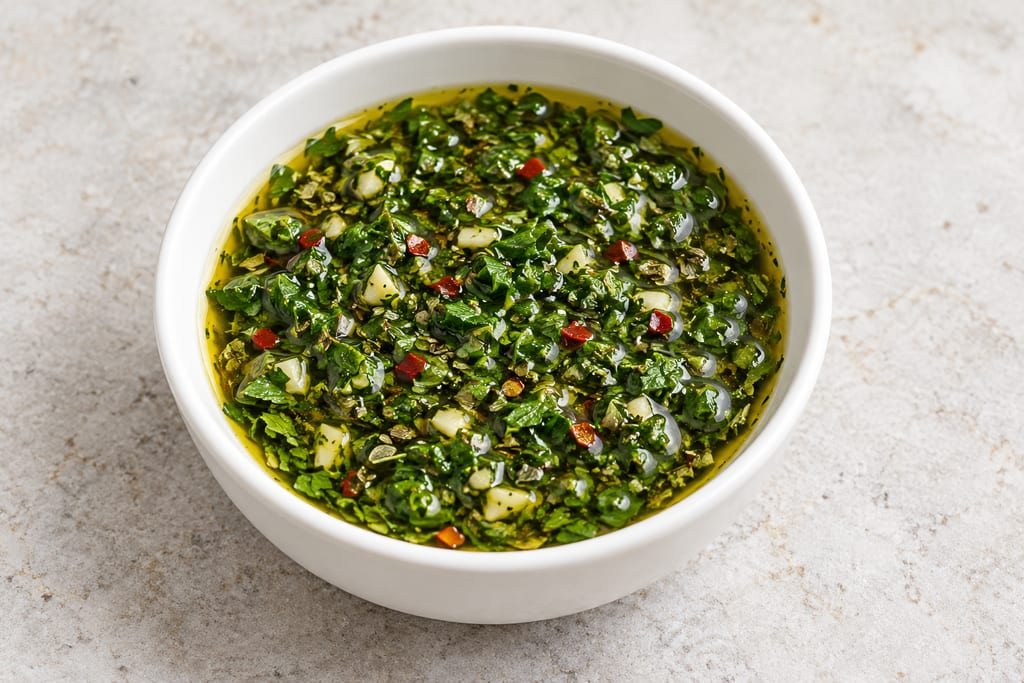
Chimichurri
Chimichurri is an uncooked sauce of chopped parsley, garlic, oregano, oil and vinegar from Argentina. It is spooned over grilled meat and has spread across Latin America.
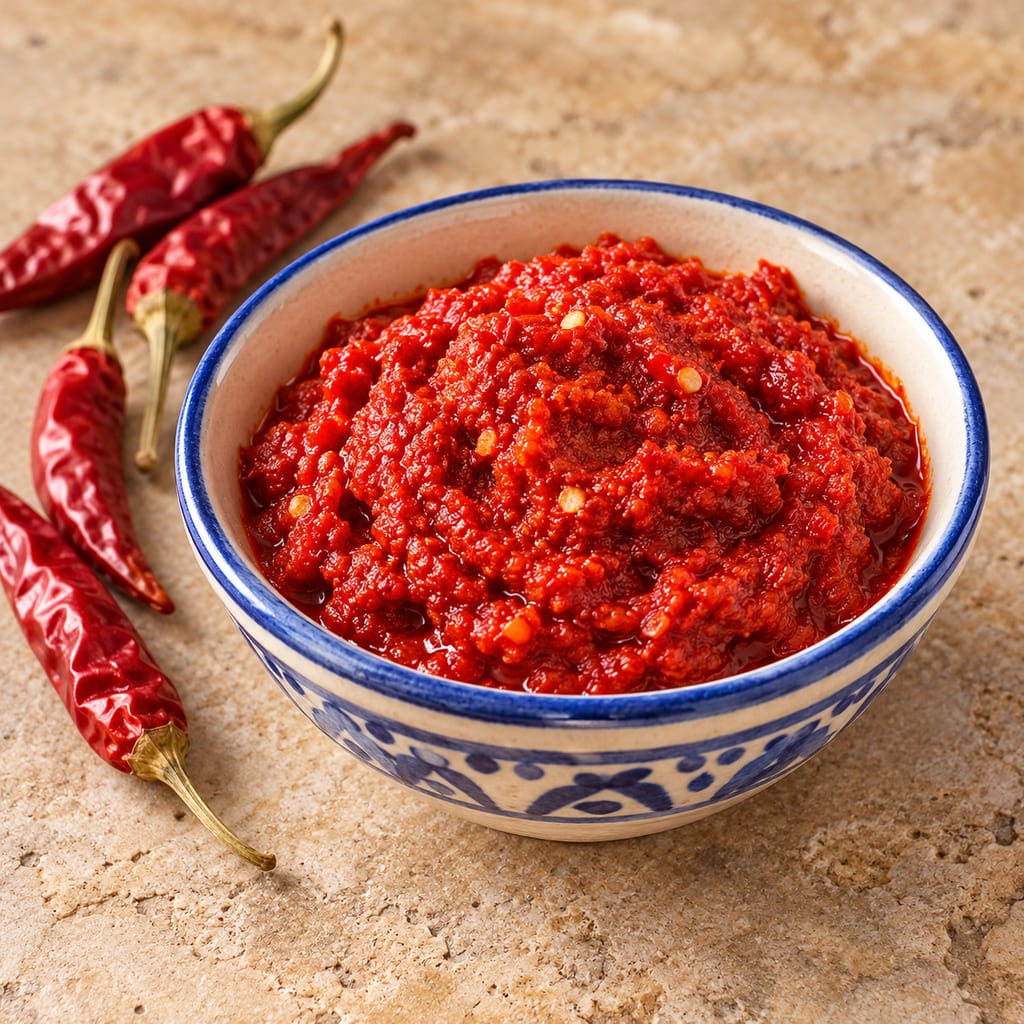
Harissa
A Tunisian hot chilli paste from Cap Bon and Nabeul: red peppers pounded with garlic, caraway, coriander, cumin and olive oil, with many household and commercial variants.
Nam pla
Thai fish sauce is a clear yellow-brown seasoning drawn from salted fish. Tank maturation produces a first extract, with further brine extractions giving other grades.
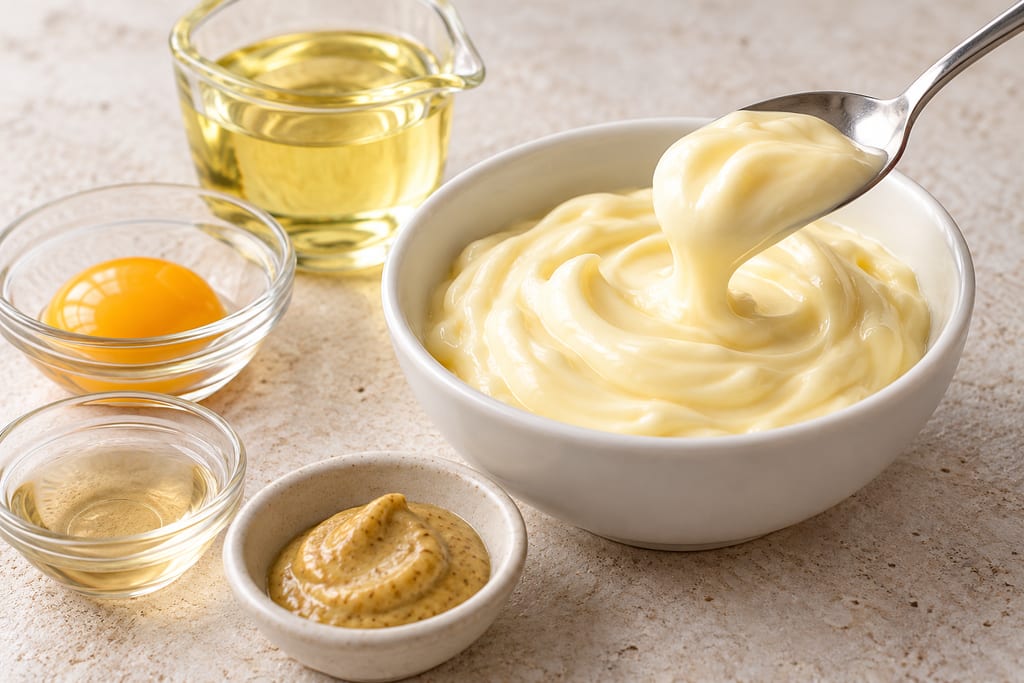
Neutral classic mayonnaise
A plain mayonnaise of 200 g refined neutral oil emulsified into pasteurised yolk, vinegar, water and a little Dijon mustard: a clean base for tasting, comparing and flavouring.
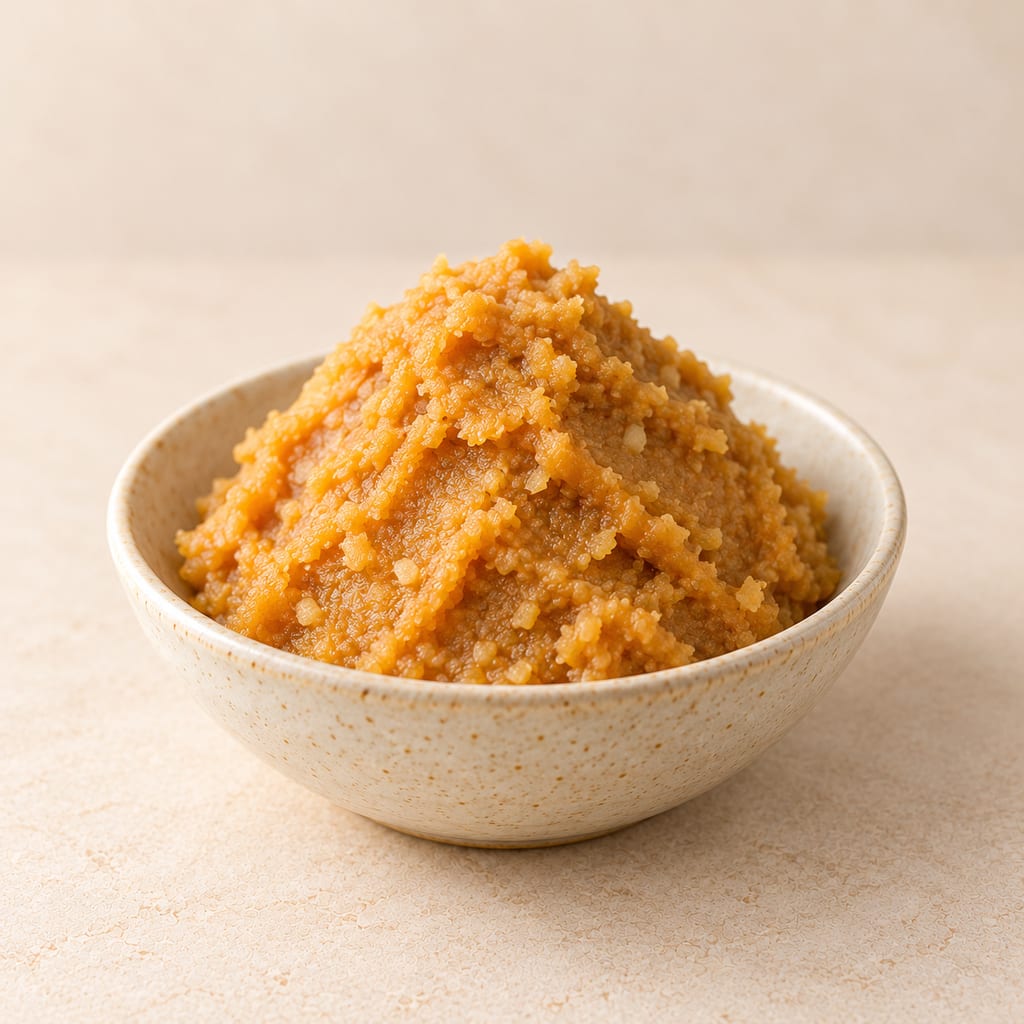
Rice-koji soybean miso
A traditional Japanese fermented paste made by mixing cooked soybeans with rice koji and salt. This guide details the ratio, the long enzymatic breakdown, and the months-long maturation required for depth.
Tkemali
A Georgian sour plum sauce of cherry plums cooked with garlic, coriander, dill-family herbs and chilli. Its sourness comes from the fruit, and it is served as a condiment with grilled meat, poultry and potatoes.
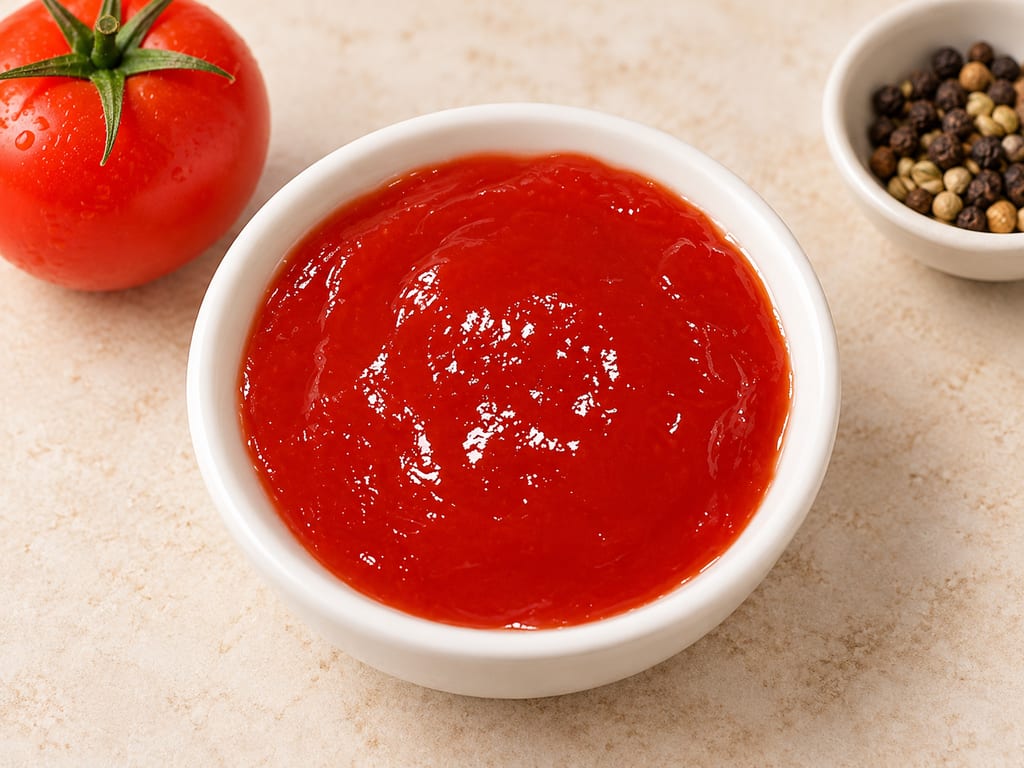
Tomato ketchup
Tomato ketchup is a smooth, sweet-sour tomato sauce whose modern form grew from an older family of savoury ketchups; this version follows a tested home-canning recipe.
Community
No community contributions have been published for this entry yet.
Share what you made
Sign in to contribute. Published comments and photos are free to read.
Sources
Heinz (Kraft Heinz UK)
Tomato Ketchup 460 gCited in: Three bottles, three kinds of engineering; Compare a bottle with a bottle; What this guide is, and what it is not; Ketchup at a glance; Heinz in Britain and the United States; Building a ketchup you can repeat; Testing a copy against the bottle; Copying a bottle without fooling yourself
Journal of Food Science and Technology (Springer); PMID 26396329; PMCID PMC4571207
Soy milk as an emulsifier in mayonnaise: physico-chemical, stability and sensory evaluationCited in: Three bottles, three kinds of engineering; Six things that make one mayonnaise differ from another; Making the base, and rescuing a split one; Holding oil without egg: soy milk, aquafaba and toum
Legal Information Institute, Cornell Law School (copy of the eCFR text)
21 CFR 169.140 MayonnaiseCited in: Three bottles, three kinds of engineering; What the name allows, and why salad cream is another sauce
Kewpie Corporation (Japan)
Kewpie mayonnaise product pages (Japanese domestic site, read in English translation of the Japanese text)Cited in: Three bottles, three kinds of engineering; Mayonnaise at a glance; Six things that make one mayonnaise differ from another; Kewpie in Japan, the United States, Europe and China
Elsevier, Food Chemistry
The effect of processing on the glucosinolate profile in mustard seedCited in: Three bottles, three kinds of engineering; Three seeds and an enzyme; Europe: a sharp root, a pickle sauce and an aged seasoning
Elsevier, Food Chemistry
Thermal and pressure stability of myrosinase enzymes from black mustard (Brassica nigra L. W.D.J. Koch. var. nigra), brown mustard and yellow mustard (full title continues beyond the record's display limit; the brown and yellow entries are Brassica juncea and Sinapis alba)Cited in: Three bottles, three kinds of engineering; Three seeds and an enzyme; Eight controls, and the conventions of the house recipes; Yellow, spicy brown and English: water first, acid next, heat last
The Woks of Life (recipe blog)
Chinese Hot MustardCited in: Three bottles, three kinds of engineering; Three seeds and an enzyme; Hot pastes, sweet dressings and kasundi
Heinz To Home (Kraft Heinz UK)
Heinz Tomato Ketchup 460gCited in: Compare a bottle with a bottle; What this guide is, and what it is not; Ketchup at a glance; Heinz in Britain and the United States; Building a ketchup you can repeat; Three ways a condiment fails; A keeping map, sauce by sauce; First experiments, and the record to keep
Heinz US (Kraft Heinz)
Tomato KetchupCited in: Compare a bottle with a bottle; What this guide is, and what it is not; Heinz in Britain and the United States; Testing a copy against the bottle; First experiments, and the record to keep
U.S. Electronic Code of Federal Regulations (eCFR)
§ 101.9 Nutrition labeling of food.Cited in: Compare a bottle with a bottle; Heinz in Britain and the United States
Heinz UK (Kraft Heinz)
Salad CreamCited in: Compare a bottle with a bottle; What the name allows, and why salad cream is another sauce
PS in foodservice (distributor product record)
Hellmanns Real Mayonnaise 5L (1720561)Cited in: Compare a bottle with a bottle; Mayonnaise at a glance; What the name allows, and why salad cream is another sauce; One name, many jars: Europe and the Americas; Kewpie in Japan, the United States, Europe and China
Duke's (spec sheet hosted by WebstaurantStore)
Mayonnaise #06003 Gallon, Product Specifications (Duke's, Richmond VA)Cited in: Compare a bottle with a bottle; What the name allows, and why salad cream is another sauce; One name, many jars: Europe and the Americas; Mustard, lemon, lime and sunflower: one variable at a time; Three ways a condiment fails; A keeping map, sauce by sauce; First experiments, and the record to keep
Auran (Turku, Finland)
Auran Makea sinappi 275g - Auran (tuotenumero 170084)Cited in: Compare a bottle with a bottle; Europe has no single mustard taste; Sweet and sharp mustards of northern and central Europe
SPAK
SPAK | Klasická hořčice 500 g - SPAKCited in: Compare a bottle with a bottle; Sweet and sharp mustards of northern and central Europe
Prymat (Prymat GastroLine shop, sklep.prymat.pl)
Musztarda sarepska Prymat GastroLine 1000 g (SKU 3116361)Cited in: Compare a bottle with a bottle; Sweet and sharp mustards of northern and central Europe
Hela Gewürzwerk Hermann Laue
Gewürz Ketchup Curry delikat 800mlCited in: Compare a bottle with a bottle; Curry ketchup, brown sauce and ‘tomato sauce’
Hela (hela-shop.eu)
Gewürz Ketchup Curry delikat 800mlCited in: Compare a bottle with a bottle; Curry ketchup, brown sauce and ‘tomato sauce’; Building a ketchup you can repeat
Nestlé India (MAGGI brand site, maggi.in)
Our Range, MAGGI sauces (maggi.in)Cited in: Compare a bottle with a bottle; Chilli ketchup in India, banana ketchup in the Philippines and the Caribbean
Nestlé India (MAGGI, maggi.in)
MAGGI Rich Tomato KetchupCited in: Compare a bottle with a bottle; Chilli ketchup in India, banana ketchup in the Philippines and the Caribbean
Kagome Co., Ltd. (カゴメ株式会社)
カゴメトマトケチャップ|カゴメ株式会社Cited in: Compare a bottle with a bottle; Japan’s ketchup and its brown sauces
legislation.gov.uk (The National Archives)
Regulation (EU) No 1169/2011 of the European Parliament and of the Council, Annex I: Specific definitionsCited in: Compare a bottle with a bottle; Heinz in Britain and the United States
U.S. Food and Drug Administration
Assuring the Safety of Eggs and Menu and Deli Items Made From Raw, Shell Eggs | FDACited in: House rules for keeping; Mayonnaise at a glance; How long a mayonnaise keeps, and what does not lengthen it; When a batch goes wrong, and how to taste one; Mayonnaise needs a safer egg, not more acid
Food Standards Agency (published on GOV.UK)
How to chill, freeze and defrost food safely - GOV.UKCited in: House rules for keeping; A Karakol noodle bowl, and keeping these sauces; Freezing, and the house windows; Preservatives, fermentation, dry mixes and less sugar or salt
Food Standards Agency (published on GOV.UK)
How to chill, freeze and defrost food safely (FSA guidance, HTML)Cited in: House rules for keeping; Fridge, freezer or a tested jar; Freezing, and the house windows; Preservatives, fermentation, dry mixes and less sugar or salt
National Center for Home Food Preservation (University of Georgia, College of Family and Consumer Sciences)
Lots of Leftovers?Cited in: House rules for keeping; Mayonnaise at a glance; How long a mayonnaise keeps, and what does not lengthen it; Mayonnaise needs a safer egg, not more acid; Freezing, and the house windows; Preservatives, fermentation, dry mixes and less sugar or salt
Food Standards Scotland
Advice on safe storage, handling and use of eggs for catering | Food Standards ScotlandCited in: Mayonnaise at a glance; Making the base, and rescuing a split one; Mayonnaise needs a safer egg, not more acid
Ministère de l'agriculture et de l'alimentation (Bulletin officiel 2021-36); INAO as service compétent
Cahier des charges de l'indication géographique protégée Moutarde de Bourgogne, homologué par arrêté du 23 août 2021Cited in: Mustard at a glance; Dijon, Burgundy and the wholegrain jar
La Moutarderie Edmond Fallot
La Moutarde en Bourgogne (La Moutarderie Edmond Fallot)Cited in: Mustard at a glance; Dijon, Burgundy and the wholegrain jar
Friedrich Accum; Project Gutenberg
Culinary Chemistry (1821), Project Gutenberg eBook #60163Cited in: When catsup meant mushrooms
Heinz US (Kraft Heinz)
Simply Tomato Ketchup with No Artificial SweetenersCited in: Heinz in Britain and the United States; Testing a copy against the bottle; First experiments, and the record to keep
Iowa State University Extension, Midwest Grape and Wine Industry Institute
Estimating Grape Maturity by Titratable Acidity - Grape Maturity Series (FS 0049E, 12/2020); companion FS49D 'Estimating Grape Maturity with the Potential or Power of Hydrogen (pH)' (12/2020)Cited in: Heinz in Britain and the United States; What moves a ketchup besides sugar
Wattie's (Kraft Heinz NZ)
9400547002290-wattie-s-tomato-sauce-300-gCited in: Heinz in Britain and the United States; Curry ketchup, brown sauce and ‘tomato sauce’; Australia and New Zealand: tomato sauce, relish and yeast extract; What the evidence does not settle
Foods (Basel, Switzerland), MDPI (PMC8535101; DOI 10.3390/foods10102395)
Effects of Breaking Methods on the Viscosity, Rheological Properties and Nutritional Value of Tomato PasteCited in: What moves a ketchup besides sugar
Open Food Facts (label database record)
Tomato Sauce – MasterFoods – 500 mL (Open Food Facts entry)Cited in: Curry ketchup, brown sauce and ‘tomato sauce’; Australia and New Zealand: tomato sauce, relish and yeast extract
Open Food Facts (label database record)
Tomato Sauce – Wattie's – 565 g (Open Food Facts entry)Cited in: Curry ketchup, brown sauce and ‘tomato sauce’; Australia and New Zealand: tomato sauce, relish and yeast extract
ブルドックソース株式会社 (Bull-Dog Sauce Co., Ltd.)
定番ソース (standard sauce) home-use product list, Bull-Dog Sauce Co., Ltd. (bulldog.co.jp)Cited in: Japan’s ketchup and its brown sauces
ブルドックソース株式会社 (Bull-Dog Sauce Co., Ltd.)
ソースは何でできている? (What is the sauce made of?) (bulldog.co.jp)Cited in: Japan’s ketchup and its brown sauces
ブルドックソース株式会社 (Bull-Dog Sauce Co., Ltd.)
基本のとんかつ|ブルドック とんかつソース|商品から選ぶ|レシピ|ブルドックソース株式会社 (Basic Tonkatsu, Bull-Dog Tonkatsu Sauce)Cited in: Japan’s ketchup and its brown sauces
Otafuku Sauce (オタフクソース)
お好みソース (オタフクソース 商品詳細)Cited in: Japan’s ketchup and its brown sauces; Building a ketchup you can repeat; Miso, ponzu, noodle dips and Japan’s brown sauces
Otafuku Sauce Co., Ltd. (manufacturer, official site)
Okonomi Sauce(for export)Cited in: Japan’s ketchup and its brown sauces; Miso, ponzu, noodle dips and Japan’s brown sauces
Otafuku Sauce Co., Ltd. (manufacturer, official site)
About Otafuku Sauce, History and Activity (Otafuku English site)Cited in: Japan’s ketchup and its brown sauces
NutriAsia
UFC brand page (NutriAsia)Cited in: Chilli ketchup in India, banana ketchup in the Philippines and the Caribbean
USDA Food Safety and Inspection Service
Freezing and Food Safety (FSIS Food Safety Basics)Cited in: Fridge, freezer or a tested jar
National Center for Home Food Preservation (University of Georgia)
Tomato Ketchup (National Center for Home Food Preservation)Cited in: Fridge, freezer or a tested jar; Ketchup and mustard for the cupboard need a tested recipe
Albert Heijn (retailer listing)
Remia Fritessaus ClassicCited in: What the name allows, and why salad cream is another sauce
Unilever Food Solutions US
Hellmann's Real Mayonnaise Mini Jar 72 x 1.2 ozCited in: One name, many jars: Europe and the Americas
Groupe Pomona (distributor technical sheet). Not Amora or Unilever France.
Mayonnaise de Dijon en bocal verre 605 g AMORA, technical sheetCited in: One name, many jars: Europe and the Americas; Mustard, lemon, lime and sunflower: one variable at a time
WSP Społem (Wytwórcza Spółdzielnia Pracy Społem, Kielce)
Majonez Kielecki 410 mlCited in: One name, many jars: Europe and the Americas
VkusVill (Russian retailer). Manufacturer named only as brand 'Слобода'.
Майонез Слобода Провансаль 67% 800 млCited in: One name, many jars: Europe and the Americas; Mustard, lemon, lime and sunflower: one variable at a time
Unilever Food Solutions Philippines (foodservice site)
Lady's Choice Real Mayonnaise 5.5L (Unilever Food Solutions Philippines)Cited in: One name, many jars: Europe and the Americas
McCormick. Elote serving material: McCormick Kitchens / McCormick for Chefs recipe pages.
McCormick Mayonesa (Mayonnaise) With Lime JuiceCited in: One name, many jars: Europe and the Americas; Mustard, lemon, lime and sunflower: one variable at a time
Kewpie Corporation (Japan)
キユーピー マヨネーズCited in: Kewpie in Japan, the United States, Europe and China
Kewpie USA
Kewpie Mayonnaise (Kewpie USA shop)Cited in: Kewpie in Japan, the United States, Europe and China
PS in foodservice (distributor product record)
KEWPIE mayonaise Japanse stijl 355gCited in: Kewpie in Japan, the United States, Europe and China
Kewpie China (丘比)
丘比 Kewpie China homepage (products categories)Cited in: Kewpie in Japan, the United States, Europe and China
Whole Foods Market (retailer listing)
Primal Kitchen Mayo Made with Avocado OilCited in: Avocado, olive and the choice of oil
Food Lion (retailer listing)
Chosen Foods Classic Mayo Made with Avocado Oil, 11.2 oz (Food Lion listing)Cited in: Avocado, olive and the choice of oil; How long a mayonnaise keeps, and what does not lengthen it; Mayonnaise needs a safer egg, not more acid
Foods (MDPI), 9(8):997; PMID 32722352; PMCID PMC7466192
Physical and Sensory Properties of Mayonnaise Enriched with Encapsulated Olive Leaf Phenolic ExtractsCited in: Avocado, olive and the choice of oil
International Journal of Food Science & Technology (Wiley)
Aquafaba from commercially canned chickpeas as potential egg replacer for the development of vegan mayonnaise: recipe optimisation and storage stabilityCited in: Holding oil without egg: soy milk, aquafaba and toum
Foods (MDPI), 10(9):1978; PMID 34574088; PMCID PMC8468250
Standardization of Aquafaba Production and Application in Vegan Mayonnaise AnalogsCited in: Holding oil without egg: soy milk, aquafaba and toum
National Center for Home Food Preservation (University of Georgia)
Freezing Garlic-In-Oil - National Center for Home Food PreservationCited in: Holding oil without egg: soy milk, aquafaba and toum; Toum, tahini sauce and shatta from the Levant; Eight house sauces, and how to handle them; What oil and vacuum hide
MDPI, Pathogens
The Combined Effect of pH and Temperature on the Survival of Salmonella enterica Serovar Typhimurium and Implications for the Preparation of Raw Egg MayonnaiseCited in: How long a mayonnaise keeps, and what does not lengthen it; When a batch goes wrong, and how to taste one; Mayonnaise needs a safer egg, not more acid
International Journal of Food Microbiology (Elsevier)
The culturability of acid-tolerant Salmonella in mayonnaise, a raw egg-based sauce.Cited in: How long a mayonnaise keeps, and what does not lengthen it; When a batch goes wrong, and how to taste one; Mayonnaise needs a safer egg, not more acid
Händlmaier
Süßer SenfCited in: Europe has no single mustard taste; Sweet and sharp mustards of northern and central Europe
Maille (manufacturer, US site)
Maille Dijon Original Mustard 7.5 ozCited in: Dijon, Burgundy and the wholegrain jar
ICA (Sweden)
Hovmästarsås (ICA recipe, 4 portioner)Cited in: Sweet and sharp mustards of northern and central Europe
American Society for Microbiology, Applied and Environmental Microbiology
Antimicrobial effects of mustard flour and acetic acid against Escherichia coli O157:H7, Listeria monocytogenes, and Salmonella enterica serovar TyphimuriumCited in: Keeping mustard: flavour chemistry is not a process; Comparing and refining a batch; A table sauce, a dip and a cooking seasoning; Ketchup and mustard for the cupboard need a tested recipe
Japan Soy Sauce Association (日本醤油協会)
Types and how to use themCited in: Japan’s soy sauces by type and by region
Kikkoman
How soy sauce is madeCited in: Japan’s soy sauces by type and by region; Brewing from the raw crop, and the step the home cook takes instead
キッコーマン国際食文化研究センター (Kikkoman Institute for International Food Culture), journal FOOD CULTURE No. 26 (2016)
一般成分分析と官能評価によるしょうゆの地域別特徴 (Regional characteristics of soy sauce by general component analysis and sensory evaluation)Cited in: Japan’s soy sauces by type and by region; What the evidence does not settle
Kikkoman Institute for International Food Culture (FOOD CULTURE journal, pp. 20-23)
Observations from the Survey into Regional Characteristics of Soy Sauce and Contributing FactorsCited in: Japan’s soy sauces by type and by region; What the evidence does not settle
Marukome (US site)
Type of miso (Marukome USA)Cited in: Miso, ponzu, noodle dips and Japan’s brown sauces
Just One Cookbook
Ponzu Sauce Recipe ポン酢 • Just One CookbookCited in: Miso, ponzu, noodle dips and Japan’s brown sauces
Ministry of Agriculture, Forestry and Fisheries (MAFF), Japan
Fukuoka regional cuisine listing (農林水産省 うちの郷土料理 / 地域の郷土料理, Fukuoka)Cited in: Sesame, wasabi, karashi, yuzu kosho and a first Japanese cupboard; What the evidence does not settle
Qualifirst (Canadian retailer); also voila.ca listing
Wasabi Ko Tube (Horseradish) 43 g S&B (retailer listing)Cited in: Sesame, wasabi, karashi, yuzu kosho and a first Japanese cupboard
UNESCO Intangible Cultural Heritage
Knowledge, beliefs and practices related to jang making in the Republic of Korea - UNESCO Intangible Cultural HeritageCited in: Korea’s jang, and brewing a base versus mixing a dip
Viet World Kitchen
Nuoc Cham - Vietnamese Dipping Sauce Recipe - Viet World KitchenCited in: Thailand, Vietnam and Laos: fish sauce and its dips; Sriracha and fish sauce: choose the target first
Saeng's Kitchen
Jeow Mak Len | Lao Tomato Dipping SauceCited in: Thailand, Vietnam and Laos: fish sauce and its dips; Sriracha and fish sauce: choose the target first
Tourism Cambodia
Khmer Foods And Drinks - Plan Your Trip to Cambodia | Tourism CambodiaCited in: Cambodia, Myanmar and the fermented shrimp pastes; Malaysia, Singapore and Indonesia: sambal, sweet soy and peanut sauce
NutriAsia
NutriAsia – Masarap Masaya Basta't NutriAsiaCited in: The Philippines, Brunei and Timor-Leste; Chutneys of India, Pakistan and Bangladesh; What the evidence does not settle
Sri Lanka Tourism
So Rich In FlavoursCited in: Sri Lanka, the Himalaya, the Maldives and Afghanistan
Lee Kum Kee UK (manufacturer)
Which Soy Sauce Should You Use? | Lee Kum Kee UKCited in: Soy, vinegar and sweet pastes of China, Taiwan and Hong Kong
Chill Crisp (Substack)
Let's Talk about Chinese Black VinegarsCited in: Soy, vinegar and sweet pastes of China, Taiwan and Hong Kong
The Woks of Life
Sweet Bean Sauce (Tian Mian Jiang)Cited in: Soy, vinegar and sweet pastes of China, Taiwan and Hong Kong
Lee Kum Kee UK (manufacturer)
Lee Kum Kee Premium Oyster Sauce (255g, 510g)Cited in: Oyster sauce, hoisin and the fermented bean bases
Lee Kum Kee UK (manufacturer)
Lee Kum Kee Hoisin Sauce (210g, 397g)Cited in: Oyster sauce, hoisin and the fermented bean bases
Lee Kum Kee Hong Kong (hk.lkk.com, foodservices)
Hoisin Sauce (Lee Kum Kee Hong Kong foodservice, Cooking and Dipping Sauce category)Cited in: Oyster sauce, hoisin and the fermented bean bases
Lee Kum Kee UK (manufacturer)
Lee Kum Kee Chilli Bean Sauce (195g, 368g)Cited in: Oyster sauce, hoisin and the fermented bean bases
Lee Kum Kee UK (manufacturer)
Lee Kum Kee Black Bean Garlic Sauce (205g, 368g)Cited in: Oyster sauce, hoisin and the fermented bean bases
Lee Kum Kee Hong Kong (manufacturer)
Sauce for Black Bean ChickenCited in: Oyster sauce, hoisin and the fermented bean bases
Asia Market (Ireland) retailer page; manufacturer UK page not found
LEE KUM KEE Chiu Chow Chilli Crispy 198gCited in: Chilli oil, XO, shacha and sesame paste
Lee Kum Kee Hong Kong (manufacturer)
Seafood XO Sauce Hot and SavouryCited in: Chilli oil, XO, shacha and sesame paste
Haw-Di-I Foods Co., Ltd. (好帝一食品有限公司), Bull Head brand
沙茶醬250gCited in: Chilli oil, XO, shacha and sesame paste
Business Today (businesstoday.com.tw); the page labels the article 廣告企畫 (advertorial)
Business Today (Taiwan) advertorial on Bull Head (牛頭牌) shacha sauce, 2015Cited in: Chilli oil, XO, shacha and sesame paste
Soom Foods (manufacturer)
Soom Foods: frequently asked questionsCited in: Chilli oil, XO, shacha and sesame paste
Georgia Travel (georgia.travel, official Georgian tourism site)
Georgian Sauces | Georgia TravelCited in: Georgia’s cherry-plum sauces and Caucasian chilli pastes
Ottolenghi (ottolenghi.co.uk)
Spicy green tahini sauceCited in: Toum, tahini sauce and shatta from the Levant
Abeer Najjar (abeernajjar.com)
Shatta | Homemade Chili Paste – Abeer NajjarCited in: Toum, tahini sauce and shatta from the Levant
The Nosher (My Jewish Learning)
Iraqi Amba Sauce Recipe | The Nosher (recipe card: Amba (Pickled Mango Sauce) Recipe)Cited in: Zhug from Yemen and amba from Iraq
Jewish Food Society
Writer Samantha Ellis Cooks Her Way Back to the Iraqi-Jewish KitchenCited in: Zhug from Yemen and amba from Iraq
Cortas (cortasfood.com; logo and copyright on site)
Cortas: MOLASSES category (two pomegranate molasses products)Cited in: Pomegranate sour, molasses and Persian pickles
Hami Sharafi (hamisharafi.com)
Zeytoon Parvardeh - Persian Enriched OlivesCited in: Pomegranate sour, molasses and Persian pickles
Destination Karakol
Kyrgyz Food and Karakol Specialties (Ashlan-Fu section)Cited in: A Karakol noodle bowl, and keeping these sauces
Mangiare in Liguria, content supplied by the Consorzio del Pesto Genovese
Pesto Genovese: la ricettaCited in: Europe: basil, olives, nuts and roasted peppers
Marseille Tourism (marseille-tourisme.com)
Tapenade Marseille | Marseille TourismCited in: Europe: basil, olives, nuts and roasted peppers
catalunya.com (Catalan Tourist Board)
Romesco Sauce Recipe: the quintessential Mediterranean flavorCited in: Europe: basil, olives, nuts and roasted peppers
Schamel Meerrettich GmbH & Co. KG (company website)
Unsere Familiengeschichte seit 1846 - Schamel MeerrettichCited in: Europe: a sharp root, a pickle sauce and an aged seasoning
National Center for Home Food Preservation (University of Georgia)
Pickled Horseradish Sauce - National Center for Home Food PreservationCited in: Europe: a sharp root, a pickle sauce and an aged seasoning
Arla Foods (arla.dk)
Remoulade - Opskrift på skøn hjemmelavet Remoulade | ArlaCited in: Europe: a sharp root, a pickle sauce and an aged seasoning
Hidden Valley
The History of Hidden Valley RanchCited in: North America: ranch and the barbecue map; What the evidence does not settle
Discover South Carolina
South Carolina's four barbecue saucesCited in: North America: ranch and the barbecue map
Visit NC (North Carolina state tourism)
Lexington Barbecue (Visit NC point of interest)Cited in: North America: ranch and the barbecue map
rickbayless.com (Rick Bayless)
Roasted Tomatillo Sauce Base (Basic Preparations)Cited in: Mexico and the Caribbean: salsas, pepper sauces, chutney and pikliz
rickbayless.com (Rick Bayless)
Salsa Macha (rickbayless.com)Cited in: Mexico and the Caribbean: salsas, pepper sauces, chutney and pikliz
Caribbean Pot
Spicy cucumber chutney (Caribbean Pot)Cited in: Mexico and the Caribbean: salsas, pepper sauces, chutney and pikliz
Visit Haiti (visithaiti.com)
The Haitian Street Food You Have to TryCited in: Mexico and the Caribbean: salsas, pepper sauces, chutney and pikliz
Oldways
Haitian Pikliz (Oldways recipe)Cited in: Mexico and the Caribbean: salsas, pepper sauces, chutney and pikliz
Bolivian Cookbook (boliviancookbook.com)
Llajwa (Spicy Bolivian Salsa)Cited in: South America: ají, llajwa, huancaína, chimichurri and pebre
Peru Delights
Classic Papa a la Huancaina RevisitedCited in: South America: ají, llajwa, huancaína, chimichurri and pebre
UNESCO Intangible Cultural Heritage
Harissa, knowledge, skills and culinary and social practices (UNESCO ICH element)Cited in: North Africa: harissa and chermoula
My Moroccan Food (mymoroccanfood.com)
Chermoula - Moroccan CondimentCited in: North Africa: harissa and chermoula
Kaluhi's Kitchen
Pilipili ya KukaangaCited in: West, East and Southern Africa: shito, awaze and cooked relishes
Greedy Gourmet (greedygourmet.com)
Mrs Balls ChutneyCited in: West, East and Southern Africa: shito, awaze and cooked relishes
Woolworths Taste (site copyright: 'Woolworths holdings limited')
ChakalakaCited in: West, East and Southern Africa: shito, awaze and cooked relishes
Vegemite (Bega Cheese)
Vegemite: frequently asked questionsCited in: Australia and New Zealand: tomato sauce, relish and yeast extract
MDPI, Fermentation
Spent Yeast from Brewing Processes: A Biodiverse Starting Material for Yeast Extract ProductionCited in: Australia and New Zealand: tomato sauce, relish and yeast extract
National Center for Home Food Preservation (University of Georgia)
Blender Ketchup (National Center for Home Food Preservation)Cited in: Ketchup and mustard for the cupboard need a tested recipe
National Center for Home Food Preservation (University of Georgia)
Country Western Ketchup (National Center for Home Food Preservation)Cited in: Ketchup and mustard for the cupboard need a tested recipe
National Center for Home Food Preservation
Canning Salsa IntroductionCited in: Ketchup and mustard for the cupboard need a tested recipe
CALS, Cornell University (content prepared by the Cornell Food Venture Center)
Acid & Acidified Foods | CALSCited in: What a pH meter, a refractometer and a water-activity reading can tell you
Gaps
- The house recipes have not been cooked, tasted against their targets or tested for keeping quality.
- No tested home canning process exists for egg-and-oil emulsions such as mayonnaise.
- Regional sweetness in Japanese soy sauce rests on 2011–2013 sales samples; its history is not settled.
- Condiment habits of Central Asia and Mongolia, and national standards for Nepalese achar, Bhutanese ezay and Afghan chutney, are thinly documented.
- Proprietary spice blends, flavourings and processing conditions of commercial sauces (Heinz, HP, Kewpie, Bull-Dog, Otafuku) are not public.
Updated 2026-10-27