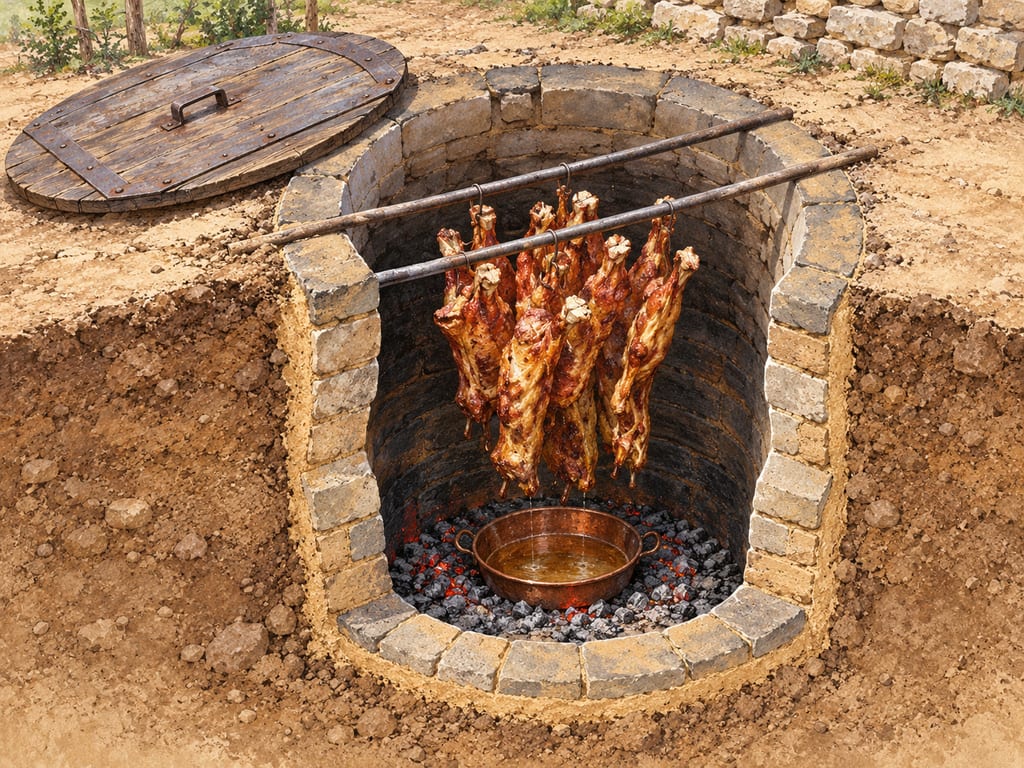
Kuyu tandırı of Denizli
A fixed, brick-lined Turkish well oven documented in Denizli: a deep circular chamber with iron hanging bars, a wood-and-sheet-metal lid, and a copper drip pan used below lambs roasting over embers.
 FermenteaWhere food goes to change
Place · Cellars, caves and ripening rooms
A natural cave beneath a hill near Divle, Türkiye, is used to mature skin-packed tulum cheese. The district describes a cool, humid seasonal store; reported cave lengths differ between official sources.
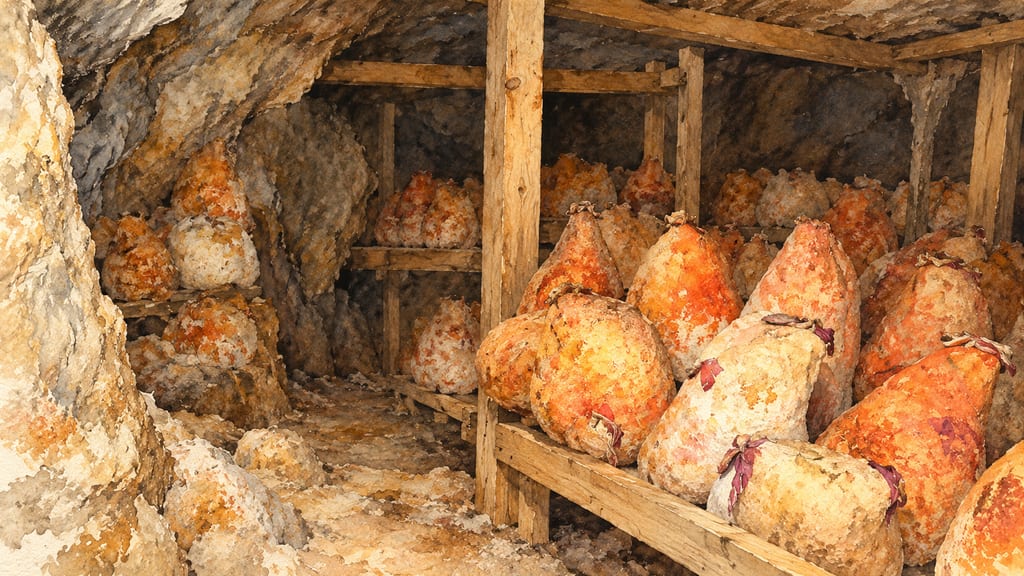
Divle Obruğu is a natural underground cavity used to mature Karaman Divle Obruğu Tulum Peyniri. The Ayrancı District Governorship places it under a hill about 1.5–2 kilometres southeast of Divle, also called Üçharman, and describes the passage as running east–west. The cave is a place-specific part of the cheese practice; it is not a cellar design that can be transferred to another site.
The local source describes the cave as a natural cold store and says a lift above the hill is used to lower and raise cheese. It reports an approximate depth of 36 metres. Its current page gives a length of about 150 metres, while a 2023 Karaman Agriculture Directorate report says about 250 metres. These differing published figures are not reconciled here.
The Ayrancı source reports an interior temperature of about 4 ± 1 °C and relative humidity of 80 ± 5% during the cheese-storage period. It says the cave reaches about +22 °C in winter, when it is empty. These values describe the local source's account of this cave; they are not a universal specification for natural caves or a claim that temperature is actively controlled.
TÜRKPATENT identifies Karaman Divle Obruğu Tulum Peyniri as a registered designation of origin, registration number 270, dated 8 December 2017. The registered geography is Ayrancı District in Karaman Province. That product designation links the cave to a named regional cheese, while this build entry focuses on the fixed natural site.
The district's description says the cheese is packed into goat or lamb skin tulum sacks and matured in the cave for five to six months. Local and cultural-heritage accounts describe a seasonal cycle, with the mature bags taken out in autumn. The Türkiye Kültür Portalı records producer, weight, type and entry date on a cave slip and in the keeper's ledger, showing that the storage is organized by batch rather than treated as anonymous cave stock.
A 2016 Anadolu Ajansı photograph shows one interior view: skin-wrapped cheeses sit on wooden racks among rough cave walls. The rack arrangement belongs to that photographed scene; neither the district page nor the product register makes it a standard plan. The linked photo remains credited to AA/Mehmet Çetin, and the source does not state a reuse licence.
The Ayrancı District Governorship calls the practice centuries-old, but the sources used here do not provide a dated first attestation. The period is therefore recorded as unknown rather than assigning a medieval or earlier date. TÜRKPATENT's 2017 registration dates legal designation, not the cave's origin.
This page describes the natural cave, its documented use and reported local conditions. A full survey, geological account or guide to entering or building an underground space is not given.
The Ayrancı District Governorship describes cheese maturation at Divle Obruğu as a tradition lasting centuries, but the sources used here give no dated first attestation. This dates no particular cave feature.
The cave is described beneath a hill 1.5–2 km southeast of Divle/Üçharman village. Official sources report different approximate lengths, both with a depth near 36 m.
A fixed, brick-lined Turkish well oven documented in Denizli: a deep circular chamber with iron hanging bars, a wood-and-sheet-metal lid, and a copper drip pan used below lambs roasting over embers.
No community contributions have been published for this entry yet.
Sign in to contribute. Published comments and photos are free to read.
T.C. Ayrancı KaymakamlığıSite · Geography · Climate · Maturation · Method · History
OBRUKThe district source places the cave 1.5–2 km southeast of Divle village under a hill, extending roughly east–west; it describes an approximate length of 150 m and depth of 36 m.
It reports about 4 ± 1 °C and 80 ± 5% relative humidity during storage, about +22 °C in winter when the cave is empty, seasonal maturation for 5–6 months, and a hilltop lift for loading and unloading.
It describes the maturation tradition as centuries-old but gives no dated first attestation.
Cited in: A natural cave used as a seasonal cheese store; A place, a seasonal environment; Skin-packed cheese in the cave; Use and historical limits
Karaman İl Tarım ve Orman MüdürlüğüGeography · Cave dimensions · Season
Coğrafi İşaretli Divle Peyniri Dualarla Obruk’tan ÇıktıThe 2023 directorate report places the cave in Divle village, Ayrancı and reports about 36 m depth and 250 m length, differing from the current district page's length figure; the discrepancy is retained rather than resolved by averaging.
The report confirms the cave is used to store and mature the geographically indicated Divle Obruk cheese.
Cited in: A natural cave used as a seasonal cheese store
Türk Patent ve Marka Kurumu, Geographical Indications PortalDesignation · Geography
Karaman Divle Obruğu Tulum Peyniri (No. 270)The portal records Karaman Divle Obruğu Tulum Peyniri as a registered designation of origin, registration number 270, registered 8 December 2017; applicant is Karaman Chamber of Commerce and Industry.
Cited in: A place, a seasonal environment; Use and historical limits
Türkiye Kültür Portalı; Karaman Provincial Directorate of Culture and TourismMethod · Season · Records
Divle Obruk PeyniriThe portal describes sheep- and goat-skin bags placed in the cave for maturation, with producer and entry information recorded on a cave slip and in the keeper's ledger; it describes seasonal use and a minimum 90-day maturation period.
Cited in: Skin-packed cheese in the cave
Anadolu AjansıVisual reference · Observed storage arrangement · Method
Mağarada bekletilen 'Türk rokforu' Fransızların da ilgisini çektiThe 12 October 2016 article credits the inspected cave photograph to AA/Mehmet Çetin and reports cheese in goat or kid skins placed in the cave; the photograph shows one cave view with wooden storage racks and skin-wrapped cheeses, not a universal interior layout.
The AA article lists no reuse licence; its image is linked to the source only, with rights recorded as link-only.
Cited in: Skin-packed cheese in the cave