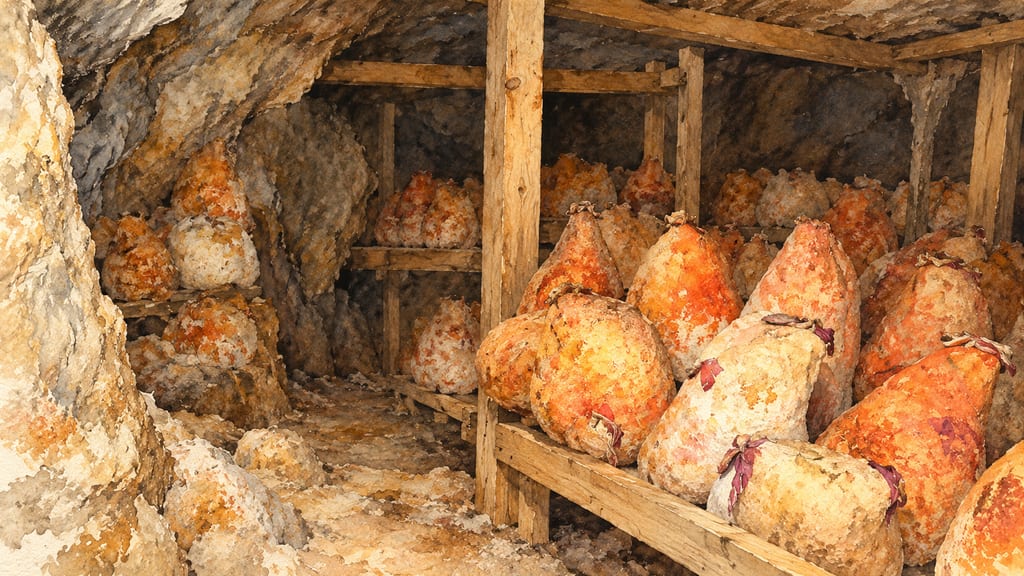
Divle Obruk cave
A natural cave beneath a hill near Divle, Türkiye, is used to mature skin-packed tulum cheese. The district describes a cool, humid seasonal store; reported cave lengths differ between official sources.
 FermenteaWhere food goes to change
Built structures · Pits and cavities
Kuyu tandırı · Kuyu tandiri · Kuyu kebabı oven · Denizli kuyu tandırı
A fixed, brick-lined Turkish well oven documented in Denizli: a deep circular chamber with iron hanging bars, a wood-and-sheet-metal lid, and a copper drip pan used below lambs roasting over embers.
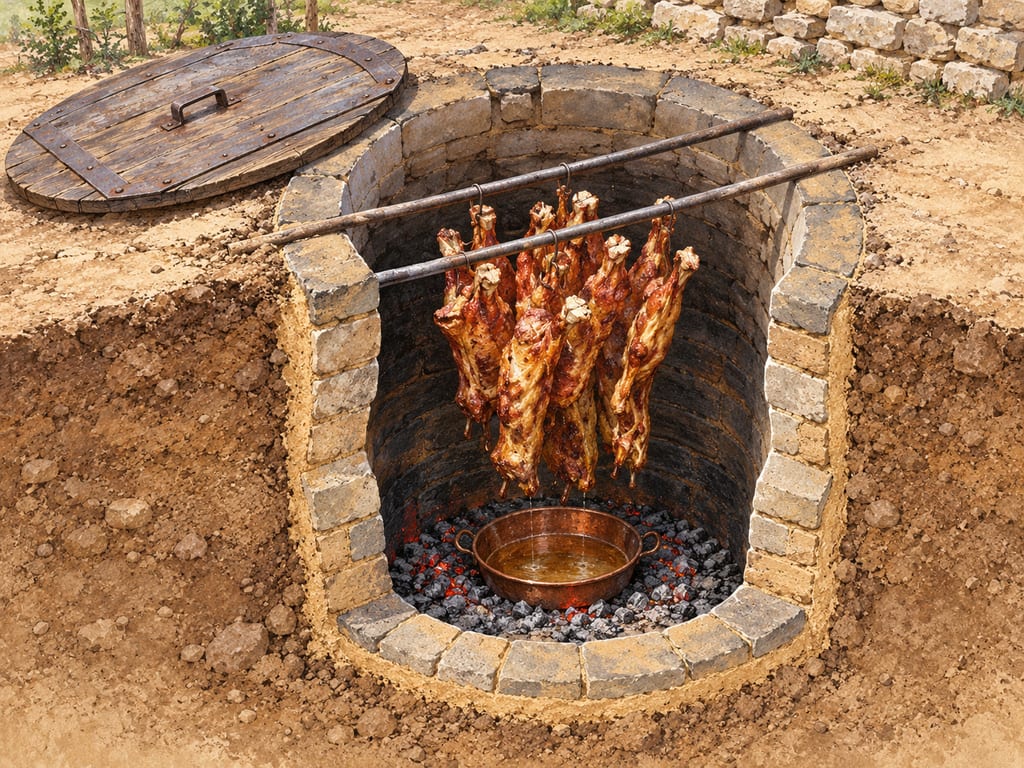
Kuyu tandırı is a fixed, circular cooking well documented by Türkiye’s Culture Portal for Denizli. Its described chamber is about 1.5 metres deep and 85–90 centimetres across. The lining is built from old cut bricks set in yellow earth mortar, and the portal describes a slight outward bulge around the well’s middle. Those figures describe the regional example in that source, not a standard for every oven called tandır.
Iron rods span the opening to carry hooks and suspended lambs. A wooden lid covered in sheet metal closes the mouth, and the same earth used for mortar seals around it while cooking. The source also notes a chimney above the well. This makes the Denizli form different in its documented details from a generic pit oven: its brick shaft, top suspension bars, metal-clad lid and drip pan work together as a fixed cooking installation.
The Denizli account names pine kindling as the fuel. Once the fire has burned down to coals, a copper pan as wide as the base, with a little water, is placed at the bottom. Lambs are hung from the iron bars above it. The lid is closed and sealed with earth for about an hour and a half, then opened for 15–20 minutes to air the chamber. The pan catches rendered fat and juices.
These details belong to the cited Denizli account and should not be generalized to every tandır. The national Ministry of Culture and Tourism’s separate Tandır Kebab recipe also describes an underground brick oven and suspended lamb, but it specifies other seasoning, a water kettle and roughly two hours of cooking. The regional recipes are related; their details are not interchangeable.
The cited cultural-portal entry is specifically titled Kuyu Tandırı (Kuyu Kebabı) – Denizli. It was added in 2013 and updated in 2022, but does not date the practice’s origin. The Ministry’s entry documents the broader Turkish tandır oven tradition; neither source establishes a single birthplace for every well oven.
The Ministry portal’s archive photograph shows lambs suspended inside a masonry-lined chamber, matching the structure’s defining arrangement. The photo is credited to the Denizli Provincial Directorate of Culture and Tourism archive; the page states no reuse license, so it appears in the attributed gallery as a link-only reference. The cutaway hero is editorial art, not a photograph or construction plan.
The Culture Portal entry was added in 2013 and updated in 2022, but gives no date for the oven’s origin. A national Ministry recipe documents related underground-brick tandır use, not the same Denizli specification.
A build is made where it stands: moving it means building it again.
The documented oven is preheated with pine kindling and lambs hang above the embers.
Hazard sourceThe sources do not provide tested modern structural, fire-clearance or load specifications; this page documents a regional form rather than a safe construction plan.
Control sourceDo not infer construction safety or structural dimensions beyond the specific source description.
The portal identifies the form as Kuyu Tandırı of Denizli; this region row does not claim a single village or a universal Turkish design.
A natural cave beneath a hill near Divle, Türkiye, is used to mature skin-packed tulum cheese. The district describes a cool, humid seasonal store; reported cave lengths differ between official sources.

Soft, spreadable Calabrian pork sausage made with a great deal of red chilli and fatty pork, stuffed into natural casings, sometimes smoked and matured while staying soft.

A way to add independent temperature logging to an existing food dehydrator without changing its built-in controls or protections. It is a monitoring method, not a rewiring plan.

Pleurotus cystidiosus is the abalone mushroom, a cultivated oyster-type fungus with dark brown caps that grows more slowly and is more demanding than other Pleurotus species.

A dark, balanced vinegar from Emilia-Romagna made by combining cooked or concentrated grape must with wine vinegar, then acetifying and refining it in wood under a protected specification.

A living dairy inoculum that starts controlled cream fermentation, developing acidity and aroma before sour cream or cultured butter is finished.

A small electric incubator holds jars at a selected temperature for yogurt and other documented warm food preparations. Controls, capacity and vessel arrangement vary by model.

Adygean salt is a seasoned table salt associated with Adygea and the wider North Caucasian culinary tradition. Salt is blended with garlic and a variable selection of herbs and spices; the exact mix depends on the named style and maker.

The African Caesar-group mushroom, Amanita masasiensis, is a wild ectomycorrhizal species of central and southern African woodlands, eaten locally. The genus contains deadly poisonous species, so identification needs care.
No community contributions have been published for this entry yet.
Sign in to contribute. Published comments and photos are free to read.
Türkiye Kültür Portalı, Ministry of Culture and TourismStructure · Materials · Dimensions · Use · Geography
Kuyu Tandırı (Kuyu Kebabı) – DenizliThe portal describes a typical Denizli well oven as about 1.5 m deep and 85–90 cm in diameter, made from old cut bricks with yellow-earth mortar; it notes a bulge around the middle, an upper chimney, iron rods for hanging lambs, and a timber lid covered in sheet metal.
Its cooking account names pine kindling; after coals remain, a copper pan with some water is placed at the bottom, lambs are suspended from the bars, the lid is sealed with earth, and the oven is left closed for about 90 minutes before airing for 15–20 minutes.
The page identifies the regional subject as Kuyu Tandırı of Denizli and credits its archive photo to the Denizli Provincial Directorate of Culture and Tourism.
Cited in: The Denizli well oven; How the chamber is used; Place, record and limits
Republic of Türkiye Ministry of Culture and TourismComparison
Tandır KebabThe Ministry describes a related underground brick tandır in a separate recipe: preheated coals, a suspended lamb, a covered and dough-sealed lid, and a different seasoning and roughly two-hour cook; this is used here only as a comparison, not as the Denizli kuyu tandırı specification.
Cited in: How the chamber is used; Place, record and limits