← Equipment

Equipment · Strainers, moulds and hoops

Fir-bark cheese cylinder

coaja de brad · fir-bark casing · pine-bark cheese cylinder

Loading ratings…

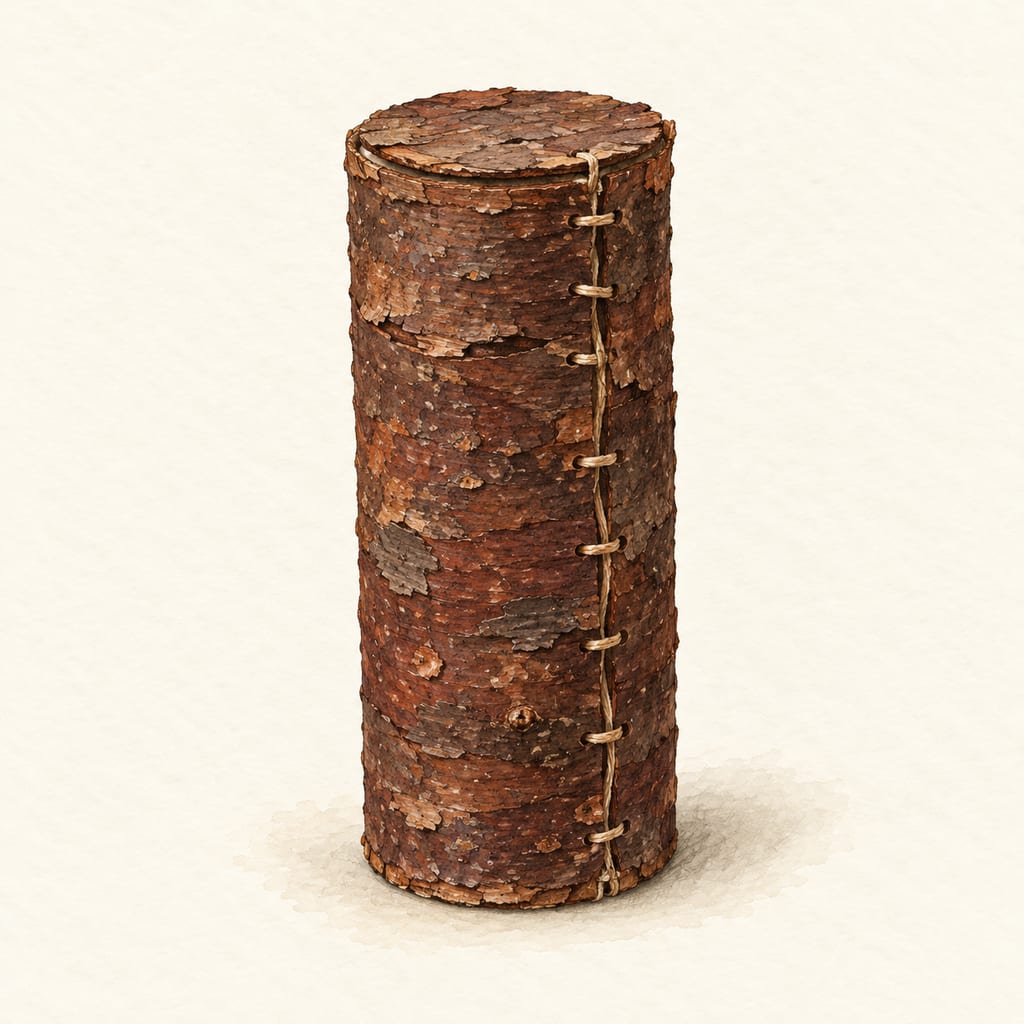
A sewn fir- or pine-bark casing used for one documented Bucegi Mountains form of brânză de burduf, shaped as a cylinder and closed with bark disks while the cheese matures.

Watercolor illustration of the closed fir-bark cheese cylinder with a fitted bark end disk and hand-sewn seam.

A bark casing for burduf

Coaja de brad—literally, fir bark—is a natural casing for a regional form of brânză de burduf, a matured cheese described in Romania’s Bucegi Mountains. The cylinder may be made from fir or pine bark. It is not a general container for every version of burduf: the account also notes other casings, including pig bladder.

The cylinder gives the cheese a distinctive form during maturation. The bark is associated with pronounced resinous notes. These details apply to the reported regional practice and do not establish that every bark species or every burduf casing gives the same result.

Sources for this section

Making and closing the cylinder

The bark is trimmed to remove its woodiest part, then softened in hot whey so it can be bent. The maker sews it with string into a cylinder reported at about 25 centimetres tall and 10 centimetres across. A bark disk closes each end. The account does not specify bark thickness, string fibre, a standard tree species, or a cleaning and reuse routine.

The cheese associated with the casing is prepared separately: milk is curdled with lamb or veal rennet, drained, fermented without salt in a fir-wood tub for up to two weeks, then ground with salt before filling the bark cylinder. This is not a complete or standardized home recipe.

Sources for this section

Maturation and limits of the evidence

The regional account reports maturation in the casing for 20 days to two months. That range is not a validated safety schedule or universal storage instruction. It gives no controlled temperature, humidity, sanitation procedure, or criteria for deciding when a casing can be reused.

Preparation is placed in May through July, when growing trees have resinous, flexible bark. The account does not give a date for the invention of the cylinder. Its dimensions and method identify one described form, not a rule for every producer or locality.

Sources for this section

Equipment details

Size25 cm tall, 10 cm across Approximate dimensions reported for this regional form; not universal.
PowerNo power A passive casing with no powered parts.
How you get oneBought from a maker The casing is fashioned by trimming, softening and sewing bark; no commercial source is specified.

Made of

  • Fir or pine bark — Casing wall and end disks
    Trimmed, softened in hot whey, sewn into a cylinder and closed with bark disks.
  • String — Seam and closure
    The source does not identify its fibre.

Places

Bucegi Mountains

Traditional use · Region evidence

This regional account situates the bark-cased brânză de burduf in the Bucegi Mountains; it does not identify one village as the sole place of use.

Related

Community

No community contributions have been published for this entry yet.

Share what you made

Sign in to contribute. Published comments and photos are free to read.

Sources