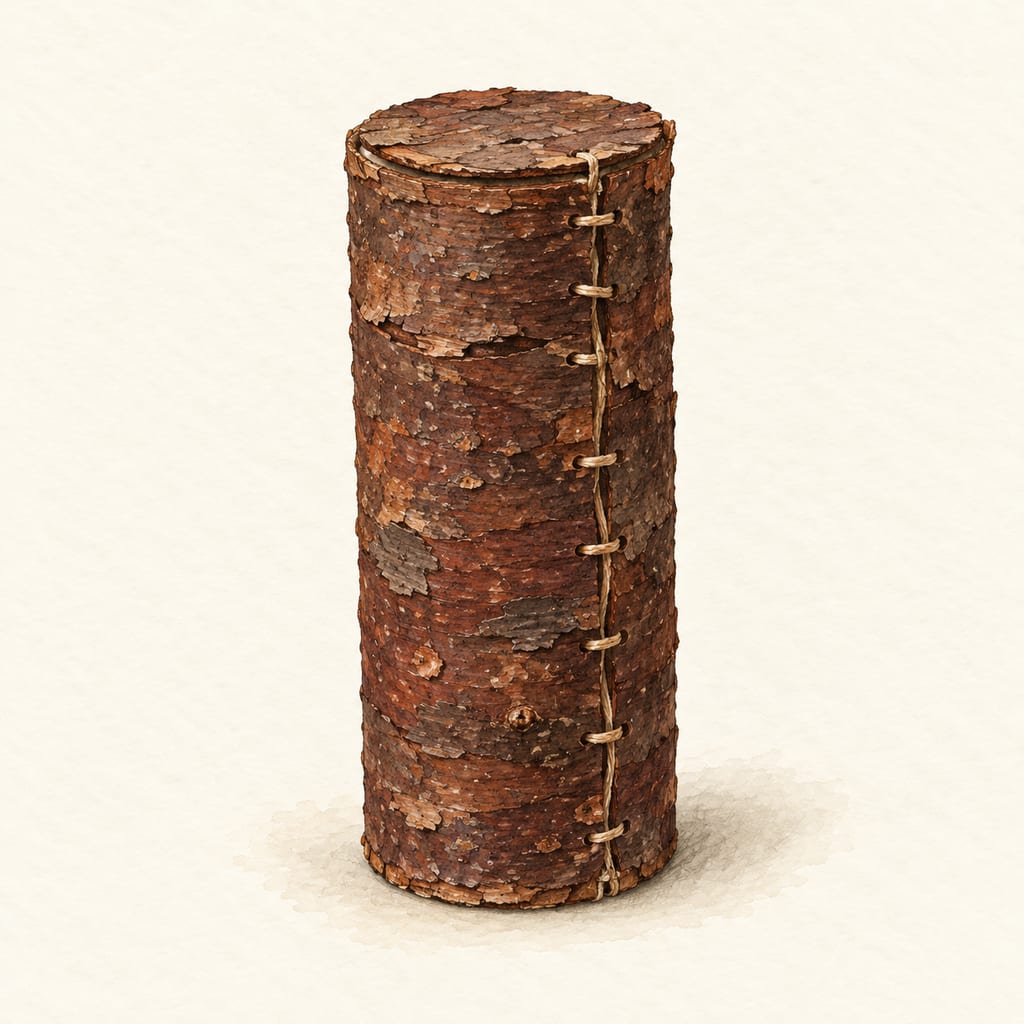
Fir-bark cheese cylinder
A sewn fir- or pine-bark casing used for one documented Bucegi Mountains form of brânză de burduf, shaped as a cylinder and closed with bark disks while the cheese matures.
 FermenteaWhere food goes to change
Equipment · Kettles, coppers and boilers
Double-walled open vats · Topoloveni steam-jacketed vats
Topoloveni's open vats use steam through a double wall and anchor stirring. DoR reports four double-wall copper cauldrons imported from France for early production; their date and the material of current vats are unknown.
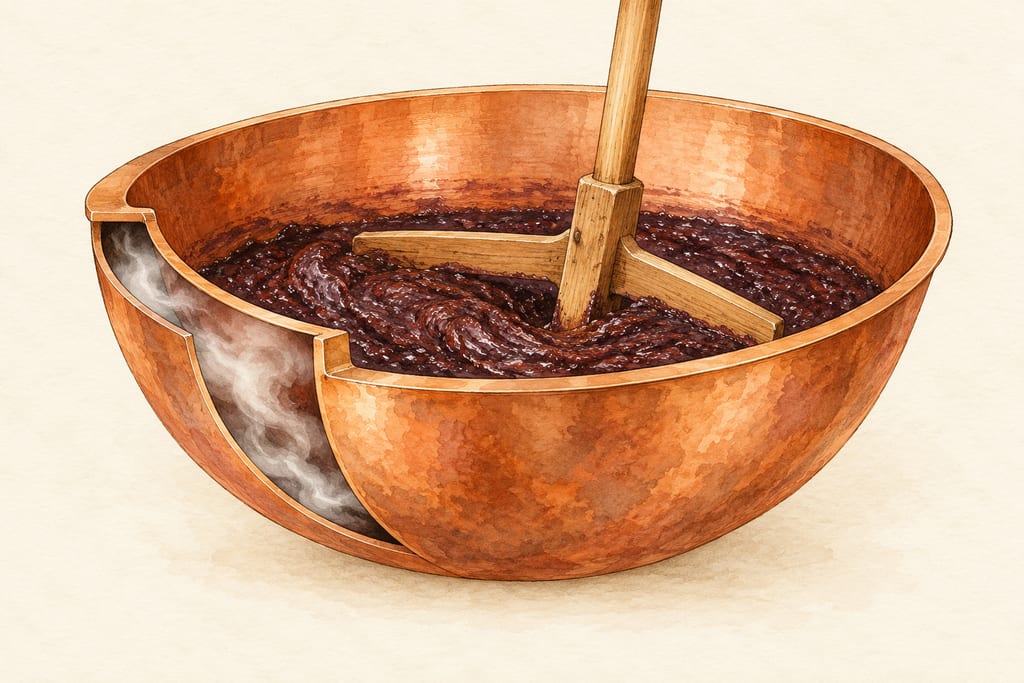
The name describes a heating arrangement rather than one standard commercial model: an open vat has a second wall around its product-holding body, and steam circulates in that intervening jacket. The EU specification for Magiun de prune Topoloveni says the plum pulp is concentrated by boiling in open, double-walled vats, heated by steam passing through the double walls. It describes this as the local method and contrasts it with vacuum concentration.
The sources also distinguish historical from current material. DoR reports that four double-wall copper cauldrons were imported from France for early Topoloveni magiun production. The article does not date their import or first use, and it does not establish that present-day vats are copper. A linked manufacturer image here is only a broad visual comparison for the open, jacketed vessel form.
Indirect heating separates the product from the heating medium: steam travels through the jacket rather than a flame acting directly on the pulp. The product specification says the vats have anchor stirrers that keep the pulp continuously homogeneous to prevent sticking and caramelisation. DoR's 2010 factory report separately describes wooden paddles turning in the double-wall bain-marie kettles. The records document anchor stirring and wooden paddles, but do not prove that a particular wooden paddle was itself the anchor stirrer.
The job is concentration. Water leaves the plum pulp during the open cook, while continuous movement helps keep the thickening mass from adhering at heated surfaces. The EU specification says the method is not performed under vacuum. Its process details belong to the protected product method, not to a general instruction for operating any jacketed kettle.
The equipment is documented here through its use in making Magiun de prune Topoloveni, whose production area is specified in the EU record. Local production history reaches further back than the direct equipment description: the EU application cites local archives for a magiun factory founded in Topoloveni in 1914. DoR reports four double-wall copper cauldrons imported from France for early production, without dating the import. Neither fact dates the first use of the precise vessel form described in the current product specification.
DoR's 2010 factory report provides the clearest dated description of the apparatus itself, including wooden paddles and an early-production account of copper cauldrons. Sonimpex's current account describes bain-marie vessels with double walls and steam circulating between them, but does not specify their material. The specific equipment's manufacturer, acquisition route and care instructions remain undocumented in these sources, so this entry identifies a working form and its setting rather than a purchasable specification.
DoR reports four double-wall copper cauldrons imported from France for early Topoloveni magiun production, but does not date their arrival or first use. The factory's 1914 establishment is product-history context, not an exact date for these vessels. The exact double-wall vat form is directly described at the factory by 2010 and by the producer today.
The sources describe steam circulating in a double wall but provide no pressure rating or installation and operating instructions; do not infer safe operating limits from this description or illustration.
The described form is tied here to the Magiun de prune Topoloveni method. The sources do not establish a universal design, material, size, capacity, pressure rating or other manufacturer's specification.
Source →This is an open concentration process, not the vacuum method that the product specification distinguishes from the local method.
Source →EU specification ties the product method to its defined geographical area. DoR describes the vats at the Topoloveni factory in 2010; the producer currently describes double-walled bain-marie vessels. This is a documented-use association, not a manufacture or origin claim.
A sewn fir- or pine-bark casing used for one documented Bucegi Mountains form of brânză de burduf, shaped as a cylinder and closed with bark disks while the cheese matures.

Soft, spreadable Calabrian pork sausage made with a great deal of red chilli and fatty pork, stuffed into natural casings, sometimes smoked and matured while staying soft.

A way to add independent temperature logging to an existing food dehydrator without changing its built-in controls or protections. It is a monitoring method, not a rewiring plan.

Pleurotus cystidiosus is the abalone mushroom, a cultivated oyster-type fungus with dark brown caps that grows more slowly and is more demanding than other Pleurotus species.

A dark, balanced vinegar from Emilia-Romagna made by combining cooked or concentrated grape must with wine vinegar, then acetifying and refining it in wood under a protected specification.

A living dairy inoculum that starts controlled cream fermentation, developing acidity and aroma before sour cream or cultured butter is finished.

A small electric incubator holds jars at a selected temperature for yogurt and other documented warm food preparations. Controls, capacity and vessel arrangement vary by model.

Adygean salt is a seasoned table salt associated with Adygea and the wider North Caucasian culinary tradition. Salt is blended with garlic and a variable selection of herbs and spices; the exact mix depends on the named style and maker.

The African Caesar-group mushroom, Amanita masasiensis, is a wild ectomycorrhizal species of central and southern African woodlands, eaten locally. The genus contains deadly poisonous species, so identification needs care.
No community contributions have been published for this entry yet.
Sign in to contribute. Published comments and photos are free to read.
Official Journal of the European Union / European CommissionMethod · Geography · Limits
Magiun de prune Topoloveni — application to approve an amendment to the product specificationThe specification describes open double-walled vats heated by steam circulating between the walls.
Anchor stirrers keep the plum pulp homogeneous to prevent sticking and caramelisation.
The process is distinguished from vacuum concentration and tied to the product's defined geographical area.
Cited in: The vessel in its documented setting; Steam between the walls; an anchor in the pulp; A Topoloveni association, not an origin claim
Decât o Revistă (DoR)Equipment · History
Mix de prune. Povestea Magiunului de TopoloveniA 2010 factory report describes plums cooked in double-wall bain-marie kettles at Topoloveni.
The report describes wooden paddles turning in the kettle.
The retrospective account reports four double-wall copper cauldrons imported from France for early Topoloveni magiun production, without dating their import or first use.
Cited in: The vessel in its documented setting; Steam between the walls; an anchor in the pulp; A Topoloveni association, not an origin claim
Sonimpex TopoloveniCurrent use · History
Despre magiunThe current producer describes using bain-marie vessels with double walls and steam circulating between them.
The producer associates the product tradition with documentary attestation in 1914; that date is not assigned here as the first use of the exact equipment.
Cited in: A Topoloveni association, not an origin claim
ODFOODVisual reference
Jacketed Cooking KettleThe page and inspected image show a generic contemporary open jacketed cooking kettle with a central agitator; it is not identified as a Topoloveni vat and does not establish Topoloveni materials or dimensions.
Cited in: The vessel in its documented setting