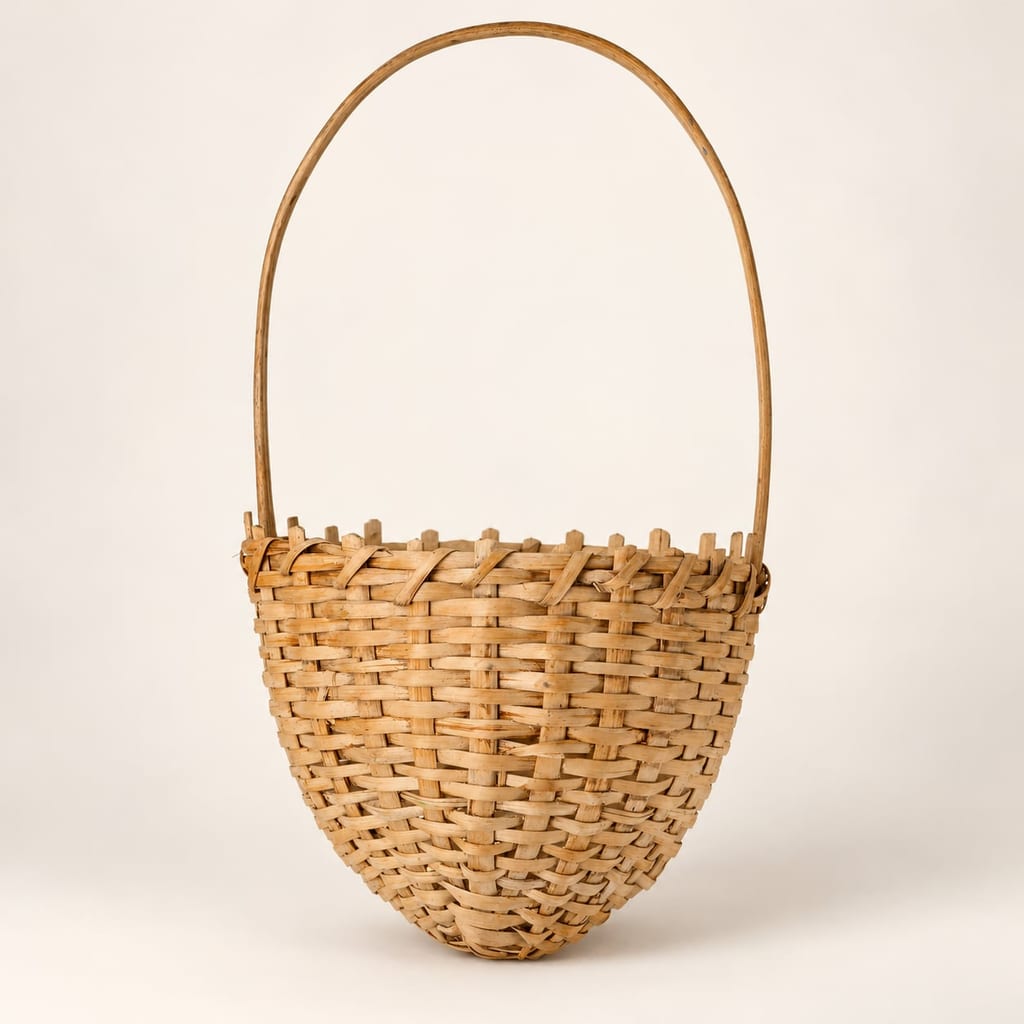
Woven cheese basket
An Adyghe cheese mould of woven willow drains fresh curd and leaves a ridged impression; a museum specimen records the traditional wooden form.
 FermenteaWhere food goes to change
Equipment · Mills, mortars and crushers
grinding mill · kernel and seed mill · seed-grinding mill
Mills grind seeds, nuts and grain into flour, meal or oil-rich paste. Stone, feed and power arrangements differ by tradition and model; the Dagestani example is one documented form, not a universal design.
A grinding mill reduces a prepared kernel, seed or grain by repeated contact with a grinding surface. The product may be a dry meal or flour, or a paste when oil-bearing seeds and nuts release oil as they are crushed. The name describes a job rather than one standard machine: hand querns, watermills and powered mills differ in their stones, supports, feed and drive. A rotary quern is one specific hand-driven form; this wider group includes other mechanisms and regional histories.
This equipment differs from a hand-cranked food mill, which presses softened food through a perforated disk to make purée. It also differs from an expeller press: a mill can grind seeds into paste, while a screw expeller compresses prepared meal to separate oil and cake. A chocolate melanger is a narrower powered refining machine. These tools can overlap in the ingredients they process, but their mechanisms and outputs are not interchangeable.
Dagestan provides a well-documented regional example. An ethnographic study describes local mill crafts for flour, grain, oil and pastes such as Urbech. It reports written references to watermills in the region from the middle of the fourteenth century, and traces later hand, water, steam, electric and wind-powered forms. Some historic watermills still make Urbech and, more rarely, flour. Those dates document Dagestan's record; they do not establish a universal origin for mills.
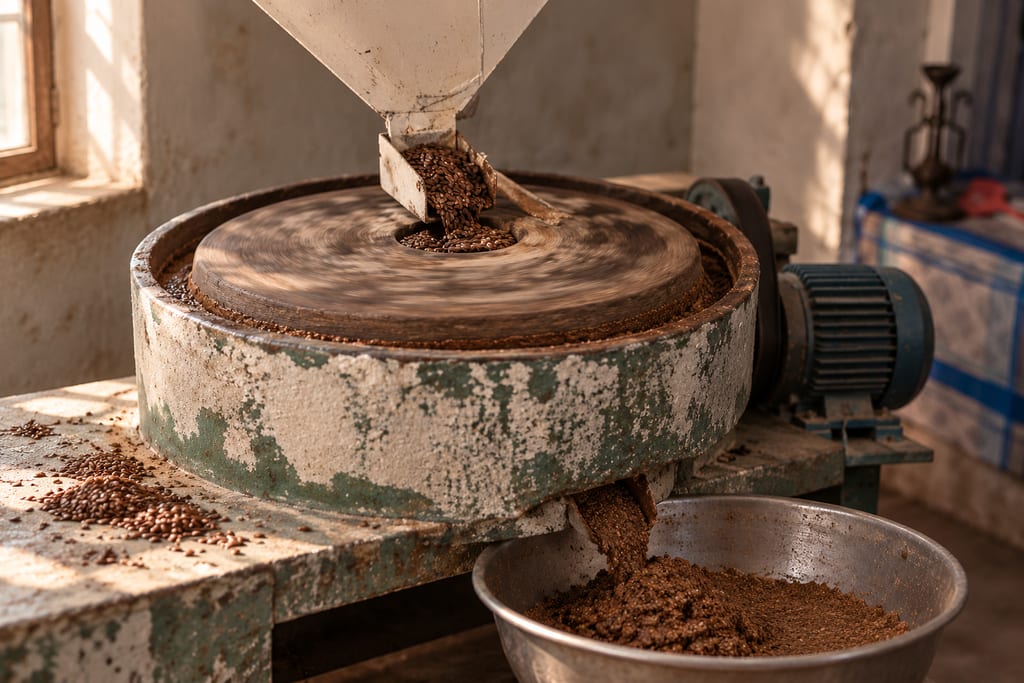
A Cunta District account describes a millstone arrangement in which a reservoir above the stones feeds seeds through a central opening. A stick coupled to the hopper vibrates as it touches the rotating disk, helping the seeds continue to fall. The material exits around the stone and drops into a collecting vessel. Depending on the grain or seed, the report describes the result as flour or a thick paste. This is a reported Dagestani arrangement, not a parts list for every mill.
A separate report from Makhachkala describes a family-run mill using electric stone circles. Flax and apricot kernels are ground for Urbech, while three electric circles at the same site are used for flour. Its photographs show the working space, seed handling and grinding; they support this contemporary example rather than an undated reconstruction of a traditional mill.
For a recipe or field record, name the mill's actual drive and grinding surfaces when known, then identify the prepared input and intended output. Record whether the goal is flour, coarse meal or paste; these results depend on the feed material and the mill's setup. The sources do not provide one standard capacity, dimension, speed or particle-size setting for this varied group, so record those values from the particular machine rather than inferring them from the category.
The linked photograph is credited to Zarema Alieva and shows a Dagestani seed-grinding context. The generated hero interprets the same documented stone-grinding form; it is an illustrative reconstruction, not a photograph of the pictured mill or a claim that every mill has this design. Neither equipment description substitutes for a tested food-preservation process or the operating instructions for an individual machine.
A study of Dagestan milling says written sources for local watermills date to the mid-fourteenth century, while describing hand, water, steam, electric and wind-powered forms. This is regional milling history, not a universal first-use date.
This functional group includes unlike hand querns, watermills and powered mills; they are not one standard or interchangeable machine.
Source →A hand-cranked food mill presses softened food through a perforated disk; this item concerns grinding kernels, seeds or grain.
Source →An expeller press compresses prepared meal to separate oil and cake, a distinct function from grinding seeds into paste.
Source →Regional evidence for mills and stone grinding; not the origin or exclusive use of mills.
An Adyghe cheese mould of woven willow drains fresh curd and leaves a ridged impression; a museum specimen records the traditional wooden form.
No community contributions have been published for this entry yet.
Sign in to contribute. Published comments and photos are free to read.
History, Archeology and Ethnography of the Caucasus; Daghestan Federal Research Centre of the Russian Academy of SciencesRegional history · Geography · Equipment forms
The Mill Traditional Crafts of Dagestan: Ethnic Culture, TerminologyThe study describes Dagestan's flour, grain, oil and paste milling crafts; written references to local watermills date to the mid-fourteenth century.
It describes hand, water, steam, electric and wind-powered forms and reports some historic watermills still make Urbech and, more rarely, flour.
Cited in: A function shared by different mill forms; Dagestan's stone mills for flour and Urbech; Describe the mill by its actual work
Official site of the Cunta District administration, Republic of Dagestan; article credited to Russkaya PlanetaTraditional use · Mechanism · Products · Geography
«Издревле в Дагестане перетирали семена» (Seeds have long been ground in Dagestan)The account describes stone-mill production of Urbech and tolokno in Dagestan, with a hopper feeding seeds through a central opening and ground product leaving around the stones.
It describes flour or thick paste depending on the material and reports electric motors on the documented millstones; these details do not apply to every mill.
Cited in: Dagestan's stone mills for flour and Urbech
Это Кавказ (It's Caucasus), TASSModern example · Mechanism · Image reference · Geography
Мельница в городе (A mill in the city)The report describes a family mill in Makhachkala where flax and apricot kernels are ground on stone circles for Urbech, and three electric circles used for flour.
The selected gallery photograph is credited to Zarema Alieva; the page does not state a separate image-reuse licence.
Cited in: Dagestan's stone mills for flour and Urbech; Describe the mill by its actual work
Institut national de la propriété industrielle (INPI)Mechanism · Distinction
Le Moulin-Légumes, il devenait pressant de l'inventer (1932)The article describes a rotating vegetable masher and sieve; it supports distinguishing soft-food sieving from grinding kernels and grain.
Cited in: A function shared by different mill forms
Food and Agriculture Organization of the United NationsDistinction
Small-scale palm oil processing in AfricaThe FAO source describes a screw expeller pressing prepared meal in a perforated cage, separating oil and cake.
Cited in: A function shared by different mill forms