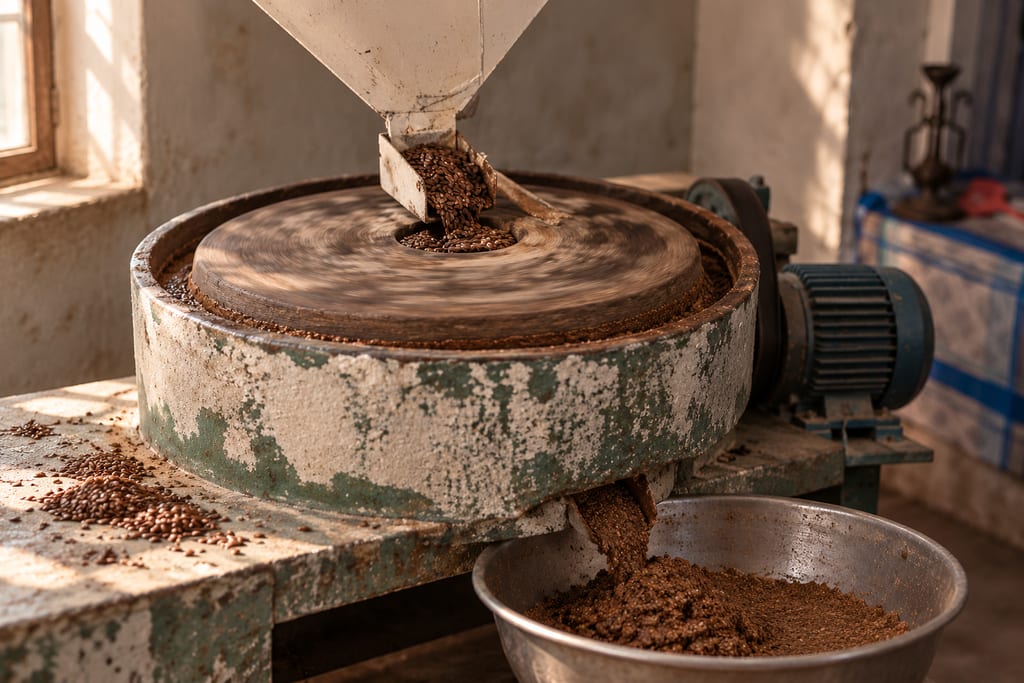
Grinding mill for paste, meal and flour
Mills grind seeds, nuts and grain into flour, meal or oil-rich paste. Stone, feed and power arrangements differ by tradition and model; the Dagestani example is one documented form, not a universal design.
 FermenteaWhere food goes to change
Equipment · Strainers, moulds and hoops
Корзина для приготовления адыгейского сыра · Cheese basket (Adyghe)
An Adyghe cheese mould of woven willow drains fresh curd and leaves a ridged impression; a museum specimen records the traditional wooden form.
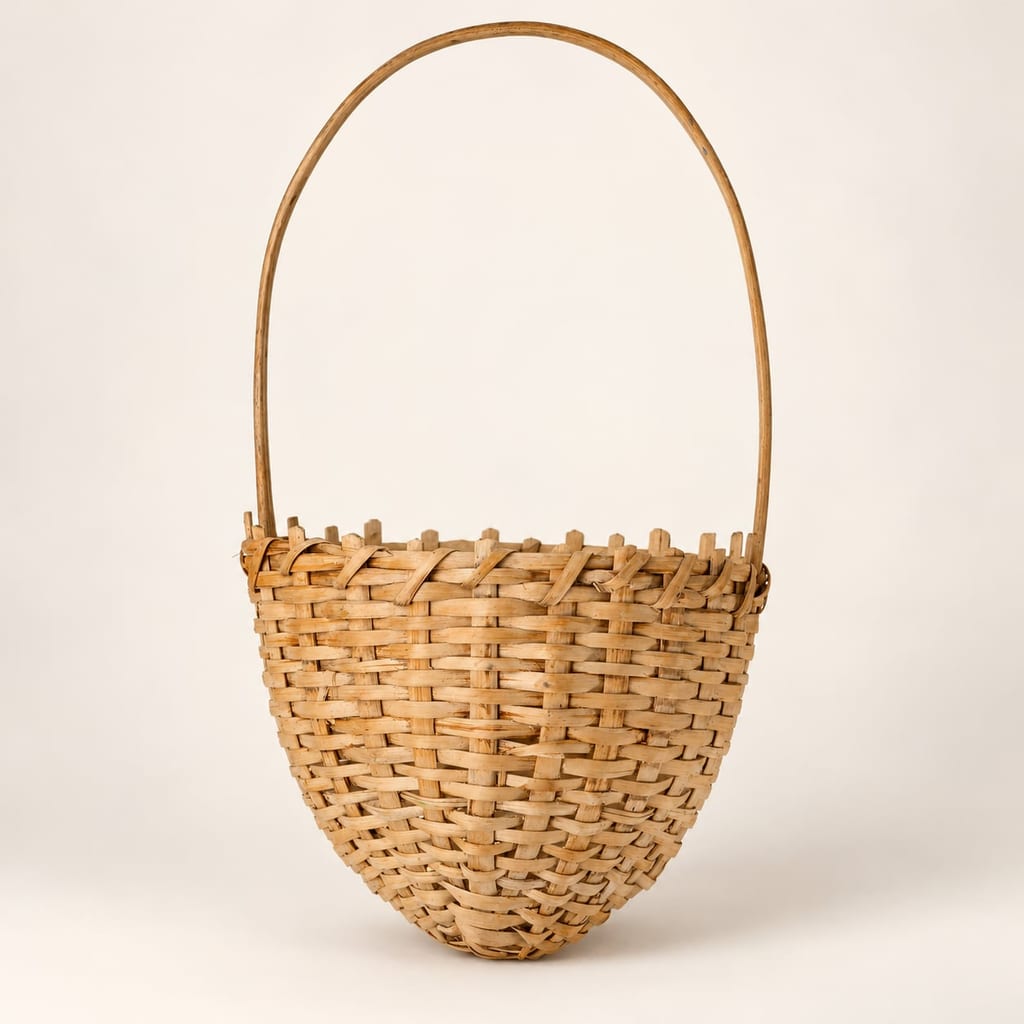
The Adygeysk Local History Museum’s catalogue records a wooden, woven cheese basket from the 1960s. It gives the object’s size as 41 × 26 × 17 centimetres, with an upper diameter of 22 centimetres, and records the place of creation as the USSR. These measurements and dates describe that museum specimen; they are not standard dimensions or an origin date for the equipment type.
The pictured example has an open rim, a tapered basket body and a tall arching handle. The museum identifies the technique as weaving and the material as wood. Its accompanying ethnographic text specifically says willow twigs were used for Adyghe cheese baskets. The catalogue does not name the exact botanical species used in this individual object.
The museum describes fresh cheese curd placed into woven willow baskets after milk has coagulated with whey. The curd is drained and salted in the basket, and its weave leaves a ridged impression on the cheese. The basket therefore serves as a curd mould and strainer: it helps the soft mass shed whey while giving its surface a recognizable pattern.
This equipment description is not a recipe. The museum’s account summarizes a local preparation, but does not give a fully quantified method, food-safety controls or instructions for reproducing the cheese. A basket’s role is to hold and drain the curd; heating, acidification, salting and later storage remain separate parts of the process.
The museum account places willow baskets in Adyghe households and notes that contemporary makers also use plastic forms. The plastic form is a modern alternative, not evidence that the documented woven basket was made from plastic. This entry keeps the traditional willow-woven form in focus because it is the object represented by the museum's catalogued specimen.
The same museum text distinguishes fresh cheese from cheese later dried or smoked. It also describes a separate flexible branch construction hung near the hearth for smoke exposure. That suspended apparatus belongs to a later preservation stage and should not be confused with the handled basket used to drain and shape fresh curd.
The museum situates the basket within Adyghe ethnography and says such willow baskets were used in Adyghe families. Its collection is the Adygeysk Local History Museum in Adygea. The object catalogue, however, identifies its creation place only as the USSR. The regional association here describes documented use, not the workshop or exact village where this specimen was made.
The catalogue’s 1960s date is a concrete record of one basket, while the museum’s household account supports the traditional-use context. Neither source establishes when basket-made cheese first appeared, how every Circassian community shaped its baskets or whether the photographed example represents all local forms. The closely related preparation page for Adyghe cheese describes the curd process this equipment supports.
The Adygeysk Local History Museum catalogues a woven wooden cheese basket made in the 1960s, with its place of creation recorded as the USSR. The museum's ethnographic account says willow baskets were used in Adyghe households to form and drain cheese. The date of the surviving specimen is not the beginning of the tradition.
The source describes a basket that receives curd, drains whey and is salted; it does not provide a complete cheese recipe or a reproducible safety process.
Source →The 1960s date and USSR place-of-creation label refer to the catalogued specimen, not the invention or earliest use of woven cheese baskets.
Source →The museum describes traditional willow baskets and also notes modern plastic moulds; the materials and form are not interchangeable claims about one object.
Source →The museum account describes willow cheese baskets in Adyghe households and exhibits the specimen in an Adyghe ethnography collection. The object's recorded place of creation is the USSR, so this regional use context does not claim that the pictured specimen was made in Adygea.
Mills grind seeds, nuts and grain into flour, meal or oil-rich paste. Stone, feed and power arrangements differ by tradition and model; the Dagestani example is one documented form, not a universal design.

Soft, spreadable Calabrian pork sausage made with a great deal of red chilli and fatty pork, stuffed into natural casings, sometimes smoked and matured while staying soft.

A way to add independent temperature logging to an existing food dehydrator without changing its built-in controls or protections. It is a monitoring method, not a rewiring plan.

Pleurotus cystidiosus is the abalone mushroom, a cultivated oyster-type fungus with dark brown caps that grows more slowly and is more demanding than other Pleurotus species.

A dark, balanced vinegar from Emilia-Romagna made by combining cooked or concentrated grape must with wine vinegar, then acetifying and refining it in wood under a protected specification.

A living dairy inoculum that starts controlled cream fermentation, developing acidity and aroma before sour cream or cultured butter is finished.

A small electric incubator holds jars at a selected temperature for yogurt and other documented warm food preparations. Controls, capacity and vessel arrangement vary by model.

Adygean salt is a seasoned table salt associated with Adygea and the wider North Caucasian culinary tradition. Salt is blended with garlic and a variable selection of herbs and spices; the exact mix depends on the named style and maker.

The African Caesar-group mushroom, Amanita masasiensis, is a wild ectomycorrhizal species of central and southern African woodlands, eaten locally. The genus contains deadly poisonous species, so identification needs care.
No community contributions have been published for this entry yet.
Sign in to contribute. Published comments and photos are free to read.
Adygeysk Local History Museum via Artefact, Ministry of Culture of the Russian FederationEquipment form · Materials · Dimensions · Traditional use · Geography · Historical attestation · Cheese making context
Корзина для приготовления адыгейского сыраThe museum catalogue dates the pictured basket to the 1960s, records its place of creation as the USSR, lists wood and weaving, gives size 41 × 26 × 17 cm and upper diameter 22 cm, and identifies the Adygeysk Local History Museum collection.
The museum narrative says willow twigs were used to weave baskets for Adyghe cheese and that such baskets were present in Adyghe households.
The account describes fresh curd placed in woven willow baskets or plastic forms and salted; the mould leaves a ridged impression on the cheese.
The source discusses later drying or smoking separately; the basket itself is the curd-forming and draining tool.
Cited in: A woven mould for fresh curd; How the basket shapes Adyghe cheese; Traditional willow beside modern moulds; Adyghe context and what the record can show