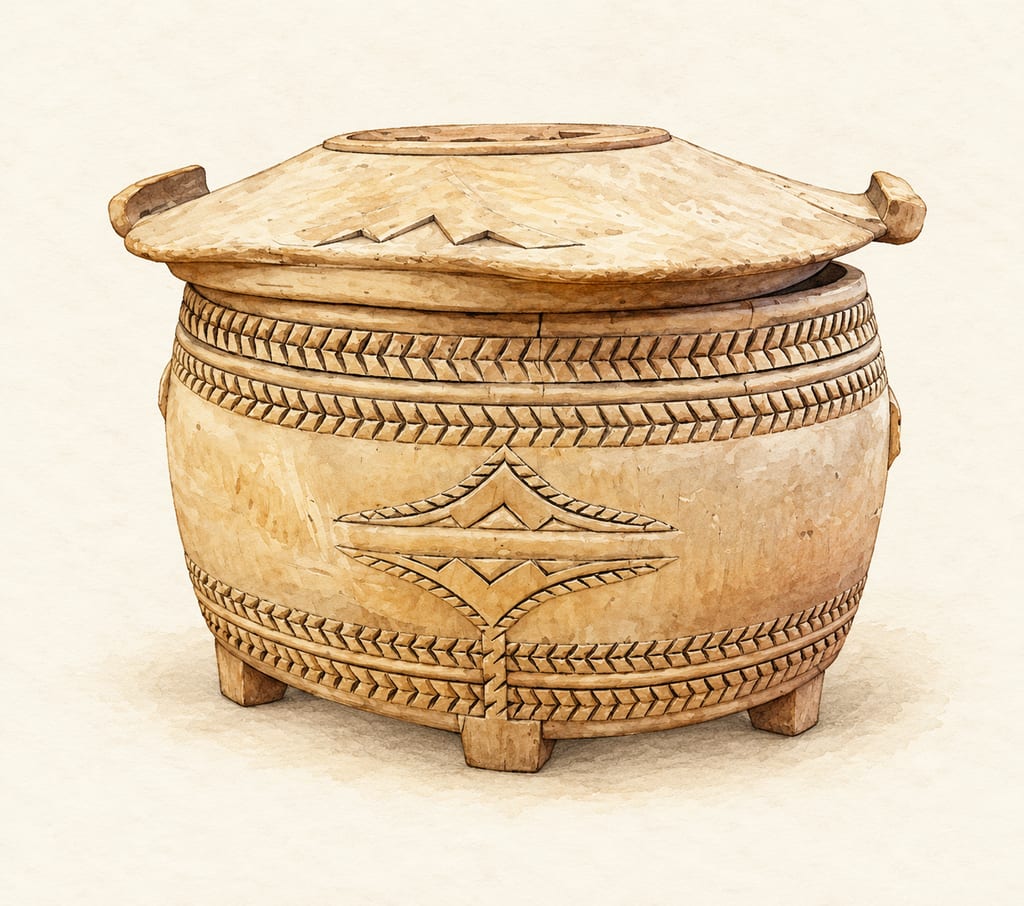
Tepen (Bashkir limewood serving tub)
Tepen (тәпән) is a low Bashkir hollowed-linden tub used for serving kumys. A National Museum of Bashkortostan object preserves one carved, lidded example; the taller siläk tub had a different preparation role.
 FermenteaWhere food goes to change
Equipment · Skins and bladders
һаба · haba · Haba · силәк
A Bashkir household account describes a large leather һаба for kumys, with one or two limewood tubs as alternatives; exact vessel dimensions and schedule are unspecified.
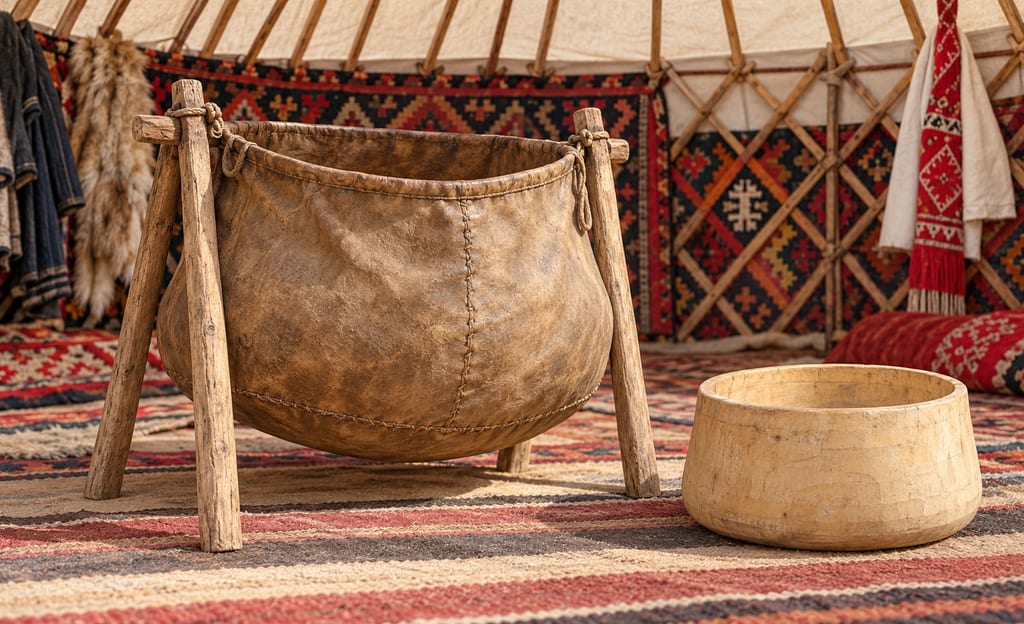
Haba (һаба) is a Bashkir leather vessel associated with preparing kumys. The National Museum of the Republic of Bashkortostan’s account of the Bashkir yurt quotes ethnographer Sergei Rudenko: a large leather һаба stood on a special support by the entrance-side working area, or one or two limewood tubs (силәк) were used instead. A separate tub held soured milk intended for qorot. The record describes a household arrangement and named uses; it does not give a standard vessel pattern, capacity, dimensions, or a fixed fermentation schedule.
This is a useful reminder that the kumys vessel was not necessarily one material or one form. The museum account presents hide and wood as alternatives, not as one composite apparatus. It also describes Bashkir leather household utensils more generally as commonly made from horsehide and formed through traditional sewing and smoking practices. That wider craft context does not prove that every һаба followed an identical production sequence, and the source does not establish the hide species of a particular vessel.
Rudenko places the һаба or its wooden substitute in the right-hand household work area, on a special stand; the nearby sour-milk vat served the making of qorot. The museum article describes this as part of a documented Bashkir domestic arrangement, not a universal rule for every household or a claim about where the vessel was first invented. It gives no measurements for the һаба or the alternate limewood tubs and no specified schedule or handling sequence for kumys.
The museum’s illustrated yurt is a modern interpretive display, distinct from Rudenko’s written ethnographic description. Its image offers context for the material culture, but does not identify a photographed historical specimen of һаба. This page’s generated illustration is likewise an explicitly interpretive reconstruction rather than a record of one artifact. The inspected sources do not establish modern availability, care instructions, the food-contact condition of surviving vessels, or present-day safety.
The National Museum of the Republic of Bashkortostan quotes ethnographer S. I. Rudenko describing a leather һаба on a special stand, or one or two limewood tubs, for kumys in the Bashkir yurt. A separate vat held soured milk intended for qorot. The evidence records traditional use, not a first date or universal household pattern.
The evidence identifies Bashkir domestic practice in Bashkortostan; it does not locate a specific household or establish place of manufacture.
Tepen (тәпән) is a low Bashkir hollowed-linden tub used for serving kumys. A National Museum of Bashkortostan object preserves one carved, lidded example; the taller siläk tub had a different preparation role.
No community contributions have been published for this entry yet.
Sign in to contribute. Published comments and photos are free to read.
National Museum of the Republic of BashkortostanUse · Geography · Materials · Context
Башкирская юрта. Журнал «Мир музея»The museum article quotes S. I. Rudenko describing a large leather һаба on a special stand or one/two limewood tubs used to prepare kumys.
A separate vat beside them held soured milk for qorot.
Rudenko places this equipment in the right-hand household work area of the Bashkir yurt; the museum also describes horsehide as common for Bashkir leather utensils generally, without specifying every һаба's hide or pattern.
Cited in: A leather vessel and its wooden alternative; Vessels within the yurt
Ufa KitapUse · Form · Geography
Башкиры: Историко-этнографические очеркиRudenko's 2006 text, cited by the National Museum, records a large leather һаба on a special stand or one/two limewood tubs for preparing kumys.
It places a separate vat of soured milk intended for qorot beside this equipment.
Cited in: A leather vessel and its wooden alternative; Vessels within the yurt