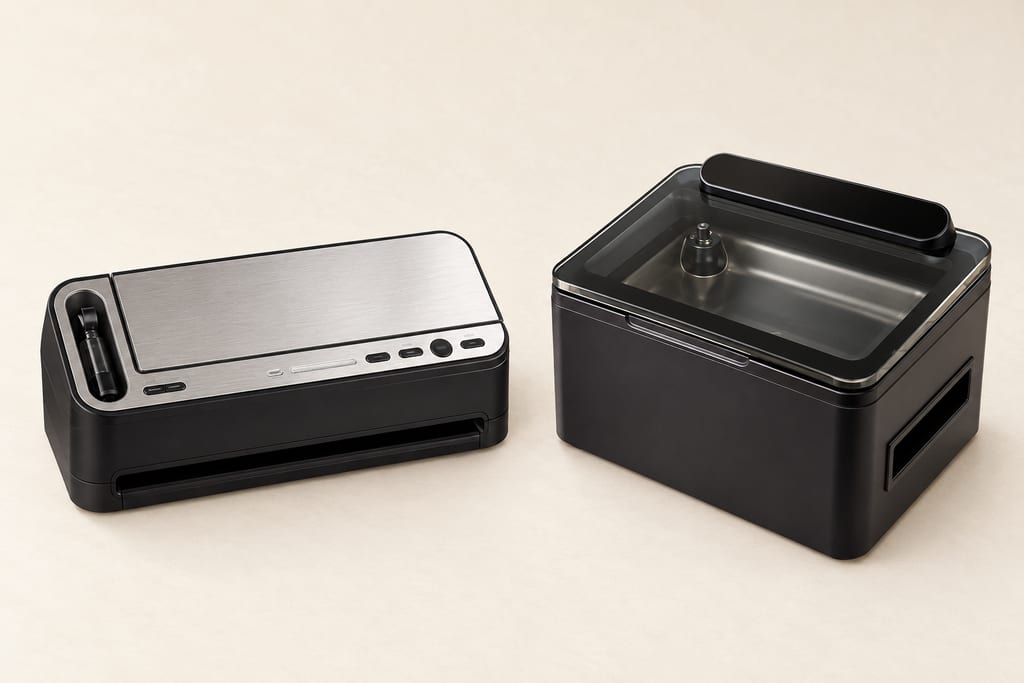
Vacuum sealer
A vacuum sealer removes air from a food package and closes it with a heat seal. Stand-alone machines commonly use external suction at the bag edge or evacuate a chamber containing the whole pouch.
 FermenteaWhere food goes to change
Equipment · Industrial and laboratory plant
Vacuum and MAP packaging line · Integrated vacuum/MAP packaging line · Industrial traysealing line
An industrial vacuum/MAP line coordinates product or tray feed, atmosphere control, sealing, inspection and downstream handling. Its modules are configured for a plant and product; it is not a countertop vacuum sealer.
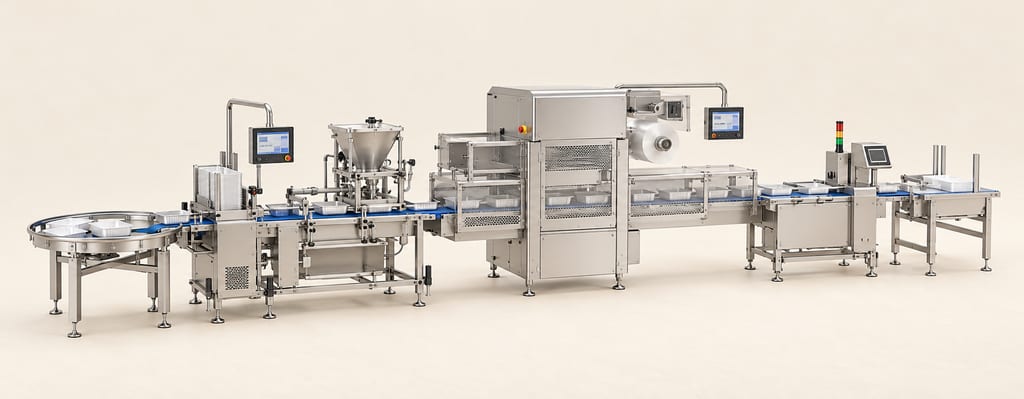
An industrial vacuum or modified-atmosphere packaging (MAP) line is a coordinated installation rather than one oversized domestic sealer. Manufactured machines move product and packaging through a selected sequence: feeding or forming, loading, atmosphere treatment, sealing, inspection, labelling and pack-out. A line may combine equipment from several suppliers, while its layout and degree of automation depend on the plant, the food and the chosen pack.
Some lines centre on a traysealer that receives preformed trays. Others use a thermoformer: a lower film is heated and formed into trays, product is loaded, and a top film is sealed over it. In both cases, conveyors and optional modules connect the package-making machine to the operations before and after sealing. The term therefore covers a designed system, not a single universal machine layout.
Vacuum packaging removes air from the package and seals it. MAP changes the package atmosphere by replacing air with a selected gas mixture; oxygen, carbon dioxide and nitrogen are common gases. The composition and packaging material are selected for a food and its intended distribution, and the mixture may change as the food and film interact.
Industrial machines can offer different package modes. ULMA documents a traysealer that can make MAP, vacuum or skin packs according to the application; GEA describes thermoforming equipment that supports both MAP and vacuum. That does not mean every line has every mode, or that vacuum followed by gas injection is a required universal sequence. The exact equipment and cycle are specification choices.
The line begins where trays or film and food enter. A preformed-tray system may add denesting, dosing, loading or weighing modules before the sealer; a thermoforming line forms its lower web before loading. At the sealing station, a chamber or tooling closes the pack with the selected atmosphere and heat-seals the film. The sealed packs can then pass to printing or labelling, vision inspection, rejection, stacking and case packing.
A documented MULTIVAC convenience-food demonstration combines a feeder, a filler, a TX 620 traysealer and an L 310 labeler whose vision system checks label presence and readability. A separate company description of a ready-meal line adds a conveyor, vision inspection and pack stacker to a traysealer running MAP. These examples show why the line boundary extends beyond the sealer itself; they are specific installations, not mandatory modules.
Industrial equipment uses a guarded frame, powered drives, controls and conveyor paths sized for production work. The cited ULMA model uses conveyor belts and servo-driven tray movement and is designed for integration into a medium production line; its technical options include loading, dosing, coding and end-of-line equipment. GEA likewise describes thermoformers with film feed, forming, loading, sealing, cutting and integration with product feed and downstream machinery.
Manufacturers offer different sizes and outputs rather than a single class-wide capacity. The MULTIVAC overview describes compact and high-output equipment and says its thermoformers are used worldwide. These machines are manufactured, specified and installed as movable plant equipment; a factory's fixed floor plan and utilities are the installation context, not part of the machine's identity.
The packaging system changes the atmosphere around food, and the pack's material and seal affect how that atmosphere behaves in distribution. Neither vacuum nor MAP is sterilisation. New Zealand's food-safety guidance warns that vacuum- and MAP-packed foods can still support hazards such as Clostridium botulinum and that storage instructions matter. The FDA Food Code separately defines these reduced-oxygen methods and serves as a model for adoption by jurisdictions.
The machine builder's line capacity or sealing specification does not establish a safe gas mixture, shelf life or food process. Those decisions require food-specific validation and controls for the product, packaging, handling and temperature. This entry describes equipment and its limits, not a commercial process schedule or a household storage rule.
Current manufacturer sources document automated vacuum and MAP packaging systems, modular line integration and several current models. They do not establish a single inventor or earliest commercial line.
A vacuum cycle removes air; MAP replaces air with a selected gas mixture. A machine capable of one method is not automatically capable of the other, and the pack atmosphere does not itself make food sterile.
Source →The line's modules, capacity and process settings are model- and product-specific; a particular traysealer example does not represent every industrial system.
Source →The FDA Food Code is a model for adoption by competent jurisdictions; it does not establish the same retail or food-service requirements in every place.
Source →Documented for international use, with no single place of origin assigned.
A vacuum sealer removes air from a food package and closes it with a heat seal. Stand-alone machines commonly use external suction at the bag edge or evacuate a chamber containing the whole pouch.
No community contributions have been published for this entry yet.
Sign in to contribute. Published comments and photos are free to read.
MULTIVAC ChinaIntegrated line example · Current equipment · Image source
Smart packaging & smart processing: MULTIVAC preview of interpack 2026The company describes a compact convenience-food traysealing line with feeding/organising equipment, a GS Italia filler, TX 620 traysealer and L 310 labeler; the labeler vision system checks label presence and legibility and rejects nonconforming packs.
A second described line uses a TX 720 traysealer with parallel product lanes, an L 310 label-inspection system, and stackers that separate and stack packs.
Cited in: A coordinated factory system; Infeed, filling, sealing and checking
MULTIVACCurrent equipment · Line integration · Global reach · Applications
Thermoforming Packaging Machines – ThermoformersMULTIVAC says its thermoforming packaging machines have been used worldwide for decades and its line offerings range from compact to high-output systems.
The manufacturer supports MAP and EMAP, among other pack formats, and describes modular solutions that may be integrated with upstream and downstream components such as slicing, portioning and loading.
Cited in: A coordinated factory system; Designed for a plant, not a household counter
MULTIVACIntegrated map line example · Line components
Experience the new compact class with the TX 6 seriesThe 2023 interpack demonstration line used a TX 620 traysealer for ready meals under modified atmosphere, conveyors, an L 310 labeller, vision inspection that rejected faulty packs, and a MPS 102 stacker.
The example line was one specific demonstration configuration, not a specification for all packaging lines.
Cited in: Infeed, filling, sealing and checking
ULMA PackagingCurrent equipment · Traysealer design · Line integration · Image source
TSA 400The TSA 400 is an automatic traysealer for preformed trays; depending on product requirements it supports MAP, vacuum and skin packaging.
The manufacturer describes single- or double-row transport, conveyor infeed, tray loading and integration in medium production lines; optional modules include tray denesters, product dosing/loading, coding, inspection and end-of-line integration.
Cited in: Vacuum and MAP are different package atmospheres; Infeed, filling, sealing and checking; Designed for a plant, not a household counter
GEAThermoforming line · Operation · Integration
GEA ThermoformersGEA describes film feed, preheating, forming trays, loading product, sealing, printing/labeling and cutting as stages/components of thermoforming equipment.
Its PowerPak combines MAP and vacuum options and is designed for mechanical and electronic integration with upstream and downstream components; GEA states that product-feed and end-of-line components vary by application.
Cited in: A coordinated factory system; Vacuum and MAP are different package atmospheres; Designed for a plant, not a household counter
New Zealand Ministry for Primary IndustriesPackaging distinction · Safety
Modified atmosphere and vacuum packaging of foodVacuum packaging removes the air around food; MAP replaces that air with a gas mixture commonly drawn from oxygen, carbon dioxide and nitrogen.
These packages are not sterile: reduced-oxygen conditions can still permit hazards, including C. botulinum, and foods may require refrigeration or freezing according to their instructions.
Cited in: Vacuum and MAP are different package atmospheres; Packaging changes conditions; it does not validate safety
U.S. Food and Drug AdministrationDefinitions · Safety
Food Code 2026FDA's 2026 model Food Code distinguishes vacuum packaging, where air is removed and the package is sealed with a vacuum remaining, from MAP, where the atmosphere is changed to a composition other than air.
FDA describes the Food Code as model advice for retail and food service jurisdictions to adopt, not a universal rule in every location.
Cited in: Vacuum and MAP are different package atmospheres; Packaging changes conditions; it does not validate safety