
Jerky
A documentary account of dried meat strips and their historical uses. It does not provide an operational home method for making shelf-stable jerky at home.
 FermenteaWhere food goes to change
Equipment · vacuum-sealers
Vacuum packaging machine · Vacuum packer · Chamber vacuum sealer
A vacuum sealer removes air from a food package and closes it with a heat seal. Stand-alone machines commonly use external suction at the bag edge or evacuate a chamber containing the whole pouch.
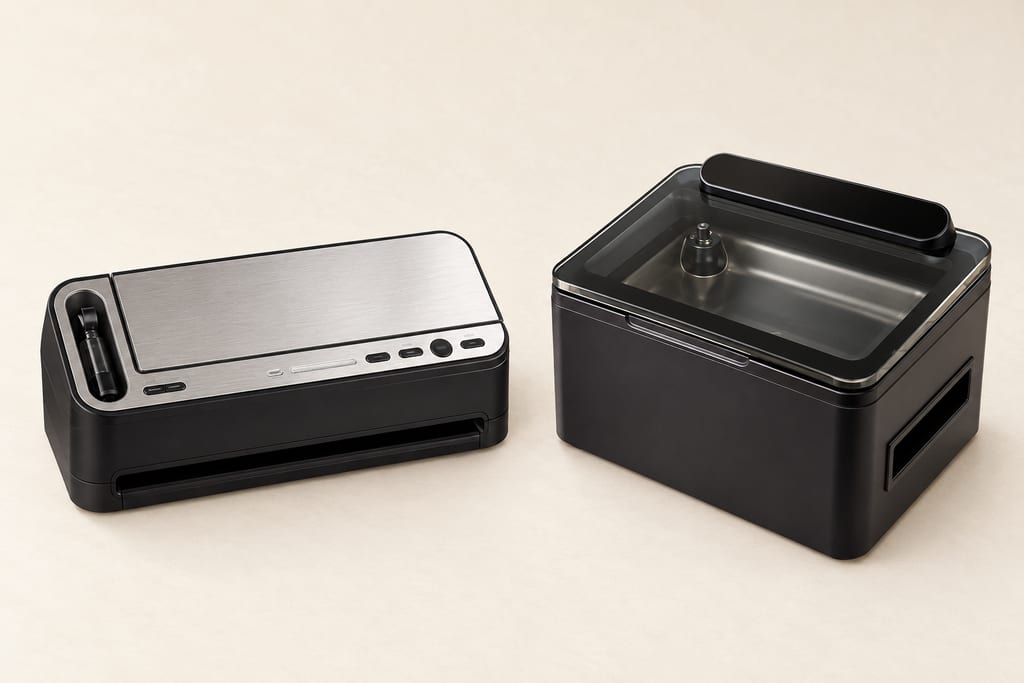
A vacuum sealer removes air from a food package and closes its open edge with a heat seal. The machine changes the atmosphere around the packed item; it does not cook, ferment, dry or otherwise make that food safe. People use sealers to package food for freezing, to protect some dry foods from oxygen and moisture, and to prepare pouches for later cooking or storage.
The name covers several formats. This page is about stand-alone machines, from countertop edge sealers to compact chamber models. A large production line that evacuates, gas-flushes, forms trays or packages continuously is a related industrial system, not simply a larger household sealer.
An external-suction or edge sealer places the open mouth of a pouch at the machine's vacuum channel. A pump draws air from the bag through that edge; a heated bar then closes the mouth. Household machines often add a cutter or roll storage, a hand-held hose or ports for compatible containers. The FoodSaver v4440 is one example: its documented package combines standard bag sealing with a retractable hand sealer for containers and zipper bags.
A chamber machine puts the whole pouch inside a lidded chamber. It removes air from the chamber and the pouch together, heat-seals the bag while pressure is equalized, then returns the chamber to atmospheric pressure. Liquids can stay in the pouch more readily because the machine is not pulling them directly through an edge channel. This arrangement makes chamber models useful for liquid-rich packs, but the exact cycle and controls vary by model.
These are alternative machine designs within the stand-alone vacuum-sealer class. Chamber units have a deep enclosure and lid; external units use a narrower sealing channel at the bag edge. The Anova chamber model is a current countertop example, with a transparent lid, seal bar and electric pump. Its specifications describe that appliance only, not every chamber sealer.
Vacuum packaging can help preserve the quality of food that is already being frozen or dried, but it does not replace those processes. It also does not turn a product into a shelf-stable preserve. Oregon State Extension warns that home vacuum packing is not a substitute for the heat treatment used in tested canning methods and does not remove the need for cold storage where the food requires it.
For fermentation, the sealer is packaging equipment rather than a culture-control system. A published white-asparagus preparation uses a vacuum bag as part of a particular measured fermentation method; the link shows a documented use, not a universal recommendation. Active fermentation can produce gas that stresses a sealed pack, and a vacuum seal does not replace fermentation time or the recipe's own storage controls.
Removing air slows some oxygen-driven quality changes, but it also changes which microbes can thrive. The UK Food Standards Agency's chilled-food guidance explains that non-proteolytic Clostridium botulinum can grow and form toxin without oxygen and requires suitable controls across the product's shelf life. Oregon State Extension also warns that low-oxygen foods may become unsafe without the smell or appearance changes associated with ordinary spoilage.
Vacuum and modified-atmosphere packaging are not the same process. Vacuum sealing removes air from the package; MAP replaces air with a selected gas mixture. The FSA's detailed limits address food businesses and must not be copied as a household allowance. A consumer should follow the product's tested storage instructions and local food-safety advice. The sealer itself provides no lethality or safety validation.
The current product examples are manufactured appliances. Their bodies, chamber volumes, pump systems, sealing bars and accessories differ, so a model's dimensions or material specification cannot stand for every machine. This entry records the stand-alone appliance class, not vacuum sealers built into a factory packaging line.
The sources document current products and their operation, not a traditional regional form or a single inventor. No country is assigned as the class's origin, and the linked manufacturer's locations are not treated as manufacturing locations without evidence.
Current manufacturer examples show both external-suction countertop sealers and chamber units. Their product documentation does not establish a single inventor, earliest model or geographic origin for the equipment class.
Vacuum packing is not a kill step and does not replace refrigeration/freezing required by the food or heat processing for safe home-canned foods.
Source →Vacuum packaging removes air; modified-atmosphere packaging replaces it with a selected gas mixture. The two processes and their control plans are not interchangeable.
Source →A sealed pack is not a fermentation vessel or a guarantee of a stable product; fermenting contents can continue to release gas and require food-specific process and storage controls.
Source →These manufacturer pages document contemporary products but do not establish where the equipment class originated or the manufacturing site of the listed examples.
A documentary account of dried meat strips and their historical uses. It does not provide an operational home method for making shelf-stable jerky at home.
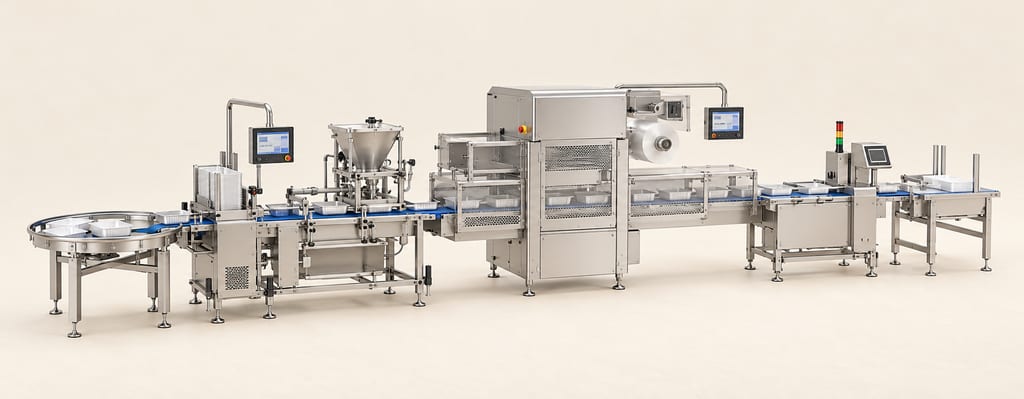
An industrial vacuum/MAP line coordinates product or tray feed, atmosphere control, sealing, inspection and downstream handling. Its modules are configured for a plant and product; it is not a countertop vacuum sealer.
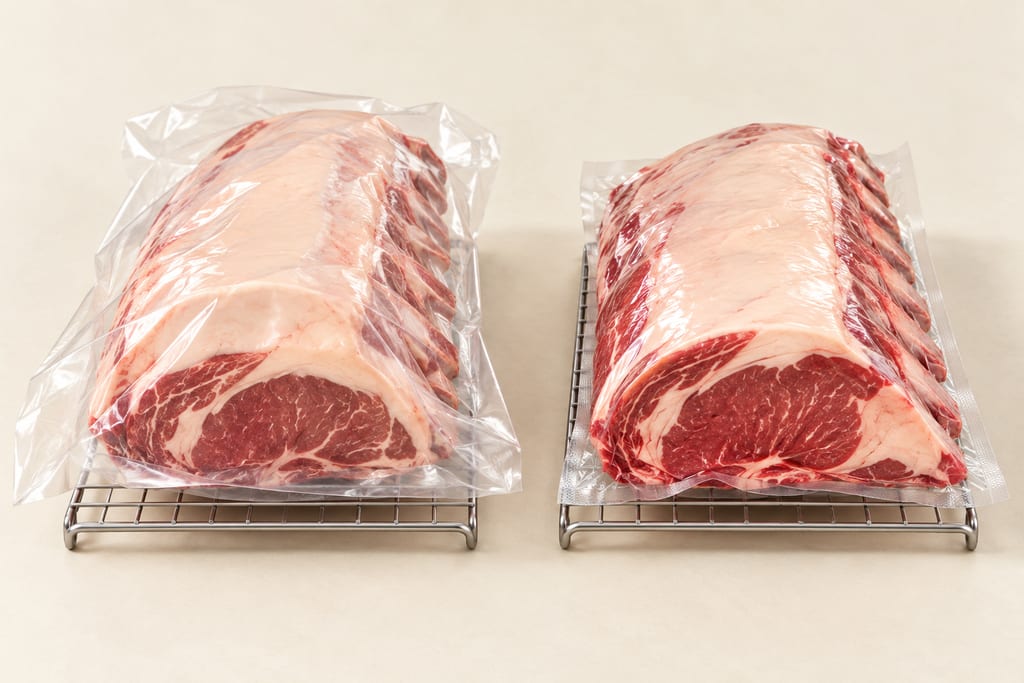
A moisture-permeable ageing membrane lets water vapour escape; a conventional vacuum pouch is designed to remove air and retain purge. Similar appearance cannot identify the film or validate an ageing process.
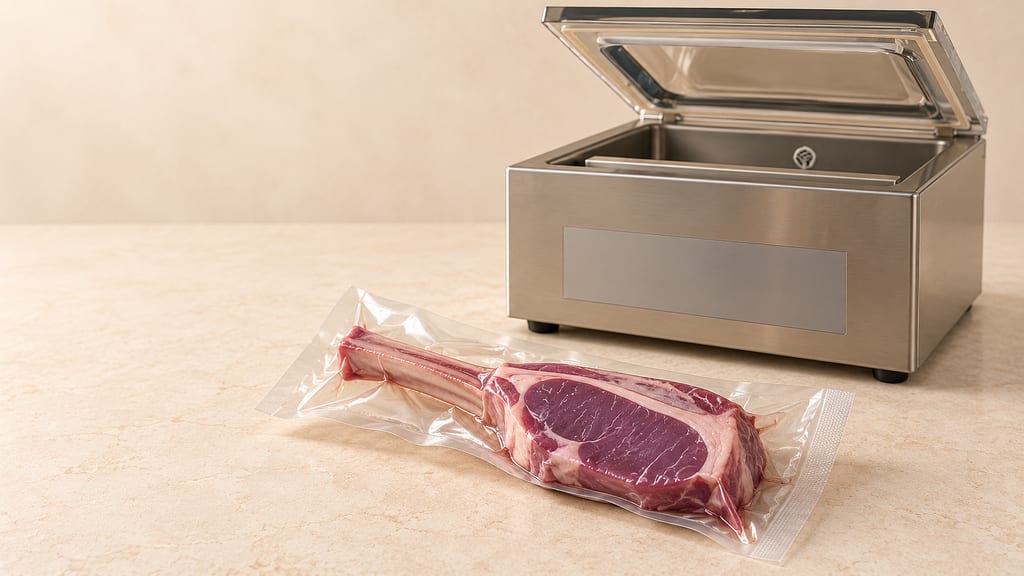
A vacuum pack keeps meat purple and spoilage slow, and it suits a bacterium that grows without air. What the seal does, what UK rules say about 3 °C and 10 days, and where packing joins a cure.
A machine can supply heat, cold, airflow, pressure or a vacuum. Many traditional foods also depend on sunlight, frost and running water, months of microbial work, or a tested kill step, and these are the places where an appliance stops.

Soft, spreadable Calabrian pork sausage made with a great deal of red chilli and fatty pork, stuffed into natural casings, sometimes smoked and matured while staying soft.

A way to add independent temperature logging to an existing food dehydrator without changing its built-in controls or protections. It is a monitoring method, not a rewiring plan.

Pleurotus cystidiosus is the abalone mushroom, a cultivated oyster-type fungus with dark brown caps that grows more slowly and is more demanding than other Pleurotus species.

A dark, balanced vinegar from Emilia-Romagna made by combining cooked or concentrated grape must with wine vinegar, then acetifying and refining it in wood under a protected specification.

A living dairy inoculum that starts controlled cream fermentation, developing acidity and aroma before sour cream or cultured butter is finished.

A small electric incubator holds jars at a selected temperature for yogurt and other documented warm food preparations. Controls, capacity and vessel arrangement vary by model.

Adygean salt is a seasoned table salt associated with Adygea and the wider North Caucasian culinary tradition. Salt is blended with garlic and a variable selection of herbs and spices; the exact mix depends on the named style and maker.

The African Caesar-group mushroom, Amanita masasiensis, is a wild ectomycorrhizal species of central and southern African woodlands, eaten locally. The genus contains deadly poisonous species, so identification needs care.
No community contributions have been published for this entry yet.
Sign in to contribute. Published comments and photos are free to read.
Anova CulinaryCurrent equipment · Chamber design · Applications · Materials · Dimensions
Anova Precision Chamber Vacuum SealerThe chamber unit removes air from the whole chamber, including the pouch, then seals the pouch before returning to atmospheric pressure.
Anova describes use with liquids and marinades and lists model-specific dimensions, chamber dimensions, pump, power and glass/coated-stainless materials.
The manufacturer describes additional chamber-pressure modes for infusion/extraction and fruit or vegetable compression; these are model functions, not a universal sealing-machine feature.
Cited in: External suction and chamber designs; Contemporary equipment with no single origin assigned
Anova CulinaryMechanism · Design comparison
Science 101: Chamber Vacuum SealersA suction-edge sealer draws air from inside the bag through the open edge and heat-seals the plastic.
A chamber sealer evacuates the chamber and pouch together, then seals the bag as the chamber returns to ambient pressure.
The manufacturer explains why this difference can help keep liquid from being pulled toward the suction channel; this is a design comparison, not a guarantee for every food or model.
Cited in: External suction and chamber designs
FoodSaverCurrent equipment · External suction example
FoodSaver 2-in-1 Automatic Vacuum Sealing System with Starter Kit, v4440FoodSaver documents a current countertop system combining standard bag sealing with a retractable handheld sealer for containers and zipper bags.
The product is one manufacturer model example, not a universal design or specification for vacuum sealers.
Cited in: External suction and chamber designs; Contemporary equipment with no single origin assigned
Oregon State University Extension ServiceFood safety · Uses · Limits
Should I Vacuum Package Food at Home? (SP 50-603)Vacuum packaging can support quality in frozen and dried foods but is not a substitute for home-canning heat processing or required refrigeration/freezing.
Removing oxygen changes which organisms can grow; low-oxygen packages can support pathogens, and food may become unsafe without obvious spoilage signs.
Cited in: A packaging machine, not a preservation process; A useful pack does not replace the food's method; Reduced oxygen needs food-specific controls
UK Food Standards AgencyFood safety · Reduced oxygen limits
The safety and shelf-life of vacuum and modified atmosphere packed chilled foods with respect to non-proteolytic Clostridium botulinumThe guidance states that non-proteolytic C. botulinum can grow and produce toxin in the absence of oxygen, and that vacuum-packed chilled foods require suitable controls throughout shelf life.
The document distinguishes vacuum packaging, which removes air, from modified-atmosphere packaging, which replaces air with a controlled gas mixture; its detailed shelf-life rules are business guidance, not a household allowance.
Cited in: A packaging machine, not a preservation process; Reduced oxygen needs food-specific controls
New Zealand Ministry for Primary IndustriesFood safety · Packaging distinction
Modified atmosphere and vacuum packaging of foodVacuum packaging removes air around food while MAP replaces it with a chosen gas mixture.
Both approaches can affect quality and spoilage, and vacuum-packed food can still support C. botulinum; readers should follow the food's storage instructions.
Cited in: Reduced oxygen needs food-specific controls
ETH Zürich; Patrick MarxerDocumented use · Fermentation example
Cook the Science: Dry lactic acid fermentation, asparagus exampleThe published asparagus example uses a vacuum bag in a measured vegetable-fermentation method; this is a documented equipment use, not a general recommendation.
Cited in: A useful pack does not replace the food's method