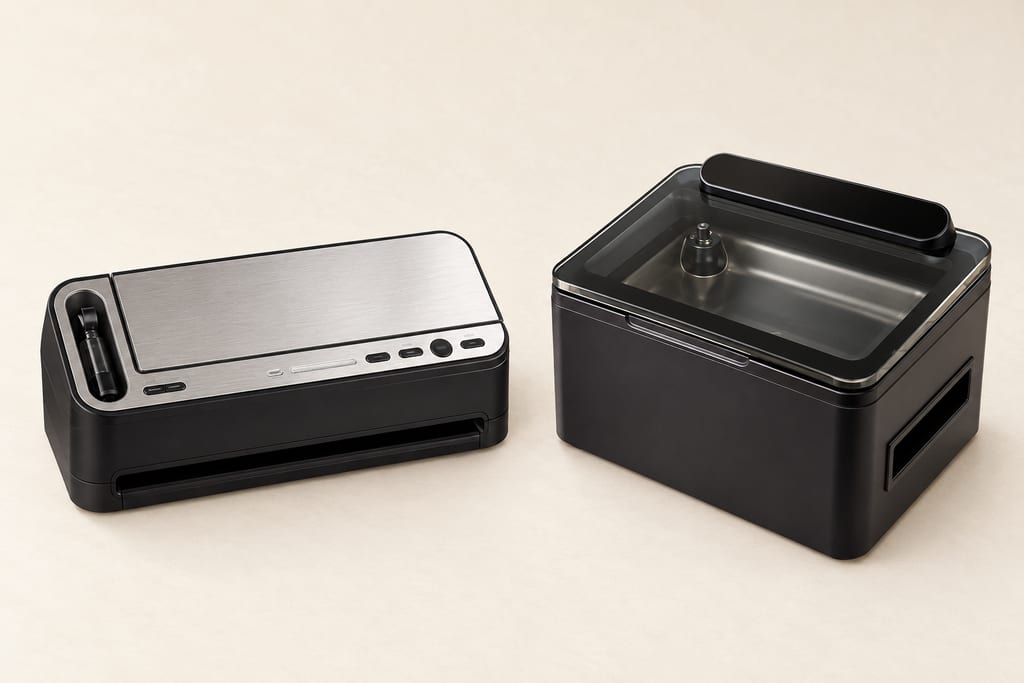
Vacuum sealer
A vacuum sealer removes air from a food package and closes it with a heat seal. Stand-alone machines commonly use external suction at the bag edge or evacuate a chamber containing the whole pouch.
 FermenteaWhere food goes to change
Equipment · Bags, sacks and casings
Dry-ageing membrane bag · Water-vapour-permeable ageing bag · Dry-age bag · Dry-ageing bag · Vacuum pouch · Vacuum packaging pouch
A moisture-permeable ageing membrane lets water vapour escape; a conventional vacuum pouch is designed to remove air and retain purge. Similar appearance cannot identify the film or validate an ageing process.
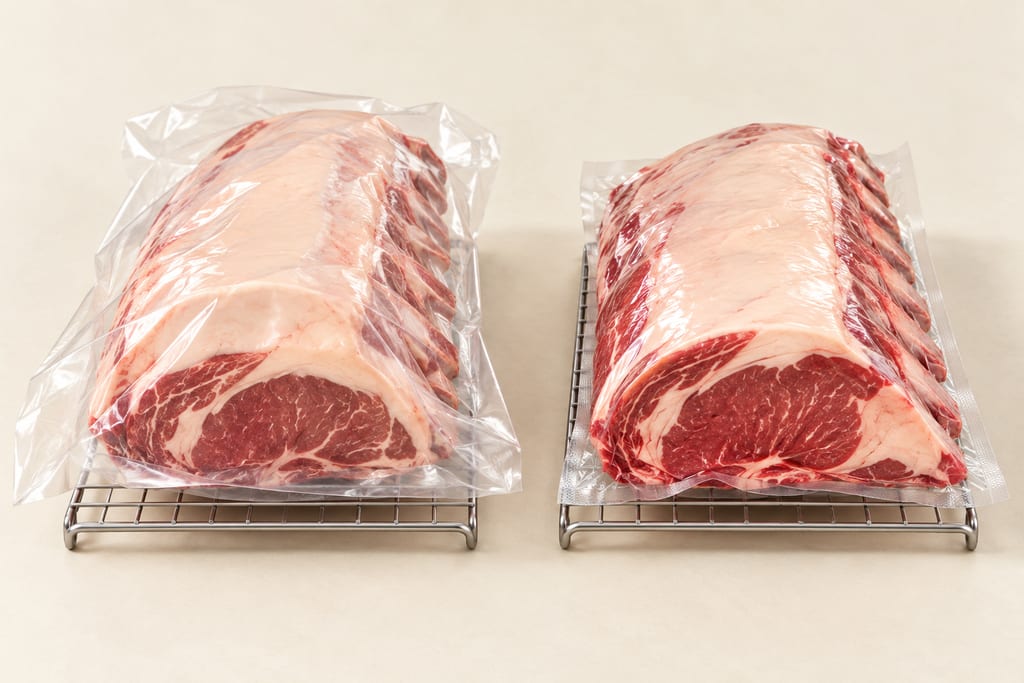
A water-vapour-permeable ageing bag and a conventional vacuum pouch may both look like clear film wrapped around a cut of meat. The difference is functional. A specialised dry-age membrane is designed to let water vapour move out of the package; a conventional vacuum pouch is designed to have air removed and the pouch sealed closely around its contents, retaining purge. A photo cannot prove which film is which.
This comparative record keeps the two forms together because studies explicitly compare them, while preserving their distinct roles. The permeable bag is a meat-maturation membrane; the vacuum pouch is a general packaging format. Neither is the machine that seals it. The separate vacuum-sealer equipment entry describes that machine.
Ahnström and colleagues compared traditional unpackaged dry ageing with a highly moisture-permeable bag using paired beef strip-loin sections for 14 or 21 days at 3°C. They found no significant differences in several measured quality and sensory outcomes. At 21 days, the bag treatment had lower ageing and trim losses and lower yeast counts, alongside higher lactic acid bacteria counts. Those are findings from a defined experiment, not a general recipe or safety schedule.
Li and colleagues later compared bag-aged beef with vacuum packaging, including a study of gluteus medius and a three-way comparison involving longissimus, traditional dry ageing and vacuum packaging. Their reported outcomes differ across cuts, methods and endpoints. The sensible reading is not that one film always produces a superior result, but that packaging changes moisture exchange and surface conditions and must be judged within the particular study or validated production process. AHDB’s project likewise treats dry ageing and packaging as variables to evaluate rather than a one-size-fits-all claim.
UMAi describes its own ageing bags as moisture- and oxygen-permeable and says they are not vacuum bags. Its instructions and sizes apply to that product line. A conventional retail vacuum pouch, such as the FoodSaver example linked here, is a different product with its own construction and compatibility details. Some membrane systems may use a vacuum sealer or an aid strip to pull the film against the meat; that sealing step does not turn the membrane into an ordinary vacuum pouch.
Before choosing a pack, check the exact film’s stated permeability, intended food and compatible sealing method. The clear reference photographs show examples, not a visual test for film composition. The generated comparison image is editorial illustration of the two forms, not evidence that a particular package is permeable.
Packaging alone does not make raw meat shelf-stable or validate dry ageing. USDA FSIS says perishable vacuum-packed meat should be refrigerated at 40°F (4.4°C) or below, or frozen at 0°F (−17.8°C) or below. Reduced oxygen can change microbial risks, and a vacuum seal does not kill pathogens. Use a tested food-safety process and the package maker’s instructions; the studies cited here should not be converted into a do-it-yourself ageing schedule.
The 2006 Ahnström et al. paper describes a novel water-vapour-permeable bag in a controlled beef study. Later comparative studies and current manufacturer pages document distinct contemporary packaging functions, not a universal origin story.
Appearance does not identify film permeability
SourceResearch results are not universal across cuts and conditions
SourcePackaging does not replace cold storage or validated safety controls
SourceThe reviewed studies and product pages document research and current examples, but do not establish a geographic origin or manufacturing location for either packaging class.
A vacuum sealer removes air from a food package and closes it with a heat seal. Stand-alone machines commonly use external suction at the bag edge or evacuate a chamber containing the whole pouch.

Soft, spreadable Calabrian pork sausage made with a great deal of red chilli and fatty pork, stuffed into natural casings, sometimes smoked and matured while staying soft.

A way to add independent temperature logging to an existing food dehydrator without changing its built-in controls or protections. It is a monitoring method, not a rewiring plan.

Pleurotus cystidiosus is the abalone mushroom, a cultivated oyster-type fungus with dark brown caps that grows more slowly and is more demanding than other Pleurotus species.

A dark, balanced vinegar from Emilia-Romagna made by combining cooked or concentrated grape must with wine vinegar, then acetifying and refining it in wood under a protected specification.

A living dairy inoculum that starts controlled cream fermentation, developing acidity and aroma before sour cream or cultured butter is finished.

A small electric incubator holds jars at a selected temperature for yogurt and other documented warm food preparations. Controls, capacity and vessel arrangement vary by model.

Adygean salt is a seasoned table salt associated with Adygea and the wider North Caucasian culinary tradition. Salt is blended with garlic and a variable selection of herbs and spices; the exact mix depends on the named style and maker.

The African Caesar-group mushroom, Amanita masasiensis, is a wild ectomycorrhizal species of central and southern African woodlands, eaten locally. The genus contains deadly poisonous species, so identification needs care.
No community contributions have been published for this entry yet.
Sign in to contribute. Published comments and photos are free to read.
Meat Science / PubMedResearch · Comparative study · Performance
Dry aging of beef in a bag highly permeable to water vapourCompared unpackaged traditional dry ageing with a highly moisture-permeable bag on paired strip-loin sections for 14 or 21 days at 3°C.
No significant differences in measured pH, moisture, fat, total plate counts, cooking loss, shear force or sensory attributes; at 21 days the bag treatment had lower ageing and trim losses and lower yeast counts, with higher lactic acid bacteria counts.
Cited in: Two films with different jobs; What the studies do—and do not—show; Cold storage remains essential
Meat Science / PubMedResearch · Comparison with vacuum · Consumer preference
Meat quality, microbiological status and consumer preference of beef gluteus medius aged in a dry ageing bag or vacuumCompared beef gluteus medius aged in a dry-age bag or vacuum package for 14 days.
Reported differences in loss, microbial counts and sensory preference; findings are specific to the cut, study design and conditions.
Cited in: Two films with different jobs; What the studies do—and do not—show; Cold storage remains essential
Meat Science / PubMedResearch · Three way comparison
A comparative study of beef quality after ageing longissimus muscle using a dry ageing bag, traditional dry ageing or vacuum package ageingCompared bag, traditional dry and vacuum package ageing across study conditions and durations; supports keeping packaging methods analytically distinct.
Cited in: What the studies do—and do not—show
Agriculture and Horticulture Development Board (AHDB)Industry research · Yield and flavour context
Dry ageing of beefAHDB project 72505 investigated dry-ageing conditions and packaging, including permeable bag approaches; results are project-specific and not a universal process validation.
Cited in: What the studies do—and do not—show
UMAi DryCurrent product example · Manufacturer instructions
Bulk Standard Aging BagsThe maker describes these specific bags as moisture- and oxygen-permeable and states they are not vacuum bags.
Its product instructions describe boneless subprimals and model-specific bag dimensions and sealing methods; those details are not universal to all membranes.
Cited in: Two films with different jobs; Identify by specification, not by appearance
FoodSaverConventional pouch example · Manufacturer product information
FoodSaver Heavy Duty Quart Vacuum Seal BagsA current example of a conventional consumer vacuum pouch; specific material and use claims apply to this listed product only.
Cited in: Two films with different jobs; Identify by specification, not by appearance
USDA Food Safety and Inspection ServiceFood safety · Cold storage
Can I keep meat in vacuum packages at room temperature?Vacuum packaging does not make perishable meat safe at room temperature; FSIS directs consumers to refrigerate at 40°F/4.4°C or below or freeze at 0°F/−17.8°C or below.
Cited in: Cold storage remains essential