
Preservation intake
Purple until you open it: what a vacuum pack does to food, and what it can't
A vacuum pack keeps meat purple and spoilage slow, and it suits a bacterium that grows without air. What the seal does, what UK rules say about 3 °C and 10 days, and where packing joins a cure.
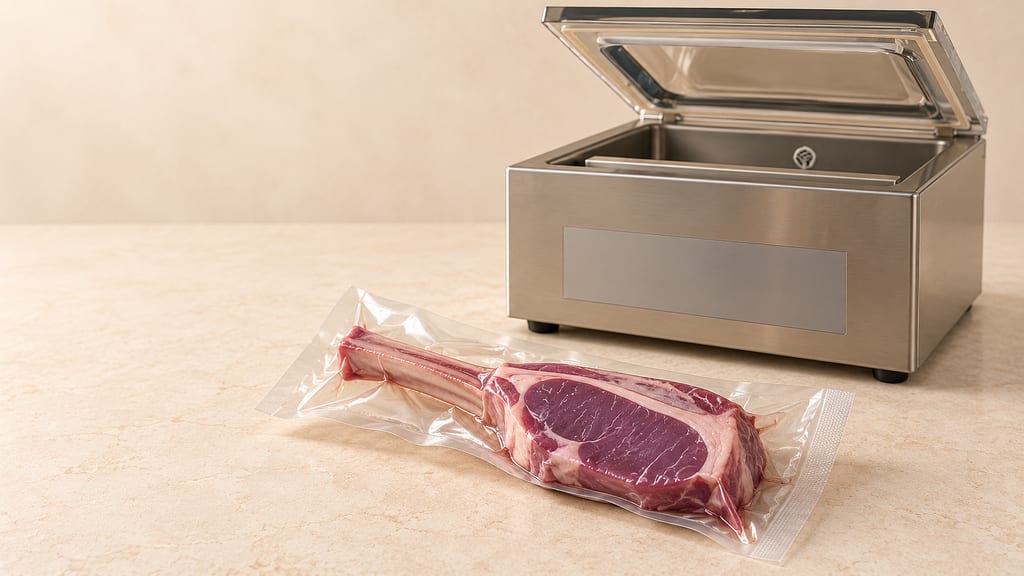
A chamber sealer beside a vacuum-sealed cut of lamb: with the air gone, the meat stays purple.
Purple until the air gets in
Open a vacuum pack of beef or lamb and the meat is purple. Leave it on the bench for a few minutes and it turns red. Nothing has been added and nothing has gone wrong. The colour belongs to myoglobin, the pigment in muscle, and it changes with the oxygen around it. Without oxygen the pigment is deoxymyoglobin, which is purple. With oxygen it becomes oxymyoglobin, the red of meat on a butcher's tray. After long exposure it turns into metmyoglobin, which is brown, and that change cannot be reversed.
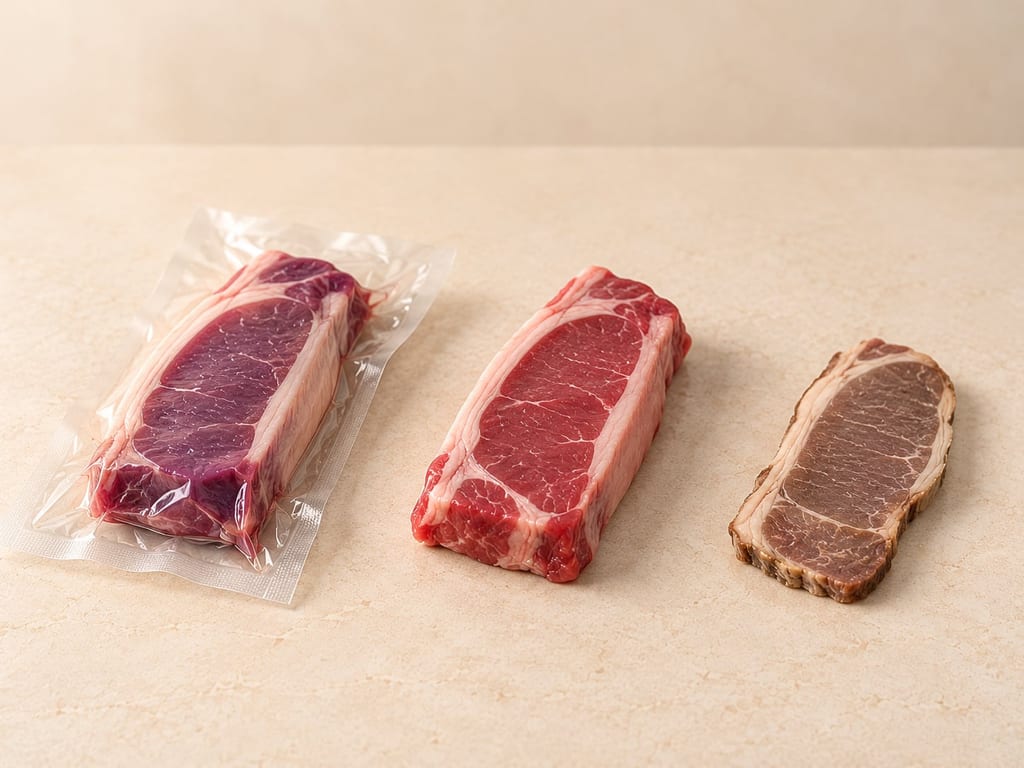
A vacuum pack is built to hold the first of those states. The food goes into a bag or pouch of barrier film, a plastic that oxygen barely crosses. A machine draws the air out and seals the film so that air cannot return. Modified-atmosphere packaging is a related method that swaps the air for a controlled mix of carbon dioxide, oxygen and nitrogen.
The purple colour has cost the method customers. In 2001 Australian meat scientists noted that vacuum packs of purple beef and lamb still met with opposition from retail shoppers, even though the packing let the meat travel further and wait longer.
What taking the air out buys
Oxygen browns the surface of meat and feeds the bacteria that spoil it. Fresh beef or lamb in air can be unacceptable to a shopper after several days, even when it is held near 0 °C. Sealing it in barrier film keeps oxygen off the surface and stretches that time. The gain is only partly from the missing oxygen. The meat tissue itself gives off carbon dioxide, and in a sealed pack the gas builds up and slows the spoilage organisms further.
The Australian figures show the scale. Lamb packed under vacuum with a carbon dioxide flush kept for up to 16 weeks at −1 to 0 °C, against a maximum of 8 to 10 weeks with conventional vacuum packing. Pork in vacuum packs typically spoiled within 8 weeks, and the organisms responsible were lactic acid bacteria, which do not need oxygen. These are spoilage times for commercial Australian red meat from one 2001 industry newsletter. They say when the meat becomes unpleasant, not when it becomes unsafe, and they do not carry over to other foods or to a home fridge.
Air also acts on fat. In oily dried fish, oxidation makes the flesh bitter, stale or paint-like, and sealing out air helps. It does not help a fish that was dried too little to begin with.
A history told by the company that sold the bags
No independent history of vacuum packaging turned up. The dated account comes from Sealed Air, the company behind the Cryovac brand, and it is the company's own telling. It gives a trademark filing in 1941, a prototype vacuum-seal barrier bag in 1946, commercial vacuum packing of perishables in the 1950s, chiefly whole turkeys, and a three-layer flexible shrink bag in 1962. It also describes work on boxed beef through the 1960s.
Other dates circulate on retail and hobby websites, among them an early patent and a modern sealer from the 1960s. None could be checked against a primary record, so they are left out here. What the company timeline does show is a method that grew up around the packing plant and the shipping of whole cuts, turkeys and boxed beef.
The bacterium that does not need air
Removing oxygen also removes the competition for organisms that never needed it. Non-proteolytic Clostridium botulinum is a spore-forming anaerobic bacterium, and it can grow and make a harmful toxin at 3 °C and above. The UK Food Standards Agency states that air in or around a pack cannot be relied on to prevent growth and toxin formation, because foods can hold oxygen-free areas where the bacterium grows. Outbreaks have followed vacuum-packed and modified-atmosphere foods, smoked fish among them.
Listeria monocytogenes is the second concern. It can grow in vacuum and modified-atmosphere packs and at refrigeration temperatures, and a UK government summary says it can grow below 0 °C. Scottish food-safety guidance warns that cold-smoked fish can carry this risk for higher-risk consumers. A pack that looks and smells normal has not been shown safe by either.
Three degrees, ten days
The Food Standards Agency turned this into numbers. Its guidance covers raw and ready-to-eat chilled foods packed under vacuum or in modified atmospheres, except fresh beef, lamb and pork. Foods held below 3 °C fall outside its scope, and its controls apply at chill temperatures of 3 to 8 °C. Where none of the controlling factors below can be shown, the maximum shelf life is 10 days from the day the product is first vacuum packed.
A longer life needs a controlling factor, alone or in combination. The guidance lists a heat treatment of 90 °C for 10 minutes at the slowest-heating point of the food, a pH of 5.0 or less throughout, at least 3.5% salt in the water phase, or a water activity of 0.97 or less. Water activity measures how much of the water in a food is free for microbes to use. A combination of heat and preservative factors also qualifies when it can be shown to prevent growth and toxin production every time. Fresh beef, lamb and pork have their own limit of 13 days. The agency calls the habit of rolling the 10 days forward a matter of great concern.
The clock is a commercial control, and it assumes the cold holds. Where a business cannot control storage after the pack leaves its hands, the 10 days should count from the point the pack reaches, or is likely to reach, 3 °C or above. A 2010 survey of British homes found a mean fridge air temperature of around 7 °C, with only 29% of domestic fridges at 5 °C or less. A date set for a chiller is optimistic for a kitchen.
A fish wrapped in plastic
In 2018 two women in New Jersey fell ill with botulism after eating fesikh, a salt-fermented gray mullet that is left uneviscerated. The fish had been wrapped in plastic in the kitchen for 20 days at ambient temperature. A leftover sample tested positive for botulinum neurotoxin type E and for Clostridium botulinum type E. The US Centers for Disease Control and Prevention published the case in November 2019.
The report gives no information about vacuum packing, and this was not a vacuum-pack outbreak. It belongs here for the conditions it describes: a salted, fermented fish with its gut still inside, sealed in plastic and left at ambient temperature for 20 days, which is an anaerobic setting. US Food and Drug Administration guidance on fish warns that uneviscerated interiors and reduced-oxygen conditions can allow dangerous toxin formation. A vacuum seal is one way to reduce oxygen. It is never a way to make the food safe.
Where a vacuum joins a cure
Vacuum packing does its best work as an addition to a process that already controls the organisms. It does not replace one. Biltong, the dried beef of southern Africa, shows both halves. In a controlled study, Gavai, Karolenko and Muriana (2022) vacuum-marinated beef and dried it at 23.9 °C and 55% relative humidity. E. coli O157:H7, Listeria monocytogenes and Staphylococcus aureus fell by more than five logs within six to eight days, meaning at least a 100,000-fold drop. The beef was inoculated with the organisms in a laboratory run, so the result is not a six-day home recipe.
Pastırma, the Turkish dry-cured beef, gives the packaging half. Gök and colleagues compared air, vacuum and modified-atmosphere packs of it in 2008 and found that each pack kept quality differently in the product they studied. The pack was added to a cure that already existed, and the cure still did the preserving.
Finnish consumer guidance for cold-smoked salmon and whitefish follows the same logic. It asks for exceptionally cold storage of vacuum-packed fish, below 3 °C, which is the threshold the UK rules use.
What the seal promises
A vacuum pack slows the changes that air causes: browning, rancid fat, the growth of organisms that need oxygen. It lets a plant ship a product further. A seal tells you none of what happened before it, whether the food was made safe, handled cold or packed clean.
For a home cook the useful reading is narrow. Seal food that is already safe to keep, keep it cold, count the days from the day it was packed, and do not treat a sealed ferment, cure or smoked fish as shelf-stable. The sources give no household storage times for particular vacuum-packed foods, and the commercial numbers above were not written for a kitchen.
Related
Discussed in this article
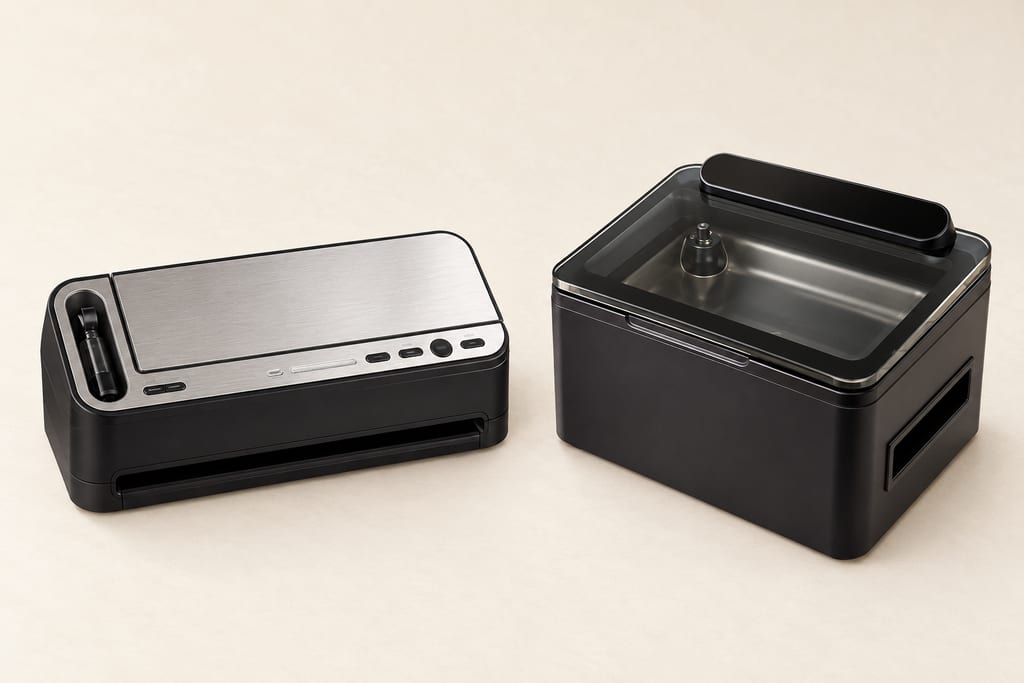
Vacuum sealer
A vacuum sealer removes air from a food package and closes it with a heat seal. Stand-alone machines commonly use external suction at the bag edge or evacuate a chamber containing the whole pouch.
Community
No community contributions have been published for this entry yet.
Share what you made
Sign in to contribute. Published comments and photos are free to read.
Sources
UK Food Standards Agency, December 2020 (revision 4)
The safety and shelf-life of vacuum and modified atmosphere packed chilled foods with respect to non-proteolytic Clostridium botulinumCited in: Purple until the air gets in; The bacterium that does not need air; Three degrees, ten days; What the seal promises
Food Science Australia, Meat Industry Services (CSIRO), August 2001
Meat Technology Update 01/4Cited in: Purple until the air gets in; What taking the air out buys; What the seal promises
Morbidity and Mortality Weekly Report, Centers for Disease Control and Prevention, 8 November 2019
Notes from the Field: Botulism Type E After Consumption of Salt-Cured Fish - New Jersey, 2018Cited in: A fish wrapped in plastic
Microorganisms, 2022 (Gavai, Karolenko and Muriana)
Effect of Biltong Dried Beef Processing on the Reduction of Listeria monocytogenes, E. coli O157:H7, and Staphylococcus aureus, and the Contribution of the Major Marinade ComponentsCited in: Where a vacuum joins a cure
Gaps
- No source gives household storage times for specific vacuum-packed foods; the 10-day framework is a commercial control, not a home guarantee.
- The history rests on one company's timeline, and no independent record of the inventor, the first commercial use or the first household sealer was found.
- Peer-reviewed work on Listeria and type E botulism in vacuum-packed smoked fish was not located.
Updated 2026-10-29