Borno and Yobe underground grain pits
A 2007 survey reports underground grain pits in Nigeria’s Sudan Savanna, especially Borno and Yobe. It describes lined pits storing threshed millet, sorghum and cowpea.
 FermenteaWhere food goes to change
Built structures · Masonry smoking ovens
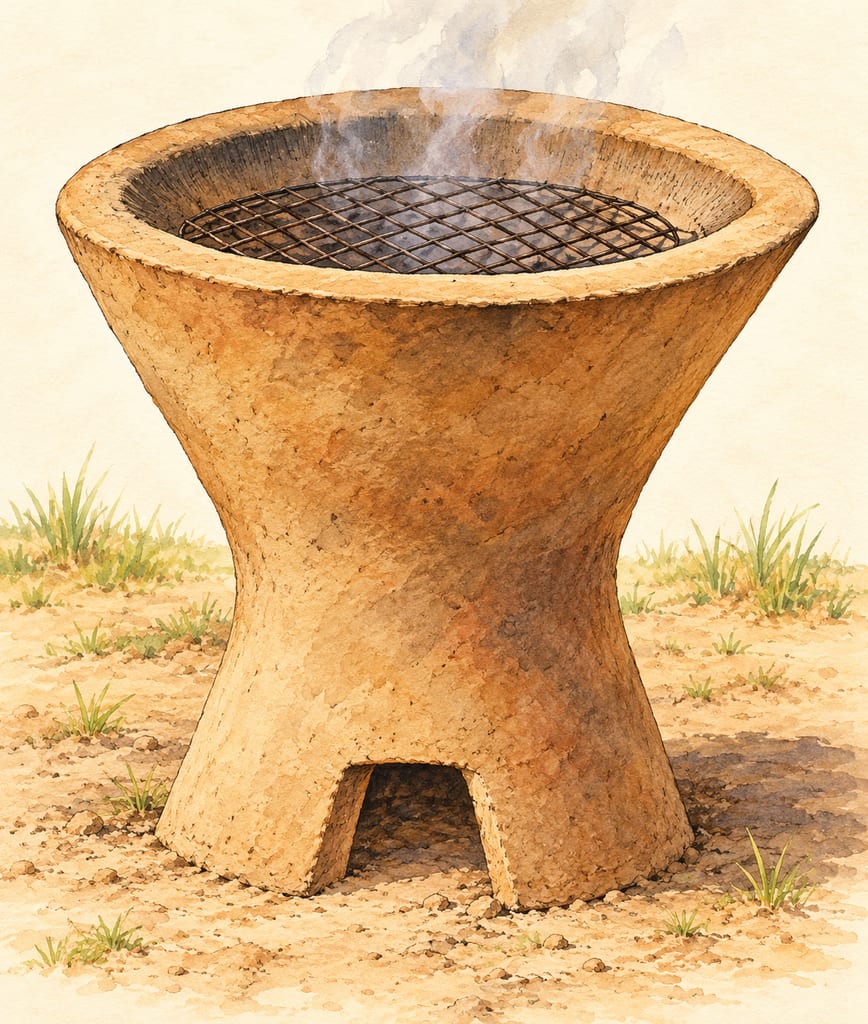
A 1974 FAO report describes varied mud fish-smoking ovens around Nigeria’s Kainji Lake basin, including an hourglass form in its northern parts. It documents the form and broad use, but gives no dimensions or construction sequence.
B. Meyboom’s FAO report on fish handling in the Kainji Lake basin describes several kinds of smoking oven observed during a visit to Nigeria from January to March 1974. Kainji Lake lies in western Nigeria within the Niger River system. The report describes the basin as savannah and records both oval and rectangular mud ovens, with some rectangular ovens grouped together. This variation matters: the report does not present one standardized kiln design for Nigeria.
The report says a typical oven contained one support on which fish rested during smoking and drying. It could be expanded metal or a steel rod frame with chicken wire, either incorporated into the structure or carried by rods set into the walls. A thin metal sheet—often flattened corrugated roofing—was commonly placed over the oven to retain heat. These are features of the observed kilns, not instructions for reproducing them.
For the more northern parts of the Kainji Lake basin, Meyboom describes a different form as hourglass-shaped. Figure 3 in the report depicts a broad upper mouth, a narrowed middle and a widened lower body, with a mesh support across the opening and a small fire opening near the base. The generated illustration on this page follows that specific figure; it is editorial art based on a published drawing, not a photograph or archaeological reconstruction.
Meyboom offers possible explanations for the profile, not settled conclusions. He suggests that the upper part might fit around open-top, half-round baskets used to hold fish after smoking and drying, making re-drying easier. He also proposes that the narrowed profile might distribute hot air more evenly. The report explicitly presents these as possibilities for future research, so neither is stated here as a proven design purpose.
In the report’s 1970s account, wood supplied the heat and smoke for most fish drying around the lake, and the observed ovens supported both smoking and drying. The report’s wider discussion describes a local market for unsalted, strongly smoked fish, while noting different demands for fish sold nearby and fish transported farther. Those historical observations situate the kiln within a working fishery; they should not be read as current food-safety guidance.
A 2022 survey of farmed-catfish processors in 20 Kainji-basin communities found local banda kilns remained common. That study concerns contemporary local ovens in general. It does not identify those kilns as the hourglass shape illustrated in the 1975 report, and it cannot establish an uninterrupted history of this particular form.
The FAO report gives no dimensions, wall thickness, foundation, mud recipe or construction sequence for the illustrated hourglass kiln. It also does not identify the exact village where the Figure 3 oven was recorded. This page describes the documented structure and its attributed context; it is not a construction plan. The report’s drawing credits no illustrator, and its image-rights status is not stated.
B. Meyboom's FAO report on fish handling in the Kainji Lake basin records multiple smoking-oven shapes and illustrates an hourglass form in the basin's more northern parts. The observation dates the report, not the origin of the kiln tradition.
A build is made where it stands: moving it means building it again.
The report places the hourglass form in the basin's more northern parts but does not give a village for Fig. 3.
No community contributions have been published for this entry yet.
Sign in to contribute. Published comments and photos are free to read.
Food and Agriculture Organization of the United NationsForm · Materials · Use · Geography · Historical attestation
Fish handling and processing in the Kainji Lake basin and suggestions for improvements and future researchThe consultant's field visit was from 10 January to 5 March 1974; the report states that Kainji Lake is in western Nigeria.
Ovens were usually made of mud, held one fish support made of expanded metal or a steel rod frame with chicken wire, and were commonly oval or rectangular; rectangular forms could be grouped.
A thin sheet, often flattened corrugated roofing, was used to retain heat in observed ovens.
The report says hourglass-shaped ovens occurred in the more northern parts of the basin. Its possible explanations for the shape are hypotheses, not established functions.
The report does not provide construction dimensions or a construction sequence for the illustrated hourglass kiln.
Cited in: A field record from the Kainji basin; The northern basin’s hourglass form; Use and historical limits; What the sources do not specify
Journal of Agricultural ExtensionContemporary context
Economics of Smoked Farmed Catfish in Kainji Lake Basin, NigeriaA 2022 survey selected 80 farmed-catfish processors from 20 basin communities and reported that at least 67 percent used local banda kilns.
This later study establishes contemporary use of local ovens, but it does not identify the specific hourglass kiln in the 1975 report or establish continuity of that shape.
Cited in: Use and historical limits