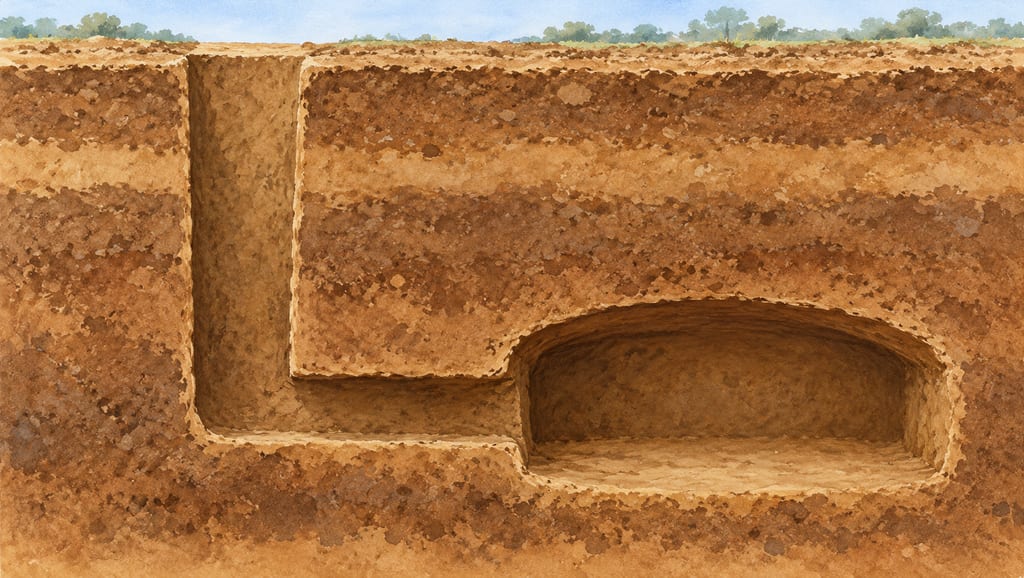
Kōji-muro (Edo underground kōji chamber)
A source-bounded account of Edo’s subterranean kōji chambers: shafts led through narrow passages to low rooms cut into Kantō loam for cultivating kōji. Excavated examples vary by site.
 FermenteaWhere food goes to change
Equipment · Incubators and warm holds
An insulated cabinet with shallow food-safe trays and controlled heat and humidity, for making koji on a grain bed from a commercially supplied culture, in the Japanese manner.
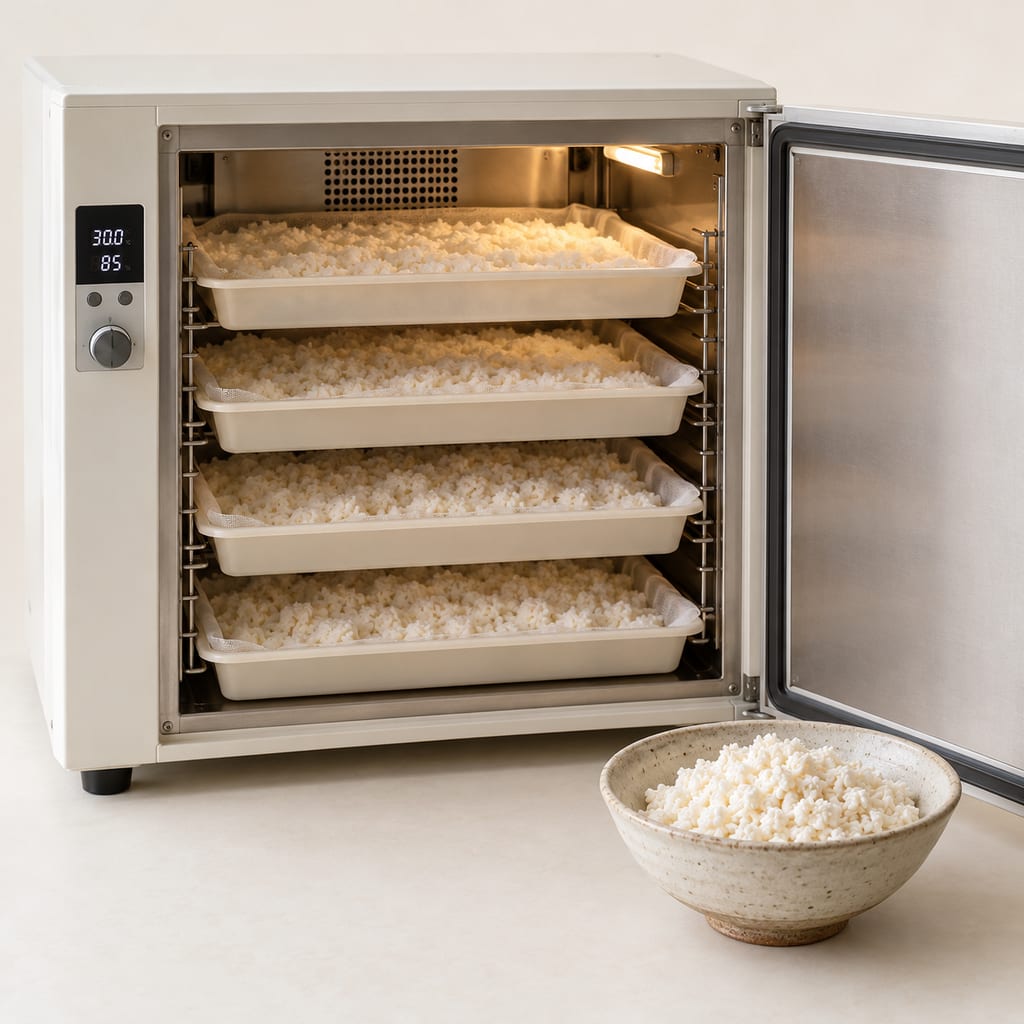
A koji tray incubator is an insulated cabinet holding shallow, food-safe trays of steamed grain that have been inoculated with a commercial koji culture. The brief specifies controllable heat, humidity that does not spray the grain, and a way to remove heat. Shallow trays keep the grain bed thin enough to stay aerated and to be mixed by hand.
The grain bed should be measured separately from the room air, because the mould generates heat as it grows.
Home koji guides report about 28 to 32 C and 70 to 80 per cent humidity, and the figures in the sources conflict. A university study reported success at 25 C and 70 per cent humidity, and at 27 C and 80 per cent, on steamed barley. The settings depend on the strain and the substrate, so the page gives no fixed setting.
Controlled koji incubation with a microcomputer has been applied to barley koji, which shows that the principle of a timed, controlled incubator is established in the literature.
Japanese koji making has also used underground chambers, called muro, which hold humidity and temperature through the earth around them. Those are builds rather than equipment, and this tray incubator is the portable counterpart for a home kitchen.
Koji temperature and humidity figures in home guides conflict and depend on strain and substrate; they are not a fixed setting.
Source →Wild mould capture and home spore propagation are not equivalent to a commercial culture and are not covered here.
SourceDocumented for international use, with no single place of origin assigned.
A source-bounded account of Edo’s subterranean kōji chambers: shafts led through narrow passages to low rooms cut into Kantō loam for cultivating kōji. Excavated examples vary by site.
No community contributions have been published for this entry yet.
Sign in to contribute. Published comments and photos are free to read.
FAO AGRISMethod · Science
Microcomputer-controlled koji incubation system and its application to barley koji manufactureControlled incubation of koji with a microcomputer, applied to barley koji.
Cited in: What it is; Conditions; Related build
The FermentaryMethod
How to make koji from scratchHome koji guide; temperature and humidity figures in home guides differ and are secondary.
Cited in: Conditions