A gourd vessel with a local history
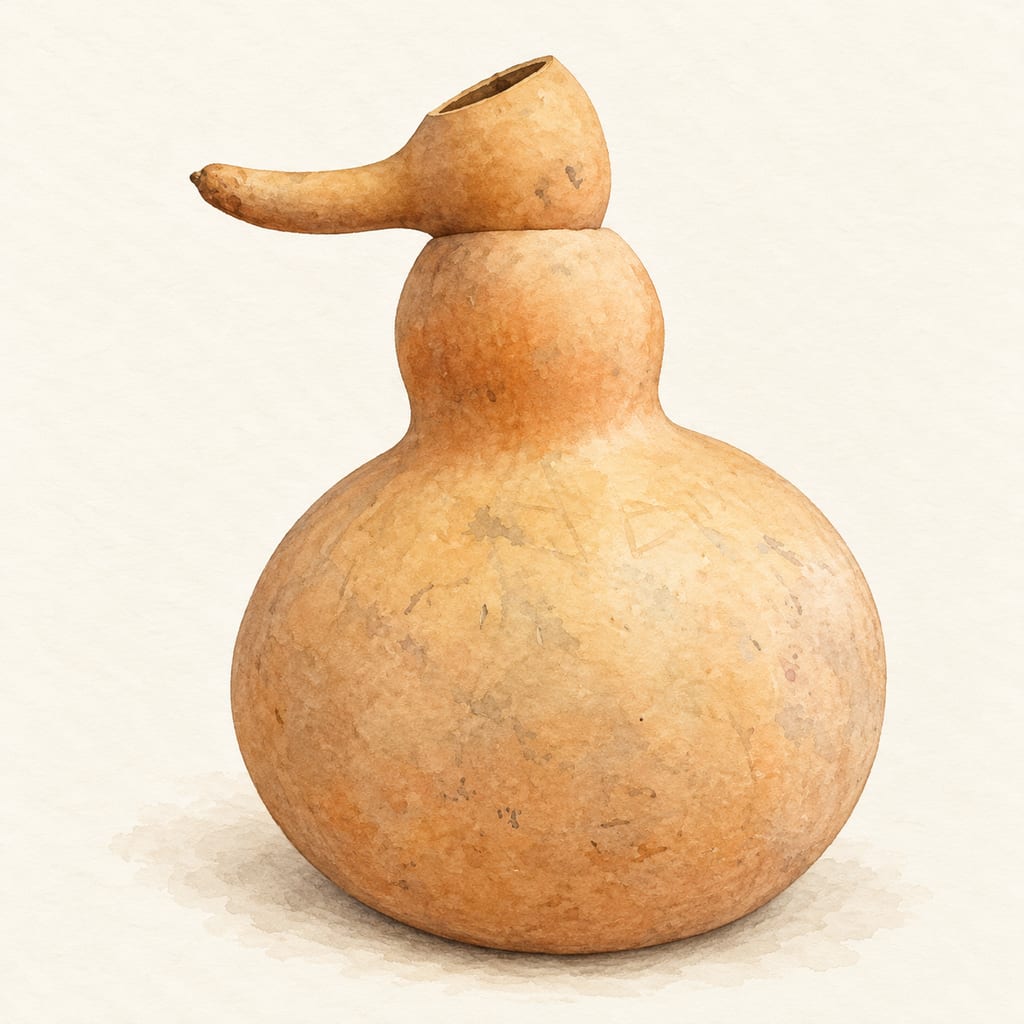
Mabisi is Zambia's spontaneous fermented milk, and calabashes are one of the vessels used to make it. A survey across nine Zambian provinces recorded gourds alongside clay, plastic and metal containers. Later interviews in Southern, Eastern and Western provinces found that many participants remembered their forebears fermenting milk in calabashes. These accounts document a living household practice, but do not establish when it began or one standard calabash design.
Sources for this section
A broad opening, sometimes a drain
The 2019 survey describes traditional gourds with large openings. The sources do not give a standard height, diameter or botanical species for the gourd. A separate Western Zambian, or Barotse, method uses a calabash with a low side or bottom opening, plugged between drains. Whey is let out and fresh milk added in repeated rounds. The plug is a useful feature of that method, not a feature to assign to every mabisi vessel. A 2024 study records participants describing three to seven days of repeated additions according to taste and temperature; the 2019 survey describes its own sequence and endpoint variants.
Sources for this section
Reuse and what the comparison found
A rural field trial used three calabashes bought from local markets, each about 20 litres in capacity. The researchers prepared them with water and a grass-and-cane mixture left inside for a day, and washed them with water between cycles. They treated previously used calabashes as a route for passive transfer of microbes between batches. In that trial, microbial diversity did not differ significantly between batches fermented in used calabashes and buckets. Active back-slopping, in which a little finished mabisi is added to fresh milk, began acidification without the lag seen in passive or no-back-slopping batches. These results concern the trial's vessels and conditions; they do not prove that gourd material has no effect in every setting, or that reported flavour preferences are imaginary.
Sources for this section
A vessel becoming less available
Participants in the three-region foodscape study described calabashes as less available where households no longer grew them, and reported turning to plastic or metal buckets because they were convenient and more durable. Some participants said mabisi from calabashes tasted better. That is important testimony about preference, not a controlled sensory finding. The same research records calabash use in present-day communities as well as its decline, so the vessel belongs to a changing practice rather than a single vanished tradition.
Sources for this section
History
A 2019 survey records calabashes among vessels used for mabisi. In 2024 interviews, participants recalled that their forebears fermented milk in gourds. Neither source dates the origin of the calabash form.
Equipment details
Capacityup to 20 L Three calabashes used in one rural Zambia field trial were described as about 20 L capacity; this is a trial size, not a universal specification.
SizeThe sources give no general height or diameter.
PowerNo power The vessel itself is unpowered; the sources describe milk fermentation in the container.
How you get oneGathered or grown A 2020 field trial obtained calabashes from local markets. A 2024 study reports that some communities no longer grew them and found them less available; it does not establish a dependable current supply route.
CareIn the 2020 field trial, calabashes were filled with water and a grass-and-cane mixture and left for a day before use, then washed with water between fermentation cycles. This records the study's practice, not validated sanitation guidance.
Made of
- Calabash gourd shell — Vessel body
Studies identify the calabash as a gourd vessel but do not identify the plant species or a standard cut and finish.
Limits
The low drain opening belongs to particular Barotse or Western Zambian methods, not every mabisi calabash.
Source →One field trial found no significant microbial-diversity difference between previously used calabashes and buckets under its conditions; this does not establish a universal material effect.
Source →Places
Zambia
Traditional use · Country evidenceCalabashes are documented in Zambian mabisi production; the cited studies do not establish an exclusive origin or one regional design.