
Vessels intake
The vessel and the ferment: pots, vats, skins and pits
Jars, barrels, skins, leaves, pits and whole rooms decide much of what happens to fermented and cured food. This is how a container works on its contents, and how people in different places chose theirs.
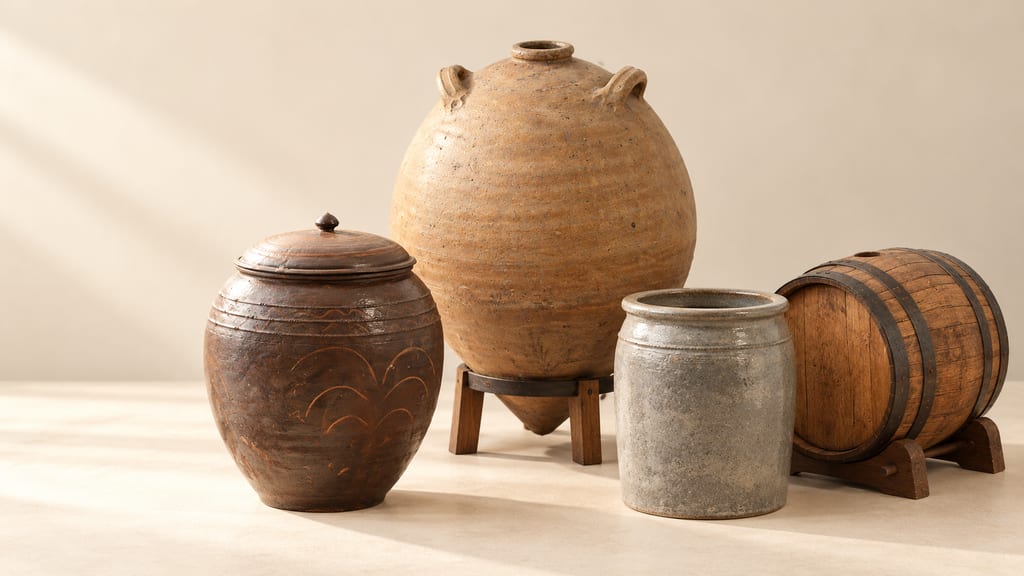
A qvevri, an onggi jar, a stoneware crock and an oak cask: the vessel shapes what happens inside a ferment.
The vessel is part of the recipe
A recipe for sauerkraut, wine or fish sauce usually lists what goes in and how long to wait. It rarely says much about the thing it all goes into, yet the container is doing work the whole time. It decides how much air reaches the food, whether gas can escape, how quickly heat leaves, whether liquid drains away or collects, which microbes are already waiting on its walls, and how easily a person can reach in to stir, press, taste or empty it.
Change the container and the process changes with it. A clay jar that lets carbon dioxide seep through its wall, a glass jar that does not, a barrel whose inner surface has carried living bacteria for a century and a new steel tank are four different starting conditions, even with the same cabbage, juice or milk inside. Sometimes the difference is large, sometimes it is too small to measure, and sometimes a change that looks harmless makes a traditional food dangerous. Finding out which needs evidence about the particular vessel and process; it cannot be read off the material's reputation.
The containers themselves vary widely. People have fermented and cured food in fired clay and carved marble, in coopered oak, chestnut and cedar, in the skins and stomachs of animals, in gourds and bamboo, in parcels of leaves and bundles of straw, in pits dug into earth or soft rock, in caves cut into limestone, and in rooms built or adapted to hold the right air. Steel, glass, concrete and plastic joined that list late, and they have not replaced it. In many workshops today a stainless tank stands beside a wooden vat, and a plastic bucket does the job a gourd once did.
This article follows the container through that history. It looks at what survives from the earliest fermentation and what does not, the buried jars and built vats of the Caucasus and the Roman world, the ways a vessel acts on its contents, the wooden walls that carry living cultures, the skins, gourds and leaves of pastoral and farming kitchens, the stone and caves of curing, and the vessels of Asia, Africa, the Americas, the Pacific and the Arctic. It ends with modern materials and with a few rules for reading a photograph or a drawing of a vessel without being misled by it.
Four layers of containment
The word vessel needs stretching to cover the subject. It helps to think of four layers, which often work together in a single workshop.
The first is the vessel in direct contact with the food: a jar, vat, barrel, trough, skin bag or bamboo tube holding the bulk liquid, curd, vegetables, fish or grain. The second is a package or porous support around a smaller mass of food, often one that lets liquid drain or gas pass: a leaf parcel, a sausage casing, a basket, a cloth bag, a straw bundle. The third is a built receptacle, food held in the ground or in a permanent installation: a leaf-lined pit, a masonry fish-salting vat, a stone press basin, a buried tank. The fourth is the enclosure around everything else, the air of a cheese cave, a ham-curing room, a koji room or a fermentation house.
Tools belong to the system too. A yeast log that carries a culture from one brew to the next, a stone that holds vegetables under their brine, a wooden disc pressing down on salted anchovies, or a paddle that stirs a cap of grape skins can matter as much as the vessel around them. A photograph of an empty jar often leaves out exactly the part that made it work.
The processes that happen inside these containers overlap, but they are not the same. Fermentation is microbial work: yeasts turning sugar into alcohol and carbon dioxide, bacteria making acid, moulds growing over a moist solid and supplying enzymes. Some of it needs air; vinegar bacteria and koji moulds cannot work without oxygen, so the popular rule that every fermenter must be airtight is wrong. Curing preserves or transforms food with salt, drying and sometimes smoke, and it may or may not involve microbes. Maturation can mean slow microbial change, the food's own enzymes, oxidation, evaporation or extraction from wood. A salted block of pork fat in a marble basin and a jar of sour cabbage are both "kept in a vessel", but they are different systems, and a spirit resting in a barrel is maturing rather than fermenting.
What survives, and what does not
The earliest containers for fermentation were probably the ones least likely to last. Food ferments readily in a hollow in the rock, a skin, a gourd, a lined basket or a mass wrapped in leaves, and almost none of those survive thousands of years. Fired clay does, and it soaks up traces of what it held. The result is a strong preservation bias: the history of pottery is far easier to write than the history of skins, wood and leaves, and the absence of a perishable container from the archaeological record says very little about whether people used it.
That makes the oldest evidence unusual rather than typical. At Raqefet Cave, a Natufian burial site in present-day Israel dated to 13,700–11,700 calibrated years before present, researchers studied use-wear and residues on three stone mortars. They interpreted the traces as the earliest archaeological evidence for brewing a cereal-based beer, made by semi-sedentary foragers, and concluded that plant foods, including malted wheat or barley, were packed into containers made of fibre and stored in boulder mortars. Here the "vessel" is a hollow in stone with a perishable fibre bag inside it, and the reconstruction rests on microscopic residues rather than on a surviving brew.
Pottery in East Asia carries an early and carefully argued case. Twelve sherds from the early phase of Shangshan in the Lower Yangzi valley, about 10,000 to 9,000 years old, including fragments of eight globular jars, held phytoliths, starch grains and fungal remains that the researchers read as evidence that rice was already being brewed, using a starter containing Monascus mould and yeast of the kind later called qu. At Jiahu in Henan, chemical analysis of residues absorbed into pottery jars from the seventh millennium BCE identified a mixed fermented drink of rice, honey and fruit, hawthorn and possibly grape. At Mijiaya, about 5,000 years ago, pottery vessels showed broomcorn millet, barley, Job's tears and tubers fermented together. None of these jars is a modern pickle crock or wine vessel; each one is a specific excavated shape, and each finding is an interpretation of residues inside it.
In the South Caucasus, residues in pottery from early Neolithic sites in Georgia, dated to about 6000–5800 BCE, are the earliest biomolecular evidence for grape wine in the Near East. The researchers suggested that the very large jars probably served at once for fermentation, ageing and serving. In the northern Zagros Mountains of Iran, a jar of about nine litres from Hajji Firuz Tepe, in a building dated to about 5400–5000 BCE, was found with five similar jars set into the earthen floor along one wall of a kitchen. Its residue was a mixture of a grape product and resin from the terebinth tree, and its excavators thought the wine had probably begun fermenting before it went into the jar. The reconstructed jar stands about 32 centimetres high, with a restricted opening, an angled shoulder and a repaired earthenware surface. It is classed as a storage container, since residue alone does not show that primary fermentation took place in it, and its resin shows that contents and container treatments have to be studied together; it was not necessarily a thick waterproof lining. Six jars of that size suggested fairly large-scale production and consumption for one household. A floor-set household jar, then, not a buried giant.
Milk left its own trace. Potsherds pierced with small holes, from early Neolithic sites in temperate Europe of the sixth millennium BCE, carried abundant milk fat. The vessels resemble modern cheese strainers, and their use to separate fat-rich curds from whey is the earliest direct chemical evidence for cheese-making in northern Europe. They drained curd; they say nothing about how, or whether, the cheese was ripened afterwards.
By the late Chalcolithic, vessels appear as parts of installations. In Areni-1 cave in Armenia, dated by radiocarbon to 4100–4000 BCE, excavators found a shallow basin of pressed clay about 3 by 3.5 feet, set so that juice would run down into a clay vat just over 2 feet high that could have held 14 to 15 gallons, among grape seeds, pressed grapes, grape must and dozens of desiccated vines. As one of the excavators put it, at that time there was no way to keep grape juice without it fermenting.
Egypt shows the same move to scale. At Abydos, a brewery probably dating to the era of King Narmer had eight large production units, each with about forty earthenware pots in two rows, held in place by vertical clay supports set in rings. A mixture of grains and water was heated in the vats, and the installation could make about 22,400 litres at a time. The vats slowly heated grain and water before the mash was strained and fermented elsewhere, so not every vat was a fermenter, and the structures were originally roofed, with stoke holes in the sides for fuel and air. That description and estimate come from the announcement of February 2021 by the mission of Matthew Adams of New York University and Deborah Vischak of Princeton with Egypt's Supreme Council of Antiquities, which gave each unit as about 20 metres long and 2.5 metres wide. After further excavation the project reported in 2022 that some structures were more than 35 metres long with over 80 vat emplacements, so that eight comparable structures would give close to 50,000 litres per batch; the estimate grew with the excavated area. These were heating vessels for the mash, not the jars in which the beer then fermented, and the difference matters. A painted wooden model from the tomb of Meketre, about 1981–1975 BCE and 73 cm long, shows a bakery and brewery in miniature: figures grinding and mixing, and rows of jars. A Sumerian hymn to Ninkasi, the goddess of beer, describes the fermenting vat set on top of a large collector vat, from which the filtered beer pours out "like the onrush of the Tigris and the Euphrates". The text names an arrangement of two vessels and a filter; it does not give their shapes.
In the Andes, at Cerro Baúl in southern Peru, a brewery of the Wari empire, which held sway with Tiwanaku from about 600 to 1000 CE, ended its life in ceremony. Its large ceramic vessels stood in a purpose-built brewery with separate processing spaces, distinct from the later Inca urpu, and archaeologists tell heating and boiling equipment from fermentation vessels by context and reconstruction. Cerro Baúl gives unusually strong evidence of coordinated brewery architecture rather than an isolated pot with ambiguous starch, though its destruction and abandonment shaped what survives. When the colony was abandoned, its people brewed, feasted, smashed their vessels and burned the buildings. A residue is not a recipe, and a smashed brewing jar is not a complete method. What these sites establish is that people built and chose containers for fermentation very early, and in many places independently.
Buried jars and built vats
A cluster of large vessels around the Black Sea and the Mediterranean is often run together, because they are big, round and partly underground. They are different objects with different jobs, and the differences are worth keeping.
The Georgian qvevri is an egg-shaped earthenware vessel. In the living method recognised by UNESCO in 2013, grape juice goes in with its skins, stalks and pips; the qvevri is sealed and buried in the ground, and the wine is made, aged and stored in it, left for five to six months before it is drunk. The knowledge is passed down through families and neighbours, and children learn to make and fire qvevri by watching their elders. A maker builds the walls up by hand a little at a time, about 20 cm at a go, and fires them at 1,200–1,300 °C; the hotter the fire, the less porous the clay. Melted beeswax is poured inside and soaks into the wall, and the outside is usually coated with lime. Buried in the earth, the wine finishes fermenting and ages in contact with its skins and lees. Installed in a cellar, almost the whole jar disappears: only a ring of mouths and lids shows at floor level. The Neolithic Georgian jars are part of the background to this tradition, but they do not show that every feature of a modern qvevri cellar is 8,000 years old. In western Georgia the vessel is called churi (ჭური). Out of the ground it tapers under a broad shoulder to a pointed or very small base, with a thick-lipped mouth, a short neck and no handles; its clay runs from russet to buff, often patchily darkened, with the irregularity of hand-building, and a pale outer coat is a lime or cement treatment rather than the clay's colour. Installed, only its round lip and flat lid show at floor level. Burial gives support and thermal buffering, and skin and stem contact, grape variety, time and microbial management change the wine as much as the clay does.
Armenia's karas belongs to the same broad family of large earthenware wine jars. In a cellar in the village of Chiva, in Vayots Dzor, one family's karas held some 240 gallons and had been used by the late head of the household to make wine through a traditional process of fermentation and storage. A karas is a giant hand-built egg with a small round mouth, a thick rim and a narrowing base, sometimes too wide to pass through the cellar door; some installations leave much of the shoulder exposed and others hide most of the body. A wine's name does not imply the same use: Zorah's Karasì ferments in concrete and then matures in karas buried about three-quarters of their height. Its girth was wider than the cellar door. Such jars become part of the building.
The Roman dolium was a very large earthenware jar for wine and other bulk goods. At Villa Regina near Boscoreale, a villa first built in the first century BCE and buried by the eruption of 79 CE, the wine cellar holds eighteen dolia beside the remains of a wooden press. A dolium has a massive rounded or ovoid body, a thick, wide lip and a very short neck, without an amphora's tall handles; set into the ground as dolia defossa, it left a grid of round mouths in the floor, each with a separate lid, while burial supported the jar and tied its temperature to the ground. Coatings changed permeability, so bare, pitch-lined and otherwise treated dolia behaved differently. A recent comparison of Roman dolia with Georgian qvevri argues that dolia were precisely engineered containers whose composition, size and shape all contributed to the wines made in them. Its flavour arguments are hypotheses rather than tasting evidence. That is a well-founded hypothesis drawn from modern analogy; no Roman wine survives to be tasted.
Dolia also held fish sauce. In the "Garum Shop" at Pompeii, house I.12.8, the remains of fish were found in six dolia. A chemical comparison with a garum made from the Roman writer Gargilius Martialis's recipe found differences in nitrogen and fat between the jars that may mean several batches were in production when Vesuvius erupted. So a garum vessel can be a round clay jar, and a dolium is not only a wine jar.
Large-scale fish salting, though, usually happened in built vats rather than jars. At Baelo Claudia in southern Spain, garum was made in the cetariae, salt works with ponds for macerating fish, and production lasted for more than seven centuries, from the second century BCE to the fifth century CE. At Tróia in Portugal, a survey identified twenty-five fish-salting workshops arranged as rooms with vats along the walls around a patio. Of 165 visible vats, the 80 that could be measured gave a minimum capacity of 1,429 cubic metres, with some vats 1.90–2.30 m deep, and some vats were later subdivided. The earliest workshop dates from the reign of Tiberius, and production continued at least to the middle of the fifth century. A cetaria is masonry in the ground, with a lining to hold liquid; it has no clay belly and no narrow mouth.
These distinctions answer a question that often comes up: whether there was a tradition of making garum in huge buried jars in the Caucasus. The evidence gathered here establishes Caucasian clay wine jars, Roman masonry fish-salting vats and Roman clay fish-sauce dolia. It does not establish a Caucasian garum tradition in buried jars, and a marble lardo basin or a pit for cheese is a different object again.
The Iberian peninsula keeps its own large jars and stone tanks. In Portugal's Alentejo, wine made in clay talhas may have the jar's floor lined with grape stalks, so that at the end of its rest the wine filters naturally through them and runs clear from a tap fitted near the base. A talha stands above the floor rather than being buried: a tall pot with an enormous rounded belly, a short open neck and a broad lip, sometimes ringed with raised bands. During fermentation the cap of skins is pushed down by hand with a long wooden implement, and some producers cool the jar by wetting a cloth around it. The practice has Roman associations, but each surviving jar has its own date. Lining the inside with a mixture of pine resin and beeswax is a custom, not a rule. The talhas are opened on St Martin's Day, 11 November, and a winery that bottles before then loses the right to call its wine vinho de talha. In Villarrobledo, in La Mancha, potters have made earthenware tinajas since the sixteenth century, near the clay deposits; the largest stood more than 4 metres high and weighed 2,500 kg, and from the later nineteenth century a whole industry turned out thousands a year by hand for wine and household use. In the Douro, the winery at Quinta do Vesuvio, built in 1827, houses eight granite lagares, broad stone treading tanks of about 13,500 litres each in which grapes are still trodden by foot; gravity carries the wine down to sixteen great chestnut vats below.
How a vessel changes what is inside it
The same handful of variables explains most of what a container does, whether it is a clay jar, a skin, a pit or a steel tank. Naming them makes it easier to compare very different vessels without pretending they are interchangeable.
The first is the gas boundary. Some fermentations need oxygen at a surface or through a bed; others go better when it is kept out after a first stage. A Sichuan paocai jar solves the second problem neatly. Its mouth is surrounded by a moat; the lid sits in the water, letting the carbon dioxide of fermentation bubble out while keeping oxygen and contaminants away. To open it, the cook lifts the lid slightly out of its water and draws it away so that no moat water drips into the pickles. A water seal of this kind is different from a pressure-tight lid, a cloth cover or a porous wall. A porous wall has been measured: in a laboratory comparison, salted Napa cabbage fermented in an unglazed Korean onggi and in a glass jar, the onggi's wall had more than twice the gas permeability of the glass, and the cabbage in it produced about a quarter more carbon dioxide. The researchers argued that the porous wall lets carbon dioxide out, lowering the level inside towards the range lactic bacteria prefer. That finding is about one unglazed onggi and salted cabbage at a set temperature; glazed onggi exist, and clay in general is not "breathable" by default.
The second is heat. Fermentation can generate heat, and a vessel's wall, mass, exposed surface and surroundings decide whether that heat builds up or escapes. Geometry matters here in a simple way: if every dimension of a vessel is doubled, its wall area rises fourfold but its contents eightfold. A successful small jar cannot be scaled into a giant vat just by keeping its shape. For fermented and dried sausages, casing diameter is treated as a critical process parameter for exactly this reason: a thicker product takes longer to reach the intended temperature and acidity at its core. Burial buffers temperature without controlling it. Alaska's traditional fermented foods were kept cold by fermenting them in the ground, away from the sun.
The third is the living surface. Wood, joints and established films on a vessel's wall can carry microbes from one batch to the next, sometimes by design. The next section is devoted to this.
The fourth is contact chemistry. A vessel can give things to its contents or take them away. When the same Sauvignon Blanc juice was fermented and aged on its lees in stainless steel tanks, oval concrete vessels, oval polyethylene vessels and clay jars, the concrete wines had the highest pH and the lowest acidity, probably because the concrete released elements such as silicon, sodium, magnesium, iron and manganese; the clay-jar wines were the most turbid and richest in soluble polysaccharides; the stainless-steel wines held the most volatile aroma compounds; and colour and phenolic composition barely differed. No vessel won. Coatings are separate variables: qvevri are lined with beeswax, talhas may be pitched, and the oak casks of Pilsen are lined with hot brewer's pitch, which must leave no aftertaste in the beer.
The fifth is water. A vessel can hold the liquid a food releases or let it go. Tulum cheese ripened for 150 days in goat's-skin bags lost moisture rapidly because of the skin's porous structure, while the same cheese ripened in plastic kept higher microbial counts; the aroma patterns of the two were nonetheless similar. Cacao is fermented in wooden boxes with holes in the bottom and sides. A cheese pit at Sogliano has a sump at its base to collect the liquids of maturation. A Swedish surströmming barrel must stay well filled and airtight.
The sixth is solids. Weights, followers, mats and boards keep food where the process needs it. Thai pla-ra makers press woven bamboo strips down firmly on fish packed into narrow-necked earthen jars, so that the liquid released in fermentation keeps the fish covered. Hatcho miso is pressed under a pyramid of river stones. A surströmming barrel has a grid mounted under its lid that stops the fish floating to the surface, because the fish must not touch air during fermentation: its polyunsaturated fat turns rancid easily.
The seventh is access. A narrow mouth limits exposure but makes filling, stirring and cleaning harder; a broad shallow vessel invites hands and feet. The granite lagares of the Douro are open stone tanks in which people tread the grapes by foot. A talha has a tap at its base, and an Orléans vinegar barrel a spigot, to draw liquid off through or beneath the solids.
The eighth is the surroundings. A room or cave can be a vessel in its own right. The cellars beneath the village of Roquefort-sur-Soulzon, dug into limestone scree, are ventilated by natural chimneys in the fissures of the rock, called fleurines, and Roquefort must ripen there for at least 90 days. Parma hams, salted by a salt master, hang first for 60 to 90 days in refrigerated, humidity-controlled rooms, are washed and brushed, then hang on frames in well-ventilated rooms with large windows; their exposed surfaces are softened with a paste of minced lard and salt, and from the seventh month they move to cellars with less air and light, for at least fourteen months from the first salting.
Changing any of these is a change of process. Sometimes the result is measurably different, as with the Sauvignon Blanc. Sometimes it is not: tempeh wrapped in banana leaf and in plastic showed no significant difference in bacterial community. And sometimes a change is dangerous. Botulism in Alaska has usually come from traditional fermented foods such as fish heads, fish eggs, beaver tail and seal and walrus flippers. Traditionally these fermented in a grass-lined hole in the ground or a wooden barrel sunk into it. Since the 1970s, plastic or glass containers above ground or indoors have often been used instead, and sealed containers and warmer temperatures make the fermentation faster and airless. Public-health advice is now not to ferment these foods in plastic or glass at all. That warning is about these particular foods and processes; it is not a judgement on food-grade glass for sauerkraut. Alaskan records also describe skin bags and, later, barrels, jars and plastic containers, and each community's pits differ in lining, depth, cover and season.
Wood that remembers
Wooden vessels are the clearest case of a container that is also an ingredient. A wooden surface is porous and irregular, and once a vat has been used for a while it carries a film of microbes that can seed the next batch within the time it takes to fill it.
The best-studied example is the tina, the wooden vat used to make Ragusano cheese in Sicily. Investigation of the biofilms of two tinas found between one and five bacterial species on each, with Streptococcus thermophilus predominant in both, and showed that the lag before the milk began to acidify could last up to five hours depending on the raw milk and the particular vat. In the Auvergne, the gerle, the wooden vat used for Salers cheese, carries a biofilm made up mainly of a great diversity of lactic acid bacteria; it can inoculate even pasteurized milk with microbes at levels higher than those in raw milk. A new wooden vat goes through an activation period, described below, and the succession of microbes on new vat surfaces was expected to be reproducible.
That does not make old wood magically safe. A study that followed Listeria monocytogenes and Shiga-toxin-producing E. coli through cheese-making in wooden vats noted that porous wood may protect attached cells, but found that the pathogens showed limited ability to colonize the vats and contaminate later batches. Their conclusion was that the risk is low if the milk is of high microbiological quality. The vessel's culture works with the milk, the cleaning and the hands of the maker, not instead of them.
Belgian lambic beer shows wood working in a brewery. Hot wort is spread across the wide, shallow surface of a coolship, a koelschip, where it takes about ten hours to cool and picks up the wild yeasts and bacteria of the air. The fermentation and maturation that follow happen entirely in wooden barrels that are used again and again, and research on lambic breweries has shown that the casks and the large wooden foeders are an additional source of microbes for the wort, and that the microbial make-up of their surfaces changes with each step of the cleaning routine. The barrels probably help to establish the stable microbial ecosystem that lambic depends on, and they also bring some variation from batch to batch. Coolships are wide, flat-bottomed pans with very low sides, of copper in some breweries and of stainless steel at Lindemans, filling an upper room under vents or opening windows; the room, ventilation and season contribute as much as the shape, which guarantees no particular community. Lambic then matures in horizontal casks on racks, while Flemish red beer, as at Rodenbach, matures in foeders, upright oval or round tanks several times a person's height. The area of wood touching each litre falls as vessels grow, and age, previous use, oxygen exposure and cleaning all matter, so a huge foeder is not a small barrel enlarged.
English brewing developed wooden systems for separating yeast. In a Burton Union, beer ferments in large oak casks, each holding 150 gallons, linked together or "held in union". The force of fermentation drives beer and yeast up swan-necked pipes into trays above, which sit at a slight slope so that beer runs back into the casks while the yeast is held back. In 2024 a Union set from Marston's in Burton was donated to Thornbridge brewery, which began brewing in it that May. At Tadcaster, where the Old Brewery was founded in 1758, Samuel Smith's still ferments all its ales and stouts in the traditional Yorkshire Square system, with a yeast strain used continuously since about 1900.
Sometimes wood is deliberately kept out of the flavour. At Pilsner Urquell, a small quantity of beer still ferments in oak tubs and matures in historic cellars, in barrels lined with brewer's pitch that must leave no aftertaste in the beer (how the coopers renew it is described under "Looking after a vessel"). The wooden vessel provides the shape and the cellar the temperature; the lining decides what the beer touches.
Vinegar needs air, and its barrels are built for it. In the Orléans method, oak barrels have holes in each end, covered with cloth or screen, to let air in and keep insects out. The scum on the vinegar's surface contains the most active mother of vinegar, which will turn the next batch; when a batch is ready after about three weeks, the vinegar is drawn from a spigot at the bottom, leaving about fifteen per cent behind, and the barrel is topped up with new wine. Part of each batch can then be moved into other oak barrels to age for months. One Orléans house, Martin-Pouret, was founded in 1797. A sealed, brim-full wine cask is a different vessel, even if it looks the same from outside.
Japanese brewers keep wood for the same reason. On Shodo Island, the soy-sauce brewer Yamaroku uses large cedar barrels more than 150 years old, and added twelve new ones in 2009; the lactic acid bacteria and yeast essential to its brewing have seeped into the wood. In Okazaki, the miso maker Kakukyu ages Hatcho miso for two summers and two winters, more than two years, in wooden vats nearly two metres across, under natural river stones stacked into a pyramid on top. A wooden vat here is a habitat, a press and a store at once.
Logs, rings and the culture that travels
Sometimes the most important object in a fermentation is not the vessel at all but the thing that carries the culture from one batch to the next. Norwegian farmhouse brewers kept their yeast, kveik, alive between brews by lowering a yeast ring or a yeast log into the foam of a fermenting beer, then hanging it to dry and using it again to start the next batch. Dried yeast could also be scraped from the bottom of beer barrels. A yeast log is a deliberately maintained culture carrier, not an arbitrary piece of wood that turns anything into beer: a hand-held block or short length of wood, often roughly rectangular, drilled with holes or cut with recesses where dried yeast lodges between uses. A yeast ring, or gjærkrans, is an open wreath of many small interlocking wooden blocks around an empty centre, hung up to dry. The culture's viability and storage, not the wood, decide whether either works, and one Voss brewer kept both a ring and a separate jar of yeast.
Other traditions carry the culture in the vessel itself. Mongolian airag, fermented mare's milk, is churned more than five hundred times inside a khokhuur, a cowhide vessel, with some starter left inside to help each new batch ferment; the technique was inscribed on UNESCO's Representative List in 2019. In Orléans the mother of vinegar stays in the barrel. In Sichuan, many families keep their paocai brine for years, adding salt water and flavourings over time. In each case what persists between batches is different: a dried culture on wood, a film in a barrel, a starter left in a skin, a liquid passed from jar to jar.
The nineteenth century changed how such cultures were understood without ending these practices. At the Carlsberg laboratory, Emil Christian Hansen isolated a single cell of good brewing yeast and grew it into a pure culture, which went into large-scale brewing in November 1883 as Saccharomyces carlsbergensis; the brewery gave it free to other brewers. Pure cultures made it possible to start every batch from a known organism in a clean vessel. They did not make the yeast logs, gerles and lambic barrels obsolete, and many of the foods described here still rely on the container to remember what worked.
Looking after a vessel
A vessel that carries a culture, a coating or a seal has to be maintained, and the way it is looked after is part of the process. Cleaning is not simply a matter of making a container sterile; in many traditions it decides which organisms stay and which go.
In lambic breweries, the microbial communities on the inner surfaces of wooden casks and foeders were found to differ from one stage of the cleaning routine to the next. Cleaning does not reset the barrel to nothing; it shifts the balance of what remains, and the next wort meets whatever survived. A new wooden cheese vat, by contrast, has to be brought into use. In one study of new vats, the surfaces were activated over seven days, during which Lactococcus became dominant, before the vats were used for cheese.
Coatings wear and must be renewed. At Pilsner Urquell, the coopers' spring and autumn maintenance includes cleaning the oak barrels and tubs and pitching them again: the old pitch is melted off, about forty litres of hot pitch, cooked slowly from resin for around four hours to about 200 °C, are poured into each barrel, and the barrel is rolled until every surface and opening is coated. A qvevri's beeswax lining and a talha's resin are likewise applied layers, put there by people rather than given by the clay.
Some vessels are cleaned with fire or lime. The pits of Sogliano are sanitised with small fires before their straw lining goes in. At the Garum Shop in Pompeii, the mineral profile of the fish remains, including their calcium-to-phosphorus ratio, has been read as a possible sign that lime was used in making the garum or in cleaning the jars, and their iron content as a possible trace of colouring. Those are interpretations of chemistry, not recovered instructions, but they show how much of a vessel's history can be read from what it held.
Other vessels are never fully emptied. An Orléans vinegar barrel keeps about fifteen per cent of its contents when the finished vinegar is drawn off, so that the mother left behind can turn the next batch. A paocai jar's brine is topped up rather than thrown away. Even the way a jar is opened is part of its care: the paocai lid is lifted just out of its moat and pulled away quickly, so that none of the seal water falls into the pickles.
What these practices share is continuity. The vessel is managed as a living environment that carries something from one batch to the next, and a change of cleaning routine, coating or filling schedule can change the food as surely as a change of recipe.
Skins, gourds, leaves and straw
Pastoral and farming kitchens have long used containers that were once part of a plant or an animal. They are easy to dismiss as primitive and hard to study, because they rarely survive and vary from household to household. Where they have been studied, they turn out to do specific things.
Animal skins hold dairy products in many regions. In Algeria, Bouhezza cheese is made and ripened inside goatskin bags called chekoua; one study of bags filled in sequence found that the cheese in the second-filled bag oxidised most during the first thirty days. In Croatia, a cheese ripened in lambskin sacks was found to host Leuconostoc mesenteroides and Lactobacillus plantarum in the sacks themselves. Turkish tulum ripened in goatskin dried faster than tulum in plastic; another study found more lactic acid bacteria in the plastic-ripened cheese, and concluded that cheese of similar character could be made in either. Skin is an active, variable container, neither a guarantee of quality nor a primitive stand-in for plastic.
Gourds and calabashes do similar work in Africa. Among the Kalenjin of Kenya, mursik begins with fresh milk boiled to make it safe; once cool, it is left to sour for two to four days in a gourd called a sotet, and charred, powdered stems of the senetwet shrub, African senna, are shaken into it, giving a fragrance like vanilla. In Zambia, mabisi has traditionally fermented in calabashes, but high cost and short supply have pushed makers towards plastic containers. A field trial comparing the two found no biological or physico-chemical difference in the mabisi they produced, with a community dominated by Lactococcus lactis in every series. The calabashes are large and round with a cut upper opening, and some regional methods add a low side opening to drain whey; the trial set 20-litre gourds beside 20-litre buckets, and active backslopping hastened acidification. A 2019 survey recorded seven production methods. A modern bucket can be a faithful replacement when the rest of the process stays the same.
In East Africa's banana-growing country, beer bananas are peeled and put into a brewing vessel, traditionally canoe-shaped, and kneaded with spear grass, Imperata cylindrica, until a clear juice runs. The filtered juice is diluted with water, roasted red sorghum is added, and the brew ferments in the same vessel under a cover of banana leaves.
Leaves, straw and baskets make the smallest vessels of all, and often the ones that let air in. In the eastern Himalayas, kinema is made by wrapping cooked soybeans in fern fronds or paddy straw inside bamboo baskets and leaving them above an earthen kitchen to ferment naturally for one to three days; Bacillus subtilis dominates. Japanese natto was traditionally made by stuffing simmered soybeans by hand into bundles of rice straw. Indonesian tempeh is sold wrapped in banana leaf or in plastic, and the wrapper made no significant difference to its bacterial community. Thai naem, fermented pork with rind, garlic and cooked glutinous rice, is wrapped in plastic film or bags and then tightly in banana leaves.
Leaves also line pits. In the enset-growing parts of Ethiopia, kocho, the fermented starch of the enset plant, is traditionally fermented in an underground pit. A trial comparing pits with a multilayer Purdue Improved Crop Storage bag over 30, 45 and 60 days found no significant microbial difference between the two, and tasters preferred the kocho from the bags. The pit and the bag were both vessels; the research did not show that either is safe or unsafe by itself.
Salt, stone and the curing room
Curing has its own vessels, and many of them are stone, wood or architecture rather than pots. In Colonnata, in the Tuscan marble country, lardo is cured in a conca, a basin of local marble rubbed beforehand with garlic and aromatics such as pepper, rosemary and salt. A conca is a squat, massive basin of grey-veined local marble with thick straight walls and a near-rectangular opening, closed by a heavy stone lid, cut from a block or assembled from slabs, in which broad slabs of pork fat lie in layers with salt and herbs. Surviving conche from the seventeenth to nineteenth centuries are firmer historical anchors than stories of Roman or Celtic origin, and claims that marble "purifies" the food need evidence. The fat is laid down in layers, the basin is closed with a lid, and the lardo stays for between six months and three years; it became a protected product in 2004. In the Aosta Valley, Lard d'Arnad matures for at least three months in doils, old containers of chestnut or oak; the first inventory of the castle of Arnad, dated 1763, already lists four of them. The two products answer the same need with different materials.
Fish curing uses small wooden casks as well as great vats. At Cetara on the Amalfi coast, anchovies caught between 25 March and 22 July are laid in terzigni, small casks of chestnut or oak, in alternating layers with salt, and covered with a wooden disc. The liquid they release is collected and poured back so that it drips through the layers of fish, and it becomes colatura di alici. In Sweden, herring for surströmming is put into brine of the right strength and packed into airtight barrels so that fermentation can begin; the correct salt level, at the chosen temperature, encourages a particular bacterial flora. The fish may finish maturing in the barrel or in the can. Because gases build up during this after-fermentation, the can must be sealed tightly despite the pressure; if air gets in or liquid leaks, fermentation can run out of control and pathogenic spore-forming bacteria can develop. The bulging tin is part of the process, not a quirk of packaging.
Pits and caves turn the ground into a vessel. Formaggio di fossa, from Sogliano al Rubicone and nearby, is matured in pits dug by hand into tufa, shaped like an upturned flask and 3 to 5 metres deep. The pit is cleaned with small fires, lined with reeds and straw, and given a sump at the bottom for the liquids that collect. Cheeses already aged at least sixty days go in, stacked in cotton bags, and the pit is closed with a wooden lid sealed with plaster, mortar and stones for about 80 to 100 days. Traditionally the pits are opened in November, around St Catherine's Day. The method is said to go back to the Middle Ages, when grain and cheese were hidden from raiders. The Roquefort caves and the Parma curing rooms described above belong to the same family: buildings and rock used as the outer layer of containment.
Some of the oldest stored foods in Europe come from bogs. In Ireland, butter has been found buried in peat. Of thirty-two samples held by the National Museum of Ireland and studied by researchers in Bristol and Dublin, five date to the Bronze Age, the oldest to around 1700 BCE, and that one is thought to have been wrapped in bark. The butter may have been stored in the cool, low-oxygen, acidic bog to keep it, or deposited as an offering; the finds alone do not decide which.
East and Southeast Asia: jars, fields and barrels
East Asian fermentation has some of the world's most elaborate jar cultures. Korean onggi, earthenware jars, have traditionally been used to make kimchi, ganjang (soy sauce), gochujang (red pepper paste) and doenjang (soybean paste). A large onggi of 1875 to 1925 stands 113.8 centimetres with its lid, its body narrowing toward foot and mouth under a domed lid with a lotus-like knob, with thumb-swept plant decoration through dark brown glaze; smaller onggi can have side handles and much wider mouths. Kimjang, the communal making and sharing of kimchi recognised by UNESCO in 2013, produces enough for every household to get through the long, harsh winter. The onggi study described above suggests one way an unglazed jar's wall can shape fermentation; the glaze, firing and age of an individual jar can change that.
Japan uses jars in the open. At Fukuyama, in Kagoshima, the Sakamoto brewery makes kurozu, black rice vinegar, in ceramic jars set out in "jar fields": more than 52,000 jars across ten fields, where saccharification, lactic fermentation, alcoholic fermentation and acetic fermentation all proceed naturally in a single jar. After about six months of preparation the vinegar matures in its jars for a further one to three years, and the brewery has kept to its methods for more than two hundred years. One jar holds every stage of the process, from rice to finished vinegar.
Koji, the mould-grown grain that starts many Japanese and East Asian ferments, is a mould culture, and moulds need air: it is the opposite of a submerged vegetable ferment, and a reminder that "keep the air out" is not a universal rule. The traditional knowledge and skills of sake-making with koji mould were added to UNESCO's Representative List on 5 December 2024.
Southeast Asian fish sauces and fish pastes use jars, tanks and barrels. On Phu Quoc in Vietnam, Red Boat ferments three parts anchovies to one part salt in wooden barrels made from bời lời trees from the island's mountains. A visitor estimated the barrels at about two metres tall and two to three metres across, each holding twelve to fourteen tonnes, and the fish age for a year; the liquid is drained and recirculated through the fish, draining a barrel takes four to five days, and only the first runnings become sauce. In Thailand, pla-ra is made from freshwater fish, salt and roasted rice, paddy or rice bran, packed into narrow-necked earthenware jars under pressed bamboo strips for six to ten months. Budu, from the south, is sea or brackish-water fish packed tightly in an earthen jar with salt, roughly three parts fish to one of salt, topped with more salt and a bamboo mat, and left in sun or shade for three to six months. Mam, a fermented meat and liver sausage of north-eastern Thailand, was made in small ox intestine or stomach, and plastic casing is now also used.
The great Asian distilled spirits add another distinction. A jar that ages a finished spirit is a storage and maturation vessel, not the place where the grain fermented, and a photograph of rows of spirit jars says nothing about how the mash was made.
The Americas, the Pacific and the Arctic
Brewing and fermenting vessels in the Americas include some of the most finely made ceramics anywhere, and also some of the least durable containers. An Inca urpu, a slip-painted ceramic jar in the Metropolitan Museum of Art dated 1400–1535 CE, is only 21.9 cm high; a jar of that size is not a production vessel, whatever its name may suggest about larger examples. A Shipibo beer container, a máhuetan made around 1940 in the Ucayali region of Amazonian Peru, stands 68 cm high and 79 cm across; it was used as a beer keg during multi-day festivals. Its role was storage and service, which is no less important for not being fermentation.
Pulque, the fermented sap of the maguey, is made in a tinacal, a room set aside for fermentation, usually about nine square metres and described as microaerophilic. In Tlaxcala, whose pulque became a protected geographical indication in 2026, it ferments in fibreglass tubs, animal hides (now disused), barrels (increasingly scarce) or plastic containers. Mezcal, distilled from fermented cooked agave, has an even wider range: the oldest documented fermentation containers are stone cavities in tepetate, a soil made porous by natural fissures, near rivers in Colima and Jalisco; producers now use buried and above-ground clay pots, wooden vats mainly of pine, cowhides, plastic and stainless steel. The materials differ sharply in how they behave. Pine vats have a highly porous structure that absorbs liquid and gas; clay pots range in porosity depending on how they were made; tepetate is porous because of its natural fissures; cowhide has low porosity; and plastic and stainless steel are impermeable, giving a more controlled and sterile environment. A producer who changes from pine to steel changes the conditions of fermentation, whatever the agave. A clay still and a clay fermenting pot are different objects.
Cacao beans are fermented with their pulp before they are dried, and the vessel controls drainage and air. In one standard set of methods, at least 50 kg of wet beans are heaped on banana leaves, covered and turned on the third and fifth days for about six days; or they go into wooden boxes about 1.2 by 0.95 by 0.75 metres, with holes in the bottom and sides, holding about a tonne and moved from box to box on alternate days for three to five days; or into stacks of shallow trays covered with banana leaves for about four days. The heap, the box and the tray are three geometries for the same job.
In Guyana, parakari is a cassava drink made with an amylolytic mould, Rhizopus, which turns the starch of the cassava into sugar before the liquid ferments. Its two-stage process is remarkably similar to the mould-and-yeast fermentations of Asia, yet it developed independently.
In the Pacific, breadfruit is a seasonal crop that produces far more than can be eaten fresh, and the most widespread way to keep the surplus has been to ferment it in a leaf-lined pit, where it can last a year or more. Hawaiian 'umeke, bowls typically made of hardwood, held foods such as poi. In Australia, Aboriginal peoples developed several techniques to remove the toxins from the seeds of Cycas, and processed other cycads including Macrozamia, about whose methods comparatively little is known. These are accounts of skilled detoxification, not recipes; cycad seeds are dangerous without the right knowledge.
The Arctic and subarctic push fermentation into conditions where the container decides safety. The Alaskan foods described earlier were traditionally fermented in the ground, and moving them into sealed plastic and glass raised the risk of botulism. In Iceland, Greenland shark is fermented and then dried into hákarl. In one recent study, fresh and frozen shark meat fermented for eight and seven weeks respectively before five weeks of drying, with Photobacterium dominant in the fresh meat and Pseudoalteromonas in the frozen. The finished product is not acidic: samples of ready-to-eat hákarl measured between pH 8.07 and 8.76, and trimethylamine was the main compound behind its strong ammonia-like smell. Fermentation is not always souring, and the container's job cannot be inferred from the word alone.
Glass, steel, concrete and plastic
Modern materials arrived as additions, not replacements. A winery can ferment in concrete and age in clay; a brewery can still ferment small quantities of beer in pitched oak tubs; a dairy can move from calabashes to plastic buckets without changing its mabisi. Each material brings its own conditions. Concrete can release mineral elements and raise a wine's pH; stainless steel kept the most volatile aroma in the Sauvignon Blanc comparison; clay gave the most turbid, polysaccharide-rich wine; and plastic or glass, sealed and warm, made Alaskan fish ferments more dangerous.
The research gives no simple ranking. Plastic matched the calabash for mabisi and the banana leaf for tempeh; a multilayer bag matched the pit for kocho and pleased tasters more; plastic kept tulum cheese moister than goatskin did. Even a cheese can trade vessels: protected Erzincan tulum cheese ripened for 150 days in sausage casing, vacuum packs and plastic barrels lost detectable coliform bacteria sooner in the casing and vacuum packs than in the barrels, and the casing's moderate barrier to moisture helped keep its quality. A material does not work in the abstract; it works in a particular process, at a particular scale, with a particular way of cleaning and filling.
What the newer materials offer is control: walls that can be cleaned to a known state, jackets that remove heat, valves that move liquid without opening the vessel, and pure cultures that start every batch from the same organism. What the older ones offer is harder to measure and sometimes real: a surface culture, a slow exchange of gas, a thermal mass, a building that holds the right air. Most of the vessels in this article are still in use somewhere, often in the same room as a steel tank.
**Concrete egg.** Many premium wineries now ferment and mature wine in concrete eggs: freestanding, vertically elongated ovoids with smoothly curved shoulders and no sharp internal corners, standing in a cradle, ring, short legs or pedestal, often with a small round hatch on top, a low drain and a larger metal clean-out door near the base, their grey surfaces sometimes textured. Curvature, temperature differences and rising gas can interact with circulation and sediment, but claims of perpetual self-stirring or certain improvement need measurement, and in real winery comparisons shape is usually tangled with size, material and practice.
**Large glass wine globe.** Glass globes are a designed industrial descendant of the glass-vessel family, used to ferment and mature wine: very large transparent spheres with a short, wide neck, seated in a fitted support, the wine and its lower layer of sediment visible through the wall. A 220-litre Wineglobe model is about 920 millimetres high and 750 millimetres across, with a 300-millimetre neck opening. Glass gives no wood extraction and very little gas exchange through the wall, though stopper and handling still matter. The maker recommends globes for fermenting and maturing white and rosé wine and for maturing red; solids complicate red fermentation in them.
**Submerged vinegar acetator.** Industrial vinegar is made by converting ethanol to acetic acid in acetators, which the manufacturer FRINGS launched commercially in 1953. An acetator is a closed stainless tank amid pipework, instruments, a control cabinet and cooling connections. Inside, an aerator near the base disperses small gas bubbles through the whole liquid, and gas leaves through foam control and exhaust treatment; no floating mother forms. Supplying oxygen throughout the liquid rather than only at a still surface, removing the heat that acetification releases, handling foam and monitoring continuously give a production rate and level of control unlike a household jar. Not every tank in such a plant is a fermenter.
**Open coffee fermentation tank.** In washed coffee processing, pulped coffee seeds still coated in mucilage ferment in masonry or concrete basins with straight or gently sloping walls, usually in several compartments beside channels at a wet mill, either under water or as a drained wet mass, before washing and drying. Some tanks are tiled or plastered, covered or shaded, and workers fill them with baskets. Water, bed depth, drainage, temperature and oxygen govern how the mucilage breaks down and how microbes act, and "wet" and "dry" fermentation within washed processing do not mean the same water conditions. This is fermentation of the coffee fruit, not of a brewed cup.
**Closed coffee drum, tank or bag.** Controlled or self-induced low-oxygen coffee fermentations use sealed plastic drums with clamped lids and gas fittings, stainless tanks with ports, or flexible multilayer bags sealed at the top, holding red or yellow whole cherries or pale pulped seeds depending on the process; a bag conforms to an irregular mound, a tank has rigid walls, and some systems carry monitoring probes. Closing the vessel changes oxygen supply and keeps carbon dioxide in, without making every part of the mass oxygen-free; research systems measure gas, temperature and chemistry because a label such as "anaerobic" does not specify them. Containers can change flavour, but closure alone does not guarantee quality.
**Industrial koji drum or aerated bed.** Koji for sake, shochu, miso or soy sauce is now often grown in horizontal stainless drums on support frames, with large hatches, drives and air ducts, or on broad circular or rectangular beds with turning machinery, the grain lying as a shallow aerated layer through or around which conditioned air flows. These machines supply oxygen while removing biological heat and controlling temperature and moisture, and automated designs can combine preparation with cultivation or turn the bed without trays. Their geometry answers the problem of heat and mass transfer in a moist solid, a different problem from fermenting beer, and they come before the later liquid mash fermentation.
**Buried industrial olive fermenter.** Spanish-style table olives ferment in large underground fibreglass-reinforced polymer vessels reached through a smaller neck or hatch at floor or platform level, so that a fermentation yard shows rows of round openings and almost no tank: burial is an industrial design choice too. Above-ground and insulated variants also exist. Burial and insulation change how the vessel responds to the seasons, while brine circulation and gas removal can be engineered separately. A 2021 field experiment compared old, buried and insulated fermenters, including 16,000-litre tanks, and later research compared conventional underground vessels with an interconnected stainless system; these are particular installations, not standard sizes.
Reading a picture of a vessel
Photographs and drawings of fermentation vessels are some of the most misleading pictures in food writing, because a vessel looks the same whether it is fermenting, storing, transporting or serving, and because the part that made it work is often hidden or missing.
Six things are worth knowing about any image of a vessel: what the object is called and by whom; where it is; the date of the object or of the practice photographed; its material and lining; the process stage actually shown; and who made the image, with its rights. A winery photograph may show storage, not fermentation. A museum object may be restored, missing its lid, or a small example of a large type. A modern revival may keep a historical shape while using stainless pipes and electric cooling.
A few errors recur. A buried jar shown standing whole above ground during use, when in a working cellar only its mouth would show. A pointed jar or amphora standing unsupported on a flat floor. A transport amphora drawn as if it were a fermenting dolium, or a masonry fish-salting vat drawn as a round pot. A draining basket shown as watertight. A spirit-storage jar shown as if the grain mash were fermenting inside it. A still mistaken for a fermenter. And a whole room's name, such as tinacal or koji room, mistaken for the name of a single vessel.
Biology rarely shows in a photograph. Foam, sediment, a surface film or visible mould can be seen; the species of yeast or bacteria cannot. Any illustration that makes a culture glow, or covers a yeast log in theatrical mould, has crossed from evidence into decoration. A drawing reconstructed from evidence should say so, and a newly generated image is an interpretation, however convincing it looks.
More vessels: Europe, the Caucasus and West Asia
The sections above follow the main families of vessel. Many individual vessels deserve their own description, and the next four sections give them region by region: what each is, how it is built, what it does to its contents, and how far the evidence for its use goes.
**Göbekli Tepe limestone troughs and barrel-shaped vessels, Anatolia.** Excavators documented six large limestone vessels, holding up to about 160 litres, in Pre-Pottery Neolithic B contexts. Grey-black adhesions gave partly positive calcium-oxalate results, but oxalate can form at several stages of cereal processing, so the beer evidence remains preliminary, and the earliest date for the whole monument does not belong to every vessel. There are two forms: an upright, barrel-like stone container with a rounded mouth, and an elongated trough with a broad open cavity. Both have thick stone walls and irregular, pecked and chiselled surfaces of pale limestone, and they sat within stone-built settlement floors. A cavity this heavy permits bulk soaking or other wet processing without pottery, but it cannot be moved, and no temperature-control or microbial function has been demonstrated.
**Mesopotamian fermenting and collector vats.** The Hymn to Ninkasi describes a fermenting vessel set above a large collector, and other compositions name several different beer containers whose shapes are hard to match with excavated pottery. A plausible arrangement is a thick-walled earthenware upper container supported over a wider collector, with a straining connection between them and room to remove the collector, so that material moves downhill; modern experimental apparatus built this way shows one researched possibility, not a proven Sumerian standard. No single recipe or vat form lasted across millennia. In such a system separation and collection are part of the vessel, and surface area, openings and gravity matter as much as material.
**Pithos, Aegean and eastern Mediterranean.** Large pithoi were major containers for agricultural storage in Minoan palaces. Wine and fermentation uses belong to the wider family, but a pithos catalogued for storage is not evidence of wine in that particular jar, and the category also includes non-food and funerary uses. A pithos is a bulky upright pot, often approaching human height, with a broad shoulder, a narrower mouth, a heavy rolled rim and a comparatively small base. Some have several loop handles, raised rope-like bands, relief knobs or incised ornament; these vary by region and period. Their capacity reduced the number of vessels needed for bulk storage, and their weight suited fixed installation in storerooms. Handles, bands and supports helped in making and moving them and had no proven microbial purpose.
**Transport amphora, ancient Mediterranean.** Amphorae were the main shipping and storage packages for wine, oil and fish products, including garum, and they are not the same as fermentation vessels. The familiar transport form has two opposing handles joining neck and shoulder, a long neck, a pronounced rim, an elongated body and a foot or toe, though types vary and some are broader or flatter-based. A pointed amphora cannot stand on a flat floor; it rested in racks, in sand, against walls or in stacked cargo, and its narrow neck and handles served closure and handling. Contents could go on changing in transit, but transport is the vessel's primary role. Small fineware imitations of transport amphorae were made too, and they are not cargo vessels.
**Sherry butts and solera arrays, Andalusia.** Sherry matures in wooden butts within a controlled bodega. The butts lie on their sides in stacked rows on supports, with weathered dark staves, dark metal hoops and chalk markings. In biological ageing a thin film of flor yeast grows on the wine's surface, below a defined air space; it is a film, not a thick cap filling the barrel, and it cannot be seen from outside. Partial withdrawals and replenishments keep the surface community going instead of starting it afresh for each batch, and headspace, air and the butt's position in the cellar matter alongside wood and wine. Not all sherries age under flor; oxidative styles are a separate process.
**Balsamic batteria, Modena and Reggio Emilia.** Traditional balsamic vinegar is made in a succession of wooden casks of diminishing size, often of different woods, kept in roof spaces with seasonal temperature swings. The casks lie in a graduated row on wooden beams, from larger to smaller, their wood and hoops varying and dark vinegar staining around their openings, which may be covered with cloth rather than plugged; the smallest are tiny beside a brewery cask. Partial transfers, evaporation, acetification and wood contact work together over years, so the array and its replenishment, not any single barrel, make the product. The tradition is distinct from everything sold as balsamic vinegar.
**Wooden mash tub and kuurna, Finnish sahti.** The sahti kuurna is a long trough used to separate wort from grain, commonly over a bed of juniper. Traditional kuurna were hollowed from a log, like a long, narrow, blunt-ended canoe with thick curved walls and a drain near one end, set on trestles over a collecting vessel; modern ones are steel, keeping the long low shape with sheet-metal surfaces and welded seams. The mash tub beside it is deeper, round and often coopered. The juniper bed holds back grain while the wort drains and can affect flavour, but practice varies: one documented brewer used a metal screen in a steel kuurna. The kuurna filters; it is not necessarily where the beer ferments.
**Saba, Kazakh kumys.** A museum saba of the later nineteenth or early twentieth century, made of horse skin for preparing and keeping fermented mare's milk, measures 76 by 38 by 38 centimetres, one object's size rather than a standard. Its broad lower body tapers into a long neck in a roughly truncated pyramid, with triangular side gussets and animal-hair stitching; the brown skin is creased and pliable, and it was worked with a wooden churn staff. The flexible bag allowed repeated agitation, and the skin was smoked; its microbial behaviour cannot be read from its appearance.
**Torsyk, Kazakh leather travel flask.** The torsyk is a portable holder for liquids such as kumys. One torsyk has a flattened body of leather panels stitched around the edge, a narrow neck with a small wooden stopper and strongly shaped shoulders; some torsyk have inward-curving, horn-like side extensions, embossed ornament and a hanging strap. Thin enough to sit against a rider or saddle, it kept a fermented drink to hand on the move. Its presence does not mean the fermentation took place in the flask, and it was not agitated or managed like a saba.
**Suspended goatskin churn (sqa, qirbah), Dhofar, Oman.** One Bedouin goatskin bag, made in the 1970s and collected in Dhofar, was used for churning milk and buttermilk and also for storage and transport. It is brown, about 58 centimetres long without its cord and 20.5 centimetres wide, 87 centimetres long overall; the bottom is closed with a thick stitched leather strip, and the opening has a plaited leather handle and a long cord, from which it hung on a tripod or branch to be rocked. Churning separates the milk mechanically; any fermentation of the milk before or during it is a separate process, and not every such bag held fermented milk.
**Feta barrel and tin, Greece.** At the Kalavryta agricultural cooperative, drained cheese goes into wooden barrels or metal tins, is salted and ripens in brine. The barrel is short and broad, with close-set staves, stout hoops and a removable round head, packed with white blocks of cheese; the tin is a rectangular or square metal can with folded seams. Brine contact, temperature and time are central. Wood influences the contact environment and moisture exchange, while a coated tin presents a different barrier, and this evidence does not show that either gives a better cheese.
**Herring salting barrel, North Atlantic.** The Herring Era Museum at Siglufjörður preserves an early-twentieth-century Icelandic salting station and demonstrates how barrels were packed. Open upright barrels with close staves, dark hoops and removable heads stood at salting tables in a waterside shed, while workers laid silver fish in ordered layers with salt, beside stacks of filled barrels and spare lids. The barrels kept fish and brine together and made standard units for storage and transport. Barrel sizes varied by trade and period; museum demonstrations are modern re-enactments; and ordinary salted herring is not fermented fish like Swedish surströmming.
**Salt-meat barrel, early modern Atlantic.** The National Museum of Bermuda has reconstructed salt-beef preparation from a seventeenth-century account. Separate rough-cut pieces of meat were packed with salt in a coopered cask with one head removed, then closed with a mallet and the loose head and hoops. The barrel concentrated the cure in a closable package and kept its liquid from being lost; salt distribution, meat preparation and storage remained the critical variables. A ship's cask could be built like a beverage barrel yet hold meat without any active fermentation.
**Oval coopered pig-salting trough, Wales.** A sycamore trough for salting pork was used in Penally, Wales, between 1850 and 1900. It is an elongated oval tub of many short upright staves bound with iron hoops, with a handle at each end, 39 centimetres high and 77 centimetres wide, its sides low against a broad opening. It gave access to large pieces of pork while holding salt and liquid; it was for curing, not managed fermentation.
**Bolted slate beef-salting trough, Wales.** Another Welsh curing trough is assembled from Penrhyn slate slabs, about 35 to 40 millimetres thick, cut with a circular saw and joined at the corners with bolts and captive nuts, with plugged holes and filled seams; it is 64 centimetres high and 76 centimetres long, and its date is not recorded. It is neither a hollowed stone basin nor a ceramic jar: flat stone panels make a durable liquid-holding box, and its joints are essential to its function. Lead was historically used in its plugs, a fact of the object, not a recommendation for food equipment today.
More vessels: East, Southeast and South Asia
**Strong-aroma baijiu pit (nijiao), Sichuan and other regions.** Strong-aroma baijiu ferments as solid, moist grain in an excavated chamber whose mouth opens at the distillery floor: a rectangular pit with dark, damp mud on its walls and floor, packed with grain and finally closed with mud. Closed pits form rows of rectangles across a workshop, and in an open one workers stand below floor level; depth and length vary. Pit mud is an active microbial habitat. Studies find complex, spatially variable communities linked to the fermentation's chemistry, so the boundary where grain meets mud is part of the process. An old pit's biology cannot be reduced to its age: maintenance, mud composition, grain, starter and practice all matter.
**Sauce-aroma baijiu stone-lined pit, Guizhou.** Sauce-aroma baijiu alternates an aerobic stage, in which warm grain is piled in conical heaps on the floor, with fermentation in rectangular cellars whose sides are lined with masonry or stone, packed with grain and sealed with mud. Sealed, such a pit looks like a mud-walled strong-aroma cellar; the lining shows only when it is emptied. Large shovels and rakes work the grain. Pile and pit impose different oxygen and temperature conditions, and the whole process, its starters and its repeated cycles shape the spirit; "stone makes this flavour" is too simple, and a stone lining is not a microbe-free boundary.
**Buried ceramic jars for light-aroma baijiu.** Light-aroma baijiu ferments in pottery jars sunk into the ground, with a circular mouth at or near floor level, a curved body hidden below and a lid or sealing layer above; depth and proportions differ by distillery. Burial buffers the physical environment without reproducing the pit-mud ecology of strong-aroma baijiu. A 2023 study contrasts these traditional buried jars with modern above-ground steel tanks; neither gives a universal historical jar shape.
**Jiuhai, Xifeng-type baijiu.** Jiuhai are very large basket-like or wooden containers with coated interiors in which the distilled spirit matures. Rattan jiuhai have a woven lattice outside rather than stave seams, and historical descriptions mention composite inner linings, so the spirit does not soak the rattan directly; plans, coatings and repairs vary, and the materials of any one lining (leather, paper, blood-based glue or lime) depend on the vessel. Analytical studies link jiuhai ageing to sensory and volatile differences, including terpenes, so the storage system matters chemically, though no single aroma can be pinned to one component of the lining.
**Shanxi vinegar solid-state ceramic vats.** In one documented factory, Shanxi vinegar's moist solid mash (cupei) undergoes aerobic acetic fermentation in broad, upright, open-topped ceramic vats about a metre across and 1.2 metres high, standing in rows; workers turn and transfer the damp grain-and-husk mass with shovels, sometimes into an empty neighbouring vat. Oxygen and turning matter here: the vessel has to let the mash be aerated and its heat redistributed, the opposite of a sealed pickle jar. Long stainless troughs now do related work at larger scale, and later ageing may use other vessels.
**Taiwanese soy-sauce vessels and koji room.** At Kimlan, soy sauce passes through separate stages with separate equipment: shallow, bed-like equipment in the koji room, the vessels where brined mash ferments, and the presses. Not every Taiwanese producer uses an outdoor field of pottery jars, and a retail sauce jar is not the fermenter.
**Jangdokdae, the jar platform.** A jangdokdae is an arrangement rather than a pot: a raised stone, masonry or earthen platform holding jars of different heights for fermenting and ageing soy sauces and pastes, each under its own overhanging lid, framed by a courtyard, roof, wall or planting. Lids are lifted during work, and covering against weather is part of the system. Placement controls access, drainage and exposure to sun, rain and seasons. The jars also carry household continuity, and UNESCO's record of jang-making includes the keeping of long-aged sauces, though an inherited sauce's age is not the age of the jar now holding it.
**Kimchi refrigerator.** Purpose-built kimchi refrigerators control fermentation and storage temperature. One Samsung chest model has two top-opening insulated compartments holding eight removable rigid lidded bins; upright drawer types also exist, and bins, locks and colours vary by maker and generation. The shift is active control of the surroundings: model-specific modes reproduce chosen temperatures more predictably than burial in soil, without recreating every material or microbial property of an onggi.
**Koji-buta, shallow wooden trays.** Koji is cultivated as mould on steamed rice in low rectangular wooden trays with shallow walls and straight corners, holding a thin spread of pale rice that turns soft and white as the mould grows. The trays are stacked, staggered or laid on tables, sometimes under cloth, and workers redistribute the bed by hand. A shallow bed lets them manage heat, moisture and oxygen by spreading, turning and rearranging; the growing mould produces heat, so the trays are active thermal management, with cloth and stacking used to keep warmth at one stage and rearranged at the next.
**Toko-koji beds, tana shelves and the muro.** At larger scale koji grows on a toko, a broad, low-walled bed or table over slatted wooden or bamboo structures, with an expandable area. Tana shelves carry grouped trays at working height. The muro is the room that encloses them: its walls, doors, cloths and racks shape the microclimate. Rice in a tray, trays on shelves and shelves in a room are three different scales, and modern mechanical koji equipment is not an old wooden room.
**Narezushi pressing tubs.** Narezushi ferments fish and rice under weight, with local variants in preparation and duration. A wide wooden bucket or low tub holds repeated layers, or neatly arranged packets wrapped in leaves, as in Wakayama, where leaf species and packet shapes vary; a fitted wooden disc carries a stone load. The tub gives packing space, while the disc and weights keep the contents compressed and limit air pockets, and the leaves form an inner container. It is not a box of fresh sushi.
**Goishicha tubs and straw-mat room, Kochi.** Goishicha passes through two microbial stages. Steamed leaves are first piled loosely in a room covered with straw mats, where air spaces allow mould growth; then they are packed into a tub under a cover, with heavy stones pressing a compact, darkening mass, and liquid is added. The steaming vessel is not the fermenter, and the word oke does not guarantee a wooden tub. The finished mass is cut into small squares and dried; the "go stones" of the name are pieces of tea, not ceramic weights.
**Awabancha tubs, Tokushima.** Awabancha is made by lactic fermentation of heated and worked tea leaves packed into a tub with their cooking liquor, then spread out to dry. It has no preceding mould stage like goishicha, and its tubs are not all cedar. The Agency for Cultural Affairs designated the regional craft in 2021, a heritage date rather than an invention date.
**Nukadoko containers.** A nukadoko is a dense, moist, granular brown bed of fermented rice bran in which vegetables are buried and pickled again and again; it is not a jar of brine. It can live in a ceramic crock, a plastic box or enamelled steel. Noda Horo's enamel container, for example, is a shallow rectangle of 255 by 160 by 70 millimetres holding 1.9 litres, with rounded corners, a fitted polymer lid and a small porcelain water collector, in white or olive. The wide opening makes the bed easy to work, the collector manages water drawn from the vegetables, and refrigeration slows fermentation. The bed's microbial community does not come from the container material alone.
**Prahok containers, Cambodia.** Prahok, salted fish fermented and matured, is made in containers of earthenware, plastic, metal and concrete. In working sites recorded in a 2020 field study, heavy stones sit on lids or followers and wooden pieces are wedged under rims to hold the fish down, and rounded pots stand beside straight plastic drums. The fish may stay separate or become a dense mass. What matters is keeping the fish under liquid and limiting air, not one material, and the study distinguishes containers for early draining and soaking from those for long fermentation.
**Burnay, Vigan and Ilocos, Philippines.** Burnay are robust stoneware jars with broad rounded bodies, narrow mouths and flat bases, brown or dark, with uneven sheen and sometimes small shoulder ears or cord-like ornament; they are not ornate Chinese dragon jars. Stout jars stand in shaded working areas, closed with plant material or modern sheeting. The National Museum places their manufacture in Vigan with Chinese migrant potters in the late eighteenth and nineteenth centuries, a local history rather than the origin of all Philippine jars. Burnay hold basi sugarcane wine as it ferments, vinegar as it forms and condiments in storage; the same jar serves different oxygen regimes, and wine fermentation and acetification are different operations.
**Tapayan, tempayan and Martaban trade jars.** These large globular or ovoid stoneware jars have relatively small mouths, heavy rolled rims and shoulder lugs for handling or lashing, under olive, brown or near-black glazes; ridges, bosses, dragons and loop handles distinguish traditions, and decoration and clay reveal origin better than the loosely used name "Martaban". Moved through maritime trade, they took on new local roles in fermentation, storage and transport, and Philippine museum records include jars used for fermented fish such as bagoong. A jar labelled only for storage was not necessarily a fermenter.
**Dadih bamboo tubes, West Sumatra.** Dadih is buffalo milk fermented in an upright length of bamboo whose natural node forms the closed bottom, with a clean-cut open top closed by folded banana leaf; the skin is green, yellow or brown, with long fibres and a pale cut rim. Inside, the milk sets to an opaque, creamy curd. Diameter and length depend on the bamboo and the producer. The tube is part of the producer's environment as well as an enclosure; microbiome studies find wide variation between producers and do not show bamboo to be the only inoculum, nor all traditional raw-milk dadih safe. Banana leaf, milk, handling and backslopping all matter. The tube is the fermenter; a small bowl of finished dadih is for serving.
**Theki, Nepal.** A theki is a reused wooden dahi vessel, hollowed from one piece, often bulging below a narrow neck and flared lip, with turned bands, dark polish from use and a heavy foot, and no staves or hoops. Some are also used for churning butter with a vertical madani stick and cord, and for storing dairy. In a 2013 survey of 236 respondents in eastern Nepal, people reported using established theki without adding starter and conditioning new ones with starter or trial batches, a close counterpart to the "magical log": repeated use can carry a working community. The survey records practice; it does not identify the organisms on the wood.
**Dahi and mishti doi earthen pots.** In the Indian subcontinent, milk is often fermented, sold and served in the same unglazed clay pot, from small tapered cups to broad-mouthed rounded vessels, terracotta-red, buff or smoke-darkened, with rolled lips and wheel marks, covered with paper or leaf. The curd is smooth and opaque, pale for plain dahi and caramel-coloured for sweetened mishti doi. Porous clay exchanges moisture with its surroundings, changing the product physically; it does not necessarily supply a desirable starter. A sale cup and a production pot serve different batch sizes.
**Sinki pits, Nepal and the eastern Himalayas.** Sinki is shredded radish taproot fermented by lactic bacteria in a pit about a metre across and deep, with prepared earthen walls lined with dried bamboo, banana or radish leaves. The radish is pressed in, covered with leaves and heavy stones, and closed with earth, so little shows from outside. A fire is lit first to dry and condition the pit; the radish does not ferment over a fire. The pit contains and buffers, and pressing and sealing remove air pockets. Households also ferment sinki in pots.
**Gundruk pots and dhungro.** Gundruk is fermented leafy greens, later dried and stored, and it is made in pots, pits and the local container called dhungro, whose material and form vary by community and is not always bamboo. In a pot, green-to-brown leaves are packed tightly under a cover. The low-air mass and the surroundings matter more than any single iconic shape.
**Mesu bamboo containers.** Mesu is bamboo shoot fermented by lactic bacteria in fresh bamboo tubes, filled with shredded shoots and plugged with leaves, so the bamboo is both vessel and food. Related products such as soibum, soidon and soijim follow different local practices. Microbiological work confirms distinct fermented-shoot communities but does not show that all vessels are interchangeable or that fermentation always removes bamboo toxins.
**Ngari jars (chaphou, kharung), Manipur.** Ngari is small dried fish packed densely into narrow-necked earthenware jars with swollen bodies and thick walls, sealed at the mouth with mud; some accounts value old jars, and some makers treat the interior with oil. Opened, a jar shows tightly compressed whole fish. Packing and sealing create a different environment from an open drying basket, and reuse and surface treatment may affect leakage and microbial carry-over, though field practice has not separated those effects. Documented variants differ in whether salt is used.
More vessels: Africa, the Americas, Oceania and the Arctic
**Imbiza, the Zulu beer-brewing pot, South Africa.** The imbiza is a substantial hand-built earthenware pot with a rounded belly, a relatively narrow base and an open rim, in which grain beer is brewed and fermented; black, burnished surfaces and raised or impressed decoration occur in the wider family of Zulu pottery, and a woven basket can cover the pot, keeping out debris without acting as an airlock. The often smaller and finely decorated ukhamba is a communal drinking vessel, not a brewing pot, and a pot's function comes from local identification rather than its black colour. A museum and archaeological study distinguished four classes of pot and found no evidence for the blackened ceramic tradition before the mid-nineteenth century, so a modern ukhamba is not an unchanged ancient African fermenter.
**Palm-wine tapping calabash, West and Central Africa.** A hollowed gourd hangs close to the cut or tapped part of a palm, its opening under the sap outlet; plastic jerrycans, bottles and buckets now do the same job. What defines it is the relationship of tree, tap and collector rather than one gourd shape. Sugar-rich sap starts fermenting while it is being collected, so the collector is also the first fermenter, though some wine is moved to other containers, and a drinking calabash belongs to a later stage. Palm wines differ in their microbes and metabolites, but the calabash has not been shown to cause those differences; palm species, tapping practice, collection interval and existing inocula all matter.
**Smoked milk gourd, mursik and related Kenyan milks.** A dried gourd, bottle- or pear-shaped, with a cut mouth and a fitted closure, tan or brown outside and darkened inside, sometimes leaving dark particles in the milk; decoration, straps and proportions vary. The prepared gourd holds souring milk while its smoke and charcoal treatment adds flavour. Communities use different plant materials and have different names for the milk. Ethnobotanical research documents the knowledge of preparing the gourd and the flavour people value; it does not show that smoke sterilises the vessel or makes raw milk safe. A pretreated container is a deliberate technology, not an unwashed pot, and ceremonial pouring shows the vessel without necessarily showing fermentation.
**Kworia calabash for nono, Fulani and Hausa contexts, Nigeria and neighbouring regions.** Nono is made in large calabashes called kworia: cut, broad-mouthed gourd bowls with rounded undersides and thin organic walls, their openings far wider than a bottle gourd's. Fermenting, selling, mixing with fura and drinking use bowls of different sizes, and a cover or faife belongs to particular serving and carrying arrangements. Milk sours in the kworia, cream may be separated, and serving can happen in another bowl, so nono shows that a fermentation vessel need not have a narrow neck or a seal. Starter candidates have been isolated from nono, but the gourd has not been shown to determine its microbes.
**Bohaka and other injera dough containers, Ethiopia.** Injera batter ferments in a wide container, historically of clay and now also of metal, wood or plastic, large enough for mixing and covered, holding pale or brownish batter and a stirring implement. The broad flat mitad is the griddle for baking, and the woven mesob a serving stand. Ersho, liquid kept from a previous batch, is the starter, not the name of a pot. Studies discuss inocula from ersho and from partly cleaned equipment, a documented practice rather than an argument against cleaning, and the open container allows a cooked portion of batter to be stirred in.
**Insera (insira, gan, gaanii), the tella brewing jar, Ethiopia.** Tella, a cereal beer brewed in several stages, ferments in a sizable earthen jar with rounded shoulders and an accessible mouth, kept indoors near grain and the equipment for smoking; plastic jars are a modern alternative, and the narrow-necked berele flask belongs to serving tej. The jar may be washed and smoked before use. Comparisons of clay and plastic jars show that the material also changes heat exchange and perhaps preparation, so neither material is always better.
**Leaf-lined baskets and covered trays for alkaline seed condiments, West Africa.** Cooked, dehulled seeds ferment as a granular mass in shallow or deeper woven containers, with leaf liners, cloth or sack covers and nested bowls varying by product and place. The container shapes drainage, aeration, heat retention and the thickness of the batch. These are alkaline fermentations, often dominated by Bacillus, so "fermentation means excluding oxygen" is especially misleading. Research in Benin distinguishes afitin, iru and sonru by process and by how makers inoculate them, and a condiment ball in a market says nothing about its fermentation vessel.
**Ugba leaf parcels, southeastern Nigeria.** Ugba is sliced African oil-bean seed fermented in small, flexible, folded leaf packets with overlapping folds, stacked or laid in shallow containers; banana, plantain and other leaves are used. The leaves are the immediate boundary of a solid-state ferment, and their layering affects moisture and exposure, while the packet is also the unit of handling and sale. Leaf type and the number of layers both change the result, and the microbial succession and volatile compounds have been traced, so leaves are not chemically interchangeable and the packet is not sealed.
**Ballas (zallaa), the mish ripening jar, Egypt.** Mish ripens as pieces of cheese in a salty, seasoned liquid inside capacious earthenware jars with smaller mouths for closing. Previously ripened mish can be part of the system, but the liquid, salt, other ingredients and microbial succession, not the clay alone, make the product, and domestic jars are one of several production containers. A modern mish jar does not inherit the date of ancient Egyptian cheese finds; continuity of product, recipe and vessel would each need evidence.
**Smen jar and skin container, Morocco and Algeria.** Smen is pale salted butter matured in a covered earthenware crock or jar, and in Algeria also in animal-skin and plastic containers; the chekoua skin used for churning is a different object from the container for maturing. The vessel limits light and air while lipolysis and other changes develop the aroma, and Moroccan chemical work has established those compositional changes. Household smen kept in different containers differs, but container material and age vary together, so this is not a clean test of clay against skin. "Fermented butter" is a customary label for several ripening mechanisms.
**Khlii storage pot, Morocco.** Khlii is meat that has been dried and cooked and is then kept submerged in fat in a crock, jar or modern tub, with the pieces of meat beneath or within an opaque layer of fat. Fat forms part of the storage environment. It is a curing and storage vessel, not automatically a microbial fermenter, and present-day photographs show its current appearance rather than an ancient date or a tested storage life.
**Dedicated chicha pot, Andean living traditions.** In a chichería, chicha ferments in earthenware jars with openings for filling and emptying, sharing the space with cooking, storage and serving vessels whose colour, decoration, necks and lids vary locally. Dedicated jars carry microbes from one batch to the next, one route of inoculation among others; it does not follow that chicha jars are deliberately left unwashed, and ingredients and tools matter too.
**Shuar cassava-chicha bucket, Ecuadorian Amazon.** Shuar households now ferment cassava mash in plastic buckets of three to five US gallons with broad openings, worked with wooden mixing and pounding tools; research contrasts these with the historical ceramic vessels. A 2014 study of seven households in two communities found microbial variation, with tools, water, handling, saliva in the documented practice and household conditions all contributing, not the bucket alone. The plastic bucket is technological replacement within a living practice, not the disappearance of traditional knowledge.
**Balata gobi, the rubber "mother" vessel of parakari, Guyana.** After the leaf-bed stage, the sweet, mould-cultured cassava mass of parakari is transferred into a gobi, a container of natural rubber from the balata tree (not wood named after it), with a flexible wall and its own mouth and support, for the second fermentation; buckets are a documented alternative. A latex vessel is a rare addition to a record dominated by clay, wood, stone and skin.
**Framed hide vat for pulque, central Mexico.** A large cattle hide fastened to a rectangular wooden frame sags into a deep basin, usually raised on legs or trestles, with irregular edges and a flexible underside; historic photographs show several such vats in a tinacal, the fermentation room. It holds agave sap while pulque ferments, and the room, the backslopped culture, the sap supply, preparation of the vat and timing work as one system. The acocote is the long gourd used to draw sap, not the vat, and mezcal's fermentation of cooked agave is a different process. Cattle hide dates the vat to after European contact, even though agave drinks are older.
**Wood barrels and modern tubs in a tinacal.** Upright wooden vessels with round openings, or modern fibreglass and plastic tubs, stand in the same kind of dedicated room and replace or accompany hides. The building's name does not tell the vat's material, the change of material need not leave heat transfer, cleaning or microbial retention unchanged, and no controlled ranking of materials exists.
**Suspended cowhide mezcal fermenter, Puebla and Oaxaca.** A whole hide stretched on a timber support droops into an open bowl, its rim irregular and tied, its lower wall soft and organic, with the hair facing in or out depending on the maker. It holds fibrous mash of cooked agave, unlike liquid pulque. Current makers, such as Finca 18 in Puebla, are stronger evidence than stories of unbroken pre-contact use; cattle hide again sets a post-contact chronology, whatever marketing calls "ancient".
**Perforated wooden cacao box, sweatbox and stepped bank.** Cacao ferments in square or rectangular wooden boxes of boards, with drainage holes or gaps in the bottom, often raised off the ground and covered with leaves; in a stepped bank, boxes descend in levels so the mass can be moved from one to the next, and tray systems are shallower. Drainage removes pulp liquid, the mass and geometry hold heat, and transfers redistribute beans and air. A Venezuelan experiment found differences between square and rectangular configurations under its conditions, which cannot be generalised without its dimensions, loads and handling: "wooden box" alone does not define the fermentation environment.
**Leaf-lined breadfruit pit (mā, ma, māsi, māhi, mahr), Pacific.** Breadfruit ferments as a packed, pale, low-oxygen mass in a pit or depression, sometimes within a raised stone structure, lined with broad leaves and closed with a leaf blanket and a weighted cover; leaf species, pit size and names differ between islands. Sour flavour and everyday eating matter as much as storage. Remathau knowledge holders describe both the traditional pits and their modern adaptations.
**Pohnpei stone-lined breadfruit pits, Micronesia.** Circular or oval stone-bounded depressions survive in the settlement landscape, known from excavated plans, stone courses and soil profiles; any leaf lining or food filling is a reconstruction of perishable parts. Research at Temwen combines pit shape, stratigraphy and plant evidence to identify probable fermentation features, showing that the absence of a pottery vessel is not an absence of food technology. The identification remains interpretive: a depression alone does not prove breadfruit fermentation, and modern practice cannot date an individual pit.
**Kete in water: kānga pirau, kānga wai, kānga kōpiro, Māori, Aotearoa New Zealand.** Maize is placed in a woven flax kete, a basket, set in slowly moving water; today water-filled containers are also used. The stream is part of the process, letting water reach the food while the basket holds it. The wider steeping and fermenting practice, mara kai, was used for fish and rock lobster and later extended to introduced maize, so maize-based kānga pirau belongs to the period after European contact while drawing on older practice. Fermentation and leaching happen together; it is not an airtight jar process, and the ethnography is not a home method.
**Water-covered sago pot, saucepan or bucket, Papua New Guinea.** Dense white or cream sago starch is kept under water in pottery, metal saucepans or plastic buckets, where it is stored and ferments spontaneously. Fieldwork found strong regional preferences, with water-covered pots prominent in East Sepik, and microbiological work documented acidification but also variable safety; "fermented" does not mean detoxified or sterile, and a wet storage vessel is not always meant to make a distinctive fermented food. Ornate Sepik pots in museums may be cooking or storage vessels rather than fermenters.
**Wrapped sago leaf bundle, Papua New Guinea.** In Western Province the preferred method is to wrap sago starch in a compact, hand-formed bundle of folded, secured leaves, elongated or block-like by local custom, which can be carried or stored without a pot. Wrapping changes moisture exchange and exposure compared with storage under water. The regional contrast is documented; it does not make either method safer everywhere. Extracting starch through a trough is an earlier stage.
**Macrozamia processing pits and Cycas ageing, Australia.** Experimental pits, shallow and covered with vegetation, have been used to reconstruct how Noongar people in the southwest processed the fleshy outer part of Macrozamia fruit, which researchers interpret as fermentation; these are modern reconstructions, not prehistoric installations. In northern Australia, Cycas seeds were aged and leached by different methods, with chemical testing in a separate primary study. Macrozamia outer-fruit processing and Cycas seed processing are different, with different mechanisms, and archaeological seed remains do not identify a vessel. These plants can be seriously toxic; this is history, not a recipe.
**Eulachon ripening bin, Nuxalk, British Columbia.** Eulachon (oolichan), small silvery fish, ripen in a substantial square bin of cedar planks, about two to three metres across in the documented account, lined with western redcedar boughs and covered, on a riverbank. It is a built plank enclosure, not a bentwood box or an earth pit. After ripening, the fish are heated in a separate rendering box with a metal floor over a fire, and the grease is skimmed off; fermentation does not take place over the fire.
**Puurtaq and other skin bags for igunaq, Inuit Arctic.** Igunaq is marine-mammal meat and fat aged in a flexible sewn skin bag, sometimes under stones or gravel, its seams, ties, fur orientation and bulges specific to local practice; plastic bags, pails, wood and other containers are also used. Research tracing botulism contamination found varied producer practices with both traditional and modern containers, and found that sensory judgement did not reliably detect toxin; a separate experiment found that the process did not reliably eliminate infective Trichinella. This is a history, not a recipe or a claim that fermentation makes raw Arctic meat safe.
**Seal-skin pouch for kiviaq, Inughuit, northwest Greenland.** For kiviaq a seal skin becomes a large soft sack, its former openings closed and its main seam sewn, packed with whole little auks into an irregular, rounded, elongated shape and left under a pile of stones on a rocky shore. The skin encloses a specialised maturation. In Siorapaluk a local maker has demonstrated it; such documentation records culture rather than a validated preservation method, and it does not show that skin kills pathogens, that other birds would serve, or that all Greenlanders make it.
**Hákarl pit, perforated box and drying shed, Iceland.** Historical accounts describe covered pits; a 2021 production experiment used perforated wooden boxes indoors, rectangular board containers with drainage holding stacked shark cuts. Afterwards the pieces hang in an open-sided or slatted drying shed under a roof, the drying stage rather than the fermentation vat. Drainage, tissue changes, microbial succession and drying all contribute. A 2023 study documented rising alkalinity and changing methylamine chemistry during production, so not all fermentation works by acidification, and its box trial compared fresh with previously frozen shark, making raw-material handling another variable. "Bury it until safe" is an inaccurate and unsafe compression of specialist practice.
Notes on what this account leaves open
This is a survey, not a complete catalogue. It is strongest where a vessel is known from an excavation report, a museum record, a scientific study or a producer's own description of its equipment, and weakest where a source says only "a pot" or "a container". Perishable containers of skin, wood, bark, leaves and fibre are underrepresented in the archaeological record; that absence is not evidence that people did not use them.
A vessel's appearance is not proof of its use. Many of the objects described here are known from a single museum specimen, field study or producer, and a jar, bag or pit that looks like a fermenter may have been used for storage, transport, cooking or serving. Perishable linings and contents rarely survive, so archaeological reconstructions of them remain interpretations.
Some of the figures here come from a single producer, study or visitor's account and apply only to that example: the size of Red Boat's barrels, the number of kurozu jars, the capacity of a karas, the dimensions of cacao boxes. None of the historical or traditional practices described is a validated method for fermenting or curing food at home.
Related
Discussed in this article

Airag
Airag is Mongolia’s fermented mare’s-milk drink, traditionally churned with saved starter in a reusable cowhide khokhuur.
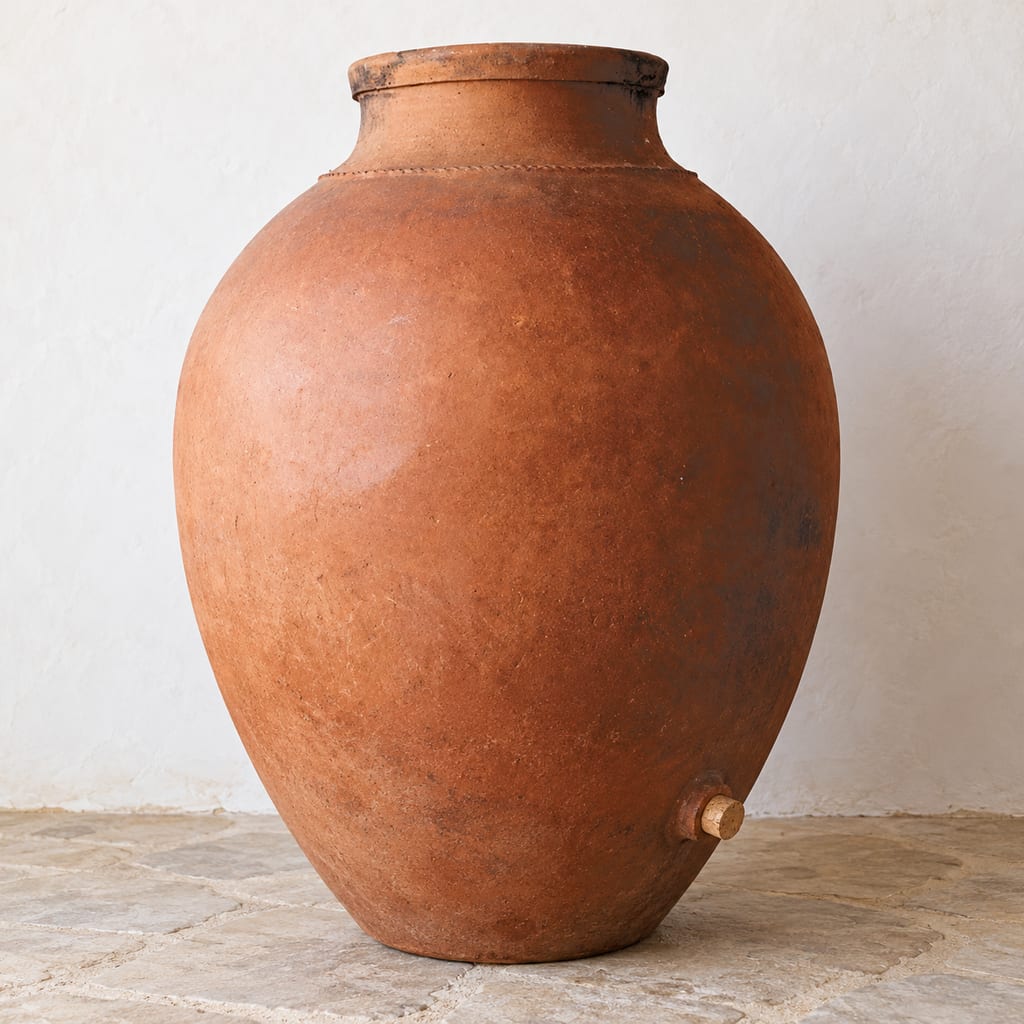
Alentejo wine talha
A large fired-clay jar for Alentejo wine, the talha has a wide mouth for grape-cap management and a low outlet for drawing wine. Its form and lining vary by maker and locality.
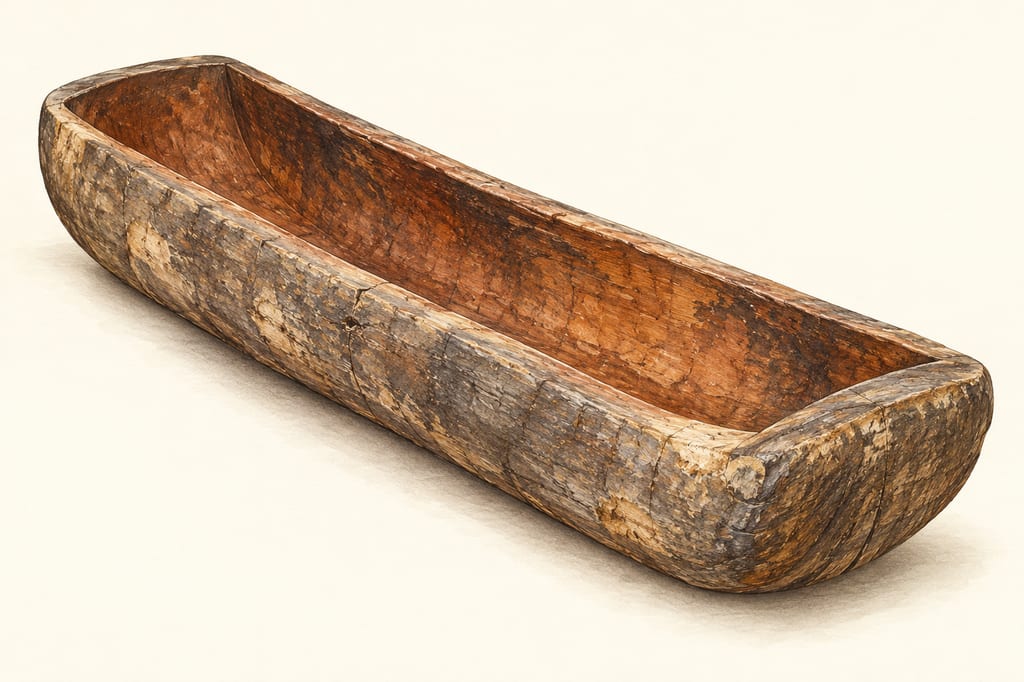
Banana-beer canoe trough
A long, low wooden trough used in parts of East Africa for extracting juice from ripe bananas and, in many documented practices, fermenting banana beer under banana leaves. Plastic barrels are a documented Burundi alternative.
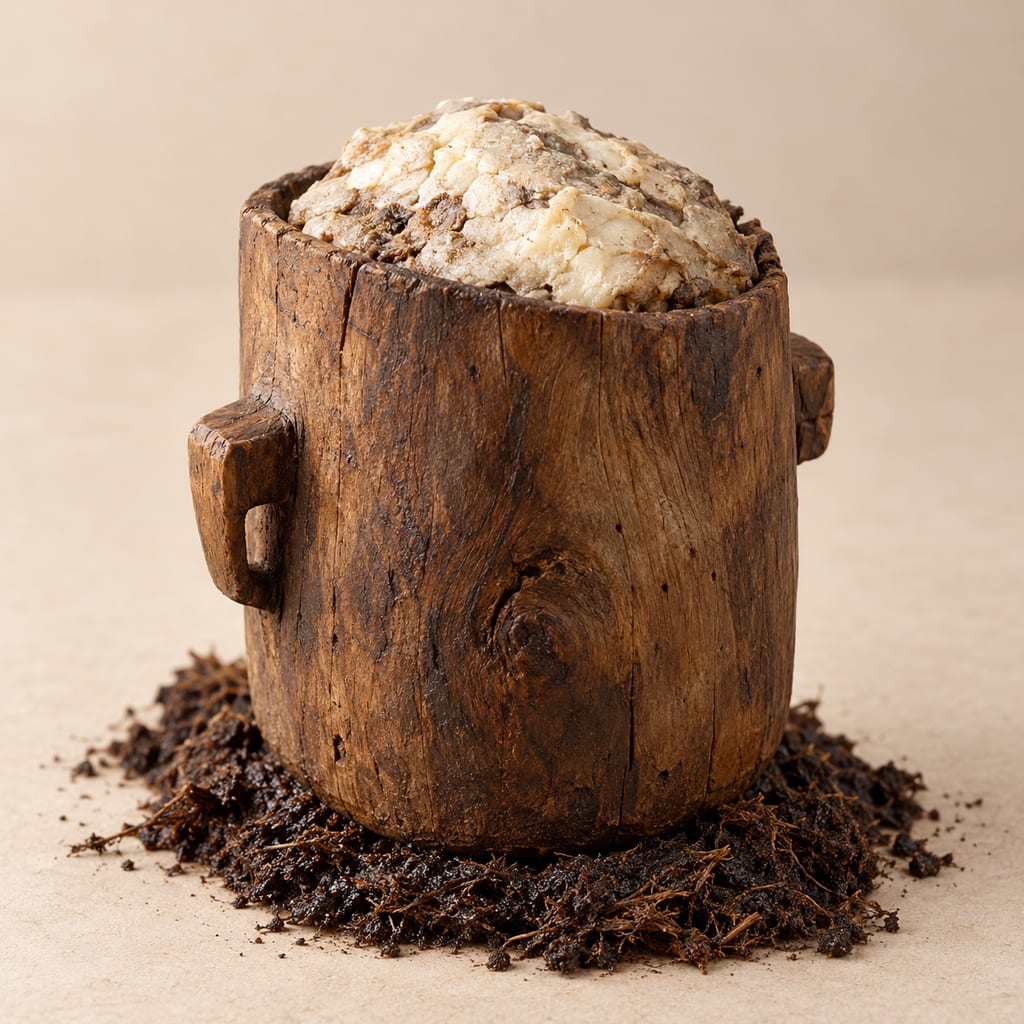
Bog butter
Butter packed into wooden containers and buried in cool, wet peat in Ireland and Scotland, a practice known from finds that may reflect storage, concealment or ritual.
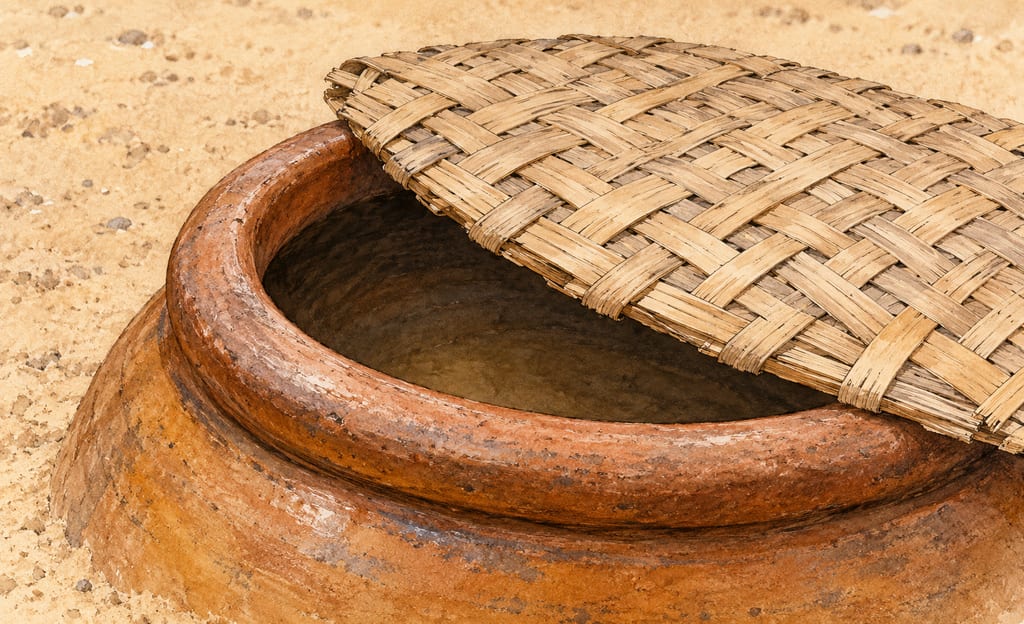
Budu earthen jar
Earthenware jars hold salted fish while budu matures. Southern Thai accounts document bamboo mat, plastic and aluminum, and wood-board covers in different production settings.
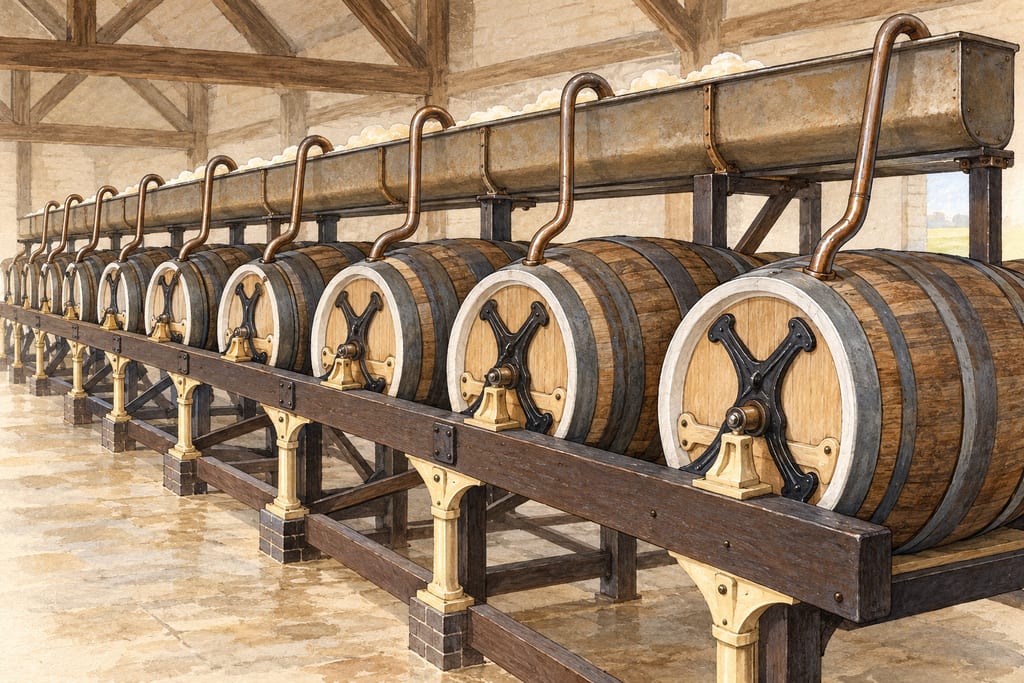
Burton Union
A Burton Union is a connected set of horizontal wooden beer casks, swan-neck pipes and shared troughs. Fermentation lifts yeast-rich foam into the trough; beer drains back to the casks, leaving yeast behind.
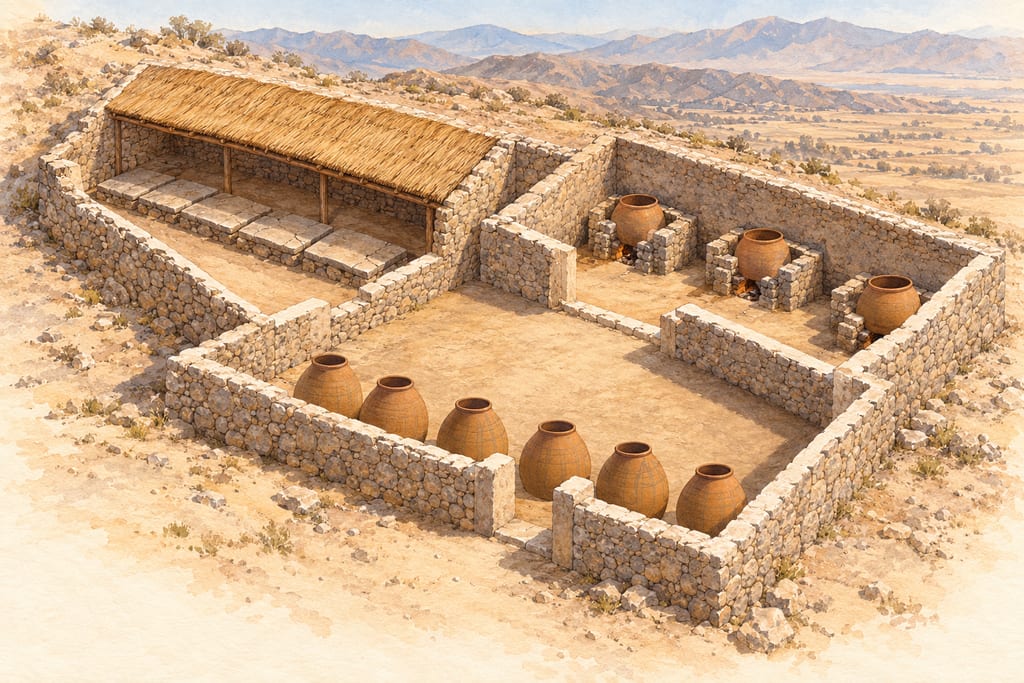
Cerro Baúl brewery
The fixed Wari brewery at Cerro Baúl in southern Peru had a trapezoidal plan with separate milling, boiling and fermentation/storage areas. Excavations document its layout, not a complete construction sequence or dimensions.
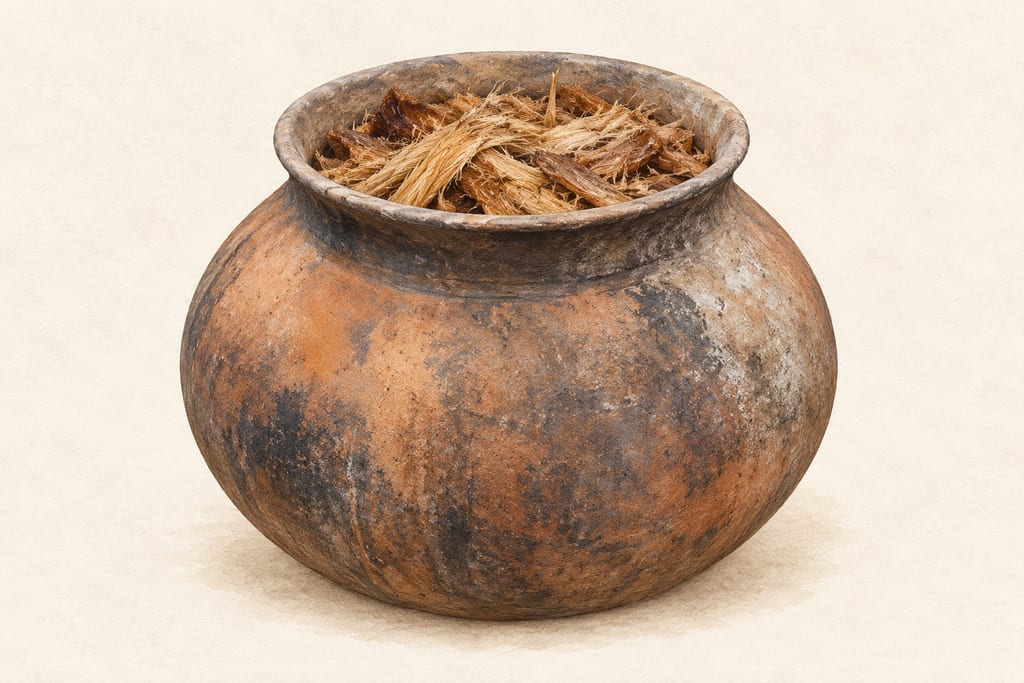
Clay mezcal fermentation pot
An open earthenware vessel for fermenting cooked agave mash before distillation, documented in Mexican mezcal production. It is distinct from the clay pot still used to distil the fermented mash.
Community
No community contributions have been published for this entry yet.
Share what you made
Sign in to contribute. Published comments and photos are free to read.
Sources
Li Liu and colleagues; Journal of Archaeological Science: Reports (2018), record at USF Digital Commons
Fermented beverage and food storage in 13,000 y-old stone mortars at Raqefet Cave, Israel: Investigating Natufian ritual feastingCited in: What survives, and what does not
PNAS 121(51), e2412274121 (2024)
Identification of 10,000-year-old rice beer at Shangshan in the Lower Yangzi River valley of ChinaCited in: What survives, and what does not
Patrick E. McGovern and colleagues; PNAS 101(51), 2004
Fermented beverages of pre- and proto-historic ChinaCited in: What survives, and what does not
Jiajing Wang and colleagues; PNAS 113(23), 2016
Revealing a 5,000-y-old beer recipe in ChinaCited in: What survives, and what does not
Patrick McGovern and colleagues; PNAS 114(48), 2017
Early Neolithic wine of Georgia in the South CaucasusCited in: What survives, and what does not; Buried jars and built vats
Patrick E. McGovern and colleagues; Penn Museum, The Origins and Ancient History of Wine
The Beginnings of Winemaking and Viniculture in the Ancient Near East and EgyptCited in: What survives, and what does not; More vessels: Europe, the Caucasus and West Asia
University of California, Los Angeles, reprinted by ScienceDaily (January 2011)
Chemical analysis confirms oldest wine-making equipment ever foundCited in: What survives, and what does not
Mélanie Salque and colleagues; Nature 493, 522-525 (2013)
Earliest evidence for cheese making in the sixth millennium BC in northern EuropeCited in: What survives, and what does not
The National (AFP), 2021
Oldest brewery may have been discovered in EgyptCited in: What survives, and what does not; More vessels: Europe, the Caucasus and West Asia
The Metropolitan Museum of Art, collection API record
Model Bakery and Brewery from the Tomb of Meketre (20.3.12)Cited in: What survives, and what does not
Electronic Text Corpus of Sumerian Literature, University of Oxford
A hymn to Ninkasi: translationCited in: What survives, and what does not
Michael E. Moseley and colleagues; PNAS 102(48), 2005
Burning down the brewery: establishing and evacuating an ancient imperial colony at Cerro Baúl, PeruCited in: What survives, and what does not; More vessels: Africa, the Americas, Oceania and the Arctic
UNESCO Intangible Cultural Heritage (inscribed 2013)
Ancient Georgian traditional Qvevri wine-making methodCited in: Buried jars and built vats; Reading a picture of a vessel; More vessels: Europe, the Caucasus and West Asia
Jamie Goode, wineanorak.com (5 January 2020)
In Georgia, on the qvevri trail: experiencing the living fossil of wineCited in: Buried jars and built vats; How a vessel changes what is inside it; Looking after a vessel; More vessels: Europe, the Caucasus and West Asia
Smithsonian Magazine, reprinted by Ecokayan
Unearthing Armenia's giant, ancient earthenware (Smithsonian Magazine)Cited in: Buried jars and built vats; More vessels: Europe, the Caucasus and West Asia; Notes on what this account leaves open
Parco Archeologico di Pompei
Villa ReginaCited in: Buried jars and built vats; Reading a picture of a vessel; More vessels: Europe, the Caucasus and West Asia
Dimitri Van Limbergen and Paulina Komar; Antiquity 98(397), 85-101 (2024)
Making wine in earthenware vessels: a comparative approach to Roman vinificationCited in: Buried jars and built vats; More vessels: Europe, the Caucasus and West Asia
Álvaro Rodríguez-Alcántara and colleagues; Zephyrus LXXXII (2018), 149-163
New technological contributions to Roman garum elaboration from chemical analysis of archaeological fish remains from the 'Garum Shop' at Pompeii (I.12.8)Cited in: Buried jars and built vats; Looking after a vessel; More vessels: Europe, the Caucasus and West Asia
Conjunto Arqueológico de Baelo Claudia, on Google Arts & Culture
The Roman city of Baelo Claudia and the secrets of garumCited in: Buried jars and built vats
Inês Vaz Pinto, Ana Patrícia Magalhães and Patrícia Brum; Selo de Mar (Fish & Ships)
An overview of the fish-salting production centre at Tróia (Portugal)Cited in: Buried jars and built vats
Sergio Crusco, Elle Brasil (19 September 2023)
Saiba o que é vinho de talhaCited in: Buried jars and built vats; How a vessel changes what is inside it; Looking after a vessel
Villarrobledo City Council Tourist Office
Centro de Interpretación de la Alfarería Tinajera (English)Cited in: Buried jars and built vats
Symington Family Estates
Vesuvio wineryCited in: Buried jars and built vats; How a vessel changes what is inside it
Sujin Kim and David L. Hu; Journal of the Royal Society Interface (2023), author proof
Onggi's permeability to carbon dioxide accelerates kimchi fermentationCited in: The vessel is part of the recipe; How a vessel changes what is inside it; East and Southeast Asia: jars, fields and barrels; More vessels: East, Southeast and South Asia
The Mala Market
Sichuan's naturally fermented pickles: pao caiCited in: How a vessel changes what is inside it; Logs, rings and the culture that travels; Looking after a vessel
Mariona Gil i Cortiella and colleagues; Molecules 26(3), 554 (2021)
Chemical and Physical Implications of the Use of Alternative Vessels to Oak Barrels during the Production of White WinesCited in: The vessel is part of the recipe; How a vessel changes what is inside it; Glass, steel, concrete and plastic
Giuseppe Licitra and colleagues; Applied and Environmental Microbiology (2007)
Variability of bacterial biofilms of the 'tina' wood vats used in the Ragusano cheese-making processCited in: Wood that remembers; More vessels: Europe, the Caucasus and West Asia
Robert Didienne and colleagues; International Journal of Food Microbiology (2012)
Characteristics of microbial biofilm on wooden vats ('gerles') in PDO Salers cheeseCited in: Wood that remembers; Logs, rings and the culture that travels; More vessels: Europe, the Caucasus and West Asia
Lei Sun and Dennis J. D'Amico; Food Microbiology 120 (2024)
Population dynamics and bidirectional transfer of Listeria monocytogenes and STEC during cheese production in wooden vatsCited in: Wood that remembers
Lei Sun and Dennis J. D'Amico; Food Microbiology 109 (2023)
Characterization of microbial community assembly on new wooden vats for use in cheese productionCited in: Wood that remembers; Looking after a vessel
Jonas De Roos and colleagues; Applied and Environmental Microbiology 85(1) (2019)
Wooden barrels as a source of microorganisms for lambic beer productionCited in: Wood that remembers; Logs, rings and the culture that travels; Looking after a vessel
Louise Vermote and colleagues; International Journal of Food Microbiology 394 (2023)
New insights into the role of key microorganisms and wooden barrels during lambic beer fermentation and maturationCited in: Wood that remembers
Roger Protz, Protz on Beer (27 June 2024)
Burton beast is brewing in BakewellCited in: Wood that remembers
Plzeňský Prazdroj (10 April 2014)
Master coopers demonstrated pitching of barrelsCited in: How a vessel changes what is inside it; Wood that remembers; Looking after a vessel; Glass, steel, concrete and plastic
CooksInfo
Vinaigre d'OrléansCited in: Four layers of containment; How a vessel changes what is inside it; Wood that remembers; Logs, rings and the culture that travels; Looking after a vessel
NIHONMONO
Yamaroku Soy Sauce – handmade soy sauce aged in barrelsCited in: The vessel is part of the recipe; Wood that remembers
Aichi Now (Aichi Prefecture tourism)
Kakukyu Hatcho Miso (Hatcho Miso Village)Cited in: How a vessel changes what is inside it; Wood that remembers
Nofima (Norwegian Institute of Food, Fisheries and Aquaculture Research)
Worth to know about kveikCited in: Four layers of containment; Logs, rings and the culture that travels; More vessels: Europe, the Caucasus and West Asia
UNESCO Intangible Cultural Heritage (inscribed 2019)
Traditional technique of making Airag in Khokhuur and its associated customsCited in: Logs, rings and the culture that travels; More vessels: Europe, the Caucasus and West Asia
Carlsberg Group
Purifying yeastCited in: Logs, rings and the culture that travels; Glass, steel, concrete and plastic
Abdelkader Senoussi and colleagues; International Dairy Journal 119 (2021)
Effects of the number of days and the filling sequence of animal skin-bags used for the traditional production of Algerian Bouhezza raw goat cheeseCited in: Skins, gourds, leaves and straw
Hacène Medjoudj, Mohammed Nasreddine Zidoune and Ali Adnan Hayaloglu; International Journal of Food Properties 20 (2017)
Proteolysis and volatile profile in the Algerian traditional Bouhezza cheese made using raw goat's milkCited in: Skins, gourds, leaves and straw; More vessels: Europe, the Caucasus and West Asia
Jadranka Frece and colleagues; Food Technology and Biotechnology 54(2) (2016)
Microbiological quality and variability of natural microbiota in Croatian cheese maturing in lambskin sacksCited in: Skins, gourds, leaves and straw; More vessels: Africa, the Americas, Oceania and the Arctic
A. A. Hayaloglu and colleagues; Journal of Dairy Science 90 (2007)
Microbiology, biochemistry, and volatile composition of Tulum cheese ripened in goat's skin or plastic bagsCited in: How a vessel changes what is inside it; Skins, gourds, leaves and straw; Glass, steel, concrete and plastic; More vessels: Africa, the Americas, Oceania and the Arctic
Songul Cakmakci and colleagues; World Journal of Microbiology and Biotechnology 24 (2008)
Influence of ripening container on the lactic acid bacteria population in Tulum cheeseCited in: Skins, gourds, leaves and straw; More vessels: Africa, the Americas, Oceania and the Arctic
Paukwa
MursikCited in: Skins, gourds, leaves and straw; More vessels: Africa, the Americas, Oceania and the Arctic
Anneloes E. Groenenboom and colleagues; World Journal of Microbiology and Biotechnology (2020)
Microbial population dynamics during traditional production of Mabisi, a spontaneous fermented milk product from Zambia: a field trialCited in: Skins, gourds, leaves and straw; Glass, steel, concrete and plastic; More vessels: Africa, the Americas, Oceania and the Arctic
Anne Vézina, ProMusa (20 December 2016)
The beer bananas of East AfricaCited in: Skins, gourds, leaves and straw; More vessels: Africa, the Americas, Oceania and the Arctic
Pynhunlang Kharnaior and Jyoti Prakash Tamang; Frontiers in Microbiology 13 (2022)
Metagenomic-Metabolomic Mining of Kinema, a Naturally Fermented Soybean Food of the Eastern HimalayasCited in: Skins, gourds, leaves and straw; More vessels: East, Southeast and South Asia
Ministry of Agriculture, Forestry and Fisheries of Japan, Our Regional Cuisines
Natto (Ibaraki)Cited in: Skins, gourds, leaves and straw; More vessels: East, Southeast and South Asia
Muhammad Erdiansyah and colleagues; Journal of Food Science and Technology 59(1) (2022)
Microbiological quality of tempeh with different wraps: banana leaf versus plasticCited in: How a vessel changes what is inside it; Skins, gourds, leaves and straw; Glass, steel, concrete and plastic
H. T. Duguma and colleagues; Heliyon 9(9) (2023)
Purdue improved crop storage bag for kocho fermentation; Ethiopian traditional fermented food from Enset (Ensete ventricosum)Cited in: Skins, gourds, leaves and straw; Glass, steel, concrete and plastic
Guida Michelin Italia (feature)
Il lardo di ColonnataCited in: Salt, stone and the curing room; More vessels: Europe, the Caucasus and West Asia
LoveVDA (Valle d'Aosta regional tourism)
Lardo di Arnad DOPCited in: Salt, stone and the curing room
Dissapore (22 October 2020)
DOP: la colatura di alici di Cetara diventa denominazione di origine protettaCited in: Four layers of containment; Salt, stone and the curing room; More vessels: Europe, the Caucasus and West Asia
Livsmedelsverket (Swedish Food Agency), Kontrollwiki
Surströmming - Princip 2 - Identifiera kritiska styrpunkterCited in: How a vessel changes what is inside it; Salt, stone and the curing room
La Gazzetta del Gusto
Viaggio tra le eccellenze d'Italia: il formaggio di Fossa di Sogliano DOPCited in: How a vessel changes what is inside it; Looking after a vessel; Salt, stone and the curing room
Institut national de l'origine et de la qualité (INAO)
Roquefort (AOP)Cited in: Four layers of containment; How a vessel changes what is inside it; Salt, stone and the curing room
Consorzio del Prosciutto di Parma
Making Parma HamCited in: How a vessel changes what is inside it; Salt, stone and the curing room
UNESCO Intangible Cultural Heritage (inscribed 2013)
Kimjang, making and sharing kimchi in the Republic of KoreaCited in: East and Southeast Asia: jars, fields and barrels; More vessels: East, Southeast and South Asia
NIHONMONO
The manufacturing process will remain unchanged for a hundred years. Sakamoto's Kurozu, a gift from nature / Kirishima City, Kagoshima PrefectureCited in: East and Southeast Asia: jars, fields and barrels; More vessels: East, Southeast and South Asia; Notes on what this account leaves open
Niigata University Sakeology Center
“Traditional knowledge and skills of sake-making with koji mold in Japan” as UNESCO Intangible Cultural HeritageCited in: East and Southeast Asia: jars, fields and barrels; More vessels: East, Southeast and South Asia
Sophie Pham, Delightful Plate (2019, updated 2024)
Visiting Red Boat Factory & the Art of Making Fish Sauce in Phu QuocCited in: East and Southeast Asia: jars, fields and barrels; More vessels: East, Southeast and South Asia; Notes on what this account leaves open
JIRCAS Thai Fermented Foods Database
Plaa-raaCited in: How a vessel changes what is inside it; East and Southeast Asia: jars, fields and barrels; More vessels: East, Southeast and South Asia
JIRCAS Thai Fermented Foods Database
BuduCited in: East and Southeast Asia: jars, fields and barrels; More vessels: East, Southeast and South Asia
JIRCAS Thai Fermented Foods Database
MamCited in: East and Southeast Asia: jars, fields and barrels; More vessels: East, Southeast and South Asia
The Metropolitan Museum of Art, collection API record (object 310520)
Urpu (jar)Cited in: The Americas, the Pacific and the Arctic; Reading a picture of a vessel; More vessels: Africa, the Americas, Oceania and the Arctic
Cleveland Museum of Art
Beer Container (Máhuetan), c. 1940 (1992.129)Cited in: The Americas, the Pacific and the Arctic; More vessels: Africa, the Americas, Oceania and the Arctic
Instituto Mexicano de la Propiedad Industrial, Diario Oficial de la Federación (10 February 2026)
Declaración de protección de la indicación geográfica Pulque de TlaxcalaCited in: The Americas, the Pacific and the Arctic; Reading a picture of a vessel; More vessels: Africa, the Americas, Oceania and the Arctic
Omar Muñoz, Mezcalistas (21 January 2025)
How fermentation tanks affect the flavor of mezcalCited in: The Americas, the Pacific and the Arctic; Reading a picture of a vessel; More vessels: Africa, the Americas, Oceania and the Arctic
Tamil Nadu Agricultural University, TNAU Agritech Portal
Post Harvest Technology :: Plantation Crops :: CocoaCited in: How a vessel changes what is inside it; The Americas, the Pacific and the Arctic; More vessels: Africa, the Americas, Oceania and the Arctic; Notes on what this account leaves open
Terry W. Henkel; Mycologia 97(1) (2005)
Parakari, an indigenous fermented beverage using amylolytic Rhizopus in GuyanaCited in: The Americas, the Pacific and the Arctic; More vessels: Africa, the Americas, Oceania and the Arctic
National Tropical Botanical Garden
Ethnobotany (Breadfruit)Cited in: The Americas, the Pacific and the Arctic; More vessels: Africa, the Americas, Oceania and the Arctic
Bishop Museum
Ethnology database: bowlCited in: The Americas, the Pacific and the Arctic; More vessels: Africa, the Americas, Oceania and the Arctic
Brit Asmussen; Technical Reports of the Australian Museum Online 23 (2011)
Changing perspectives in Australian archaeology, part X: There is likewise a nut... a comparative ethnobotany of Aboriginal processing methods and consumption of Australian Bowenia, Cycas, Lepidozamia and Macrozamia speciesCited in: The Americas, the Pacific and the Arctic; More vessels: Africa, the Americas, Oceania and the Arctic
US Centers for Disease Control and Prevention
Alaska Native foods and botulismCited in: The vessel is part of the recipe; How a vessel changes what is inside it; The Americas, the Pacific and the Arctic; Glass, steel, concrete and plastic; More vessels: Africa, the Americas, Oceania and the Arctic
CDC, Morbidity and Mortality Weekly Report
Botulism outbreak associated with eating fermented food, Alaska, 2001Cited in: How a vessel changes what is inside it; The Americas, the Pacific and the Arctic; More vessels: Africa, the Americas, Oceania and the Arctic
Sigrún Jensen and colleagues; Heliyon 9(11) (2023)
Unlocking the microbial diversity and the chemical changes throughout the fermentation process of "hákarl", Greenland sharkCited in: The Americas, the Pacific and the Arctic; More vessels: Africa, the Americas, Oceania and the Arctic
Andrea Osimani and colleagues; Food Microbiology 82 (2019)
Microbiota of ready-to-eat hákarlCited in: The Americas, the Pacific and the Arctic; More vessels: Africa, the Americas, Oceania and the Arctic
Federica Cardinali and colleagues; International Journal of Food Microbiology 450 (2026)
Novel insights into hákarl: A deep dive into the microbiological and physico-chemical features of Iceland's traditional fermented sharkCited in: The Americas, the Pacific and the Arctic; More vessels: Africa, the Americas, Oceania and the Arctic
US Department of Agriculture, Food Safety and Inspection Service (2023)
FSIS Ready-to-Eat Fermented, Salt-Cured, and Dried Products Guideline (FSIS-GD-2023-0002)Cited in: How a vessel changes what is inside it
A. Çelik and colleagues; Journal of Food Science 91 (2026)
A Sustainable and Alternative Packaging Approach for EU PDO Erzincan Tulum Cheese Affecting Food Safety, Proteolysis, Lipolysis, and Volatilome in Cheese: Sausage CasingCited in: Glass, steel, concrete and plastic
North Abydos Archaeology Expedition, Abydos Archaeology blog (2022)
What Would King Narmer Do with 100,000 Pints of Beer?Cited in: What survives, and what does not; More vessels: Europe, the Caucasus and West Asia
Associated Press via NBC News (February 2021)
Archaeologists unearth ancient beer factory in EgyptCited in: What survives, and what does not; More vessels: Europe, the Caucasus and West Asia
Gaps
- No Caucasian or Armenian tradition of making garum in buried jars is attested; the buried-jar evidence concerns wine.
- Most early containers of skin, wood, bark, leaves and fibre have not survived, so how widely they were used before pottery is unknown.
- The Areni-1 basin and vat are interpreted as a pressing and fermentation installation from their arrangement and residues; the function is an interpretation.
- The Göbekli Tepe limestone vessels' beer evidence is preliminary, because oxalate also forms in other cereal processing.
- Whether the 1621 date sometimes given for Norwegian yeast logs refers to a surviving object is unresolved.
- The Abydos brewery's capacity has two published estimates, about 22,400 litres in 2021 and close to 50,000 litres per batch in 2022, because excavation was still extending the structures.
- Whether clay, wood or skin vessels change a ferment more than the process around them has rarely been tested directly; the few controlled comparisons (onggi, mabisi, Sauvignon Blanc vessels, tella jars) apply only to their conditions.
- Pohnpei's stone-lined pits are identified as probable breadfruit fermentation features; a depression alone cannot prove the use.
Updated 2026-10-27