A long trough with two jobs
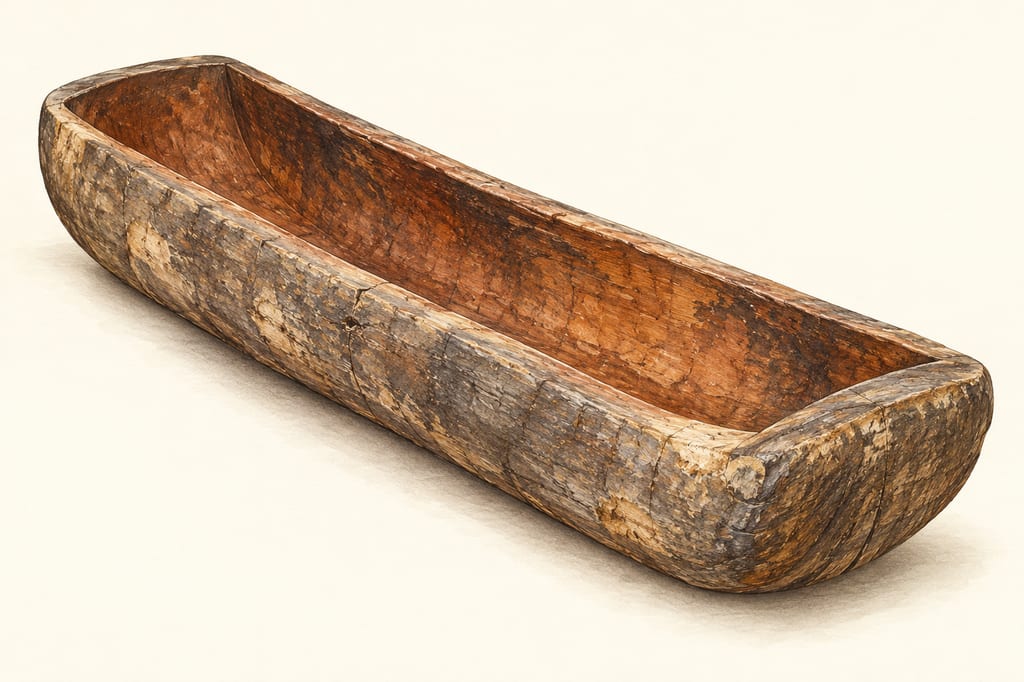
The banana-beer trough is a low, elongated wooden vessel with an open top and a canoe-like profile. It is an object used at a work site, not a pit in which bananas ripen and not a transport jerrycan. The photographic record from North Kivu shows the trough long enough for people to work along its length, with a deep hollow that retains pulp and liquid during extraction.
The available sources do not give its dimensions, capacity, wood species, joinery or maker. The canoe comparison describes its shape; it does not establish that the trough is a boat or that every example is carved in an identical way.
Sources for this section
Extraction before fermentation
The trough first receives peeled bananas. Brewers knead the fruit with spear grass until juice is extracted; the grass acts as a fibrous working material during this physical separation. The juice is filtered, diluted with water and combined with roasted red sorghum. These stages explain why the vessel is broad and open: the source documents hands-on kneading and juice collection, rather than a sealed container used only for ageing.
Fermentation is a later use of the same vessel in many accounts. The vessel is covered with banana leaves. The documentation does not isolate the effect of the wood, leaves, vessel depth or exposure on the fermentation, so none should be treated as a proven microbial control or flavour mechanism. It also does not provide a universal time, temperature, capacity or safety limit for this vessel.
Sources for this section
A regional form, not a universal kit
ProMusa documents banana-beer practices in Uganda, Tanzania, Burundi, Rwanda and the Democratic Republic of the Congo. Names for the beverages include urwagwa or urwaga and lubisi, but those names do not imply one uniform recipe or one vessel everywhere. In Burundi, plastic barrels are a documented alternative for fermentation; the wooden canoe trough should therefore be understood as a regional equipment form rather than a required vessel for all East African banana beer.
Construction, purchase, cleaning and storage instructions remain undocumented in the consulted material. The sources give no capacity or measurements. A reader comparing or sourcing one should treat those details as unknown rather than infer a standard size from the canoe-like shape.
Sources for this section
History
ProMusa's 2016 account documents continuing banana-beer practices in rural East Africa and describes a traditional canoe-shaped brewing vessel. This establishes a date by which the form was documented, not when it originated.
Equipment details
CapacityNo capacity or batch volume is reported in the inspected sources.
SizeNo length, width or height is reported in the inspected sources.
PowerHand or animal power The documented work is manual: banana pulp is kneaded with spear grass. No powered components are described.
How you get oneNot established The consulted sources identify the wooden trough but do not say who makes it, how it is obtained, or its present availability.
CareThe consulted documentation does not give cleaning, seasoning, storage or repair instructions.
Made of
- Wood — Vessel body
The source describes a canoe-shaped wooden trough; it does not identify the wood species or construction details.
Places
East Africa
Documented preparation · Region evidenceRegional scope of the banana-beer account; it does not claim that every country uses a wooden trough, since Burundi plastic barrels are documented.
North Kivu
Documented preparation · Region evidenceThe photograph records a wooden trough used in banana-beer preparation in North Kivu; it does not establish the trough's origin or region-wide prevalence.