A brewery set, not a single barrel
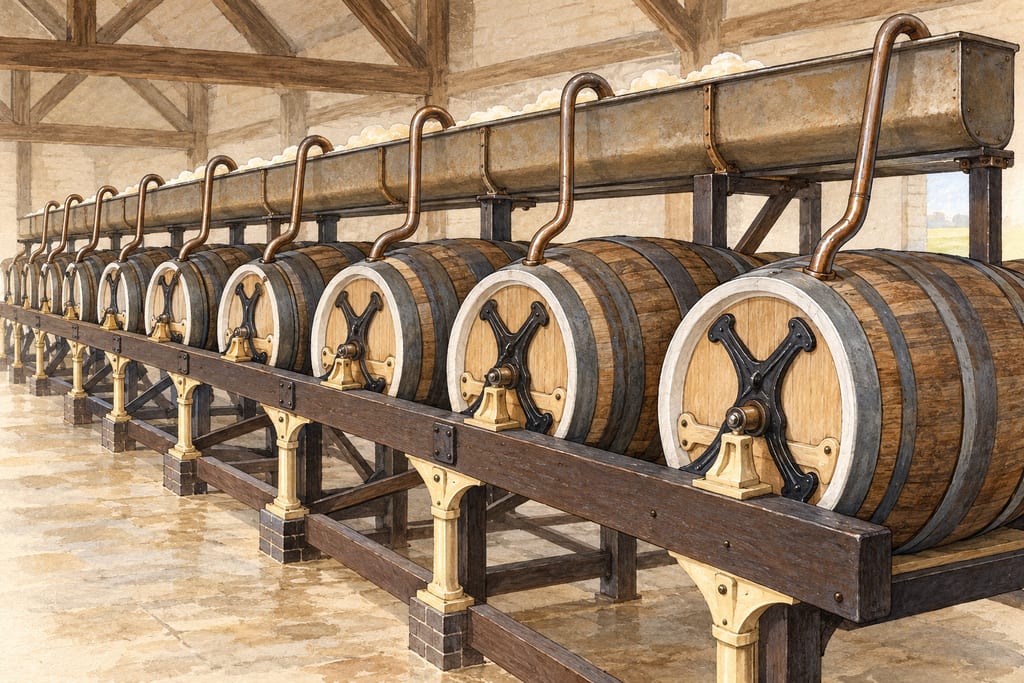
The Burton Union is a working arrangement of horizontal wooden casks held in a frame and connected by pipes to troughs above. It is the repeated system that matters: each cask joins a shared route for rising yeast and returning beer. In the classic description, a curved swan-neck pipe rises from each cask into the overhead trough. Some installations also use feeder pipes to return settled beer to individual casks. The casks, connections, trough and working space form one piece of brewery equipment.
This design took shape in the industrial brewing world of Burton-upon-Trent during the nineteenth century. It is often linked to Peter Walker and his patent for beer-cleansing apparatus, but brewing historian Paul Bayley distinguishes the earlier patent from the mature Union arrangement and notes that the system's defining features accumulated over time. An 1889 account describes casks connected in sets, with bent copper swan-neck tubes carrying fermentation yeast into a trough. That is a firm description of an established system, not proof of a single moment of invention.
The name points to the way the casks are joined in union. Burton brewers adopted the system as they sought clear, bright pale ales. Later accounts describe its spread beyond Burton to other British brewing centres and farther afield. Individual sets differed in size and layout, so an illustration or photograph of one installation should not be treated as the dimensions of every Union.
Sources for this section
How the circulation works
Beer is transferred into the wooden casks, sometimes after fermentation has already begun in another vessel. As fermentation produces carbon dioxide and a rising head of yeast-rich foam, the pressure and movement carry the froth up the swan-neck pipes. The trough gives foam and liquid room to separate. Yeast collects there while beer drains back towards the casks, by gravity in the documented arrangement. The brewer can then draw off beer that has shed much of its suspended yeast.
This is not simply an open barrel with an airlock. The swan necks, upper trough and return route make the system recognisable and give fermentation overflow a managed path. A contemporary Thornbridge account describes transferring half of a 10,000-litre Jaipur brew into its Union around fourteen hours after brewing; it fermented there for about four days, then was pumped into a separate racking tank. The beer was later primed, fined and conditioned in serving casks. Those timings describe one 2024 batch, not a fixed schedule for all beers or Union sets.
The Union also makes yeast behaviour visible to the brewer: the foam rises from the pipes into the trough, where its level and movement can be watched. Historical brewing accounts describe the apparatus as a way of cleansing beer of excess yeast. The system does not make the beer sterile, and the residual yeast is part of later cask conditioning when a beer is prepared for that stage.
Sources for this section
Scale, materials and maintenance
Accounts of historical sets report large oak casks, with one source giving 150 imperial gallons per cask. That figure is an individual-cask capacity, not the capacity of a whole set: breweries installed different numbers of casks, and the sources inspected here do not state a total capacity for the section Thornbridge received. No overall height, footprint or diameter is published for this equipment record, so those dimensions are left unstated.
Wooden casks depend on skilled coopering and regular care. Thornbridge reports that its inherited casks date from 1990 and describes the system as labour-intensive; before accepting the equipment, the brewery had to consider whether it could clean the casks and pipework properly. That practical burden helps explain why a Union is not a plug-in alternative to a modern fermentation tank. It needs room for the cask bank, elevated troughs, access and handling, as well as staff who can maintain the equipment.
Sources for this section
A system returned to use
When Carlsberg Marston's decided to retire its remaining Burton Union system in 2024, Thornbridge accepted and restored a section at its Riverside brewery in Bakewell. The transfer preserved a functioning set and its brewing practice, rather than merely placing old casks on display. Thornbridge's first reported brew in the system was Jaipur; it later described using the Union for additional beers and collaborations. Its account says the resulting Union-fermented Jaipur tasted softer and more rounded than the conventional version, while acknowledging that the difference was difficult to put into words. That is a brewer's tasting report about a specific beer, not a guaranteed effect of every Union set.
Sources for this section
History
Burton Union sets became characteristic of nineteenth-century brewing around Burton-upon-Trent. Their full development was gradual: a related patent is often associated with Peter Walker, but the historical literature cautions that the patent does not establish a single inventor or the complete mature system. A surviving set returned to brewery use at Thornbridge in 2024.
Equipment details
CapacityPublished accounts give capacities for individual historical casks, but the number of casks varies by set and Thornbridge does not publish the total capacity of its transferred section.
SizeNo inspected source gives dimensions for a complete Union set.
PowerNo power Fermentation pressure carries foam and beer up the swan-neck pipes; the return flow is by gravity. The documented circulation does not rely on a powered pump.
How you get oneBought from a maker A Union set is a brewery-scale assembly of coopered casks and fitted pipework, not a standard household product. Thornbridge received part of Marston's set through a brewery transfer in 2024.
CareThe casks require regular cleaning and coopering; Thornbridge says the system takes substantial labour and that its team assessed whether they could clean it properly before installation. No universal cleaning schedule is stated.
Made of
- Oak — Cask staves and heads
The casks are described as oak in historical accounts; Thornbridge inherited oak casks dating from 1990. - Copper and other metal — Swan-neck pipes, troughs, supports and connections
An 1889 description quoted by Bayley specifies bent copper swan-neck tubes; Thornbridge's revived set uses metal fittings and a stainless-steel collection trough visible in its photographs.
Limits
A Union set needs substantial brewery floor space and ongoing manual attention; Thornbridge made room by moving its bottling line, and labour demands contributed to the Burton system's retirement.
Source →Places
Burton-upon-Trent
Historical attestation · Locality evidenceHistoric setting of the system; not a claim that every later set was made there.
Bakewell
Modern adaptation · Locality evidenceThornbridge installed and brewed with a transferred section at its Riverside brewery.