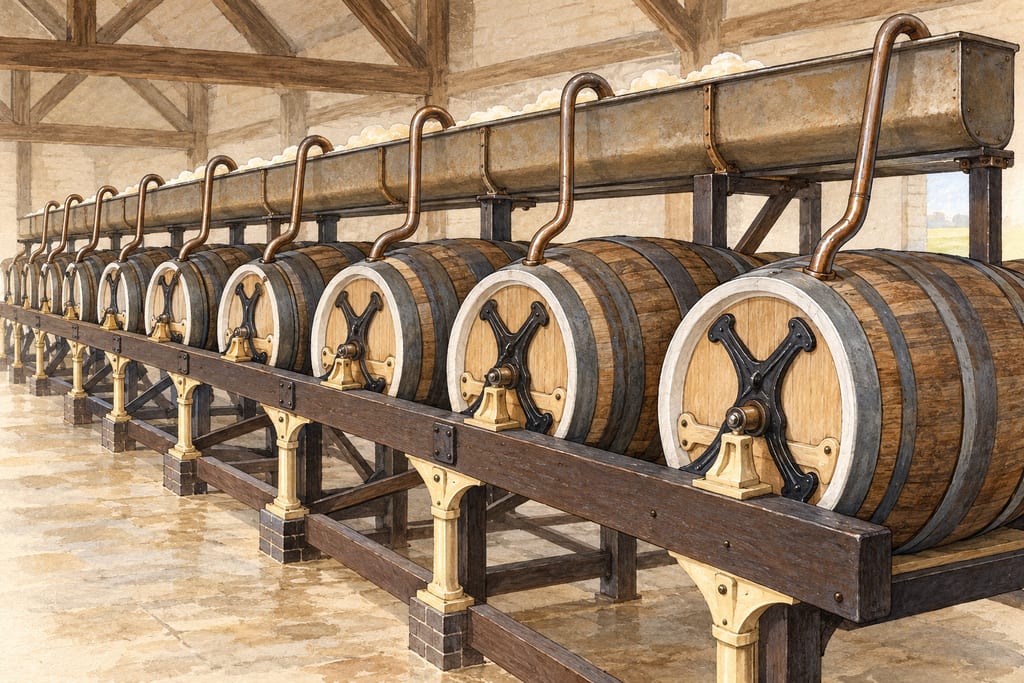
Burton Union
A Burton Union is a connected set of horizontal wooden beer casks, swan-neck pipes and shared troughs. Fermentation lifts yeast-rich foam into the trough; beer drains back to the casks, leaving yeast behind.
 FermenteaWhere food goes to change
Equipment · Stoneware bottles
A late nineteenth-century stoneware bottle for ginger beer, represented by an Aberdeen museum object dated 1850–1899. It documents beverage packaging, not a fermentation vessel or a universal bottle design.
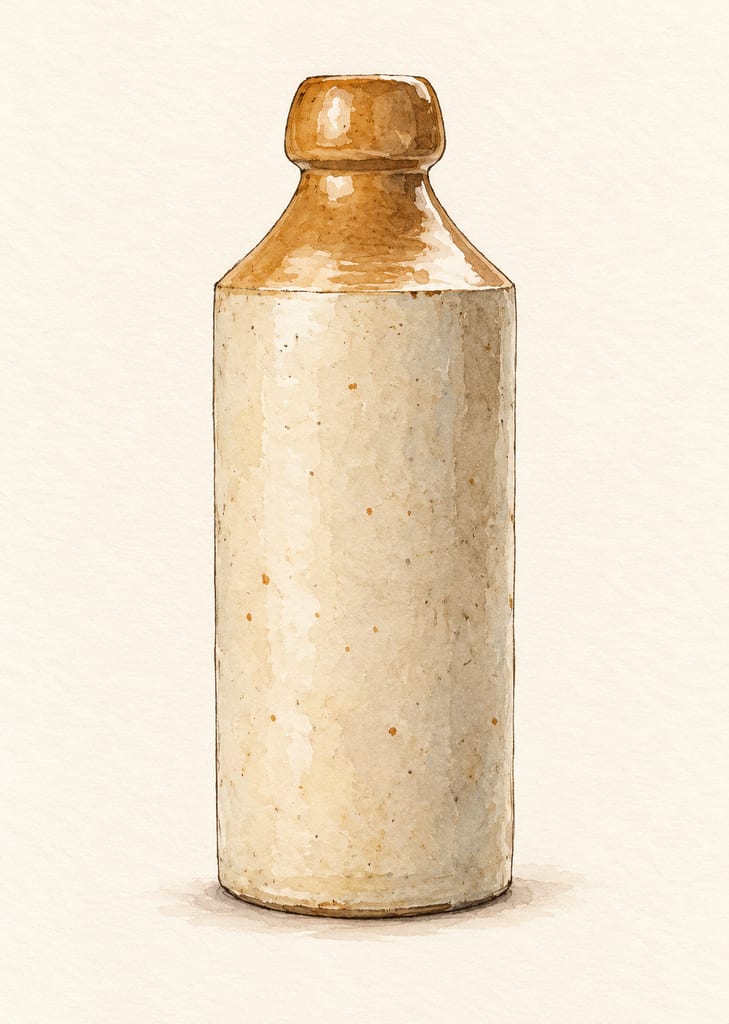
Aberdeen Art Gallery and Museums records a stoneware ginger-beer bottle made by Brook And Hale and dates it 1850–1899. The object is 17 centimetres high and 6.9 centimetres in diameter. Its photograph shows a tall, narrow bottle with a straight-sided body, sloping shoulder and short neck. A transfer on the bottle names Lancaster, but the record does not locate the pottery or say where the drink was filled. The place on the mark should not be expanded into an unsupported factory address.
The object is best understood as packaging for a drink. The museum catalogue calls it a ginger-beer bottle, but does not describe it as a vessel for fermenting the beverage. A bottle used to hold or sell a finished drink is not automatically equivalent to a primary fermentation jar, and this particular catalogue gives no process instructions.
The museum notes that ginger-beer consumption grew greatly during the nineteenth century. It says the drink was sometimes considered safer than local water and that its refreshing non-alcoholic properties appealed to the expanding temperance movement. Those statements explain the drink’s cultural appeal; they do not measure alcohol in every batch or prove how this individual bottle was used.
Other collections preserve related bottles, not identical ones. The Science Museum Group describes a separate stoneware bottle for Coles home-brewed ginger beer, dated 1890–1920, with a cork that may not be original. This shows that bottling and closure details varied across makers and objects.
The Aberdeen catalogue specifies stoneware and supplies exact dimensions for this bottle. Another London Museum example is described as a half-pint cylindrical stoneware bottle with a brown salt glaze and a blob top; its stopper is missing. That comparison helps place the Aberdeen bottle among ceramic ginger-beer packaging, but it cannot supply missing details about its finish, closure, capacity or pressure tolerance.
A stoneware bottle is materially and historically distinct from a modern glass or plastic bottle, and from a wide fermentation jar. The surviving surface and maker’s transfer help identify the Aberdeen example. They do not establish whether its mouth took a cork, wire closure or another stopper, nor whether it was designed for carbonation pressure.
The record documents a late nineteenth-century container associated with ginger beer, alongside a broader British history of increasing consumption and temperance appeal. It does not give a recipe, fermentation stage, alcohol content, carbonation level, cleaning method or reuse practice for this object. Those details should remain unknown unless another record identifies them.
The existing ginger-beer-plant preparation link points to a separate candidate method. It is a useful process connection, not evidence that the Aberdeen bottle was used with that culture or for primary fermentation. Treat the bottle as a specific historical packaging object rather than a tested modern fermentation vessel.
The museum identifies this example as a ginger-beer bottle, names Brook And Hale as manufacturer and gives its material and dimensions. Its history belongs to a period when ginger beer became more widely consumed; the museum says temperance groups were drawn to its refreshing non-alcoholic properties. That general cultural description does not establish the alcohol content or brewing process of every drink sold in such a bottle.
This is evidence for a specific stoneware beverage bottle. The museum record does not establish that it held active fermentation, was pressure-rated, or used a particular closure.
Source →Ginger beer’s nineteenth-century appeal to temperance groups does not establish that every historical batch was alcohol-free; this object record reports no alcohol measurement.
Source →The cork and stopper details in other museum records belong to different bottles and do not establish the closure of object ABDMS008726.
Source →The museum photograph shows a transfer naming Lancaster. The catalogue identifies Brook And Hale as manufacturer but does not establish the pottery or bottling site; this records a marked place, not a verified works address.
Aberdeen Art Gallery and Museums catalogues and displays the bottle; this is a collection location, not a claim that it was made or used there.
A Burton Union is a connected set of horizontal wooden beer casks, swan-neck pipes and shared troughs. Fermentation lifts yeast-rich foam into the trough; beer drains back to the casks, leaving yeast behind.
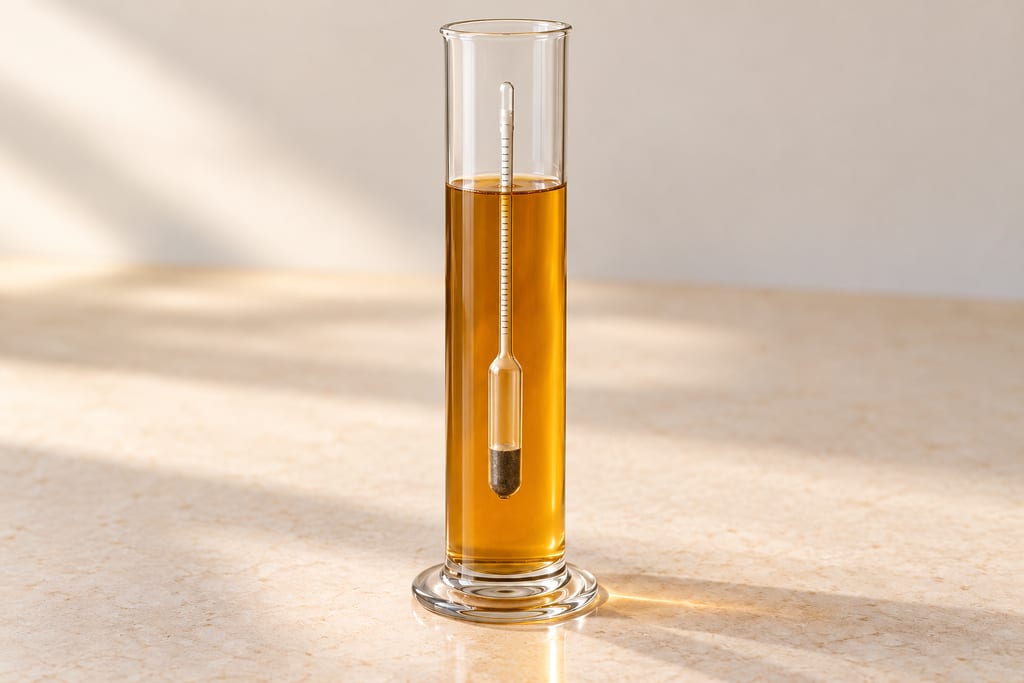
A hydrometer floats in liquid and uses its weighted body's depth to indicate density. In brewing, readings track changing gravity, not every dissolved substance or kombucha alcohol.
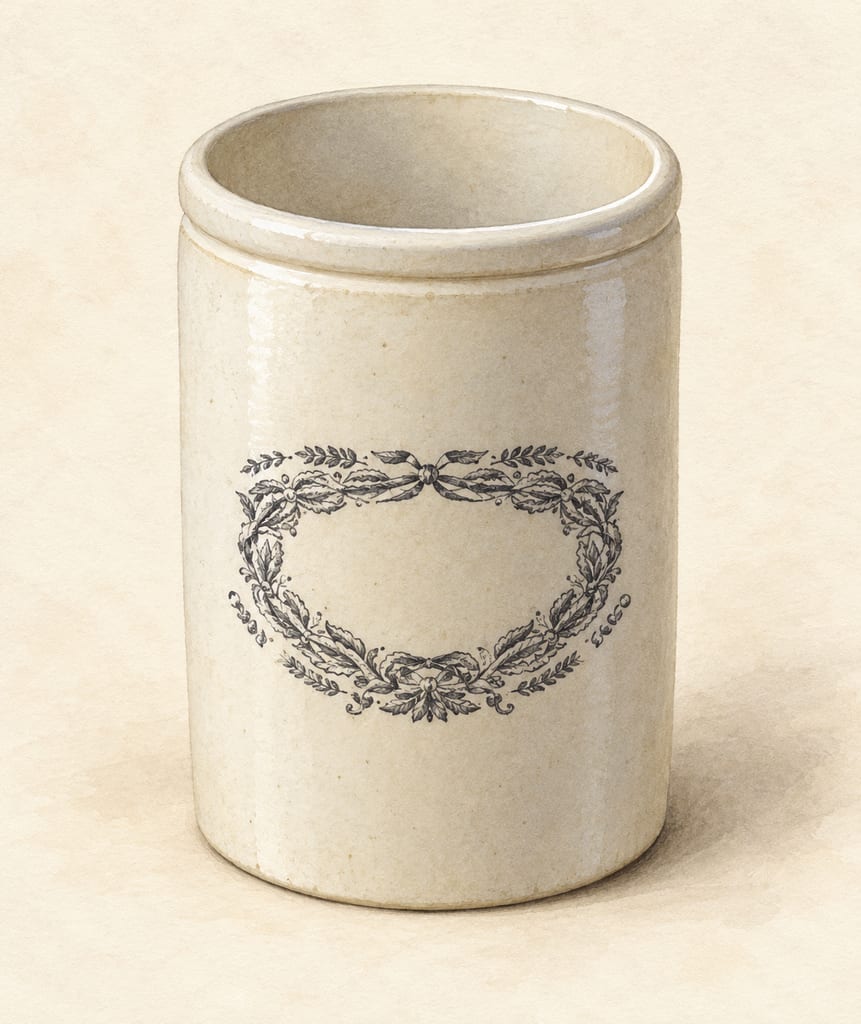
Keiller-branded stoneware jars were commercial packages for Dundee marmalade. Collections show cylindrical forms with printed marks; sources distinguish the Dundee brand from documented Maling manufacture in Newcastle.
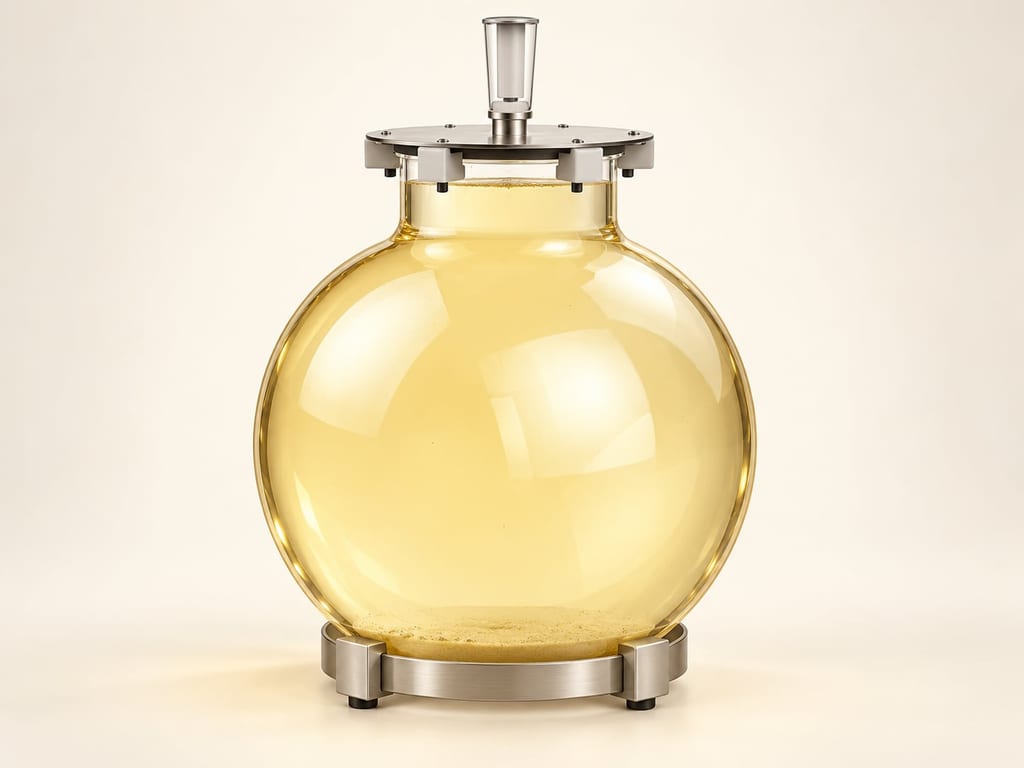
A large, transparent, spherical borosilicate-glass vat designed for modern wine fermentation and maturation. The 220-litre Wineglobe model has a wide neck, fitted lid and support; its use and fittings vary by model.
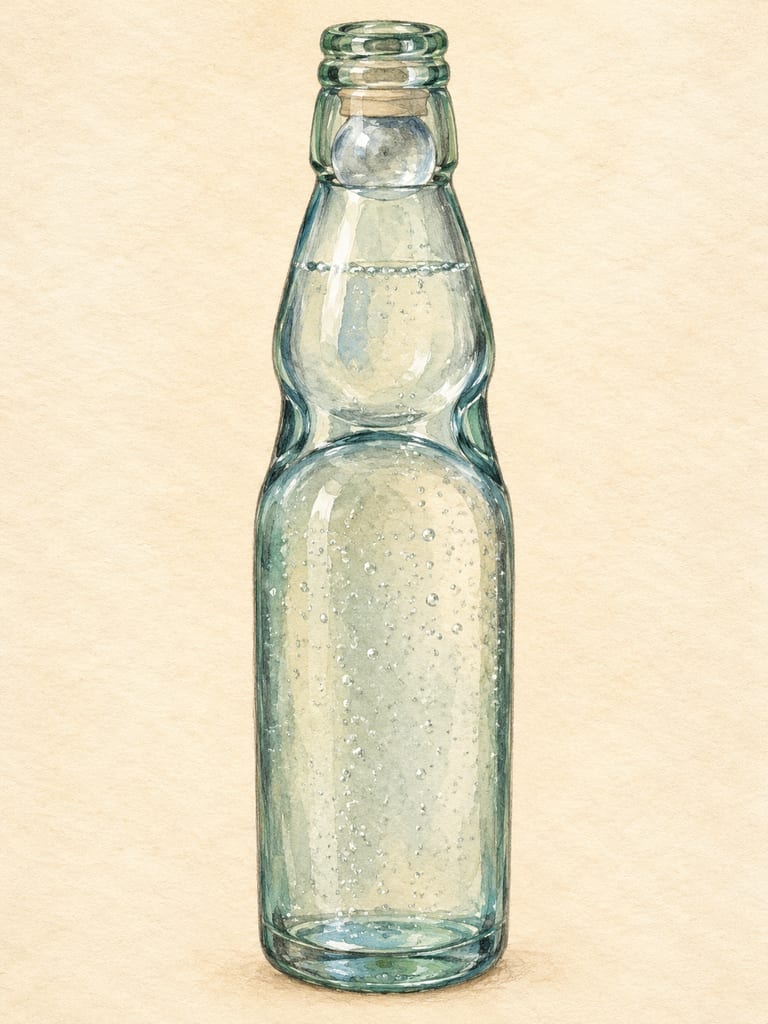
A marble-stoppered bottle is a glass carbonated-drink bottle sealed by a glass marble pressed against a rubber washer. Its Codd neck holds the marble at the mouth when sealed and gives it a side pinch after opening.
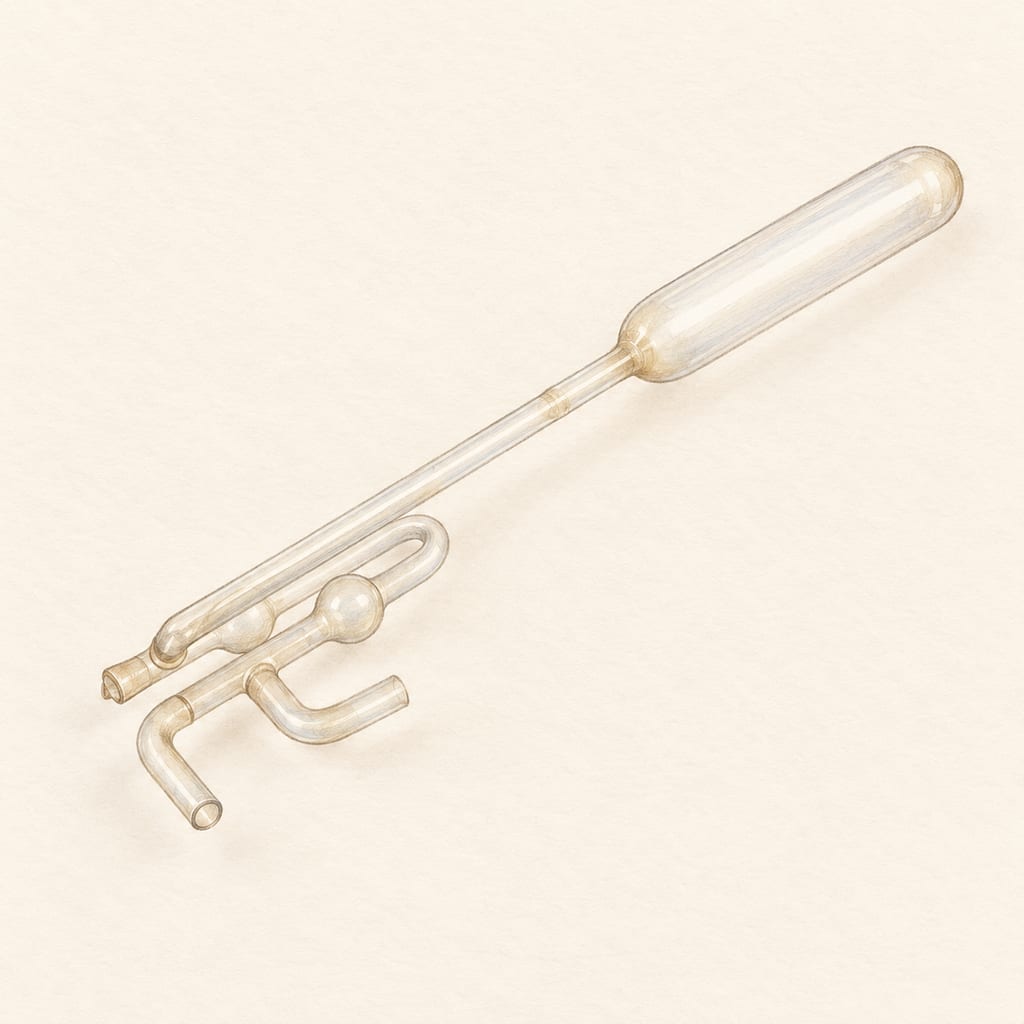
A thermostat senses temperature and regulates heating or cooling to a chosen condition. It may be built into an appliance or supplied as a separate controller; a sensor reading describes its measured point, not every part of a batch.

A Cap-Pelé boucanière is an Acadian herring-smoking building. The documented Willie Niles example is a one-storey wood-frame structure with a ridge smoke vent and interior bays for hanging fish-bearing cannes.

Achcharu is a family of Sri Lankan vinegar pickles made with mixed vegetables or seasonal fruit and a piquant spice dressing. This version is a quick, refrigerated, non-fermented mixed-vegetable pickle.

The acocote is a long, hollowed and dried gourd used to draw aguamiel from a mature maguey. It is a harvesting tool: the sap is transferred to a separate vessel before it ferments into pulque.

Adrak murabba preserves young ginger in sugar syrup, a sweet South Asian preparation recorded in Indian cookery and food-processing sources.

Parkia biglobosa seeds are fermented into regional West African seasonings, including nététou, iru, dawadawa and soumbala. The yellow fruit pulp is a separate food, and names and methods vary by place.

Japanese reddish-brown vinegar from sake lees matured about three years, turned to vinegar by acetic bacteria; the vinegar of Handa and Edomae sushi rice.

A refined common-wheat flour blended for a broad range of baking; its protein and behavior vary with wheat, milling and market.

The almond mushroom, Agaricus subrufescens, was cultivated in eastern North America in the 1800s, lost its market, and returned as a cultivated mushroom from Brazil, where it is grown under several names.
No community contributions have been published for this entry yet.
Sign in to contribute. Published comments and photos are free to read.
Aberdeen Art Gallery and MuseumsObject record · Material · Form · Date · Use · Geography
Ginger Beer Bottle, object ABDMS008726The catalogue identifies a stoneware ginger-beer bottle made by Brook And Hale, dates it 1850–1899 and gives dimensions of 17 cm high by 6.9 cm diameter.
The museum says nineteenth-century ginger-beer consumption increased and its refreshing non-alcoholic properties appealed to temperance groups; this is context, not a measurement of alcohol in this bottle’s contents.
Cited in: A named bottle, not a generic fermenter; Ginger beer and nineteenth-century temperance; Stoneware form and the limits of comparison; What the bottle tells us—and what it leaves open
Science Museum GroupComparative object · Bottling · Closure · Limits
Stoneware bottle for Coles Ginger Beer, object 1998-7116A separate stoneware Coles ginger-beer bottle is dated 1890–1920 and its description says the cork may not be original; it demonstrates a related but distinct bottle and uncertain closure.
Cited in: Ginger beer and nineteenth-century temperance
London MuseumComparative object · Form · Trade · Limits
Bottle, ginger beer bottle, object 2006.51A London Museum example dated 1890–1900 is described as a half-pint cylindrical stoneware bottle with brown salt glaze and a blob top; its stopper is missing. Its details should not be generalized to the Aberdeen object.
Cited in: Stoneware form and the limits of comparison