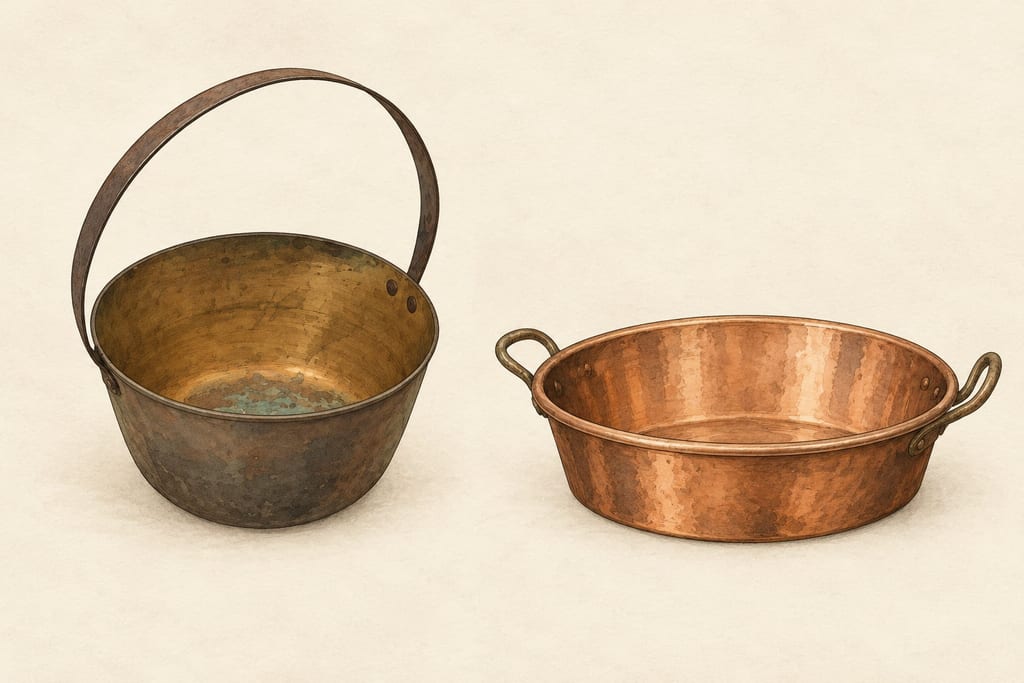
Household preserving pans
Open, heated pans cooked fruit into preserves before transfer to jars. Historical records document copper and enamelled cast-iron forms, while museum objects show variation in material and shape.
 FermenteaWhere food goes to change
Equipment · Jars, pots and crocks
Keiller-branded stoneware jars were commercial packages for Dundee marmalade. Collections show cylindrical forms with printed marks; sources distinguish the Dundee brand from documented Maling manufacture in Newcastle.
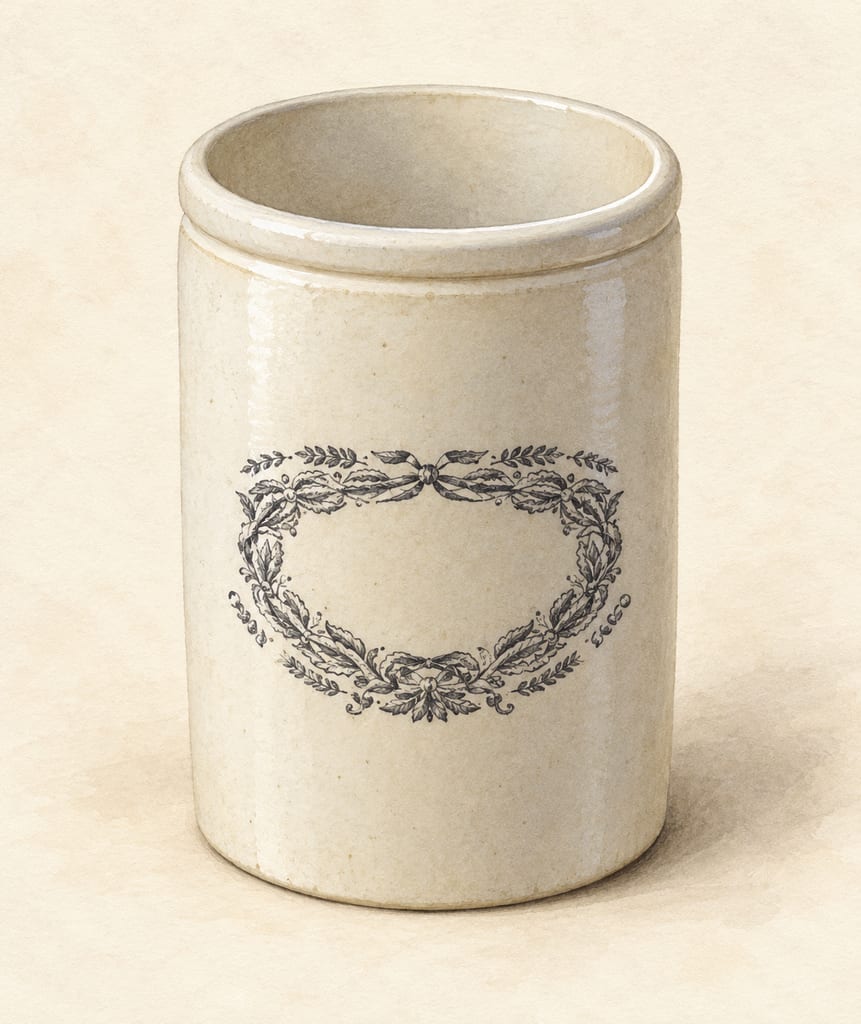
Keiller stoneware jars made a preserve recognizable as a commercial product. National Trust records show the James Keiller & Son name and Dundee identity printed on pale cylindrical vessels. One catalogued object carries marks referring to a Grand Medal of Merit in Vienna in 1873 and a London marmalade medal in 1862; an undated group of 50 jars has a similar cylindrical form and groove below the rim. These inscriptions are evidence of what the containers displayed, not independent proof of the award claims.
The records do not describe one standard jar. National Trust object 82544 is dated across 1872–1950, while the Calke Abbey group is undated. Another Keiller jar in the Hampshire Culture Trust collection is specifically catalogued as late nineteenth century. These are examples from a changing package tradition, not a complete catalogue of every factory size or design.
Stoneware is a high-fired pottery body that vitrifies during firing. Peter Atkins describes it as non-porous and explains its wider role in nineteenth-century food packaging. His history states that Keiller continued to sell marmalade in stoneware jars made in Newcastle at the Maling pottery. A surviving Maling-made Keiller jar is described as cylindrical, giving a source-grounded form rather than a generic reconstruction.
This production geography is easy to blur: Dundee identifies the marmalade business and brand, while Newcastle is documented as a place where Maling made Keiller jars. The National Trust's catalogue also lists Dundee as the place of origin for one object, but that field does not overturn the more specific Maling manufacture evidence for the other jar. No source here establishes that every jar was made at one pottery.
Transfer-printed marks turn a container into a dated trade record. Wessex Archaeology reports that excavated cylindrical jars at Harris Manchester College in Oxford carried different Keiller labels. The company name changes and medal wording help order some examples; the 1873 Vienna mark occurs on one label design, while a date letter identifies another specimen as 1880. The printed surface can therefore assist dating when the exact mark is legible, but it cannot date an unmarked jar by itself.
The ceramics also document reach beyond Dundee. An archaeological find in Oxford and surviving National Trust objects show Keiller-branded packaging away from the company's Scottish base. This evidence supports distribution of a marked commercial product; it does not show that every jar held the same marmalade or that each was imported with contents intact.
The jars are often paired with a story that a storm-delayed ship brought overripe Seville oranges to Dundee and prompted Janet Keiller to invent marmalade. The detailed Abertay Historical Society study cautions against that account: it says the founding records are missing, the celebrated story contains errors about family relationships and chronology, and the 1797 founding year is not established by written evidence. Keiller's importance is better grounded in the documented growth of a Dundee confectionery and marmalade business than in an origin legend.
A jar's date, label and material can tell us about packaging, branding and manufacture, but they are not a recipe. The National Trust records do not give a closure system or canning process, and the surviving objects are historical collection pieces. Their form should not be treated as a modern home-canning specification or reused on the assumption that a seal or safe process is known.
National Trust object records document Keiller-marked stoneware jars associated with Dundee marmalade. One is catalogued 1872–1950; a separate undated group comprises 50 cylindrical jars. A late-nineteenth-century Keiller jar in the Hampshire Culture Trust collection is catalogued as Maling stoneware made in Newcastle. The label motifs and marks are evidence of packaging and branding, not a recipe or proof of an exact production date for every vessel.
Dundee is the marmalade brand's association and is listed as the origin of a National Trust jar. This does not claim that every Keiller jar was manufactured there.
A Hampshire Culture Trust object and Peter Atkins's account identify Maling-made Keiller stoneware jars in Newcastle; this row applies to that documented production link, not every surviving jar.
Open, heated pans cooked fruit into preserves before transfer to jars. Historical records document copper and enamelled cast-iron forms, while museum objects show variation in material and shape.
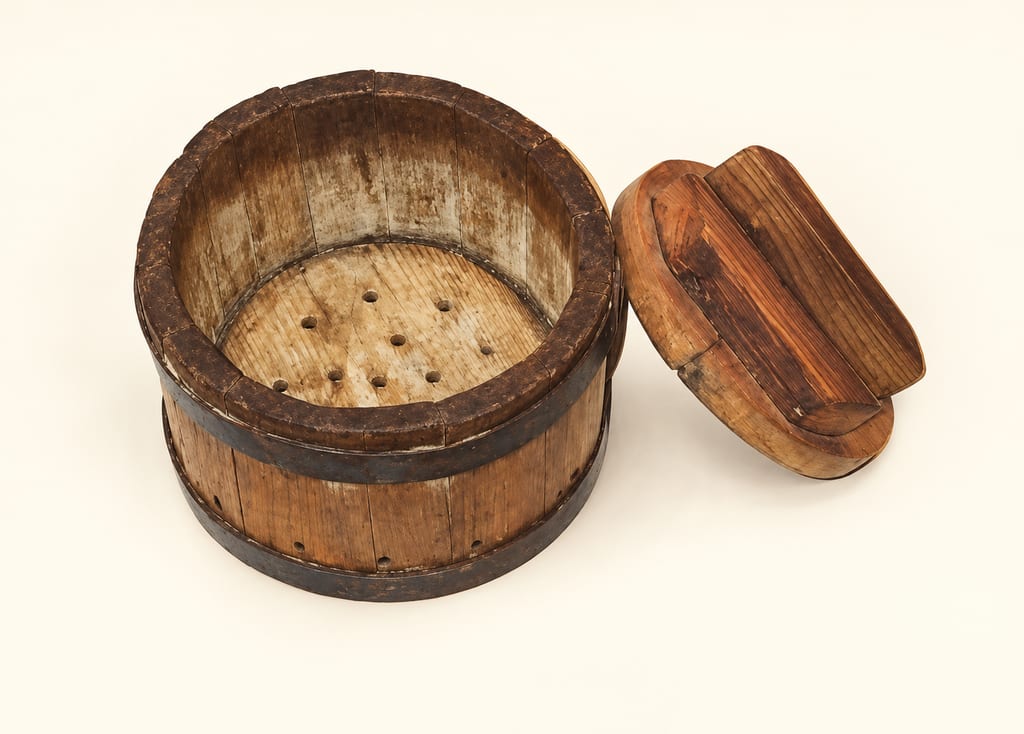
A cheese press applies weight or mechanical force to curds in a draining vat or mould. Tiree’s wooden fiodhan, stone weights, screw presses and a documented New Zealand lever press show distinct forms, not one standard design.
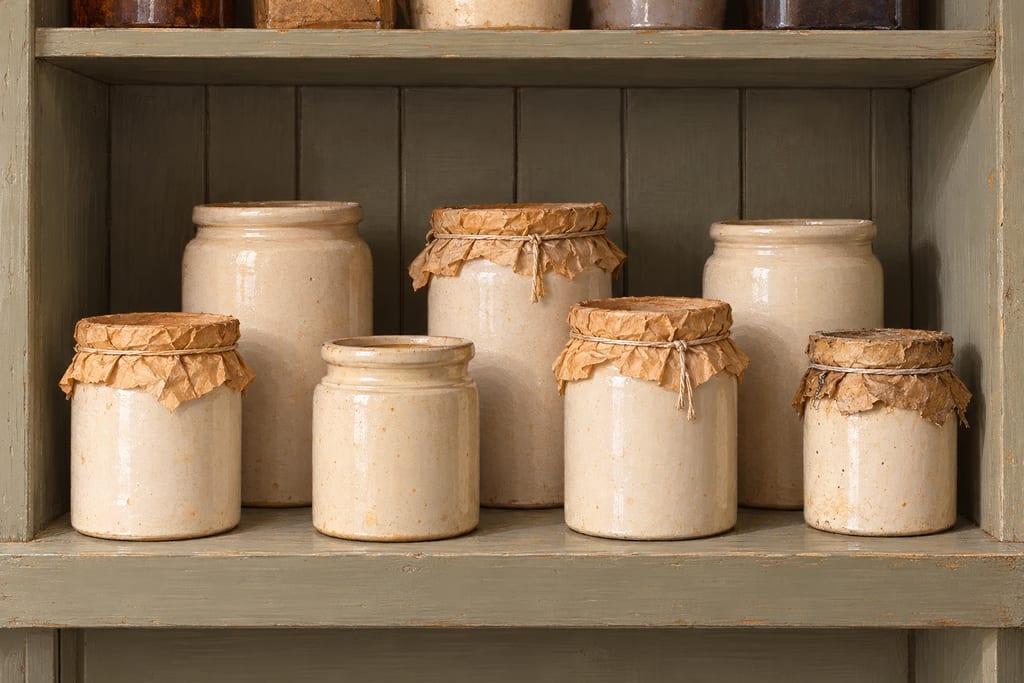
Three dated jam labels at Glasgow’s Tenement House record household preserves: Victoria plum (1947), strawberry (1961), and rhubarb and ginger (1963). They document storage and domestic history, not a recoverable recipe.
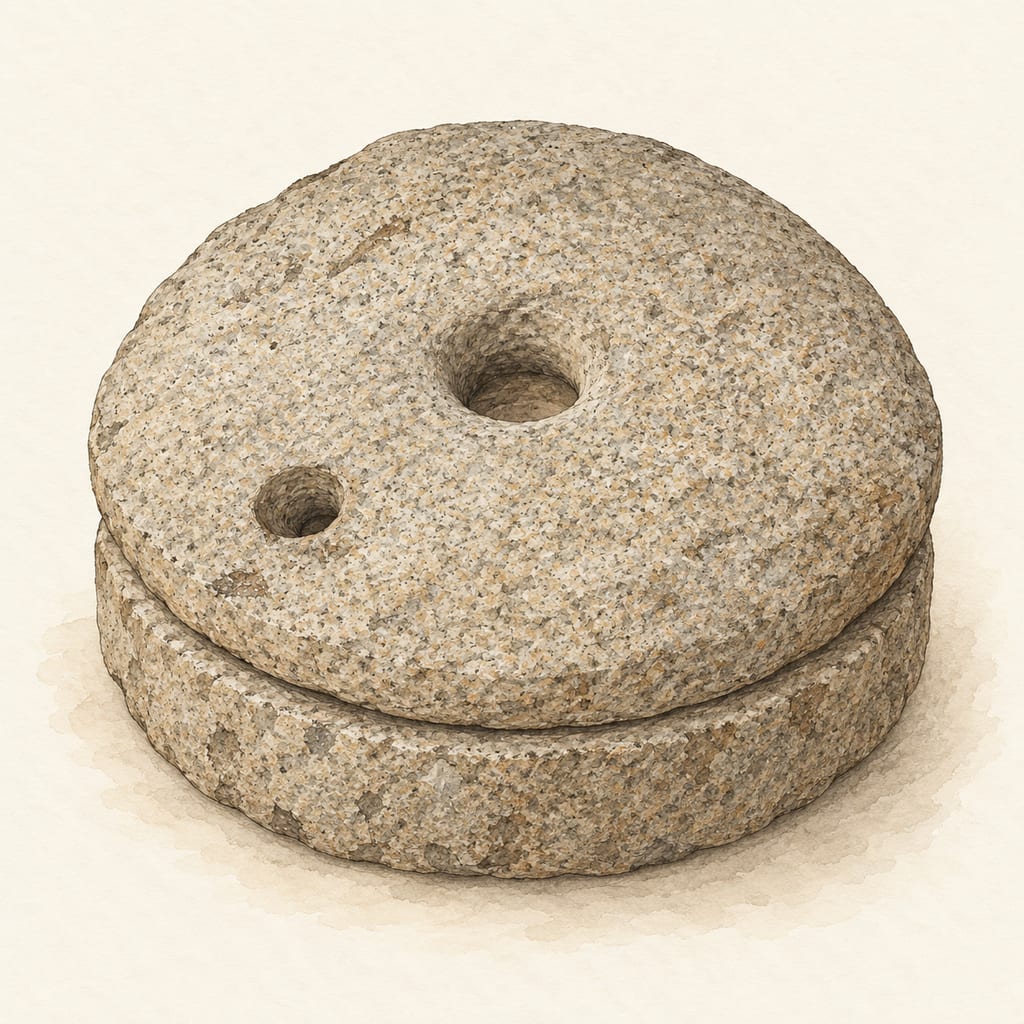
A rotary quern is a hand-operated mill with a runner turning over a fixed bedstone to grind grain. Scandinavian household use of rotary querns increased around the beginning of the Viking Age.
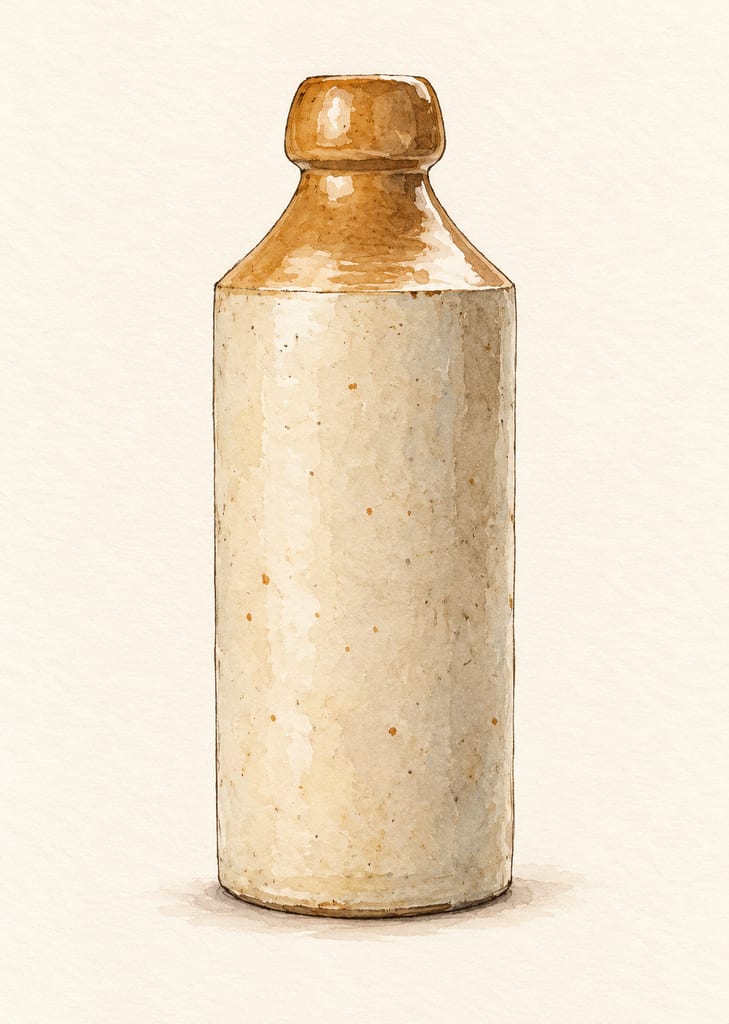
A late nineteenth-century stoneware bottle for ginger beer, represented by an Aberdeen museum object dated 1850–1899. It documents beverage packaging, not a fermentation vessel or a universal bottle design.

A Cap-Pelé boucanière is an Acadian herring-smoking building. The documented Willie Niles example is a one-storey wood-frame structure with a ridge smoke vent and interior bays for hanging fish-bearing cannes.

Achcharu is a family of Sri Lankan vinegar pickles made with mixed vegetables or seasonal fruit and a piquant spice dressing. This version is a quick, refrigerated, non-fermented mixed-vegetable pickle.

The acocote is a long, hollowed and dried gourd used to draw aguamiel from a mature maguey. It is a harvesting tool: the sap is transferred to a separate vessel before it ferments into pulque.

Adrak murabba preserves young ginger in sugar syrup, a sweet South Asian preparation recorded in Indian cookery and food-processing sources.

Parkia biglobosa seeds are fermented into regional West African seasonings, including nététou, iru, dawadawa and soumbala. The yellow fruit pulp is a separate food, and names and methods vary by place.

Japanese reddish-brown vinegar from sake lees matured about three years, turned to vinegar by acetic bacteria; the vinegar of Handa and Edomae sushi rice.

A refined common-wheat flour blended for a broad range of baking; its protein and behavior vary with wheat, milling and market.

The almond mushroom, Agaricus subrufescens, was cultivated in eastern North America in the 1800s, lost its market, and returned as a cultivated mushroom from Brazil, where it is grown under several names.
No community contributions have been published for this entry yet.
Sign in to contribute. Published comments and photos are free to read.
National Trust CollectionsObject record · Material · Markings · Date · Geography
Marmalade jar 82544The record catalogues a James Keiller & Son Dundee marmalade jar as stoneware, gives a date range of 1872–1950, lists Dundee as place of origin, and transcribes medal and brand marks.
The record describes the orange-cargo story as traditional and says the Keillers adapted an existing marmalade recipe.
Cited in: A branded container for Dundee marmalade; Stoneware and manufacture; Marks, dates and what archaeology can tell us; The Keiller story and its limits
National Trust CollectionsObject record · Form · Material · Markings
James Keiller and Sons Dundee Marmalade 285781The record describes a group of 50 stoneware marmalade jars of cylindrical form, with a groove under the rim and black printed Keiller, Dundee and medal marks.
The date is recorded as unknown; an individual specimen is measured 140 mm high and 100 mm wide, which is not a class-wide standard.
Cited in: A branded container for Dundee marmalade; The Keiller story and its limits
Hampshire Cultural TrustObject record · Form · Material · Manufacturer · Geography
Maling Pottery Marmalade JarThe late-nineteenth-century cylindrical stoneware jar was made by Maling Pottery in Newcastle upon Tyne for James Keiller's Dundee marmalade.
The page describes Maling's production of everyday food-company jars and its shift to machine-made packaging.
Cited in: A branded container for Dundee marmalade; Stoneware and manufacture
Peter Atkins, in The Food Industries of Europe in the Nineteenth and Twentieth CenturiesManufacture · Material · Industry · Geography
Vinegar and Sugar: the Early History of Factory-made Jams, Pickles and Sauces in BritainPeter Atkins says Keiller continued selling marmalade in stoneware jars made in Newcastle at the Maling pottery.
The chapter describes stoneware as high-fired and vitrified, and contextualizes the growth of pottery jars for preserved foods.
Cited in: Stoneware and manufacture
Wessex ArchaeologyArchaeology · Form · Markings · Date · Distribution
Marmalade for the students?Excavations at Harris Manchester College, Oxford, recovered cylindrical jars marked as Keiller marmalade packaging.
The labels differed between objects; the 1862 and 1873 medal marks help date some examples, and an 1880 example is identified by its date letter.
Cited in: Marks, dates and what archaeology can tell us
Abertay Historical SocietyHistory · Geography · Brand
Keiller’s of Dundee: The Rise of the Marmalade Dynasty 1800–1897William Matthew describes the origins story as containing multiple errors and notes that no documents concerning the firm's foundation have survived.
The study says Keiller's did not invent marmalade and treats the often-cited 1797 founding year as suspect without written evidence.
Cited in: The Keiller story and its limits