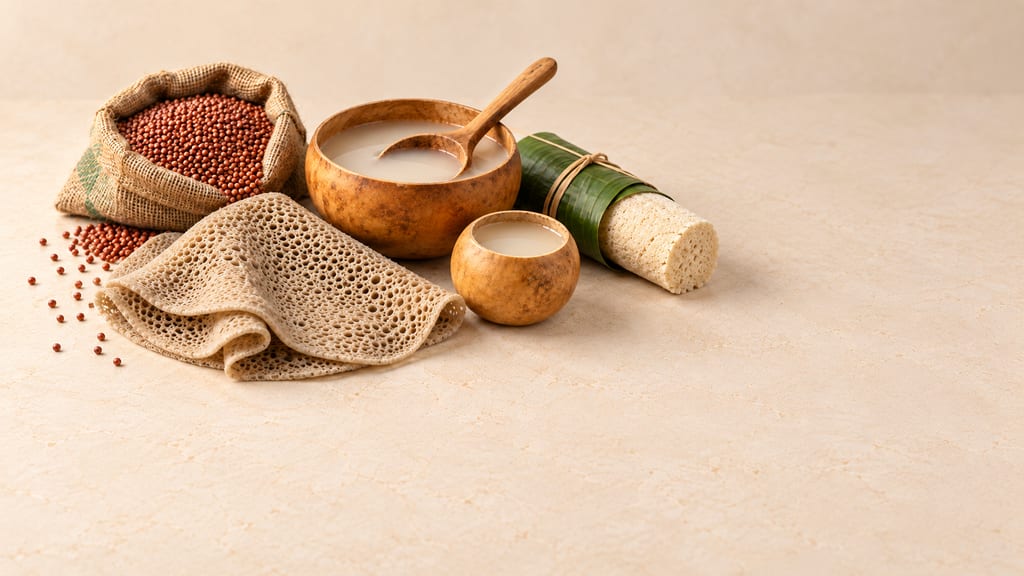
African fermented foods, drinks and preservation
From sour breads and milk to savoury seeds, cassava staples and living beers, African fermentation follows the crop, the community and the work of transformation.
 FermenteaWhere food goes to change
Substrates
Parkia biglobosa seeds are fermented into regional West African seasonings, including nététou, iru, dawadawa and soumbala. The yellow fruit pulp is a separate food, and names and methods vary by place.

Parkia biglobosa is an accepted species in the legume family, Fabaceae. Kew gives its native range as West Tropical Africa to South Sudan and records it as a tree of seasonally dry tropical settings. African locust bean and néré are common English and French names, but néré can refer to the tree, its pods or their edible contents. Parkia clappertoniana and Parkia uniglobosa appear among recorded botanical synonyms; a market name alone cannot confirm the species in an unlabelled sample.
This page is about the seeds as a raw ingredient. It keeps them separate from the fermented seasoning made from them and from the sweet, floury pulp around the seeds. The botanical name identifies the plant, not a finished food, a fermentation starter or a single regional method.
The mature fruit is a long, dark pod containing hard seeds embedded in yellowish, mealy pulp. People use the two parts in different ways. The pulp may be eaten as it is, dried and milled, mixed with cereal flour, or combined with water for a sweet drink. Seeds are used in cooked foods, roasted as a coffee substitute in some accounts, and processed into fermented condiments.
A household or market description that says “locust bean” may refer to unprocessed seeds, a boiled ingredient, a fermented seasoning, or a dried and ground form. Ask which part and stage is meant before treating two names as interchangeable. Fruit pulp is not the fermenting seed, and the finished condiment is not a raw seed variety.
Parkia biglobosa is valued as a multipurpose tree in farming landscapes. Its foods are one part of a wider set of uses that includes shade and other household products; the edible seed trade gives the pods a place in local markets. A systematic review of conservation and domestication research describes the tree as important in traditional parklands and notes that the publication record is uneven across its range. Much of the reviewed literature came from Nigeria, Burkina Faso and Benin, while Central and East African populations were less studied.
A two-village survey in Kagnobon and Mangagoulack in Basse Casamance, Senegal, describes trees retained in farm parklands. It reports fruit collection mainly from May through August in those villages. Its comparison of pulp collected before and after the first rains is a local observation, not a national harvest calendar or a planting instruction.
Across West Africa, cooked seeds of Parkia biglobosa are fermented into savoury seasonings used in soups, sauces and stews. The products are often alkaline rather than sour: fermentation breaks down seed proteins and creates a strong aroma. The same broad food family appears under several names, including nététou or netetu, iru, dawadawa, soumbala or soumbara, afitin and sonru. The names overlap in some writing, but local use does not make every product the same recipe.
People commonly add a small amount during cooking to season a larger pot. Product forms include moist seeds, cakes or balls, dried pieces, powder and paste. Drying, pounding and packaging are later handling choices; they do not establish how a batch was fermented or prove how it should be stored.
The names belong to particular languages, markets and production settings. A field survey in Basse Casamance records nététou and local names for fermented seeds in two villages; it reports bu guéday in Kagnobon and bu niok in Mangagoulack without identifying the language for those two terms. Those spellings should stay attached to the places where they were recorded.
In Benin, a direct comparison of afitin, iru and sonru describes different processing details and distinct roselle-seed adjuncts for the studied products. Iku-iru and yanyanku in that account refer to processed Hibiscus sabdariffa seeds used in the respective methods; they are not names for Parkia seeds or purified commercial starter cultures. A separate study of soumbara in Korhogo, Côte d'Ivoire, examines market forms and quality. The word is therefore useful for finding related foods, but not enough to identify a producer's substrate, additions or fermentation conditions.
The archive's regional survey groups iru with Nigeria, dawadawa with Ghana, soumbala with Burkina Faso and Mali, nététou with Senegal and netetu with Guinea-Bissau, while retaining additional spellings. These are research leads and documented associations, not a universal language map. Check the product label and seller's usage where a specific ingredient or method matters.
Descriptions of the shared seed-condiment family commonly place several operations in sequence: dry seeds are cleaned and boiled for an extended period, the seed coats are removed, the cotyledons are cooked again, then held moist while fermentation develops. One Beninese production study describes first boiling periods spanning 6 to 24 hours, a shorter second cooking stage, and fermentations spanning 24 to 72 hours across the products it examined. Those ranges summarize that investigation; they are not a universal home method or a validated safe limit.
The Beninese comparison shows why names should not be collapsed into one formula. The studied afitin used a shorter fermentation without the same roselle-derived adjuncts reported for the Beninese iru and sonru samples. Such differences can affect taste, microbial succession and measured composition. The existence of a traditional sequence does not make an unspecified batch reproducible.
The intended transformation is different from the acidification used for vegetable pickles or sour milk. Protein-rich cooked cotyledons soften and break down; free amino compounds and other products contribute to the seasoning's savoury character and strong smell. Studies have found Bacillus species among the organisms in these foods, but the organisms reported in a sample are not automatically a suitable starter for another batch.
Market analyses and laboratory studies describe chemical or microbial properties of selected samples. They do not provide one fixed pH, microbial profile or fermentation endpoint for every region and product name. A chemical analysis of nététu sold in Dakar, for example, examined market samples and raw seeds; it was not a household process trial. Do not turn its introduction's process references into instructions.
For cooking, the seasoning is used in small quantities to add a deep, savoury note to soups, sauces and stews. It may be crushed, crumbled, pounded or dissolved into a dish depending on the form bought and the local preparation.
Buyers may encounter whole moist seeds, loose dried beans, compressed balls, powder or a paste. These forms can differ in salt, moisture, additives and processing. Read the label when present and ask the producer or seller about the species, ingredients and handling if the information affects your cooking. The sensory strength of one form does not make it a direct substitute for another.
The sources reviewed here do not establish one storage life or temperature for every moist, dried, powdered or packaged Parkia condiment. A product's water content, salt, packaging, heat treatment and handling can differ, so a dry-looking surface or pungent aroma is not evidence that it is shelf-stable. Follow the producer's label and storage instructions for the exact product; when those are absent, do not infer a safe storage period from another format.
The ingredient itself is usually sold as dry seeds before household processing, but this record does not give a verified commercial grading standard or a measured shelf life for raw seed. Keep raw materials protected from moisture, pests and contamination in accordance with supplier directions. These are general handling practices, not a tested preservation schedule.
Raw seeds are not ready to eat as though they were a cooked seasoning. The documented processing includes cooking before fermentation, and the species' seeds contain antinutritional factors that vary with raw, boiled and fermented state. That finding is not a health claim and does not establish a home detoxification threshold.
The supplied atlas notes reports of Bacillus cereus in samples of alkaline African condiments and warns that detecting a species does not assess the safety of an individual batch. An alkaline pH is not evidence of pathogen control; a smell, taste, appearance or bubbling cannot establish safety either. No validated household time, temperature, pH, salt or storage endpoint was found for the broad family here. This ingredient page does not present a recipe or substitute for process validation.
The reviewed sources do not establish a complete allergen declaration for every Parkia product, especially where recipes include other seeds or seasonings. Check product labels and ask about cross-contact when needed; do not treat a named ingredient as a complete allergen statement.
Some regional fermented condiments use other seeds or plant parts. They may share a seasoning role without sharing a species or process. The source literature records some substitutes for fermented Parkia seeds, including pigeon pea or baobab seeds in Burkina Faso and Prosopis species in Benin. Those are separate ingredients and should not be sold or indexed as Parkia synonyms.
Do not substitute fresh fruit pulp, roasted seeds, unfermented seeds or another fermented seed condiment as though they were the same product. They have different texture, flavor and processing. A recipe may be adaptable, but the amount and cooking result need a recipe-specific source or testing.
The tree's native range is broad, and its culinary associations cross current national borders. The map entries here distinguish the plant's range from specific uses: a botanical range does not by itself prove that a particular condiment is traditional in every place where the tree grows. Documented associations include seed uses in Basse Casamance, Senegal; a market study in Korhogo, Côte d'Ivoire; Beninese comparisons of afitin, iru and sonru; and netetu in a Guinea-Bissau field study.
A 1906 account of French Guinea is cited in the atlas for fermented néré seeds processed as soumara. This is a dated written attestation for Guinea, not evidence that the food began then. The earliest culinary use remains unknown. The 1993 CIRAD catalogue entry for a book on nététou in Senegal is useful bibliographic metadata, but its full chapter was not inspected for this page.
The combined record supports the plant identity, the distinction between pulp and seed, several uses, a wide botanical range and named regional condiment traditions. It also supports the point that products grouped under related names can have distinct additions and fermentation periods. It does not supply a single complete, measured batch for household production.
A systematic review of nutrient-composition research found substantial variation among Parkia accessions and among pulp, raw seed and fermented seed studies. Values reported for one accession or sample should not be advertised as universal nutrition facts. A local study's season, village names, market samples and nursery conditions each stay within their own scope.
How household methods and ingredient additions vary by community, the history behind the earliest written attestations, and safe controls for specific product forms are not established. Missing details are not filled with a generic recipe.
A two-village survey documents fruit and seed uses in Kagnobon and Mangagoulack; this is not a claim about all Senegal.
The supplied atlas identifies a 1906 account of fermented néré seeds in French Guinea; this dates a written attestation, not the origin of the food.
A market study documents soumbara forms and quality in Korhogo; it does not establish a birthplace.
A comparative production study examines afitin, Beninese iru and sonru; the association is country-level.
An ethnobotanical field study of edible-plant trade includes netetu; its country-level association does not establish a precise locality.
A Nigerian study examines iru alongside other alkaline seed condiments; the association is country-level.
From sour breads and milk to savoury seeds, cassava staples and living beers, African fermentation follows the crop, the community and the work of transformation.
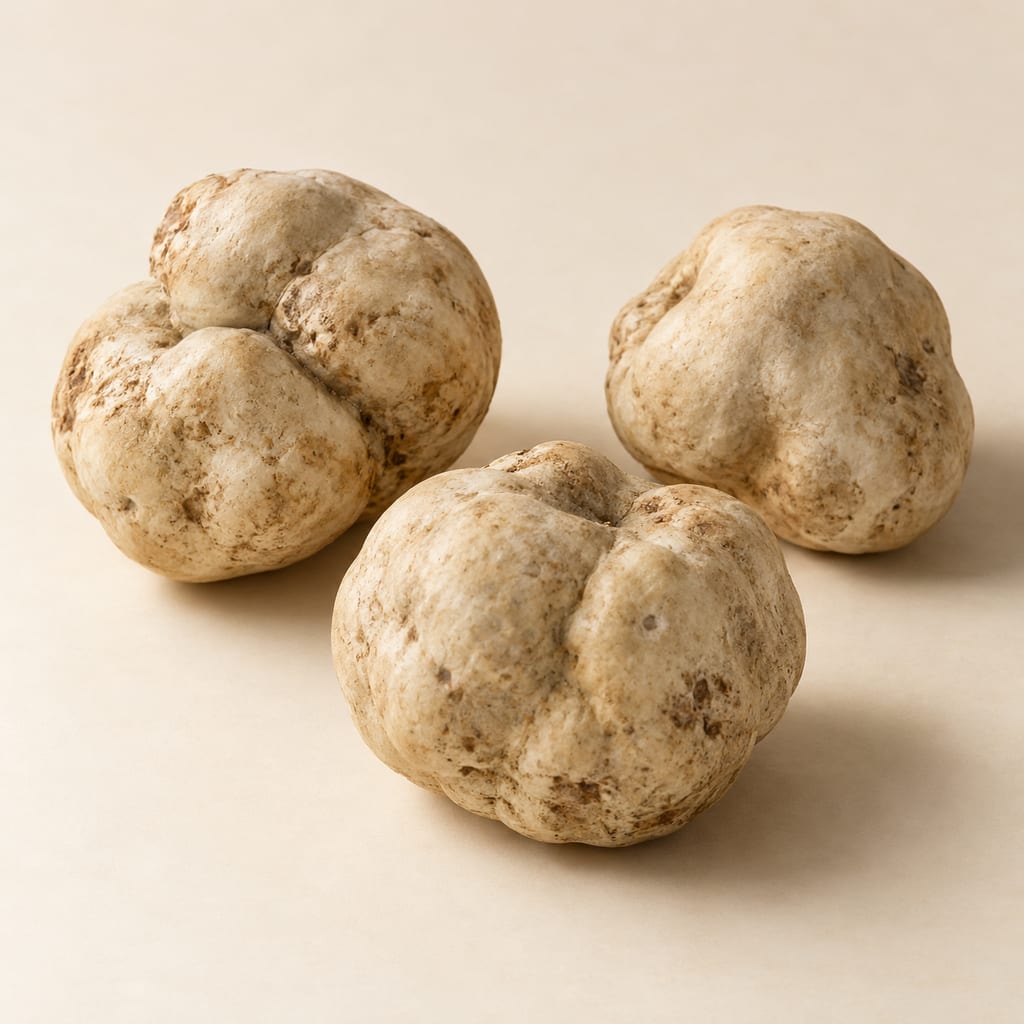
Afrocastellanoa ivoryana is a truffle-like false truffle of African woodlands, ectomycorrhizal with woodland trees and recorded as a regional wild food in West and Central Africa.
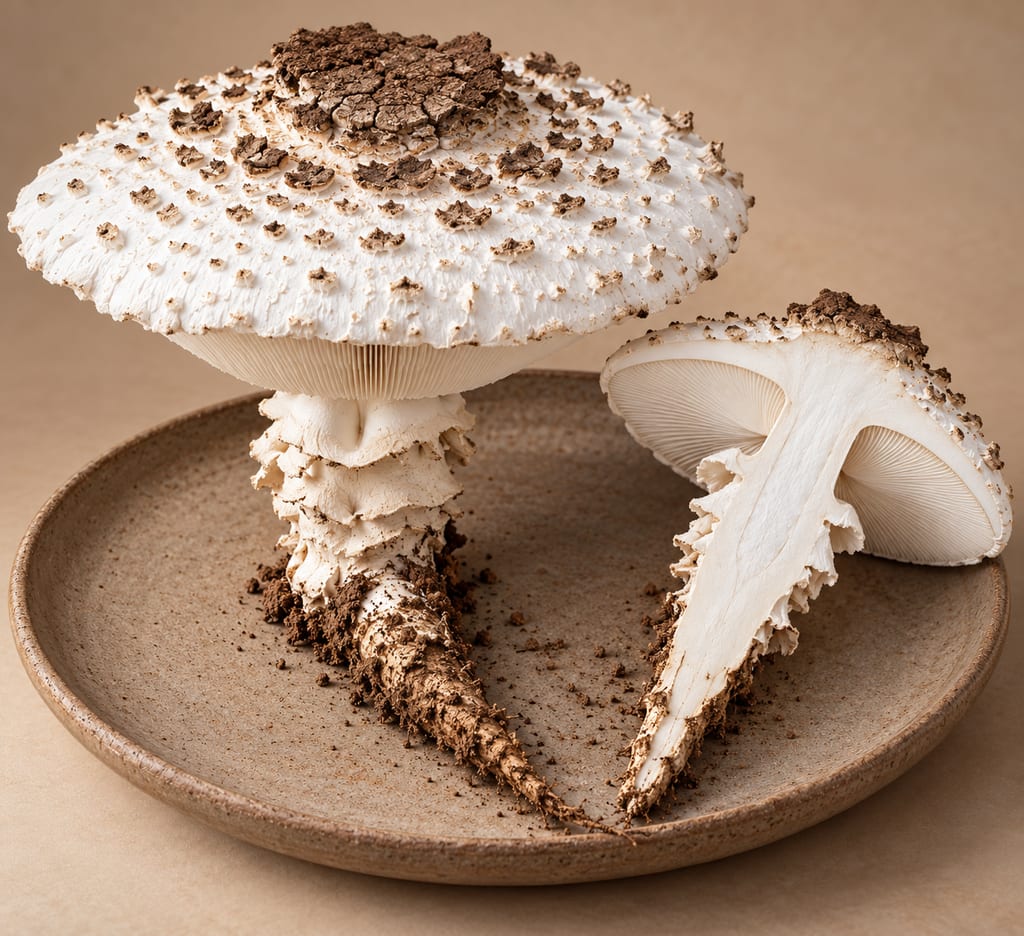
A large wild termite-associated mushroom gathered across parts of tropical Africa. Local food uses and fruiting seasons vary by place and rainfall; its appearance alone cannot establish a safe identification.

A Cap-Pelé boucanière is an Acadian herring-smoking building. The documented Willie Niles example is a one-storey wood-frame structure with a ridge smoke vent and interior bays for hanging fish-bearing cannes.

Achcharu is a family of Sri Lankan vinegar pickles made with mixed vegetables or seasonal fruit and a piquant spice dressing. This version is a quick, refrigerated, non-fermented mixed-vegetable pickle.

The acocote is a long, hollowed and dried gourd used to draw aguamiel from a mature maguey. It is a harvesting tool: the sap is transferred to a separate vessel before it ferments into pulque.

Adrak murabba preserves young ginger in sugar syrup, a sweet South Asian preparation recorded in Indian cookery and food-processing sources.

Japanese reddish-brown vinegar from sake lees matured about three years, turned to vinegar by acetic bacteria; the vinegar of Handa and Edomae sushi rice.

A refined common-wheat flour blended for a broad range of baking; its protein and behavior vary with wheat, milling and market.

The almond mushroom, Agaricus subrufescens, was cultivated in eastern North America in the 1800s, lost its market, and returned as a cultivated mushroom from Brazil, where it is grown under several names.
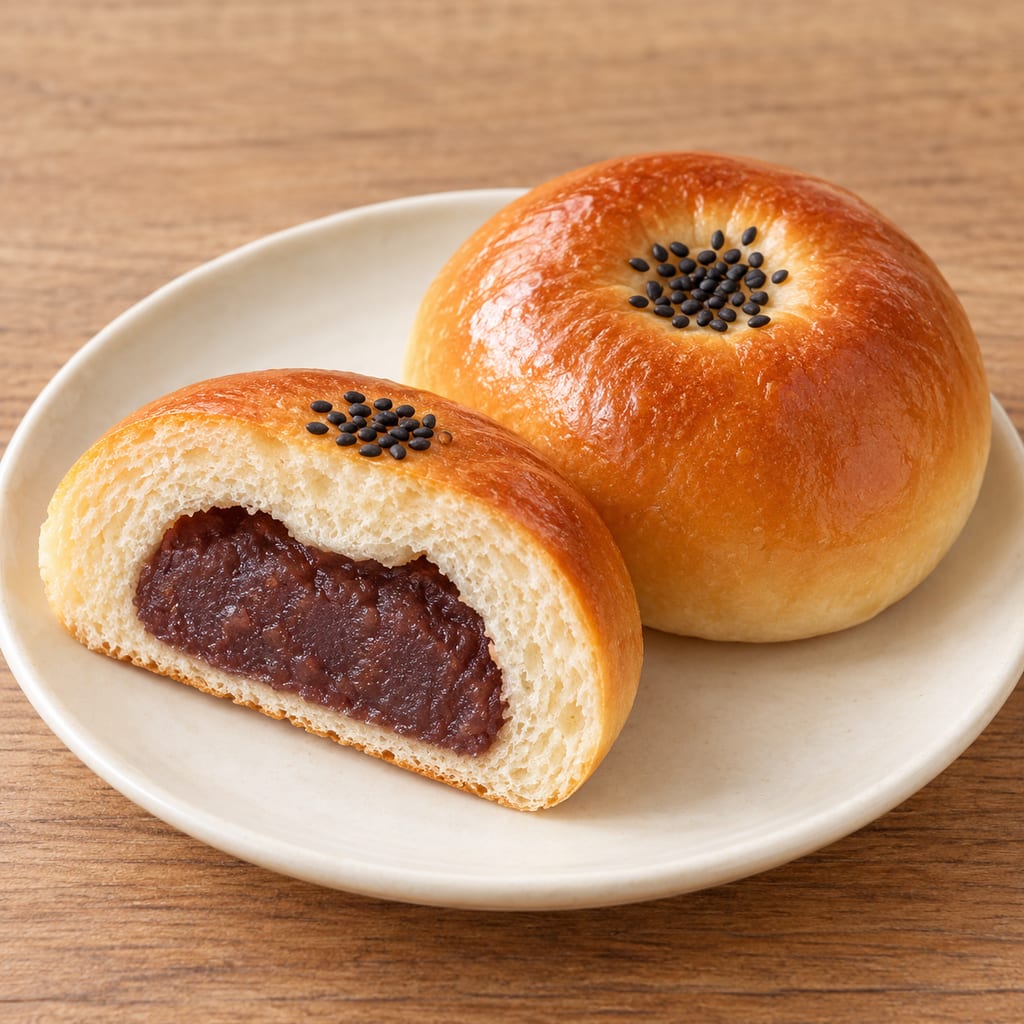
Anpan is a soft wheat bun filled with sweet red-bean paste and finished with egg wash and black sesame. This dough rises with commercial instant yeast.
No community contributions have been published for this entry yet.
Sign in to contribute. Published comments and photos are free to read.
Royal Botanic Gardens, KewBotanical identity · Distribution
Parkia biglobosa (Jacq.) R.Br. ex G.Don | Plants of the World OnlineAccepted name and native range
Recorded botanical synonyms
Cited in: The tree, the seed and the name; A parkland tree with several livelihoods; Substitutes and near relatives; Geography and the written record
Diatta et al.; Afrique SCIENCE 17(4):1–17 (2020)Regional use · Growing context · Harvest season
Importance socio-économique de Parkia biglobosa (Jacq) R. Br. Ex G. Don (néré) dans le système agroforestier en Basse Casamance, SénégalTwo-village uses of pulp and fermented seeds
Basse Casamance parkland setting and local collection period
Cited in: Pods contain two different foods; A parkland tree with several livelihoods; Local names carry local distinctions; Cooking uses and ingredient forms; Geography and the written record; What the evidence can support
Ndir et al.; Biotechnologie, Agronomie, Société et Environnement 4(2):101–105 (2000)Market sample analysis · Research limits
Composition chimique du nététu, condiment alimentaire produit par fermentation des graines du caroubier africain Parkia biglobosa (Jacq.) Benth.Chemical analysis of raw seed and nététu samples sold in Dakar
Not a process trial or safety validation
Cited in: Fermentation is alkaline and proteolytic; Storage and handling limits; Food-safety evidence and uncertainty; What the evidence can support
Omar Biteye; ISFAR/ENCR, Université Alioune Diop de Bambey library catalogueNursery research
Etude de la germination et de la croissance de Parkia biglobosa (Jacq.) R. Br. ex G. Don en pépinièreUniversity catalogue abstract and stated nursery research limits
Cited in: What the evidence can support
Université Alioune Diop de BambeyBibliographic cross check
Curriculum vitae: Elhadji FayeThe linked CV gives a different page count for the nursery thesis than the catalogue
Cited in: What the evidence can support
CIRAD bibliographic catalogue (1993)Bibliographic lead
Le nététou au Sénégal, systèmes techniques et innovationCatalogue record identifies a Senegal nététou publication; full text not inspected
Cited in: Geography and the written record; What the evidence can support
FermenteaExisting research provenance
Néré and nététou in Senegal (Parkia biglobosa): original plant researchResearch scope and limitations carried forward from the existing research article
Cited in: Cooking uses and ingredient forms
Plant Resources of Tropical Africa (PROTA), hosted by Pl@ntUsePlant uses · Fruit and seed forms
Parkia biglobosa (PROTA)Uses of pulp, fermented seeds and roasted seeds
Reported substitution and botanical-use context
Cited in: The tree, the seed and the name; Pods contain two different foods; Fermented seeds become a seasoning; Local names carry local distinctions; Cooking uses and ingredient forms; Storage and handling limits; Substitutes and near relatives
Ifagbemi Bienvenue Chabi; Université d'Abomey-Calavi repository (2018)Regional process comparison · Aroma research
Some traditional fermented food from African locust beans (Parkia biglobosa): production and volatile compoundsAbstract reports operations and process ranges across examined condiments
Variations in process affect analyzed properties; not a universal recipe
Cited in: Fermented seeds become a seasoning; What a reported process looks like; Fermentation is alkaline and proteolytic; Storage and handling limits
Termote et al.; Critical Reviews in Food Science and Nutrition 62(1):119–144 (2022)Evidence synthesis · Variation
Nutrient composition of Parkia biglobosa pulp, raw and fermented seeds: a systematic reviewSystematic review compares pulp, raw and fermented seed evidence
Nutrient composition varies among accessions and studies
Cited in: Pods contain two different foods; What the evidence can support
Houndonougbo et al.; Genetic Resources and Crop Evolution (2020)Tree ecology · Research coverage
A global systematic review on conservation and domestication of Parkia biglobosaTraditional parkland and non-timber value
Research concentration and geographic gaps
Cited in: A parkland tree with several livelihoods
Sanni et al. (2000)Nigeria · Microbial and market evidence
Market isolates and composition of iru, ugba and ogiriNigerian market study of iru alongside other alkaline condiments
Cited in: Fermented seeds become a seasoning; Local names carry local distinctions; Fermentation is alkaline and proteolytic; Food-safety evidence and uncertainty
Kambiré et al. (2021)Geography · Market forms
Soumbara formats and market quality in Korhogo, Côte d'IvoireStudy of soumbara forms and quality in Korhogo
Cited in: Fermented seeds become a seasoning; Local names carry local distinctions; Cooking uses and ingredient forms; Geography and the written record
2024 field studyGeography
Ethnobotanical field study of edible-plant trade in Guinea-BissauNetetu appears in a Guinea-Bissau edible-plant trade study
Cited in: Fermented seeds become a seasoning; Local names carry local distinctions; Geography and the written record
Azokpota et al. (2006)Benin · Process distinctions
Direct comparison of afitin, iru and sonru fermentationComparison of named Beninese products and their process adjuncts
Cited in: Local names carry local distinctions; What a reported process looks like; Geography and the written record
Henri Pobéguin (1906), digitized by Université Claude Bernard Lyon 1Historical attestation
Essai sur la flore de la Guinée française1906 account describes néré seeds fermented and processed as soumara in French Guinea
Cited in: Geography and the written record; What the evidence can support
Ouoba, Thorsen and Varnam; International Journal of Food Microbiology 124(3):224–230 (2008)Food safety research
Enterotoxins and emetic toxins production by Bacillus cereus and other species of Bacillus isolated from Soumbala and Bikalga, African alkaline fermented food condimentsThe study screened Bacillus isolates from soumbala and bikalga for toxin-production evidence
Its findings do not validate a household process
Cited in: Fermentation is alkaline and proteolytic; Food-safety evidence and uncertainty