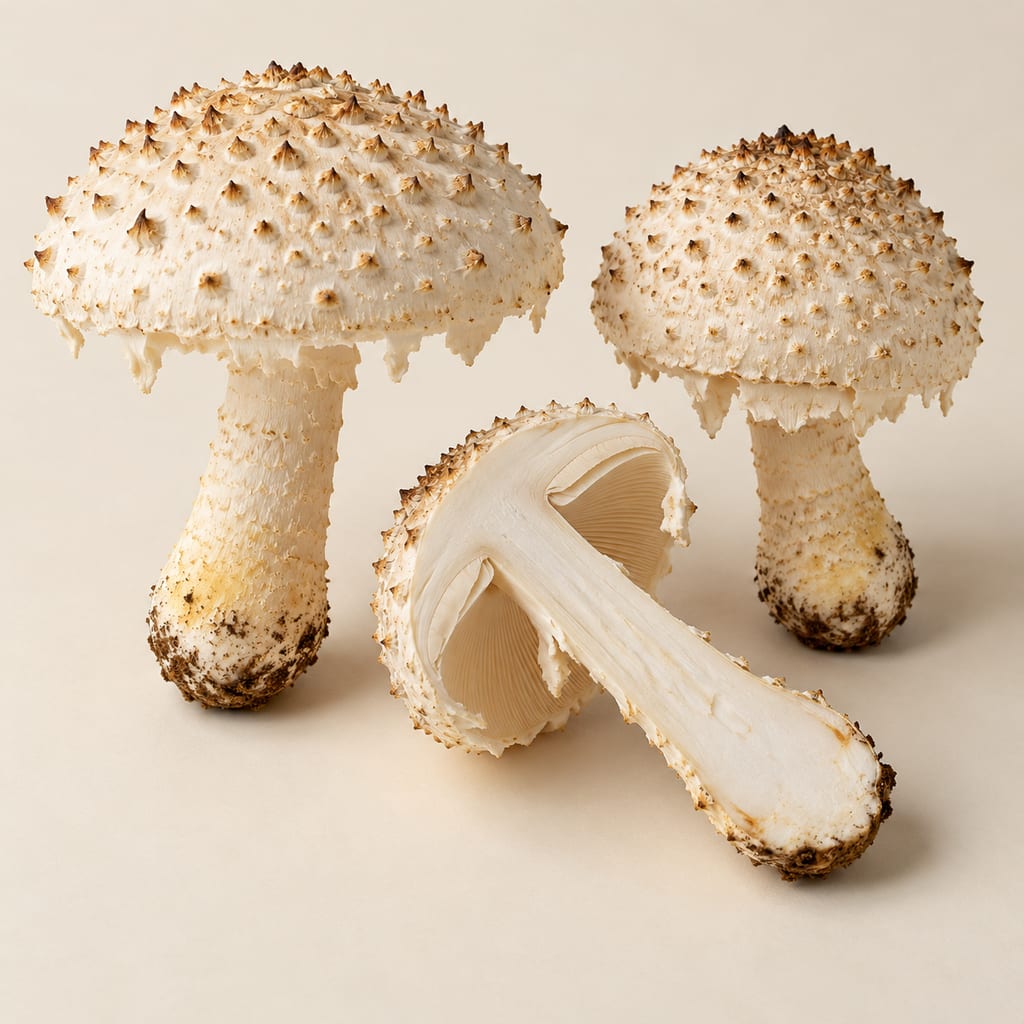
Amanita afrospinosa
Amanita afrospinosa is a white, warted Amanita of miombo woodland in southern and central Africa. A regional food-use record exists, but the Amanita genus includes deadly species, so no safe use is established here.
 FermenteaWhere food goes to change
Mushrooms
A large wild termite-associated mushroom gathered across parts of tropical Africa. Local food uses and fruiting seasons vary by place and rainfall; its appearance alone cannot establish a safe identification.
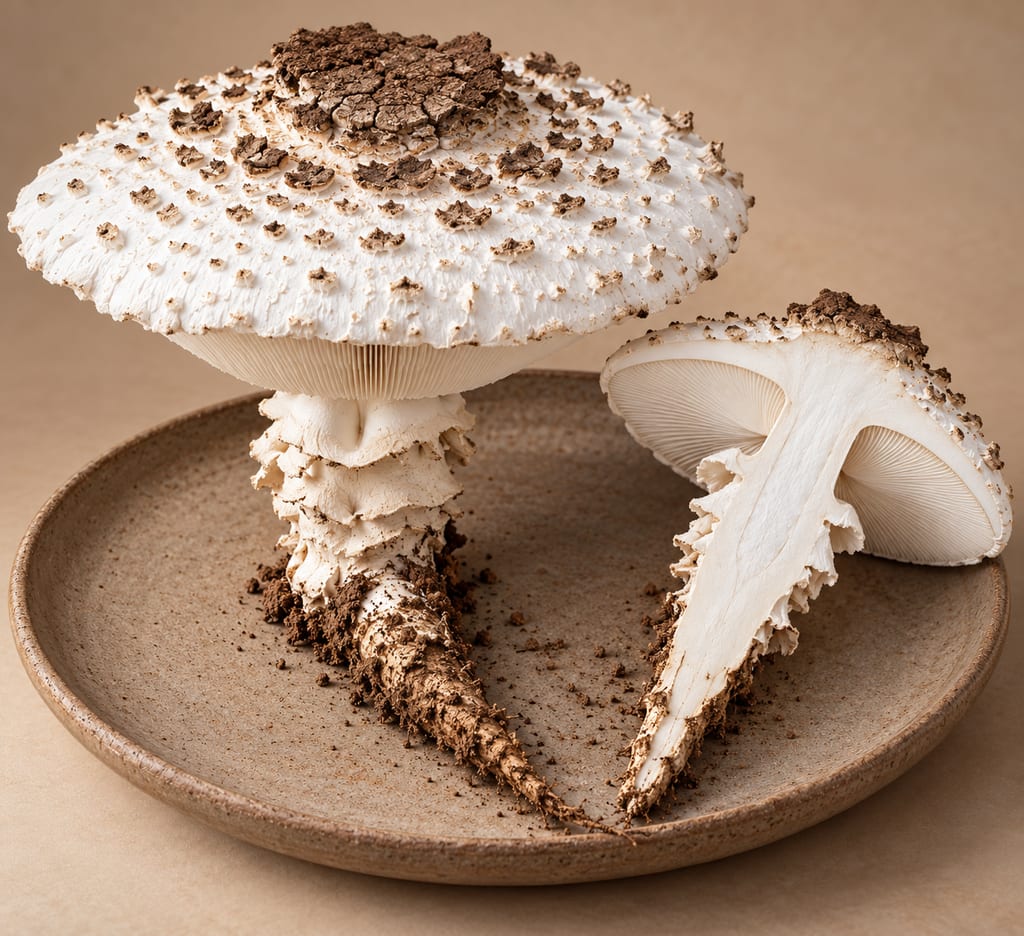
The name now used is Termitomyces schimperi. In 1891 Narcisse Patouillard published the mushroom as Lepiota schimperi; Roger Heim later transferred it to Termitomyces in 1942. The older name remains useful in catalogues and searches. These dates trace European scientific publication, not the beginning of local knowledge. Communities have named, gathered and cooked termite-associated mushrooms in their own languages; the literature gives no reliable date for when those traditions began.
A single English label such as “termite mushroom” can conceal many different species. Local names also differ by language and place, and a word for one mushroom may be applied to unrelated taxa. The literature records names including omajowa in Namibia, siber and simire in Ghana, oluérin in Benin, and several Zimbabwean names such as dare and huvhe. These are records of particular communities, not universal translations or a single pan-African name.
Termitomyces is not a log-decaying mushroom or a crop raised independently on a bag of grain. It belongs to a mutual partnership with fungus-growing termites: the insects maintain fungal gardens inside their nests, and the fungus's fruit bodies emerge above ground from the mound system. The mushroom may appear at the mound base or nearby, while its underground pseudorhiza can extend deeply into soil. The visible cap is only the short-lived reproductive structure of a larger partnership.
References name different termite partners in different records. The Meise Botanic Garden flora identifies an association with Odontotermes, especially O. patruus and O. latericius. A detailed species account and the preliminary fungal assessment also list Macrotermes associations, including M. michaelseni, M. natalensis, M. subhyalinus and M. ukuzii, with Odontotermes patruus in some areas. The safest account is that the fungus is termite-dependent and that its documented partners vary by place; it is not tied to one universal mound builder.
The partnership also limits cultivation. A 2023 specialist account reported that fruit bodies had not yet been produced independently of their associated termites. A Cameroon study found that young fruit bodies could continue expanding for up to about two days after collection under suitable conditions. That concerns post-harvest growth and is not a storage-life measurement, preservation method or safe handling window.
This is one of the largest species in its genus. Detailed descriptions report caps that can span roughly 12 to 40 centimetres, growing from a closed, rounded young stage into a broad, flat cap. The surface is pale to white with dark grey-brown, thick scales concentrated in the centre. As the cap expands, the central scales break into smaller plates. Crowded gills begin white or cream and can become rosy-buff; the spore print is also described as rosy-buff.
The stem is sturdy and white, with a long, tapering pseudorhiza below ground. A ring can be present in very young mushrooms, but it soon breaks down, so mature specimens often have only fragile remnants. The flesh is white and solid in the specialist descriptions. This mixture of scale pattern, size, stem and substrate is useful to explain the mushroom's biology, but no single visible feature is enough to identify a wild specimen safely.
The fruiting season follows local rainfall rather than a single fixed month. A preliminary fungal assessment gives a broad September-to-March window across the records it reviewed, but also reports peaks around September in Côte d’Ivoire, September to November in Ghana, and December to March in Zimbabwe. A detailed species account likewise describes fruiting as dependent on the rains, calling it a late rainy-season mushroom in Côte d’Ivoire and a December-to-March species in Zimbabwe.
National surveys reinforce the limits of a global calendar. In Côte d’Ivoire, Termitomyces fruiting occurred through the year across the country's climate zones, but each species had its own window; T. schimperi was one of only two species marketed on a relatively large scale. Those national findings should not be collapsed into a statement that this mushroom appears year-round everywhere. Fruit bodies are ephemeral and under-recorded, so reported months are local observations, not a dependable forecast for every region.
Specialist records place the species across West, Central, East and Southern Africa. Country records in the Meise Botanic Garden flora and the preliminary fungal assessment include Angola, Benin, Botswana, Burundi, Cameroon, the Central African Republic, Côte d’Ivoire, the Democratic Republic of the Congo, Ethiopia, Gabon, Ghana, Guinea, Guinea-Bissau, Kenya, Liberia, Malawi, Mozambique, Namibia, Nigeria, the Republic of the Congo, Rwanda, Senegal, Sierra Leone, South Africa, Tanzania, Togo, Zambia and Zimbabwe. The two catalogues do not list exactly the same countries, so this is a set of reported records rather than a claim of continuous distribution.
The habitat descriptions range from moist evergreen and deciduous forest to open woodland, miombo, savanna, old fallows and grassland. What these settings share is the termite relationship, not one tree host or one landscape. Country-level reports do not identify a precise origin or prove the mushroom is used as food in every locality where it has been recorded. Community-specific names, season and food practice should stay attached to their place.
About 66 widely spaced records were counted in GBIF by November 2025. Short-lived fruit bodies and limited search effort leave the species under-recorded, so a missing record for a country or month is not proof that the fungus is absent there. The count is not an estimate of population size.
Food records are regional rather than uniform. In a survey of southern Ghana, collectors, consumers and traders listed T. schimperi among mushrooms commonly gathered for consumption. Research in Côte d’Ivoire found the species regularly consumed and among the two Termitomyces sold on a relatively large scale. The detailed species account describes an even more varied picture: the mushroom is valued in Côte d’Ivoire, sold in Malawi, eaten at home in Zimbabwe, and less popular in Zambia where a reputed bitter taste is given as a reason for domestic rather than market collection.
These differences matter. A name may cover local knowledge about a particular mound, community or species concept. “Commonly eaten” in one study cannot be stretched to every country in a broad range, and a market record does not tell us who harvested it, how much was sold or what a household recipe looks like. Where an account does give a local name or practice, it belongs to that language and setting rather than to a generic African cuisine.
The southern Ghana survey also records the people behind the trade: women were especially involved in mushroom gathering, held extensive mushroom knowledge and derived income from it. The researchers list T. schimperi among common collected foods, but do not assign every gendered economic finding to this species alone. The distinction matters because a household ingredient can sit inside a wider livelihood system. A species page can record that connection while still avoiding claims about a single community's roles, prices or customary rights beyond what the study actually observed.
A Zimbabwe account based on the species monograph author's field observation says local households use the cap and roast it or boil it with salt. The same account notes that the large mushroom is seldom seen for sale along roadsides there. The Ghana study establishes collection, exchange and consumption but does not provide a species-specific recipe for T. schimperi. Côte d’Ivoire's national study documents consumption and market trade without giving a universal household method. No one of these descriptions should be presented as the way all communities prepare the mushroom.
The references reviewed here do not provide a general post-harvest storage life or a standardized preservation procedure for this species. Nor do they show a domesticated cultivation method independent of the termite partnership. That leaves real practical questions unanswered: how quickly a gathered fruit body should be handled, whether a given practice applies to a particular community's species identification, and how methods differ within a region. The page keeps those gaps visible instead of inventing storage times or giving a universal recipe.
Termitomyces schimperi is a gathered raw mushroom ingredient. The sources reviewed describe cooking, gathering and market use, along with the fungus's relationship to termites. They do not document a species-specific fermentation tradition or a measured role for the mushroom in a fermentation process. It therefore should not be described as a starter, fermenting substrate or preservation ingredient without additional evidence.
The fact that termites cultivate fungal gardens is a biological mutualism, not a human fermentation recipe. The termites' underground process and the human food uses of the mushroom are separate subjects. Any future account of processing should cite a community or study that documents the method, preserving the name used locally and the identification limits that accompany it.
The documented edible use belongs to communities and records that identify the species; it does not make an unknown mushroom safe to eat. The preliminary fungal assessment explicitly warns that T. schimperi is confused with the toxic Chlorophyllum molybdites. Both may be large, pale, scaled mushrooms, and photographs do not show every feature needed for expert identification. A broad place name, vernacular label, mound association or generated illustration cannot verify a specimen.
This account is not a foraging key or a recommendation to collect wild fungi. A dangerous lookalike can be close enough in appearance to make casual comparison unreliable. Never use this page, a screen image or an online identification to decide whether a mushroom is edible. The regional food-use record is valuable cultural and ecological evidence, not a safety test.
The mushroom's food value is joined to the persistence of its termite partners and their mounds. The preliminary fungal assessment notes threats from habitat loss, repeated mound destruction in agricultural clearing, changes in rainfall, collection pressure and some uses of mound earth. It says available information from Côte d’Ivoire and community interviews in Benin suggests decline, but also states that there is not enough evidence to estimate the rate across the species' wide range. The assessment is preliminary and calls for more country-level monitoring.
That uncertainty deserves careful language. A decline reported in some places does not establish the same trend everywhere, while a wide distribution estimate does not guarantee local abundance. The fruit bodies are short-lived and scientific records are sparse, so monitoring depends on community observations and accurately identified records as well as habitat surveys. The best account connects a particular fruiting season and food practice to its locality, without turning one country's observations into a continent-wide rule.
Ethnographic accounts attach stories and practices to specific places as well. The species monograph reports, through personal communication, a MaChangana belief in Zimbabwe's Lowveld that lightning brings out the mushroom. It also cites an older report of ritual clapping during collection in Zimbabwe, described as a way to encourage regrowth at the same place. These are situated reports, not universal customs or explanations that can be assigned to every Shona-, Ndebele- or MaChangana-speaking community. Their presence in the literature is a reminder to preserve local attribution and uncertainty rather than treating cultural knowledge as a single regional rule.
Country-level occurrence or food-use record in specialist references; does not establish a continuous range or the same food practice in every locality.
Country-level occurrence or food-use record in specialist references; does not establish a continuous range or the same food practice in every locality.
Country-level occurrence or food-use record in specialist references; does not establish a continuous range or the same food practice in every locality.
Country-level occurrence or food-use record in specialist references; does not establish a continuous range or the same food practice in every locality.
Country-level occurrence or food-use record in specialist references; does not establish a continuous range or the same food practice in every locality.
Country-level occurrence or food-use record in specialist references; does not establish a continuous range or the same food practice in every locality.
Country-level occurrence or food-use record in specialist references; does not establish a continuous range or the same food practice in every locality.
Country-level occurrence or food-use record in specialist references; does not establish a continuous range or the same food practice in every locality.
Country-level occurrence or food-use record in specialist references; does not establish a continuous range or the same food practice in every locality.
Country-level occurrence or food-use record in specialist references; does not establish a continuous range or the same food practice in every locality.
Country-level occurrence or food-use record in specialist references; does not establish a continuous range or the same food practice in every locality.
Country-level occurrence or food-use record in specialist references; does not establish a continuous range or the same food practice in every locality.
Country-level occurrence or food-use record in specialist references; does not establish a continuous range or the same food practice in every locality.
Country-level occurrence or food-use record in specialist references; does not establish a continuous range or the same food practice in every locality.
Country-level occurrence or food-use record in specialist references; does not establish a continuous range or the same food practice in every locality.
Country-level occurrence or food-use record in specialist references; does not establish a continuous range or the same food practice in every locality.
Country-level occurrence or food-use record in specialist references; does not establish a continuous range or the same food practice in every locality.
Country-level occurrence or food-use record in specialist references; does not establish a continuous range or the same food practice in every locality.
Country-level occurrence or food-use record in specialist references; does not establish a continuous range or the same food practice in every locality.
Country-level occurrence or food-use record in specialist references; does not establish a continuous range or the same food practice in every locality.
Country-level occurrence or food-use record in specialist references; does not establish a continuous range or the same food practice in every locality.
Country-level occurrence or food-use record in specialist references; does not establish a continuous range or the same food practice in every locality.
Country-level occurrence or food-use record in specialist references; does not establish a continuous range or the same food practice in every locality.
Country-level occurrence or food-use record in specialist references; does not establish a continuous range or the same food practice in every locality.
Country-level occurrence or food-use record in specialist references; does not establish a continuous range or the same food practice in every locality.
Country-level occurrence or food-use record in specialist references; does not establish a continuous range or the same food practice in every locality.
Country-level occurrence or food-use record in specialist references; does not establish a continuous range or the same food practice in every locality.
Country-level occurrence or food-use record in specialist references; does not establish a continuous range or the same food practice in every locality.
Amanita afrospinosa is a white, warted Amanita of miombo woodland in southern and central Africa. A regional food-use record exists, but the Amanita genus includes deadly species, so no safe use is established here.
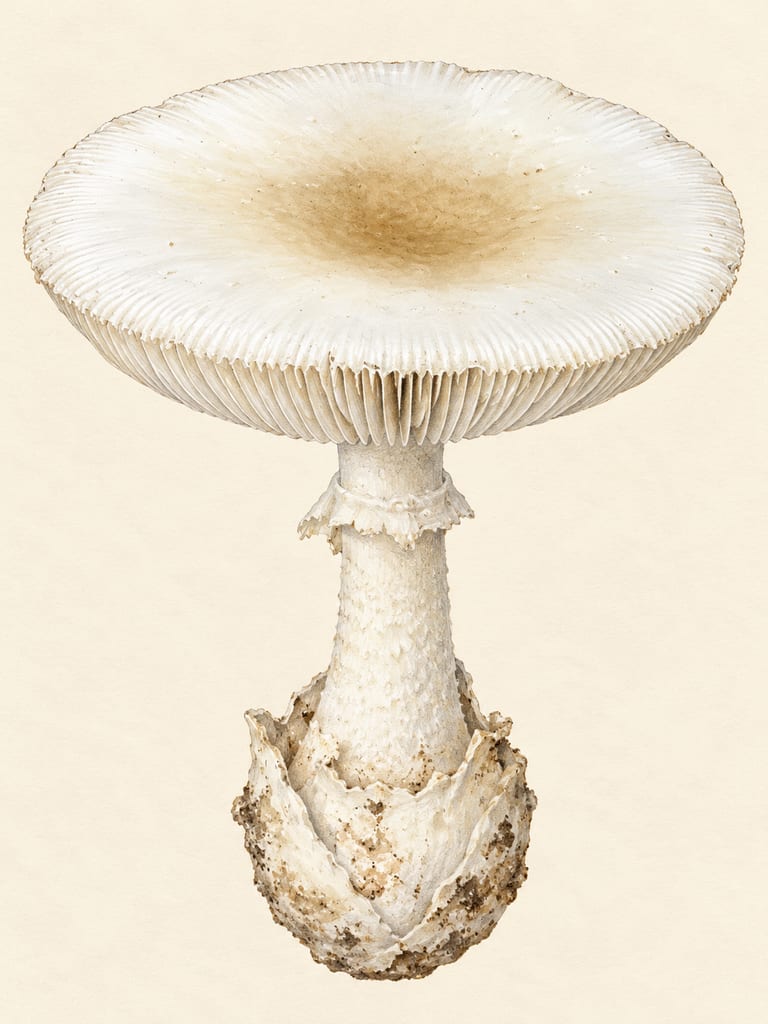
Amanita loosei is a large wild Amanita of tropical African miombo and open woodland, gathered and sold as a valued seasonal food. Regional food-use evidence is not a guide to identifying wild mushrooms.
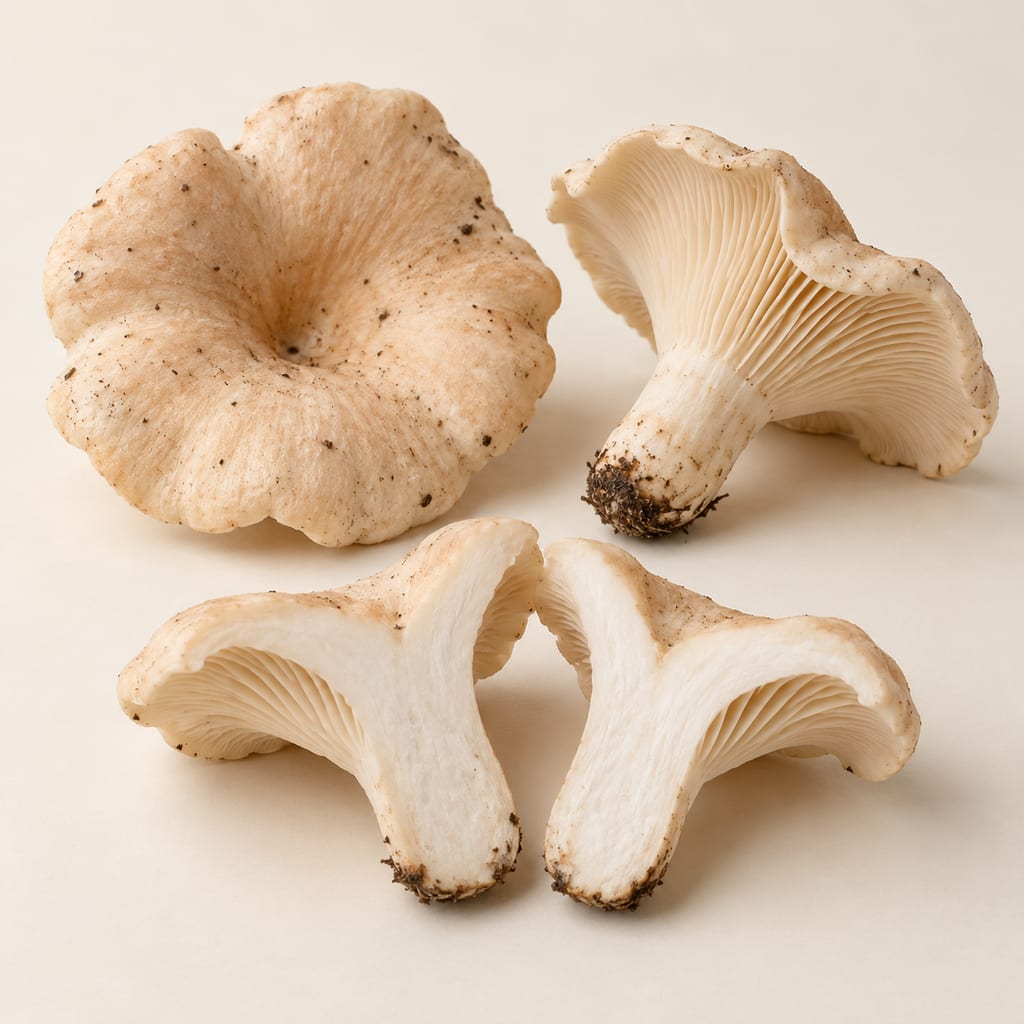
Lactifluus gymnocarpoides is an African milkcap of open Uapaca and miombo woodland. Regional inventories record it as food, but its bitter taste means local cooks remove it before eating, and the sources give no preparation.
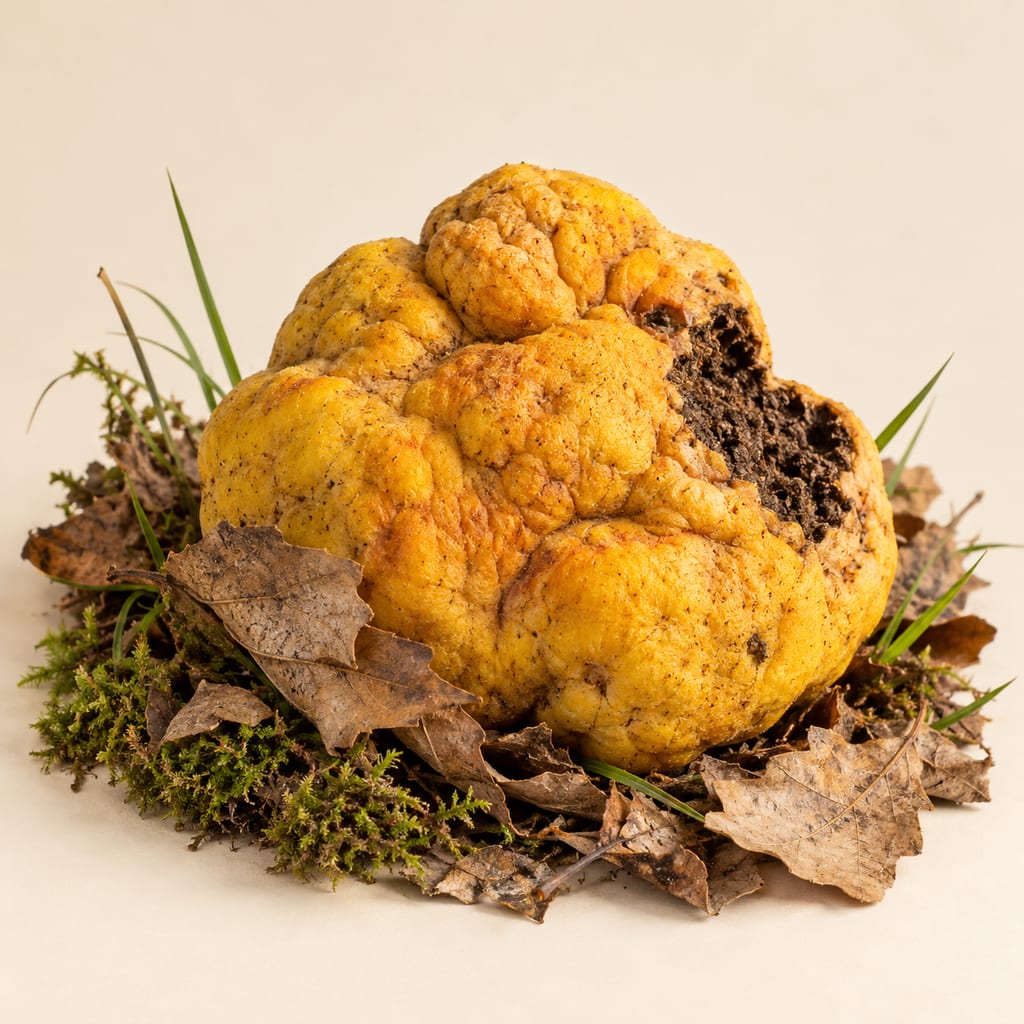
The African false truffle, Mackintoshia persica, is an ectomycorrhizal truffle-like fungus of miombo woodland in southern-central Africa. It is recorded as a regional edible, though its preparation is not documented.
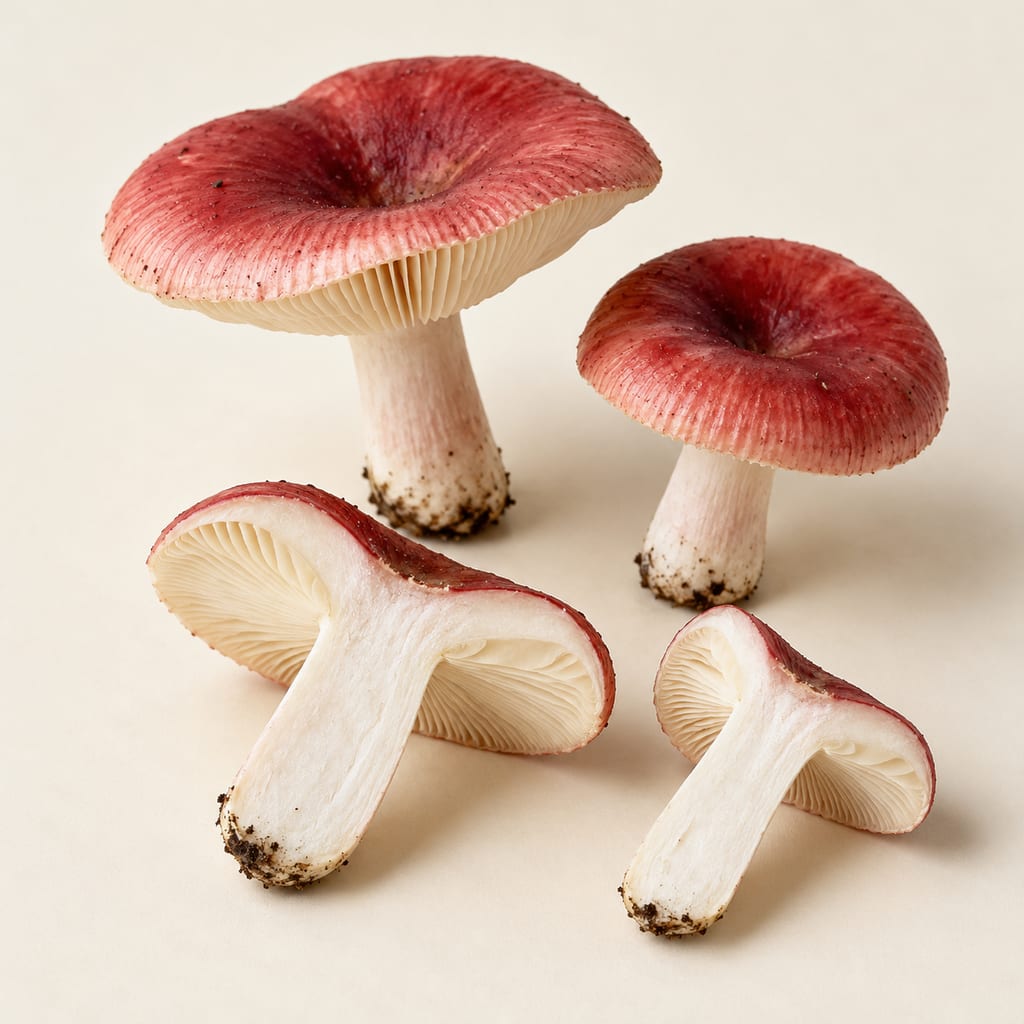
Russula congoana is an ectomycorrhizal brittlegill of miombo and savanna woodland in tropical Africa, recorded in an edible-fungi inventory. Preparation, identity and current safety still need validation.
No community contributions have been published for this entry yet.
Sign in to contribute. Published comments and photos are free to read.
Edible Fungi of Tropical Africa, Meise Botanic GardenIdentity · Taxonomy · Ecology · Distribution · Culinary context
Termitomyces schimperiLepiota schimperi synonym; Odontotermes associations; mound ecology; forests and savanna; known country records; diagnostic morphology.
Cited in: A mushroom whose life is tied to termite farming; A massive fruit body that changes as it opens; A broad recorded range, not one continuous habitat
Descriptions of Fungi and Bacteria 235, CAB InternationalTaxonomy · Morphology · Ecology · Seasonality · Culinary use · Vernacular names
Termitomyces schimperi, Sheet 23291891 and 1942 name history; form, pseudorhiza and ring changes; termite associations; regional vernacular names; varied country food practice; regional fruiting windows and rain dependence.
Cited in: A name with a long paper trail and a much older food history; A mushroom whose life is tied to termite farming; A massive fruit body that changes as it opens; Rain sets the calendar, but each place has its own season; Gathered and valued in distinct food traditions; Preparation varies; preserve the limits of each report; No documented fermentation role in the sources reviewed; A food record is not a safe identification
Journal of FungiSeasonality · Distribution · Food use · Market use
Diversity, phenology and distribution of Termitomyces species in Côte d’IvoireNational survey, seasonal species-specific fruiting periods, broad ecoregion distribution, regular local consumption, and large-scale market importance of T. schimperi.
Cited in: Rain sets the calendar, but each place has its own season; Gathered and valued in distinct food traditions; Preparation varies; preserve the limits of each report; No documented fermentation role in the sources reviewed; Knowledge, harvest and the mound landscape
Global Fungal Red List Initiative, preliminary assessmentDistribution · Seasonality · Ecology · Conservation · Safety
Termitomyces schimperiBroad sub-Saharan records; country list; rain-dependent, regionally variable fruiting; termite mound habitat; under-recording; possible confusion with Chlorophyllum molybdites; preliminary population caveats.
Cited in: A mushroom whose life is tied to termite farming; Rain sets the calendar, but each place has its own season; A broad recorded range, not one continuous habitat; A food record is not a safe identification; Knowledge, harvest and the mound landscape
CSIRSpace, Food Research Institute, Council for Scientific and Industrial Research, GhanaFood use · Regional context
Indigenous knowledge and utilization of edible mushrooms in parts of Southern GhanaSouthern Ghana interviews and market/home observations list T. schimperi among commonly collected mushrooms; local mushroom names may be shared across unrelated taxa.
Cited in: A name with a long paper trail and a much older food history; Gathered and valued in distinct food traditions; Preparation varies; preserve the limits of each report
Index FungorumTaxonomy · Identity
Index Fungorum name record 291356: Termitomyces schimperiAccepted combination and 1942 publication; Lepiota schimperi basionym from 1891.