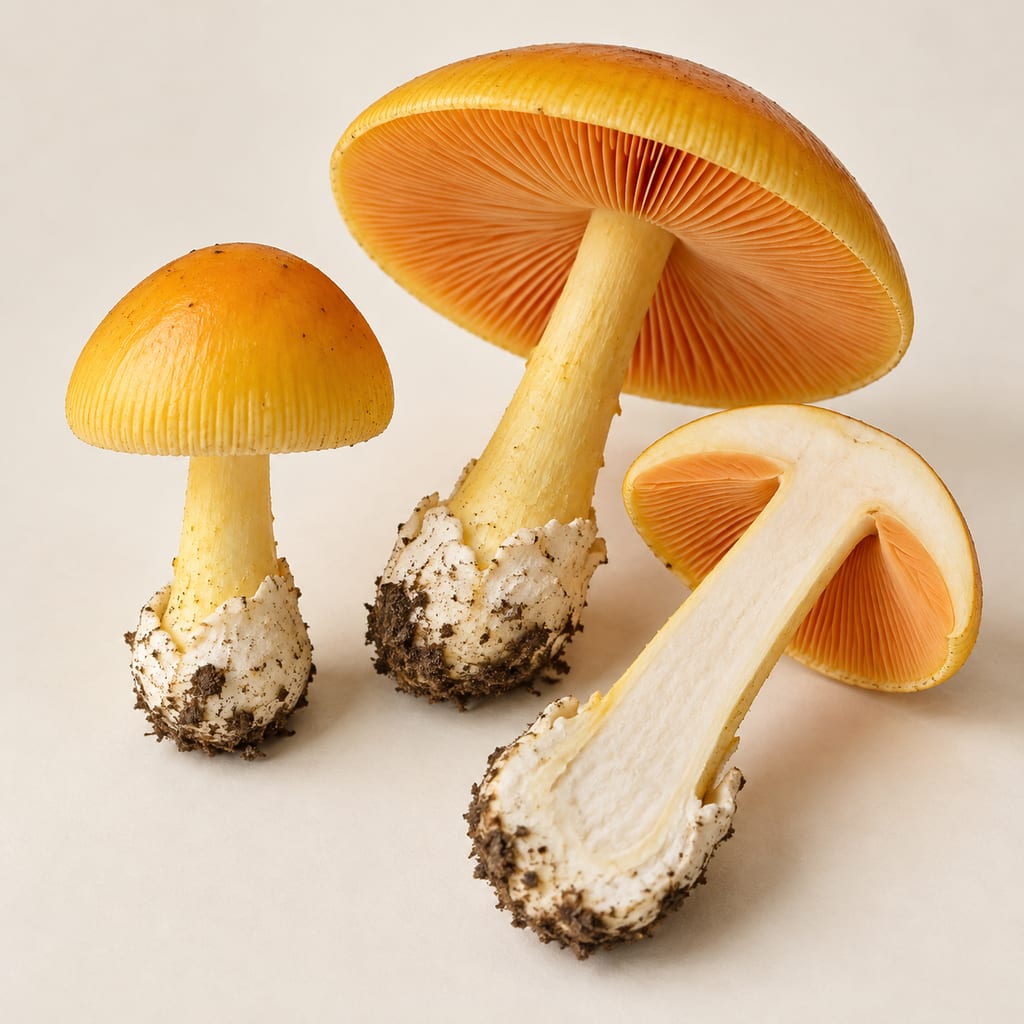
Amanita flammeola
A wild miombo Amanita recorded as a local food in northern Zambia, with collections also documented in Haut-Katanga, DRC. The evidence is regional and does not make wild identification safe.
 FermenteaWhere food goes to change
Mushrooms
Lactifluus gymnocarpoides is an African milkcap of open Uapaca and miombo woodland. Regional inventories record it as food, but its bitter taste means local cooks remove it before eating, and the sources give no preparation.
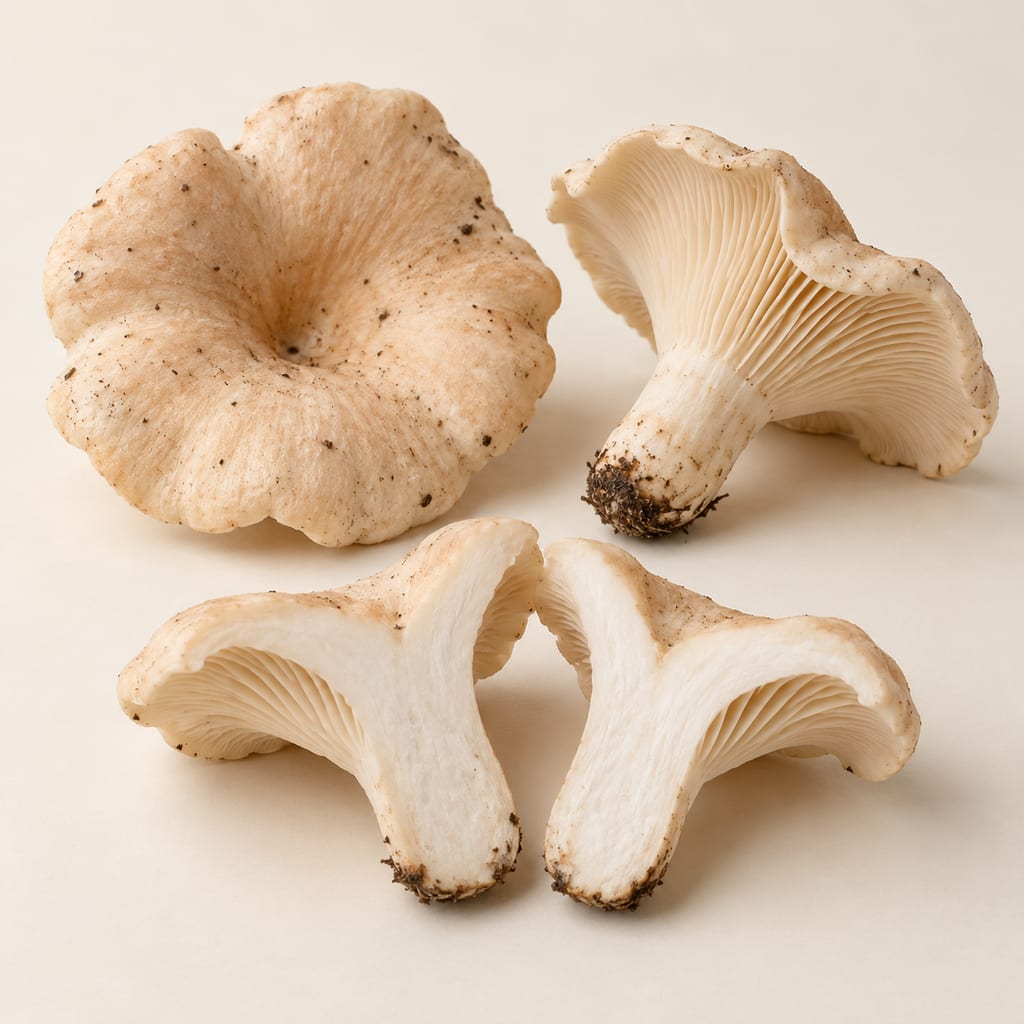
Lactifluus gymnocarpoides is a milkcap of the family Russulaceae that grows in open forest and miombo in West, Central and Southern Africa. It is ectomycorrhizal, forming a root partnership with several legume trees and with Uapaca.
The species is named in the inventories as an edible milkcap. Its taste is bitter, and local cooks have methods for removing the bitterness, which this page does not reproduce as a recipe.
The species was described as Lactarius gymnocarpoides by Verbeken in 1995 and moved to Lactifluus in 2012. The catalogue searches it under the older name and keeps the name as a research label rather than a reconciled accepted name.
The English label African milkcap is also used for other species, so this page uses the scientific name.
The species grows in open Uapaca forest and in miombo, with a broad ecological range. The EFTA inventory lists records from Angola, Benin, Burkina Faso, Burundi, the Democratic Republic of the Congo, Cote d'Ivoire, Guinea, Kenya, Madagascar, Malawi, Mali, Mozambique, Niger, Senegal, Tanzania, Togo, Zambia and Zimbabwe.
The taxonomic revision reports that the species is common in Haut-Katanga and apparently not recorded as food in Tanzania or Zambia. The range record and the food record therefore differ in detail.
The species is recorded as food in Haut-Katanga, and the catalogue lists food-use contexts in Angola, Benin, Burkina Faso, Burundi and the DR Congo.
The taste is bitter, and the latex is slightly bitter. In many countries, local people use various techniques to remove the bitterness. The sources do not describe those techniques, so this page gives no preparation steps.
The species is separated from the similar Lactifluus gymnocarpus by the gill and latex colour. Lactifluus medusae is often confused with it: L. medusae has a coloured gill edge and longer terminal elements in the pileipellis, over 100 to 120 micrometres against about 60 to 70 in this species. Lactifluus longisporus and L. pumilus are smaller species that the EFTA page also lists as lookalikes.
One Zambian specimen illustrated in a 2015 paper has brown-stained gills and resembles L. gymnocarpus, so it may have been misidentified. The EFTA page gives no separate edibility verdict for this species.
This page is not an identification guide. Milkcaps are identified by microscopic features as well as colour, and the sources do not give a poisoning record. Do not eat a wild milkcap on the basis of this page. Confirm identity with an expert before eating any wild fungus.
The sources do not give the preparation used to remove the bitterness, a recipe, or nutritional data. The record for Tanzania and Zambia is in conflict between the range list and the taxonomic revision.
The RBINS taxonomic work reports the species as well known as food in Haut-Katanga, where it is abundant in miombo. The sources do not give a village or market.
Recorded in the catalogue and the EFTA edible-species inventory. The EFTA page lists the country as a range record.
Recorded in the catalogue as a regional food-use context. The sources give no locality.
Recorded in the catalogue as a regional food-use context. The sources give no locality.
A wild miombo Amanita recorded as a local food in northern Zambia, with collections also documented in Haut-Katanga, DRC. The evidence is regional and does not make wild identification safe.
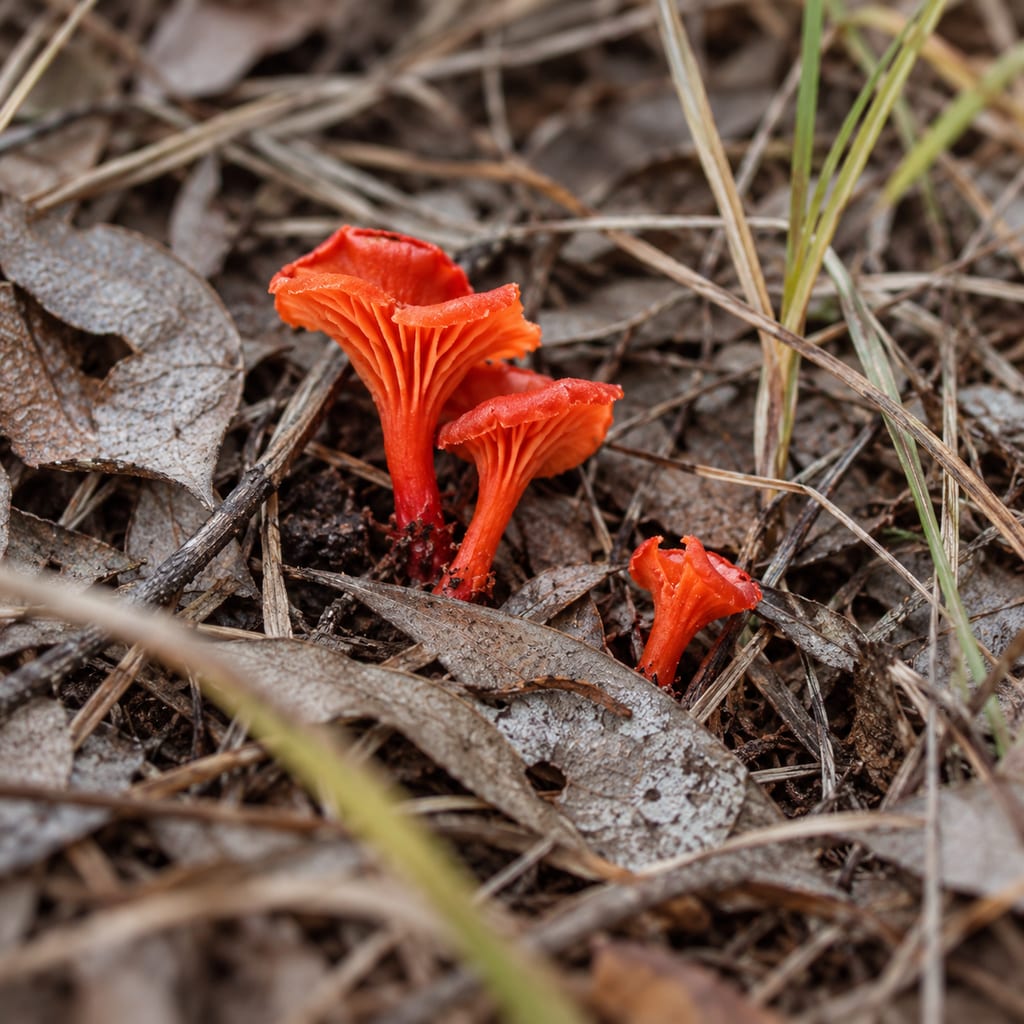
A small red ectomycorrhizal chanterelle of African open forest and miombo. Sources document regional food use but differ on taste and harvesting preference; older records as C. floridulus or C. miniatescens require care.
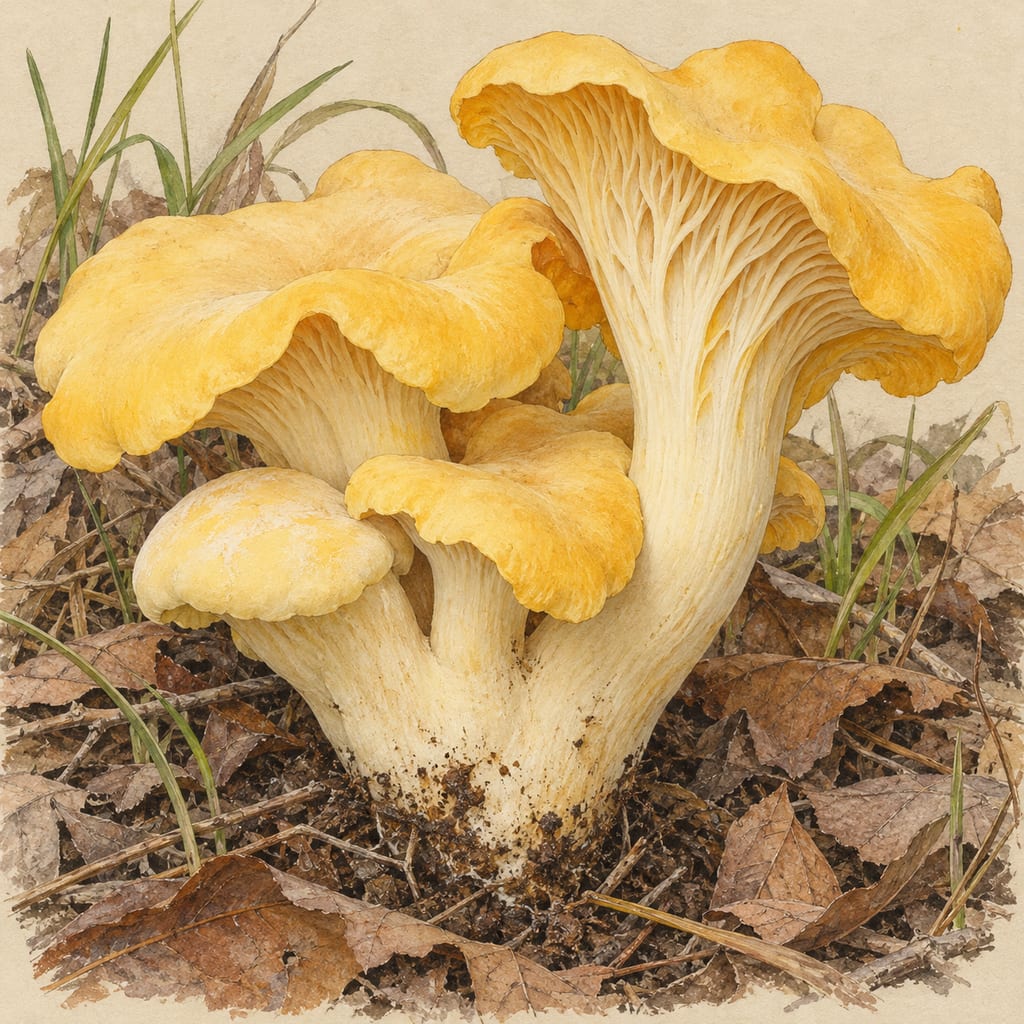
Cantharellus afrocibarius is a robust yellow chanterelle of the miombo woodlands of southern Central Africa. It is eaten and sold locally, is rated Vulnerable on the IUCN Red List, and is hard to tell from related species in the field.
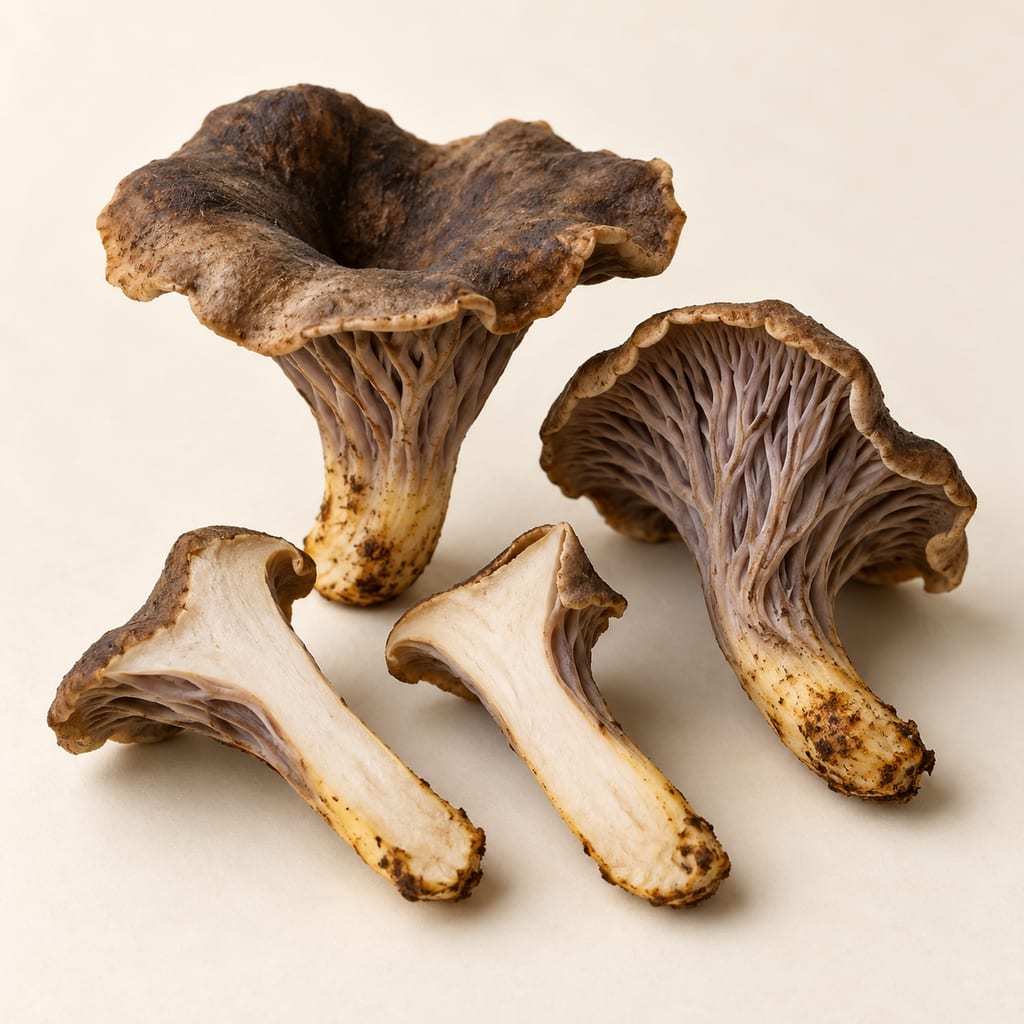
Cantharellus congolensis is an ectomycorrhizal chanterelle of sub-Saharan Africa, eaten in the Democratic Republic of the Congo under local names. Its edibility rests on food-use surveys, not on toxicity tests.
No community contributions have been published for this entry yet.
Sign in to contribute. Published comments and photos are free to read.
EFTA (European Fungi Taxonomy and Assessment) species inventoryFood · Identification · Distribution · Taxonomy
Lactifluus gymnocarpoidesSynonym Lactarius gymnocarpoides Verbeken (Mycotaxon 55, 1995); current name Lactifluus gymnocarpoides, Mycotaxon 120 (2012)
Ectomycorrhizal with Brachystegia, Julbernardia, Isoberlinia, Berlinia and Uapaca in open forest and miombo
Bitter taste; local people use various techniques to remove the bitterness
Lookalikes: L. gymnocarpus, L. longisporus, L. pumilus, L. medusae; L. medusae differs in coloured gill edge and longer pileipellis terminal elements
Cited in: Overview; Names and taxonomy; Habitat and distribution; Food use and preparation; Identification and safety
Royal Belgian Institute of Natural SciencesFood · Taxonomy · Distribution
ABC Taxa vol. 17, part 7 (Royal Belgian Institute of Natural Sciences, taxonomic revision of African milkcaps)Well known as food in Haut-Katanga, where the species is abundant in miombo
Apparently not recorded as food in Tanzania or Zambia
Cited in: Overview; Habitat and distribution; Food use and preparation; Open questions